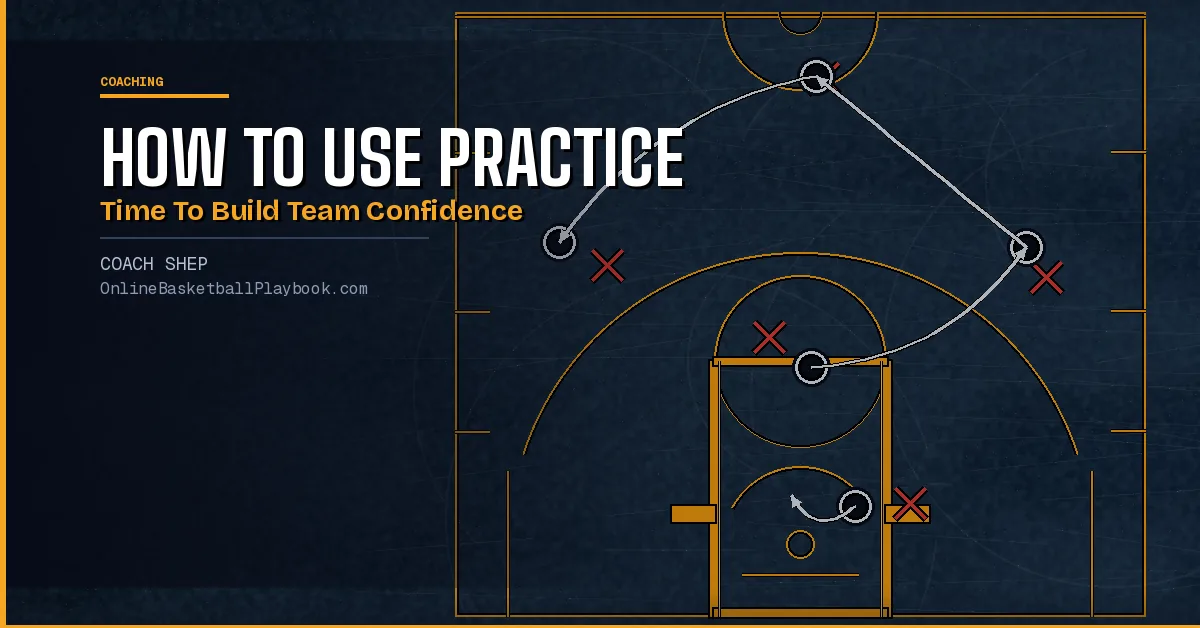
Confidence doesn't arrive on game night. It gets built rep by rep inside your practice gym, through clear teaching, deliberate structure, and the right language at the right moment.
Why Confidence Is a Coaching Problem, Not a Personality Problem
Too many coaches treat confidence as something a player either has or doesn't have, a personality trait baked in before they walked into the gym. That framing lets coaches off the hook, and it sells players short.
Confidence is the product of competence plus repetition plus feedback. When a player knows exactly what to do, has done it hundreds of times in practice, and has heard a coach confirm they did it right. They step onto the floor with belief. When any one of those three elements is missing, you get hesitation. You get a player who second-guesses in the middle of an action. You get a team that plays tight in big moments.
That means every time a player hesitates under pressure, the coaching staff has a question to answer first: did we teach it clearly? Did we give them enough reps? Did we tell them when they got it right? Start there before you start pushing for more toughness or more mental strength. Belief follows understanding, and understanding is built on the practice floor, not in a pregame speech.
The good news: if confidence is a coaching problem, coaches can solve it. The practice plan is the confidence plan. Structure your reps intentionally, and you will see the difference in how your team carries themselves when the game slows down in the fourth quarter.
Teach One Thing at a Time and Win It Completely
The fastest way to undermine team confidence in practice is to introduce too many concepts in a single session. Players end up half-knowing six things instead of fully owning two. Partial knowledge produces tentative execution. Tentative execution in games gets punished, which erodes belief.
The counter-move is deliberate scope control. Pick the one skill, concept, or coverage that matters most this week. Install it in progressions: start with a walk-through, move to a form drill, then a competitive drill, then live play with a specific constraint. Each step should feel like a small win before the next level of difficulty is introduced.
When your players can execute something at game speed, in a competitive environment, with noise around them, they own it. Ownership produces confidence that survives the chaos of a real game. The player who has won a drill a hundred times in practice doesn't panic when that same situation shows up in the second half. They recognize it and react.
This applies on both ends of the floor. On offense, running the same set until every player can identify their read and their secondary option without hesitation. On defense, drilling one coverage assignment until it is automatic. The temptation is to cover more ground. The teams that play with the most confidence in January are usually the ones whose coaches covered the least ground in October but covered it completely.
Use Shared Language to Build Shared Belief
Language is infrastructure. The words you use in practice wire the behavior. When your whole team uses the same word to describe the same action, they can communicate faster under pressure, trust that their teammates are seeing the same picture, and execute without hesitation.
Elite coaches understand this deeply. Tuomas Iisalo's principle applies well beyond defensive coverages: "the word is the behavior." When you install a term (drop, show, early, last, low-man), you are not just naming a concept. You are programming a response. When a player hears the word in a live rep, the body should react before the conscious mind catches up. That only happens when the word has been tied to the action through hundreds of repetitions in practice.
Build your practice vocabulary intentionally. Introduce terms one at a time. Use the same word every time you refer to the same action. Correct players who use vague language: "just help" or "go help him" tells nobody anything. "Low man, take the roll" tells the right player exactly what to do. Specific language creates specific confidence because it removes guesswork at the moment of action.
When the whole team speaks the same language, it also builds collective trust. Players who know their teammates will use the right call and respond to it play with less anxiety. The floor feels smaller. Communication replaces hesitation.
Design Drills That Let Players Succeed Before They Struggle
Confidence is fragile early in the learning curve. If you run a drill that players fail at 80% of the time before they understand the skill, you are training failure. You want the opposite: structure the drill so the success rate is high at the teaching level, then raise the difficulty as competence grows.
This is not about protecting players from competition or avoiding hard work. It is about sequencing correctly. A player who has successfully executed a skill in a controlled drill fifty times will attack a competitive drill with a completely different mindset than a player who has mostly experienced failure in that same movement. Early wins compound into belief. Early failure, without the right context and feedback, compounds into avoidance.
Walk-through first. No defense, slow motion, every player talks through their assignment as they move. Then add a token defender, someone who makes the action live but does not contest at full intensity. Then add a competitive defender. Then run it in a small-sided game with a live consequence. By the time players hit the full-game version, they have a mental track record of success at every previous level. That track record is what confidence actually is.
The sequence also tells you where understanding breaks down. If players are struggling in the walk-through, the teaching was unclear. If they win the walk-through but fail with a live defender, they haven't internalized the decision. They were following choreography. Knowing which level breaks tells you exactly how to fix it.
Name the Win Before You Name the Mistake
How you deliver feedback shapes whether players feel capable or incompetent. Not because confidence needs to be manufactured through empty praise. Players know when they played well and when they didn't. The issue is about sequencing: when coaches lead with what went wrong before acknowledging what went right, players stop trusting their own reads. They start playing to avoid correction instead of playing to execute.
The standard correction model is: positive, then correction, then positive. That framework exists for a reason, but it can become mechanical. A more useful principle is simpler: before you tell a player what broke, tell them what held up. Name the specific thing they did correctly. Then name the one thing that needs to change. One thing, not three.
This matters especially for team-level corrections during practice. When the coach stops the drill and immediately identifies what went wrong, the team experiences the interruption as an indictment. When the coach first names what the team executed well and is specific about it (not generic), the team can hear the correction as coaching instead of criticism. They stay open. Their body language stays loose. The correction lands and they run it again with confidence instead of anxiety.
Over a full season, teams that are coached this way develop a different relationship with mistakes. Errors become information rather than proof that they can't execute. That shift is the foundation of playing free, and teams that play free in games were coached to be free in practice.
Build Defensive Confidence Through Systematic Situational Training
Defensive confidence is specific. A team that is confident guarding transition may fall apart guarding the ball screen, because they have never been taught a clear decision-framework for that situation. Confidence on defense comes from knowing, not guessing, what the right action is in each specific scenario the game throws at you.
Quin Snyder articulated this through what he called systematic situational training: identify the situation, train it explicitly, hold players accountable to a specific standard in that situation. That sequence (identify, train, hold) is what separates teams that react from teams that play with purpose. When your players know they will face this specific screen action, know the call, and have won a drill running that call hundreds of times, they don't hesitate when it shows up in the game. They execute.
The key is to identify your highest-leverage situations and drill them relentlessly. For most teams, pick-and-roll defense (how the two on-ball defenders handle the screen, and what the three off-ball defenders do to protect) is the situation that gets coaches hired and fired. Get it right in practice, own the language, and practice each role until it is automatic.
Accountability makes the confidence real. When players know their coach tracks specific outcomes, did the ball get into the paint? did the low man take the roll? They take each defensive rep seriously. That seriousness in practice translates directly to poise in games. The players who practice with the highest standards are the ones who don't blink when the pressure rises.
After every teaching drill, give players thirty seconds to self-evaluate before you give your feedback. Ask them what they did well and what they'd change. This habit builds internal confidence rather than dependence on external approval, which is what survives on game night when the coach can't call a timeout.
- Control scope: Pick one concept per practice block and drill it all the way to competitive speed before introducing anything new. Partial knowledge produces hesitation.
- Install shared vocabulary: Name every assignment with a specific term and use it consistently. The word becomes the behavior when it's tied to enough reps.
- Sequence for early success: Walk-through first, token defender second, live defender third. Let players build a mental track record of winning before the difficulty peaks.
- Lead feedback with the specific win: Name what held up before naming the one thing that needs to change. Players who feel capable are more coachable, not less.
- Drill your highest-leverage situations: Identify the two or three scenarios that decide the most possessions in your games, and train those situations explicitly every week with real accountability standards.
Want more basketball coaching strategies and drills?
Join the Online Basketball Playbook newsletter →
Draw this play free in the play drawer →
Membership: the full library, playbook packs, and Pro drawing tools →
Keep Building
Related breakdowns
Game Situations in Practice: How to Build Them In
Game situations in practice: how much time to give them, situation cards, formats side by side, scrimmage rules, pressure free throws and checking transfer.
Basketball Conditioning: How to Build a Program That Lasts
Basketball conditioning built as a program. The energy system, work and rest, the runs and tests, cardio, a preseason ramp and how programs split the year.
Basketball Practice Structure: Segment Order and Time Budgets
Basketball practice structure from the opening drill to the last whistle: segment orders, time budgets, the daily core, rest and the week around it.