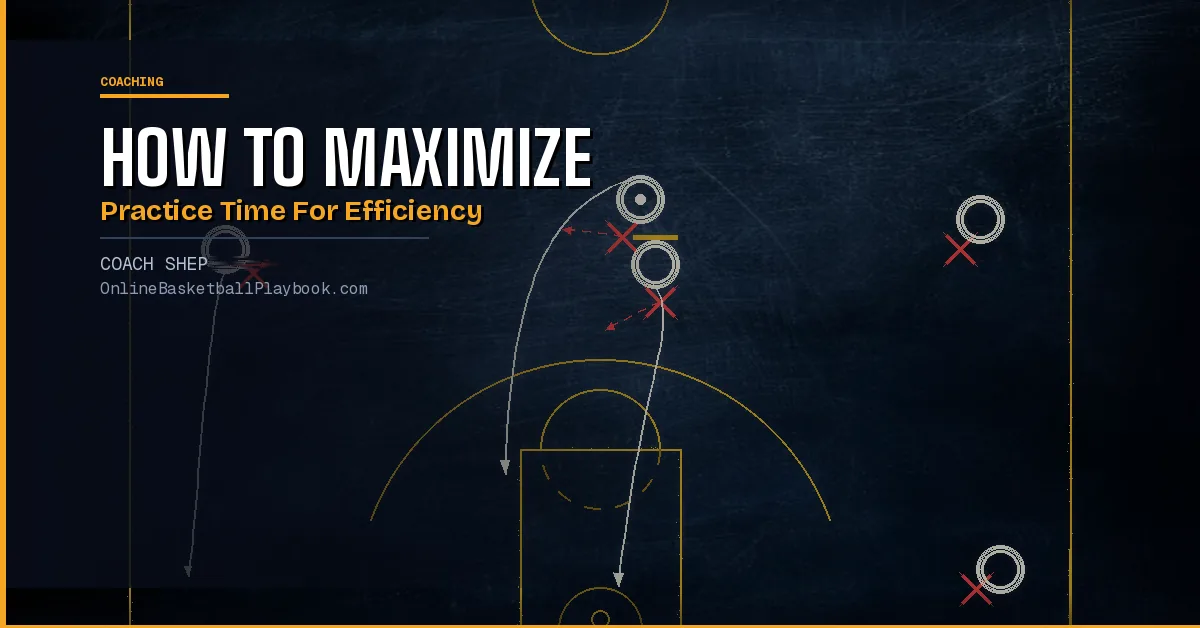
Most coaches don't lose because they lack talent. They lose because they waste practice time. Here is a practical framework for structuring every minute around the skills and situations that actually win games.
Start with the Highest-Leverage Skills
The single most important question in practice planning is simple: what happens most often in a real game? If your practice doesn't reflect game frequency, your players will be well-rehearsed in situations that rarely occur and underprepared for the ones that do.
Ball screens are the clearest example. Pick-and-roll actions with a pass account for roughly 30 to 40 percent of all half-court possessions. Add transition ball screens and drag screens, and you are looking at more than half of everything your defense will face. If your team only spends 10 percent of practice time on ball-screen defense, you are budgeting against reality.
The same logic applies on offense. In the Princeton offense, the dribble-entry, the pass-and-cut, the back-door read. These sequences happen on almost every possession. Repetition of the highest-frequency actions builds the automatic reads that let players execute without hesitation under pressure.
Before you build next week's practice plan, list your five most common offensive and defensive situations from your last three film sessions. Then check how much practice time you actually gave each one. The gap between what you faced in games and what you drilled is your inefficiency. Close that gap first.
Build a Repeatable Practice Script
Great practice does not happen by improvisation. It happens through structure. The coaches who run the most efficient practices are the ones who arrive with a written script that accounts for every minute and then execute it with discipline.
A good practice script has four layers. The first is the warm-up and dynamic movement block, which should take no more than eight to ten minutes and serve double duty: it gets bodies ready and starts reviewing concepts from the previous session through light skill work. The second layer is individual and small-group breakdown drills, which isolate specific skills or defensive coverages at 2-on-2 or 3-on-3 intensity. These are the highest-quality teaching reps of the practice because the coach can give immediate feedback and the situation is simple enough for players to focus on technique.
The third layer is the team installation block, where you run the schemes and systems you need for the next opponent. The fourth layer is competitive team segments: controlled scrimmage, situational late-clock work, or free-throw pressure situations. End every practice with something that raises the competitive temperature. Players remember the end, and it sets the mindset heading into the next day.
Stick to the clock. If a drill is scheduled for six minutes, run it for six minutes. Running long on one drill is a choice to cut something else. Make that a deliberate decision, not an accident of poor timekeeping.
Use Systematic Situational Training
Situational training means identifying specific in-game problems, designing drill sequences to attack them, and then holding your players accountable to executing the right reads in those specific situations. The phrase "systematic situational training" is deliberately precise: it means you have identified the situation, you have built a drill for it, and you revisit it until you own it.
The most common failure in situational training is vagueness. "We need to be better in the pick-and-roll" is not a situation. It is a category. A situation is: "Ball is caught high by the handler, our big is attached at the arc, what do we do?" That precise description is what allows you to drill it. Once the situation is named, the drill writes itself: set the conditions, run the coverage, evaluate the outcome, correct and repeat.
Specificity also makes accountability real. When the situation is named, the player knows exactly what the standard is. "On every ball caught high, you drop to the arc" is a rule that can be enforced in a drill, praised in film, and corrected on the fly. Vague expectations produce vague results. Specific expectations produce habits.
Plan for at least three defined situational blocks per week. Rotate through the situations that appear most frequently in your scouting reports. In the final two weeks before a tournament, narrow the list to the situations that your next opponent specifically forces. Preparation is sharpest when it is pointed at a real target.
Teach the Language Before the Play
One of the most underrated practice efficiency tools is vocabulary. When your entire team speaks the same precise language, communication in the drill is fast, correction is fast, and player-to-player communication on the floor is fast. When language is inconsistent, every correction costs extra time because the coach has to first establish what they are talking about before they can teach it.
Build a practice vocabulary list and post it in your locker room. Every key concept in your system (every coverage name, every help position, every cut, every screen action) should have one consistent name. Coaches borrow from each other constantly. The key is to settle on one word per concept and never deviate.
The payoff is substantial. When a big calls out "drop!" as the ball handler turns the corner, the on-ball defender knows exactly how to respond because the word was drilled in practice until it triggered automatic behavior. The word becomes the behavior. That kind of communication cannot be taught in a game timeout. It can only be built over weeks of consistent repetition in practice with consistent language.
When you install a new concept, say the name, demonstrate the movement, and immediately have players call the name while performing the movement. The verbal + physical pairing accelerates retention far faster than silent demonstration alone. Give short quizzes at the start of practice: "If the ball is caught high and our big has separation, what coverage do we run?" Make language a daily practice, not a one-time installation.
Measure What You Guard, Not Just What You Score
Most coaches track offensive output with precision: shots made, turnovers, assist-to-turnover ratio. Far fewer track defensive output with the same rigor. But efficient practice planning requires knowing whether your defensive work in the gym is actually translating to better defensive performance in games.
The most useful defensive metric for practice efficiency is paint touches allowed. How many times did the ball get inside the three-point line in a live segment? A well-run defensive possession ends with the ball contested on the perimeter, the rim protected, and the rebounding box sealed. A possession that allows a paint touch, even one that doesn't result in a basket, is a possession where your scheme broke down somewhere in the coverage, protection, or recovery phase.
When you watch your own practice film, and every efficient coaching staff watches at least some practice film, focus first on these three questions: Where did the coverage break? Was it the two on the ball or the three off it? And where did the recovery close-out fail? If the coverage held but the protection was late, that tells you what to drill tomorrow. If the two on the ball gave up a drive-around, that tells you something different. The three-phase breakdown (coverage, protection, recovery) is the diagnostic framework that turns film into a practice plan.
Track these metrics in real time during competitive team segments. Keep a simple tally on a clipboard: paint touches, open corner threes allowed, recovery closeout grades (good / late / missed). After three weeks of tracking, you will know exactly which parts of your defensive system are holding and which are leaking. Let the data, not your gut feeling, drive your practice priorities.
Before you finalize your weekly practice plan, watch five minutes of your own game film from last week and identify one specific situation your defense mishandled repeatedly. Design Tuesday's breakdown drill around that exact situation, give it a precise name, and hold every player to the standard by name during the rep. You will fix more in one focused drill than in an hour of general team defense.
- Map game frequency first: chart your five most common offensive and defensive situations from recent film, then verify that your practice plan allocates time proportional to how often each appears in a real game.
- Script every minute: write a timed practice plan with four named blocks (warm-up, individual breakdown, team installation, competitive segment) and stick to the clock even when a drill runs well.
- Name every situation precisely: vague expectations produce vague habits; give every coverage, cut, and help position one consistent name, post the vocabulary list, and quiz players on it daily.
- Track paint touches in live segments: keep a real-time tally during scrimmage of how many times the ball enters the paint, then use those numbers to identify which phase of your defense (coverage, protection, or recovery) is breaking down and build tomorrow's drill around it.
Want more basketball coaching strategies and drills?
Join the Online Basketball Playbook newsletter →
Draw this play free in the play drawer →
Membership: the full library, playbook packs, and Pro drawing tools →
Keep Building
Related breakdowns
Basketball Practice Structure: Segment Order and Time Budgets
Basketball practice structure from the opening drill to the last whistle: segment orders, time budgets, the daily core, rest and the week around it.
How to Use Practice Time to Build Team Confidence
How to Use Practice Time to Build Team Confidence
Fun Basketball Games for Practice: Scored Games for Any Team
Fun basketball games for practice at any level: shooting games, defense-only scoring, rebounding contests and passing games, with scoring rules and records.