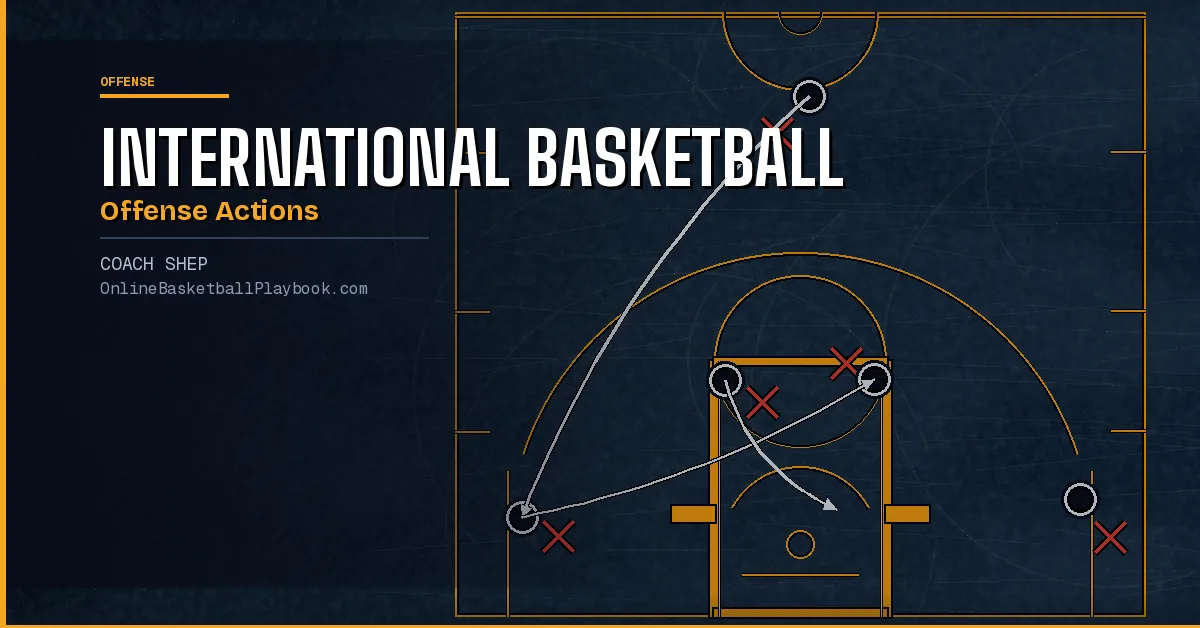
The best offensive coaches in the world share one belief: ball movement beats player movement, and reads beat plays. Here are the international actions and principles that separate good offenses from great ones.
The Obradović Fake-First Rule
Svetislav Obradović is one of the most decorated coaches in European basketball history, multiple EuroLeague titles, decades of elite competition. His most transferable offensive principle is deceptively simple: a fake always precedes the move.
On every catch, the player looks at the rim first. Then, before cutting, driving, passing, or shooting, the player fakes a direction. Not only a shot fake. A fake cut. A fake drive. A fake stay. The rule applies everywhere on the floor, every possession.
The off-ball companion to this rule is equally important: the off-ball player cuts only when the on-ball defender turns his head, never before. Cutting at random does nothing. Cutting the instant a defender's attention shifts elsewhere exploits a real defensive lapse. Obradović's phrase: "Take what the defense gives, that's the best offense." The fake creates the moment. The read is what you do with it.
This principle is easily drilled. In 5-on-0 walkthroughs, require a visible fake before every action. Players who skip the fake are corrected immediately. Within a week, the habit begins to form. Within a month, defenders start reacting to fakes that aren't there, which is exactly the point.
Obradović also states plainly that "the direct pass doesn't exist." Every pass should be preceded by a fake to occupy the nearest help defender. Even a simple skip pass becomes more effective when the passer looks off the helper first. This is not advanced basketball. It is basic deception made into a team standard.
Ball Movement Over Player Movement (Messina)
Ettore Messina has coached at the highest levels of European and NBA basketball for three decades. His foundational motion principle reorders the way most coaches think about offense: five players standing still but passing quickly beats five players moving with one always holding the ball.
Most coaches tell players to move. Messina's insight is that ball movement is what actually forces defenders to adapt. When the ball travels faster than defenders can shift, gaps open. When a player holds the ball, all defensive initiative transfers to the defense. They can set, communicate, and recover. The player holding the ball over his head, in Messina's framing, has surrendered every advantage the offense earned.
The practical implication: any non-penetration dribble should do exactly one thing. Improve the passing angle. Massima limits this to two bounces in the same spot before the ball must move. Dribbling to dribble is not an action. It is a stall that kills offensive timing and lets help defenders settle.
This connects directly to the catch-ready principle. Messina teaches players to develop peripheral vision during reception, so that when the ball arrives, the player already sees the next pass. The receiver who has to survey the floor after catching the ball has already slowed the offense. The receiver who arrives at his spot with a clear pre-read can release the ball in one or two seconds, and the defense never settles.
For coaches running any read-based system, this principle is a useful corrective. If possessions are stalling, the first question is usually not "are we running the right play?" It is "who is holding the ball too long?" Track possession time on your slowest possessions in film and the answer will reveal itself.
Shoot If Sagging: Aito's Non-Negotiable
Aito García Reneses is one of the most influential minds in European basketball. His rule on penetration-and-kick situations is one of the clearest offensive decision rules in coaching: when a defender is sagging, the receiver must shoot. Do not re-penetrate when the shot is open.
This sounds obvious. It is not practiced. Players who receive kick-outs from penetration frequently hesitate, put the ball on the floor, and lose the advantage the drive created. The defense has already given up the open shot. Re-dribbling lets them recover. Aito's rule converts this into a non-negotiable: if the defender is sagging when you catch it, that is your shot, and you must take it.
The rule creates an accountability structure coaches can use immediately. In film sessions, any catch-and-dribble off a kick-out is marked as a violation. Players who take the open shot, even if they miss, are correct. Players who dribble away from an open look are wrong, regardless of what happens next.
The companion rule on the dribble itself: dribbles are for penetration only. Any dribble that does not attack the basket should improve the passing angle, and it should not exceed two bounces in the same spot. These two rules, shoot if sagging, dribble only to penetrate, compress the decision tree in a way that makes the offense predictably efficient. Remove unnecessary choices, and players execute more cleanly under pressure.
Move Without the Ball, Drilled, Not Hoped
Obradović makes this point with unusual bluntness: "In all of Europe, nobody moves without the ball." He does not mean European players are better athletes. He means off-ball movement is treated as a non-negotiable standard. Drilled relentlessly rather than requested occasionally.
His specific practice method is the no-dribble passing game, run 5-on-5 every practice session. No dribbles allowed. Because the ball cannot be advanced by one player, every player must move to create passing angles and open looks. Players who stand are immediately exposed. The team cannot function without their movement. The constraint teaches what encouragement cannot.
The motion principle that underlies this is simple: every pass is followed by a cut or a screen. "Standing is a technical mistake," as one motion offense framework puts it. This is not metaphorical. When a player stands after passing, they allow a nearby defender to become a helper (to sag, to double, to clog the lane). The moment a player becomes static, they stop costing the defense anything.
The rule gives players clarity. After every pass, two questions: Am I cutting? Am I screening? Those are the only two options. If neither is available, find the nearest spot that reopens a passing angle. This keeps the floor alive and forces the defense to account for all five players on every possession, not just the ball-handler.
American coaches often treat off-ball movement as a character or attitude issue. "they just don't want to move." The international coaching frame treats it as a teaching and drill design issue. If players aren't moving without the ball, you haven't constrained them in a way that forces the habit. The no-dribble passing game is one of the most direct solutions available.
Majerus's Cut Taxonomy: Six Cuts Every Player Needs
Rick Majerus built one of the most detailed cutting vocabularies in American college basketball. His taxonomy names six specific cuts, each with footwork and reads attached. Teaching these as a system, rather than as improvised reactions, gives players a trained progression instead of instinct-dependent chaos.
Fill Cut
Two reads determine the fill cut. If the defender is in help position, the player blasts straight to fill the open spot. If the defender is in denial in the passing lane, the player uses a V-cut to create separation before filling. The read happens before the cut starts.
Seven Cut
The player takes approximately two steps, pivots hard on the inside foot to get across the defender's face, and cuts to the basket. Majerus emphasizes hard-slow: cut hard to get past the defender, slow into the target area to receive the pass in rhythm. A player who sprints through the target area without slowing makes the pass difficult and the finish rushed.
Hornacek Curl
Two versions. The tight curl uses high hands and finishes with a running hook to the dominant hand, useful against defenders who trail. The Hornacek curl (named after Jeff Hornacek) also uses high hands but finishes with a shoulder-over-toe square to the basket for a catch-and-shoot. The choice between versions depends on how tight the defender is when rounding the screen.
Flare Cut
The best shooter on the floor at the elbow always gets a flare. The cutter reads the screen defender: if the defense goes over the screen and anticipates the flare, the screener pins and the cutter dives inside. If the defense goes under the screen, the cutter fades for the three and the screener pins. The defensive adjustment determines which option triggers. The cutter doesn't decide until the screen is set.
Back Cut and Outlet to Three
When a defender overplays denial, the back cut is automatic. The player reads the overplay, cuts behind the defender, and catches for a layup. The outlet-to-three version adds a second read: after the back cut, if the player doesn't receive, they spin to the three-point line and become the outlet for a kick-out three. This converts a failed cut into a scoring read rather than dead movement.
Majerus's master rule across all six cuts: economy of motion. Don't move unless the movement costs the defense something. Every cut should either get a shot or open a shot for someone else. Purposeless movement is worse than standing still. It wastes energy and creates visual noise that makes the offense harder to read for your own teammates.
Named Actions Give Motion a Coaching Language
One persistent criticism of motion offense is that it is hard to coach in real time. Free motion is rule-based, but when five players are improvising simultaneously, the coach cannot call adjustments fast enough. The international solution, used consistently by coaches like Obradović, Messina, and Rumjahn, is to name the recurring actions.
Naming an action does not make it scripted. It makes it coachable. When a player calls "curl!" off a down screen, or a coach says "Fist" on the sideline, everyone knows the read sequence that follows without needing a pause in action. The communication is built into the vocabulary, not added on top of it.
The most important named actions to install are the ones players encounter every possession. Post Screen Away: the big screens for a wing after a pass into the post. Post Flare Screen: the post player flares for a corner shooter on a pass out of the post. High Ball Screen with its three options: drive, roll, or roll-pop-and-seal. Down screen reads: slip, bump, flare, or curl, depending on how the defender navigates the screen.
Davidson's Bill McKillop adds another dimension to this: running the same named action out of different formations. A stagger that looks the same to the defense from a box set, a 1-4 set, or a stack set is functionally a different play. The defense cannot key off alignment to predict it. The action is named and trained; the alignment varies to prevent scouting. This is McKillop's anti-scouting principle, and it is one of the most underused ideas in American coaching at the high school level.
The Dead Corner Is a Structural Scoring Trigger
Bill McKillop's Davidson system adds one idea that transfers directly to any read-based offense: the dead corner is not a spacing afterthought. It is a wired-in scoring look on every reversal.
The dead corner is the weak-side wing position that the defense has abandoned to help on the primary action. Every time the ball is reversed, the strong-side help defender has shifted toward the ball or the drive, leaving the weak-side wing unguarded or late to recover. In McKillop's system, every reversal simultaneously triggers a look to the dead corner. The weak-side wing receives a stagger screen (called "Strong") automatically, without a call from the bench.
This converts a routine swing pass into a live scoring read on every possession. The offense doesn't need to manufacture the look. The reversal creates it structurally every time. Players just need to be trained to see the dead corner as a shooting trigger, not a rest spot.
The teaching application is simple: in film, mark every reversal and ask where the dead corner was. Over the course of a game, coaches can show players how many times the defense abandoned that spot and how many times the offense failed to convert the look. This builds awareness faster than any whiteboard explanation.
The principle also names the defensive answers the dead corner player may face (eight in total in McKillop's system) so players can work through a trained progression as the defense adjusts within a game rather than improvising against each new coverage.
Start with one international principle per week, not all seven at once. Pick the principle most relevant to your current offensive problem. If your players hold the ball too long, install the Messina two-bounce rule first. If your kick-out shooters hesitate, drill Aito's shoot-if-sagging standard with film accountability. Adding one clear standard at a time lets it become automatic before you layer the next one. A team that owns three international principles executes better than a team that has heard all seven once.
- Fake before every action: Require a visible fake (cut, drive, or pass fake) before any movement. Correct players who skip it immediately, even in walkthroughs.
- Two-bounce dribble rule: Any non-penetration dribble must improve a passing angle and must not exceed two bounces in the same spot. Mark dribble-for-dribbling-sake as a possession violation in film.
- Shoot if sagging. Enforce in film: Mark every catch-and-dribble off a kick-out as an error if the defender was sagging at catch time. The player who shoots and misses is correct; the player who re-dribbles is wrong regardless of the outcome.
- No-dribble passing game: Run 5-on-5 with no dribbles allowed at least twice per week. This forces off-ball movement as a structural necessity, not a request. Players who stand stop the offense from functioning.
- Name and drill five core actions: Post Screen Away, Flare, High Ball Screen, Down Screen reads (slip/bump/flare/curl), and Back Cut are the minimum named vocabulary. Introduce the name the first time you teach the action; never let an action exist nameless.
- Dead corner on every reversal: Train players to locate the weak-side wing on every ball reversal. Run film review asking "where was the dead corner?" until the look becomes automatic and expected.
- Cut taxonomy before screens: Install Majerus's six cuts in isolation before adding screen actions. Players who cannot read a fill cut from a seven cut cannot read screens correctly. The foundational vocabulary comes first.
Want more basketball coaching strategies, drills, and tools?
Join the Online Basketball Playbook newsletter →
Draw this play free in the play drawer →
Membership: the full library, playbook packs, and Pro drawing tools →
Keep Building
Related breakdowns
3 Out 2 In Basketball Offense: Spacing, Actions and Reads
The 3 out 2 in basketball offense explained: alignment, actions off every pass, the high-low counter, drive rules for the posts, add-on plays and who fits it.
Horns Basketball Play: The Horns Set, Actions and Reads
The horns basketball play explained: the horns set, the elbow pick and roll, roll and pop rules, hi-lo, flex and shooter actions, the reads and the install.
Motion Offense: Spacing, Rules, Actions and How to Install It
Motion offense runs on rules, not called plays. See the spacing, four core actions, 5-out versus 4-out 1-in, the install order, drills and where it struggles.