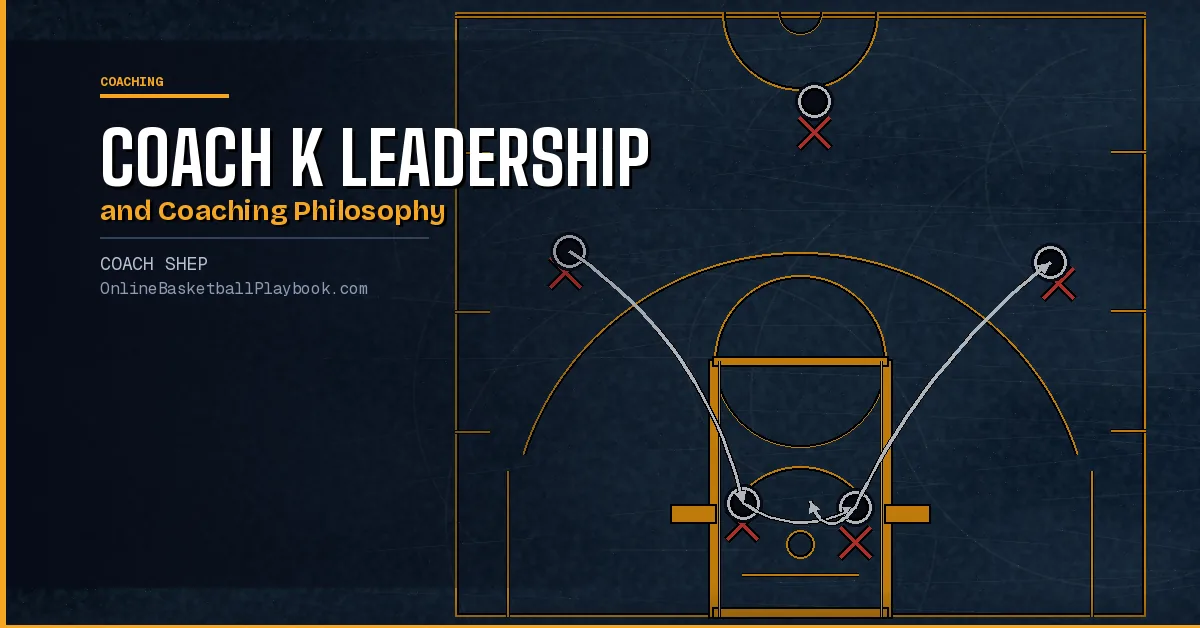
Mike Krzyzewski built one of college basketball's greatest dynasties not by outscheming opponents, but by building a culture so strong that players competed for each other. Here is what every coach can take from his model.
Identity First: The Foundation of Coach K's Program
The first thing Mike Krzyzewski did at Duke was not install an offense. He defined who Duke basketball would be. Before any scheme, any drill, any recruiting visit, he established a clear identity, a visible, public philosophy that would serve as a magnet for the right players and repel the wrong ones.
This approach aligns with what the best program builders across the sport have understood for decades: you do not start by collecting talent and then figure out who you are. You decide who you are, then build around that identity. At Duke, that identity centered on togetherness, relentless defense, and an almost military standard of preparation. Every practice, every conversation, every recruiting pitch communicated the same message.
What made Coach K's approach distinctive was his refusal to let the identity drift based on personnel. When Duke had great shooters, they shot. When they had great athletes, they attacked. But the culture beneath the personnel never changed. The commitment to defense, to team over individual, to preparation. Those were constants through five national championships spanning more than three decades.
The principle here is clear: a foundation of core players plus a known, public team philosophy is the magnet that attracts the right additions. The way you play and the values you stand for do the recruiting. Coach K understood this better than almost anyone in the history of the sport. He did not merely describe a culture in preseason speeches. He built operational systems that enforced it every single day.
For coaches at any level, the identity-first lesson is actionable immediately. Before the first practice, write down three sentences that describe how your team plays and what your players must demonstrate to stay on the floor. That statement becomes the lens through which every roster, personnel, and playing-time decision gets made. Without it, culture is just a poster on the wall.
Trust and Accountability as Non-Negotiables
Coach K's teams were famous for their chemistry. The Duke locker room, across decades and wildly different rosters, consistently produced players who competed for each other at the highest level. That chemistry was not accidental. It was the product of a trust infrastructure that Krzyzewski built deliberately and maintained without exception.
The core of that infrastructure was accountability. At Duke, no player was bigger than the standard. Stars were held to the same rules as walk-ons. When a player loafed in practice or failed to carry out an assignment, the correction came immediately and in front of the group. This was not cruelty. It was respect. Treating your best player differently than your least experienced player is a signal to everyone watching that the standard is negotiable. Coach K made it non-negotiable.
Accountability is only meaningful when it comes from a place of genuine care. What Krzyzewski understood is that players accept hard feedback from coaches they trust. The relationship work (the one-on-one conversations, the investment in each player as a person before a player) gave him the relational equity to push extremely hard without players shutting down or resenting it.
The lesson from this program-building framework is direct: align each newcomer's individual goals with team goals through repeated individual conversations. This is the Coach K method. Before he pushed a player, he made sure that player understood where the pushing was taking them. Once a player believes the coach is genuinely working in their interest, accountability becomes a gift rather than a punishment.
Coaches who skip the relationship side and go straight to demanding accountability typically get compliance at best and resentment at worst. Coach K never separated the two. Every standard he enforced was backed by a player who trusted why that standard existed and believed the coach was pulling them toward something worth reaching.
Recruiting Character Over Talent
One of the most consistent themes in Coach K's program, and in the best program-building philosophies across the sport, is that talent alone has never been sufficient. The players Duke recruited were, almost universally, people who had already demonstrated the capacity to compete in difficult environments, accept coaching, and sacrifice individual recognition for a collective goal.
The framework for this is precise: recruit for character, genuine hard work, position-specific fundamentals, and what the best coaches call "hunger for titles." These traits can be identified before a player ever steps on your floor. They cannot be installed in someone who lacks them. This is the hardest truth in recruiting, and Coach K never flinched from it.
His four-source approach to player evaluation (game film across multiple seasons, conversations with past coaches who held different philosophies, network intelligence from people who knew the player outside of games, and direct conversation with the player) gave him a complete picture that raw talent evaluations miss entirely. A player who looks great on film but deflects criticism from every coach who ever worked with them is a culture risk that no amount of athleticism can offset.
The coachability filter was central to Duke's success. Anson Dorrance, who built a 22-national-title program at UNC Women's Soccer, articulated the same principle: watch how a player responds to correction, not how well they perform when things are going right. Great players, per this framework, actively seek to understand their weaknesses. They do not deflect. They ask "what do I need to fix?" and they mean it.
Coach K built rosters where that trait was the norm, not the exception. When a locker room is full of players who genuinely want to improve and accept feedback, the daily standard becomes self-policing. Players hold each other to the level because they all share the same hunger. That is not a function of recruiting budgets or facilities. It is a function of knowing exactly what you are looking for and refusing to compromise it.
Building Standards That Last All Season
The most overlooked part of Coach K's coaching philosophy is the operational side, how he built habits so deeply ingrained that his teams performed under maximum pressure without breaking down. The Duke system was not simply a collection of great players executing great plays. It was a program where correct execution had become automatic because it had been repeated thousands of times under conditions that replicated game pressure.
Bill Parcells, whose program-building philosophy maps closely onto what Coach K deployed in basketball, described this as the defining purpose of preparation: "We don't want players to think during a game, we want them to react. Thinking takes too long." Every repetition in practice is a deposit into the reflex bank. When the game is on the line, players fall back on what they have practiced most, not what they have been told most.
Coach K understood this at a structural level. Duke practices were designed to be harder than games, more competitive, more consequence-laden, less forgiving of mistakes. This is what Dorrance called the competitive cauldron principle: if practice is a safer environment than games, players will shrink under real pressure. Duke players, by the time they played in March, had already been through harder environments. The tournament felt like relief, not a step up in intensity.
The standard at Duke was also unconditional. Non-negotiables were enforced identically in game one and game forty. The moment enforcement becomes selective, when the best player gets a pass on punctuality, or the star wing is allowed to loaf through a drill, the entire standard erodes. Every player is watching. They know immediately when the rules apply to everyone and when they apply to everyone except the people who matter most. Coach K's record on this is one of the defining traits of his career: no one was above the standard.
For coaches building programs at any level, the habit principle is the most transferable. Pick your non-negotiables (effort on defense, sprint back in transition, acknowledge the passer) and enforce them unconditionally from the first day to the last. The repetition over a full season builds the reflexes that show up when the game is tight and thinking is not an option.
Culture Is the System, Not the Plays
Dan Hurley's statement ("our system is how hard we play") captures something Coach K practiced for 42 years before Hurley said it out loud. The plays matter. The X's and O's matter. But the plays are downstream of the culture. Teams that understand why they are running an action, that trust the teammate they are passing to, and that refuse to give up a possession on either end. Those teams win with average schemes. Teams that have beautiful schemes but fractured locker rooms find a way to lose regardless of their talent advantage.
Coach K's culture rested on four pillars that he communicated explicitly and consistently: total commitment to the group, absolute standards of preparation, trust built through genuine relationships, and an identity that was public enough for every player to hold themselves and each other accountable to it. These were not abstract values. They were operational. They showed up in how practice was run, how corrections were delivered, how playing time decisions were explained, and how the team traveled and ate and prepared together.
The framework from Hurley's program is instructive: no blaming, complaining, or defending. These three behaviors (the instinct to blame a teammate when a play breaks down, to complain when a call goes against you, to defend your own poor decision rather than own it) are the primary corrosives of team chemistry. When they are permitted, they compound. A team that blames in October will fracture in March.
Coach K's teams were not perfect at eliminating these behaviors. No team is. But the standard was clear, and the coach modeled it. He did not blame his players in postgame press conferences. He did not make excuses for losses. He took responsibility publicly and demanded the same from his roster privately. That consistency between what he asked of players and what he demanded of himself is a large part of why his teams played for him at the level they did for so long.
Preparation and the Fourth-Quarter Test
One of the most practical tools in Coach K's coaching arsenal was his emphasis on fourth-quarter readiness, not just physical readiness, but cognitive readiness. Every player on his roster needed to be able to articulate their specific assignment in a late-game situation without prompting. If a player could not clearly state their role under pressure, the preparation was not finished.
This is what Parcells called the 4th-quarter role test, and it is a coaching accountability tool as much as a player accountability tool. When a player fails to state their assignment clearly, the correct question is not "why doesn't this player know their role?", it is "did we drill it until it was automatic?" Mental errors under pressure are a coaching receipt, not a talent verdict. The coach is the one responsible for whether the work was done deeply enough to survive a hostile environment.
Coach K used this principle to design his preparation philosophy from the ground up. Duke practices did not just run plays. They simulated the conditions under which plays break down. Fatigue, pressure, noise, deficit. All of these conditions were replicated so that when they appeared in games, players had already been through them. The habit had already been set. The reaction was already trained.
Over-scheming was something Coach K consistently avoided. A complex system that gives players too many decisions in the moments they most need to act is a liability, not an asset. Duke's offense and defense were not simple, but they were principled. Players understood why every action existed, which meant they could adapt when the action was covered without abandoning the principle underneath it. That conceptual clarity is what separates great preparation from elaborate preparation.
Applying Coach K's Lessons to Your Program
The most common mistake coaches make when studying elite programs is to copy the scheme and ignore the culture underneath it. Coach K's motion offense, his pack-line defense influences, his out-of-bounds plays. None of those are what made Duke great. What made Duke great is transferable to any level of basketball, because it is fundamentally about how a coach builds trust, enforces standards, and assembles people who genuinely want to compete for each other.
The starting point is identity. Write down, in plain language, what your program stands for and how you play. Make it specific enough that a player could tell you, without prompting, whether a particular behavior is consistent with that identity or not. Then communicate it constantly: in preseason meetings, in individual conversations, in how you run practice, in how you handle winning and losing. The identity is only real if it shows up in the daily operational decisions, not just in the preseason speech.
The next step is standards. Pick your non-negotiables (two to four behaviors that are unconditional) and enforce them identically for every player on the roster, from the first day of practice to the last game of the season. The moment you give a star player a pass that a reserve would not get, you have told every player in the gym that the standard is actually negotiable. That signal is nearly impossible to walk back.
From there, invest in relationships before demanding accountability. Coach K never separated the two. The relational work gives you the equity to push hard without players shutting down. One-on-one conversations at the start of the season (understanding each player's goals, their fears, their family situation) are not a luxury. They are the foundation that makes everything else possible.
Finally, design your practices to be harder than your games. Not just physically harder, but more consequence-laden, more competitive, more demanding of the exact decisions players will need to make when the game is on the line. If practice is the safest environment your players face all week, you are not preparing them for March.
Start the season by declaring the role of every player on your roster, out loud, in a team meeting, and in a follow-up individual conversation. Role ambiguity is one of the most common culture leaks in competitive programs. When players are uncertain about their role, they compete against teammates rather than alongside them, and energy that should go toward the opponent gets spent on internal anxiety. A five-minute role declaration conversation at the start of the year eliminates weeks of uncertainty and keeps every player invested, regardless of their position in the rotation.
- Define your identity before day one: Write a three-sentence program identity statement that covers how you play, what you value, and what is non-negotiable, then use it as the lens for every personnel and playing-time decision all season.
- Run the 4th-quarter role test weekly: Ask each player, without prompting, to state their specific assignment in a late-game situation. If they cannot answer clearly, add more reps before the next game. This is a coaching checkpoint, not a player verdict.
- Hold stars and walk-ons to the same standard: Every player is watching how you handle correction with your best player. Selective enforcement destroys the culture faster than any loss on the scoreboard.
- Make practice harder than games: Add scored competitions with consequences at least twice per week. If your players feel less pressure in practice than in games, they will shrink when the moment matters most.
- Do the relationship work first: Before the first competitive drill, have individual conversations with every player about their goals and their role. The trust built in those conversations is the equity that makes accountability possible later.
- Acknowledge the passer on every made basket: Implement a team-wide pointing ritual that honors the assist as much as the score. It is a no-cost, daily culture rep that reinforces team-over-self identity from the very first practice.
Want more basketball coaching strategies, drills, and tools?
Join the Online Basketball Playbook newsletter →
Draw this play free in the play drawer →
Membership: the full library, playbook packs, and Pro drawing tools →
Keep Building
Related breakdowns
Basketball Coaching Leadership: 5 Strategies That Hold Up
Basketball coaching leadership in five habits: state who your program is, keep a few standards, build culture in practice, declare roles and develop player leaders.
Basketball Coaching Philosophy: Examples and a Template
Basketball coaching philosophy examples from Pat Summitt, Dean Smith, Bob McKillop and Dan Hurley, what a philosophy covers and a fill-in template.
Basketball Leadership: Captains, Accountability and Toughness
Basketball leadership for coaches: how captains are picked, standards and consequences, accountability systems, mental toughness tools and named coach frameworks.