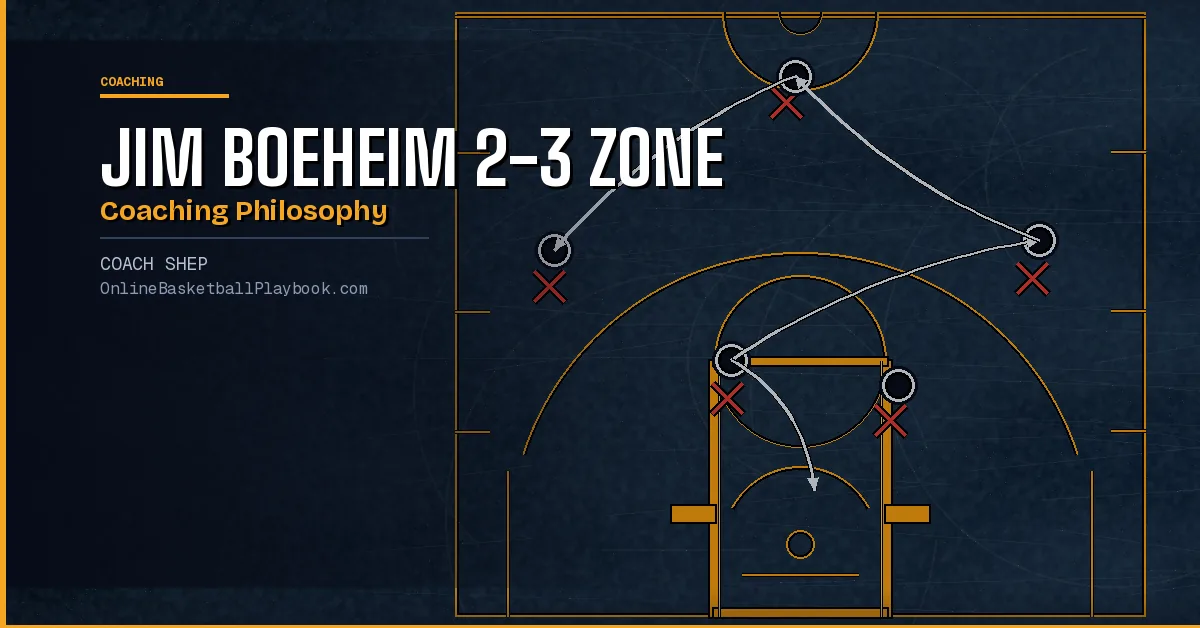
Jim Boeheim coached Syracuse for 47 years, won over 900 games, and reached nine Final Fours, almost entirely on the back of one defense. Here is how the 2-3 zone actually works.
Why Boeheim Committed to the Zone
Most coaches treat the zone as a change of pace, something you drop in for a few possessions to break rhythm or hide a foul situation. Jim Boeheim made the opposite bet: build an entire program identity around one defense, run it every possession, and become better at it than anyone else on the planet. That commitment is the first coaching lesson, and it is the one most coaches skip.
Boeheim inherited a program at Syracuse in 1976 that had limited NBA-level athletes compared to the ACC powerhouses. The zone let him compete without needing to match up body-for-body against superior man-to-man defenders. More importantly, it created an annual recruiting pitch that no other program could offer: come to Syracuse and learn the most famous defensive system in college basketball. That pitch landed Derrick Coleman, Lawrence Moten, Hakim Warrick, and eventually Carmelo Anthony, the player who delivered the 2003 national championship.
The philosophical commitment matters as much as the X's and O's. When a team runs zone every possession, defenders develop intuition that man-to-man players simply never build. They read ball flight, they anticipate skip passes before they happen, and they develop a shared language of rotations that becomes automatic under pressure. Boeheim understood that defensive excellence in a zone is less about athleticism and more about collective intelligence accumulated over thousands of repetitions.
Base Alignment and Starting Positions
The 2-3 zone sets up with two guards in the slots and three defenders across the baseline. But the starting positions are more precise than most coaches teach, and the details are where the defense either holds or breaks down.
The two top guards (X1 and X2) line up one step inside the three-point arc. They must be close enough together that the space between them cannot be exploited with a direct pass to the high post. If a gap opens between the two front defenders, the offense gets a straight pass to the elbow, and an elbow catch with no immediate pressure is the most dangerous moment in any 2-3 zone. Boeheim drilled his top guards to stay connected, almost uncomfortably close, to eliminate that vertical seam.
The three back defenders are not a flat line across the baseline. The two wing players (X3 and X4) should start on the wing, not planted on the block. This positioning is counterintuitive to coaches who visualize the zone as a low, spread defense. But if the wings start at the block, every corner catch is an open three-pointer. The wing simply cannot cover that distance before a shooter gets off a clean look. Starting on the wing allows X3 and X4 to close out on corner catches with a short, controlled sprint rather than a desperate six-foot scramble.
The center (X5) anchors the paint. This is the hub of the entire defense, and the demands on this player go well beyond what a typical post defender handles in a man-to-man system. X5 must protect the rim, defend the short corner, contest lob passes, and communicate every rotation to the other four defenders in real time. Boeheim built his best Syracuse teams around elite X5 players who could handle all of these responsibilities simultaneously.
Rotations and Ball-Side Responsibilities
Understanding the 2-3 zone requires knowing what each defender does when the ball moves, not just where they stand in the starting position. Ball movement is the stress test for any zone, and the Boeheim system has specific, practiced answers for every common ball entry.
Top Guard Duties
The ball-side top guard contains the dribble and forces the ball handler in one direction. On a reversal, a pass from one side to the other, the two top guards execute a jump switch: the off-guard immediately bumps to the ball while the original ball-side guard recovers to the middle. This switch must happen before the ball arrives, not after. A delayed jump switch is a missed switch, and a missed switch gives the offense a free moment with no defensive pressure.
Wing Duties
When the ball enters the corner, the ball-side wing (X3 or X4) closes out with a specific technique: butt pointed toward the corner, shoulder to the baseline. This body position accomplishes two things at once. It contests the catch and seals off the baseline drive. The wing cannot give up the baseline. A baseline drive that gets into the paint against a 2-3 zone is a breakdown, because X5 must choose between the corner and the rim and will be wrong either way. The wing's job is to prevent that choice from ever being forced on the center.
Center Duties on Rotations
On a corner entry, X5 steps up toward the short corner to discourage the pass from corner to low block. The weak-side wing simultaneously drops a foot into the paint to cover any lob or backdoor cut. This coordinated movement (wing closes, center steps up, weak-side drops) must happen as a single fluid action. Teams that execute this rotation correctly force the offense into the next pass and the next pass after that, gradually pushing the shot clock down without ever generating a clean look.
Protecting the Soft Spots
The 2-3 zone has two well-known weaknesses, and every offense that prepares for Syracuse targets them: the high post at the elbow and the short corner. Boeheim spent his career developing specific answers to both, because a zone with no answers to its known weaknesses is not a system, it is just a formation.
The High-Post Problem
When a pass reaches the high post, the two front guards are typically in a poor position to immediately contest. The standard solution, collapse all five defenders toward the ball, creates the exact problem it is trying to solve, because collapsing the zone opens corner shooters. The correct answer, and the one Boeheim taught, is the opposite: when the ball reaches the high post, the four perimeter defenders sprint out to their corner-box positions while X5 takes the high-post catch one-on-one. The center goes 1v1 with a high-post player so that the zone stays expanded and kick-out threes are eliminated.
This requires X5 to be capable of defending one-on-one in space, which is exactly why the center position is the limiting factor in any version of this defense. If X5 can handle the high-post 1v1, the zone trades a tough contested mid-range two for no corner three. That is a good trade. If X5 cannot handle it, the high post becomes an automatic advantage for the offense.
The Short-Corner Problem
The short corner, the area from the block extending toward the wing, just beyond X5's natural range, is the second soft spot. The Boeheim answer here is X5 steps out to contest while the weak-side wing (X3) rotates under the basket to cover any dive cut. When those two movements happen simultaneously, the short corner entry triggers no clean second pass. The breakdown occurs when X5 steps out but X3 is slow to rotate, leaving the dive lane completely open. This rotation takes hundreds of reps in practice to become reliable under game speed.
The Analytics Behind the Zone
Modern analytics have actually strengthened the case for the 2-3 zone as a primary defense. But only if it is taught correctly. The data point that matters most is points per possession by shot type. An open corner three generates approximately 1.15 to 1.20 points per possession. An uncontested rim shot generates 1.25 or more. A contested mid-range jumper from 10 to 12 feet generates roughly 0.75 to 0.80 points per possession. The zone's job is not to prevent every shot. It is to funnel the offense toward the contested mid-range while eliminating the corner three and the clean rim shot.
This means that when a team running the 2-3 correctly gives up a tough pull-up two from the elbow, that is the defense working as designed. The coaching response to that shot should be "that's fine." The coaching response to a corner catch with no closeout, or a high-low entry that leads to a clean layup, should be "that's a breakdown." Many coaches get this exactly backward. They accept corner threes passively and panic when an opponent makes a pull-up two. The analytics say the pull-up two is the acceptable trade and the corner three is the unacceptable breakdown.
Boeheim's Syracuse teams historically ranked among the nation's leaders in opponent three-point percentage allowed, not because they were athletically superior to other programs, but because the zone architecture made corner catch-and-shoot attempts rare. Opponents were forced into their second-best offensive options possession after possession, which compounds into a significant efficiency gap over the course of a game and a season.
Personnel Demands and the X5 Problem
Coaches who want to run the 2-3 zone as a primary system need to evaluate their roster against one honest question: can our center handle everything the X5 position demands? If the answer is no, you can still run a flat 2-3 with a more conservative approach, but the aggressive, turnover-generating version of the defense requires a very specific player in the middle.
X5 in a Boeheim-style 2-3 needs the point-guard IQ of a play-reader, the communication skills to call every rotation before it happens, the athleticism to close out on the short corner without help, and the toughness to defend the high-post 1v1 without fouling. That is a rare combination. Boeheim was fortunate throughout his career to have a series of big men who could meet those demands, and in the years when his X5 was limited, the zone was noticeably more vulnerable.
The top guard positions (X1 and X2) need to be athletic enough to execute the jump switch cleanly and disciplined enough to stay connected in the starting alignment. The wing positions (X3 and X4) need lateral quickness to close out from the wing, not outright speed, but change-of-direction ability. A wing who takes two steps to stop and redirect will be consistently late on corner closeouts, and consistently late closeouts mean consistently open threes.
Before installing the 2-3 zone as your primary defense, run your X5 candidate through a short-corner close-out drill and a high-post 1v1 session, not once, but at game speed for several consecutive possessions. If that player cannot sustain both responsibilities without significant help, assign a more limited zone role and build the defense around what your actual personnel can execute reliably.
How to Apply This to Your Program
You do not have to run the 2-3 zone every possession to benefit from Boeheim's system. The principles are transferable regardless of how much zone you play. Teaching your defenders to move on the flight of the ball, repositioning before the catch, not after, makes every defense better. Teaching your wings the body position for corner closeouts (butt toward the corner, shoulder to the baseline) pays dividends in man-to-man ball-screen coverage as well. Teaching your center to communicate rotations builds the defensive IQ that the best teams operate from regardless of system.
The biggest application for most programs is using the zone as a change-of-pace call that you have actually practiced, not just drawn up in the huddle. Teams that spend two or three practices per week on zone rotations can drop into a 2-3 in the fourth quarter and look like they have run it all season, because they have the rotation patterns wired. Teams that only pull the zone out in emergencies look panicked, because they are. Boeheim's commitment to the system was not just a philosophical preference. It was the practical result of understanding that competence requires repetition.
Consider installing the jump switch between your two top guards as a standalone drill. Run it daily for two weeks, at game speed, until it happens automatically on every reversal. Then add the wing closeout technique. Then add the X5 short-corner coverage. Build the system one layer at a time so each piece is solid before you add the next. That is how Boeheim built it at Syracuse, starting with the foundation and adding complexity as his players demonstrated they could handle it.
Another practical takeaway is the zone-to-man trigger. Boeheim was not rigid about using the zone exclusively when it was being exploited. His teams had practiced transitions from zone to man coverage, and he would make the switch when a specific weakness was being attacked persistently. Having a clear trigger, such as switching when the high post has caught the ball twice in a row for clean looks, prevents the zone from becoming a liability late in games when opponents have had time to prepare counters. The switch should be called with a word or hand signal that your players have rehearsed, not improvised under pressure.
- Start your wings on the wing, not at the block. This single adjustment eliminates most open corner threes before they happen.
- Teach the jump switch between top guards as a standalone daily drill; it must become automatic before it works in a game environment.
- Evaluate your X5 candidate in practice against both the short-corner closeout and the high-post 1v1. The whole defense is built on what that player can handle.
- Coach your players to accept the contested mid-range two as a win, not a failure. This reframes the defensive mindset around analytics rather than optics.
- Practice the zone-to-man trigger with a clear signal so your team can shift without confusion when opponents attack the high post or short corner successfully two or more consecutive possessions.
- Run the wing bump, outside foot forward, hand high, back to the corner, as a daily rep so your wings can stunt on skip passes and recover to their rotation box in one fluid motion.
Jim Boeheim's legacy is not just 900 wins. It is proof that a single well-executed system, committed to fully and taught precisely over decades, can compete at the highest level regardless of recruiting budget or raw athleticism. The 2-3 zone works not because it is clever, but because most teams do not practice it rigorously enough to teach it correctly, and the gap between a drilled zone and an improvised one shows up every time the ball gets reversed against you.
Want more basketball coaching strategies, drills, and tools?
Join the Online Basketball Playbook newsletter →
Draw this play free in the play drawer →
Membership: the full library, playbook packs, and Pro drawing tools →
Keep Building
Related breakdowns
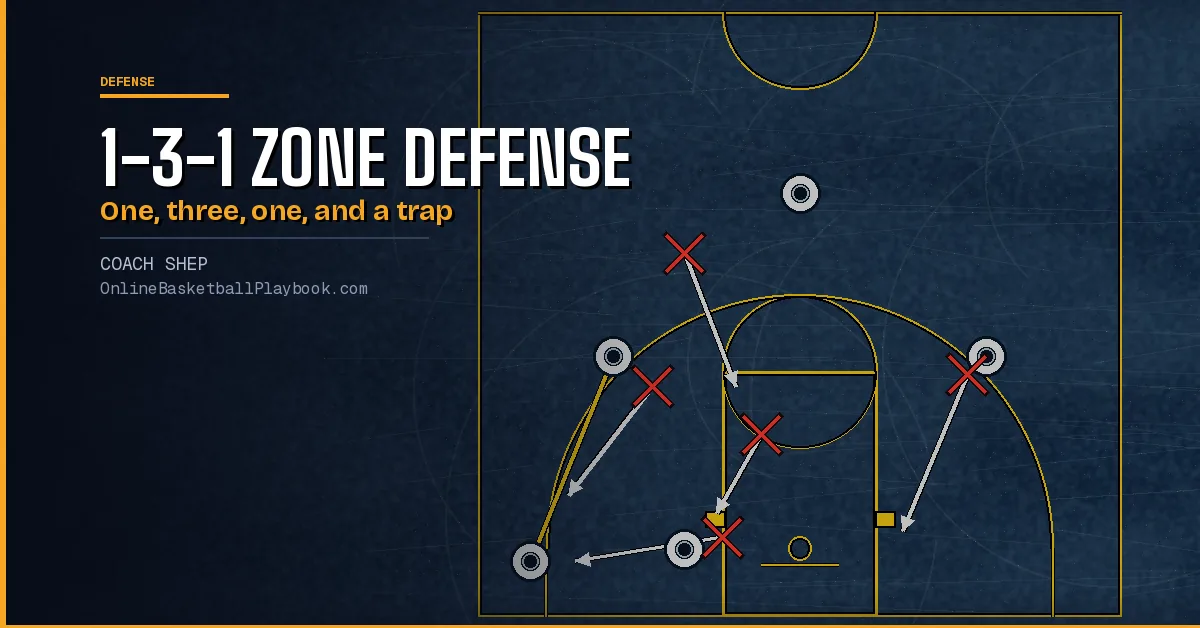
1-3-1 Zone Defense: Traps, Rotations and Drills
How to run the 1-3-1 zone defense: the five roles, the corner and wing traps, the skip pass that beats it, loose and tight depth, and the drills to install it.
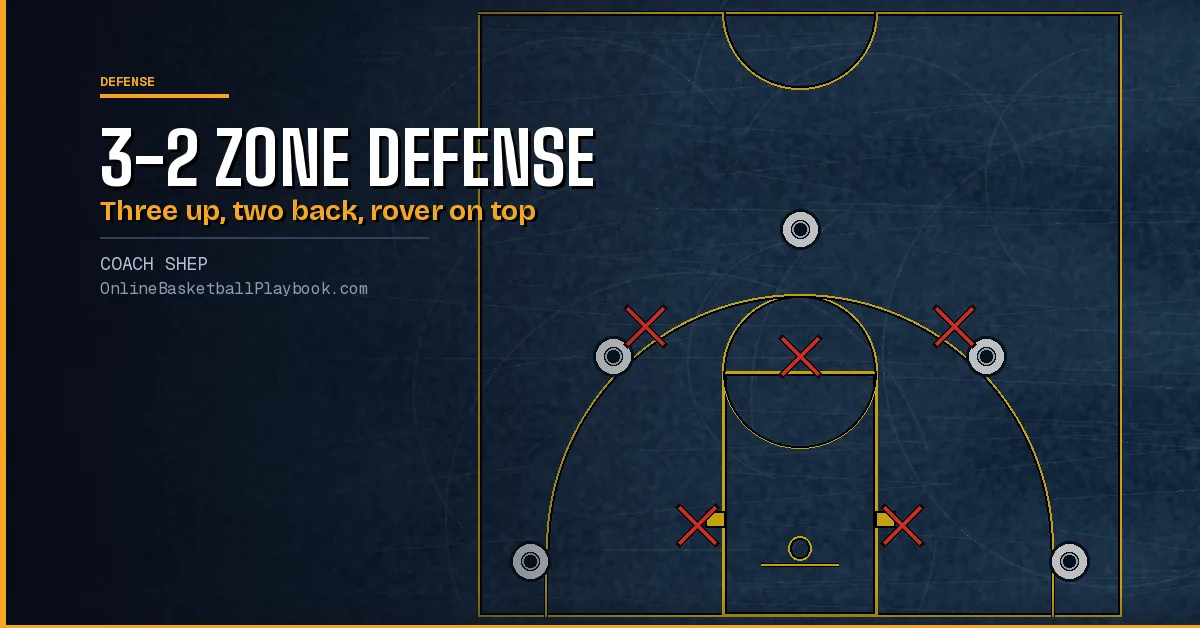
3-2 Zone Defense: Rotations, Weak Spots and Drills
How to run the 3-2 zone defense: the alignment, the rover, every rotation, the weak spots, the 3-2 matchup zone and the drills, plus when to pick it over a 2-3.
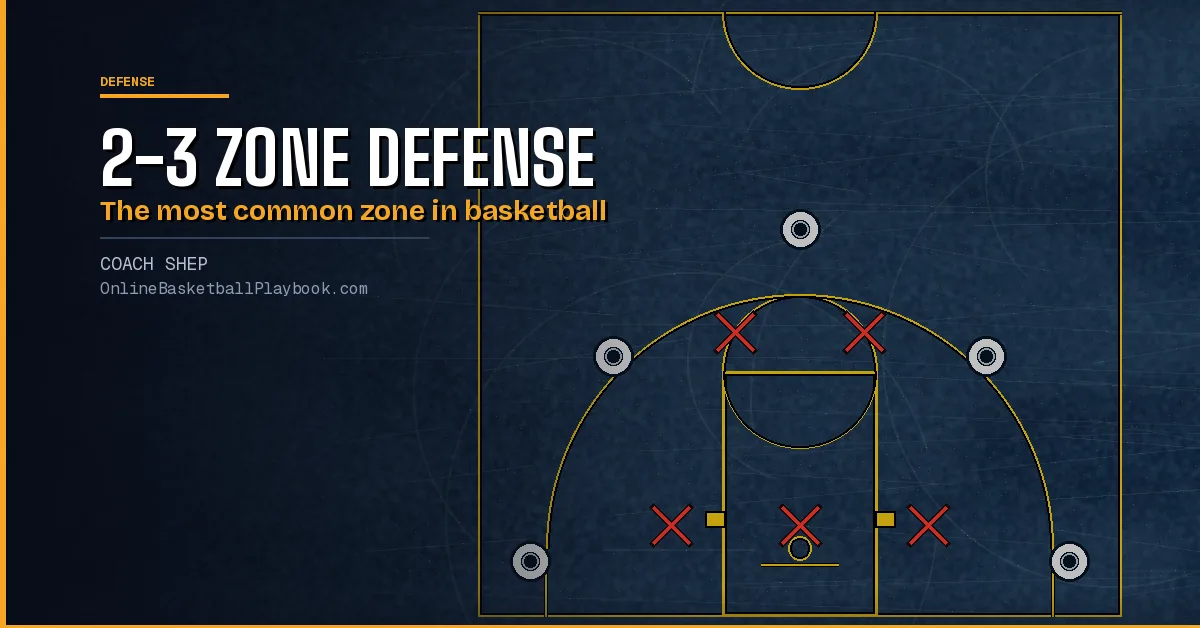
2-3 Zone Defense: Rotations, Weak Spots and Drills
How to play the 2-3 zone defense: the starting positions, how it shifts to the ball, where it leaks, when to trap, and the drills that install it.