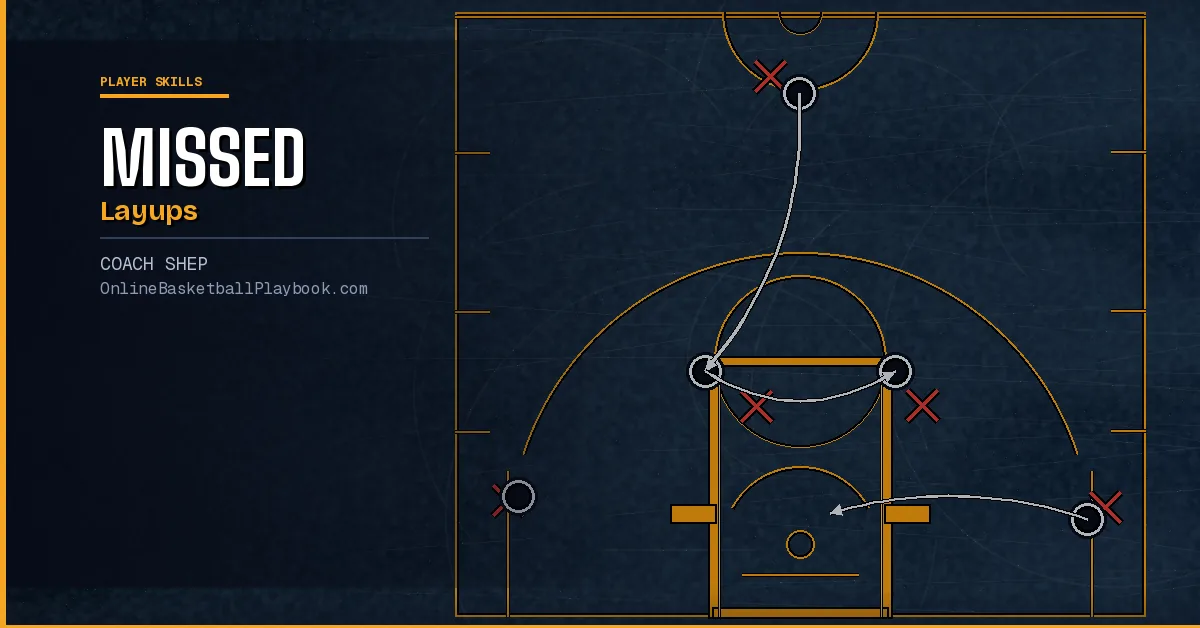
Layups are the highest-percentage shot in basketball, yet players miss them constantly. The cause is almost never lack of effort. It's three fixable mechanical problems: a broken gather, wrong footwork sequence, and a single finishing option when defenders take it away.
Why the Layup Is Harder Than It Looks
Every coach has watched a player blow past a defender, go to the rim with nobody in front of them, and then put the ball off the side of the backboard. The crowd groans. The coach puts a hand over his eyes. The player looks at his hands like they betrayed him. But the miss was decided well before the attempt, usually two or three steps earlier, sometimes at the moment the player caught the pass.
The layup looks simple because the mechanics are simple when practiced in isolation. Walk up, one-two, lay it in. That isolation rep is nearly useless for game preparation. What separates players who finish from players who miss is their ability to execute those same mechanics while moving fast, absorbing contact, making reads, and arriving at the basket at an angle they didn't choose.
Speed changes everything. At full game pace, the gather (the moment where the player transitions from dribbling to finishing) compresses to a fraction of a second. Players who haven't drilled that moment at speed will rush it, mistiming the footwork so that they arrive at the basket off-balance, their momentum carrying them past the rim or sideways into a help defender.
Then there's the single-finish problem. Many players have practiced exactly one layup: right hand on the right side. Ask them to finish with the left hand, use a power stop, throw a floater, or reverse under the rim, and they have no answer. When a shot blocker takes away the primary finish, the play dies. A complete finisher has four or five answers at the rim and chooses based on what the defense gives.
The Three Root Causes of Missed Layups
Coaching diagnosis starts by naming the specific failure, not just the result. Missed layups generally fall into one of three categories, and mixing them up leads to the wrong correction.
1. The Broken Gather
The gather is the dribble that sets up the finish, typically the last one or two dribbles before the player goes up. When the gather is rushed or late, the player arrives at the basket out of rhythm. They may take an extra shuffle step (travel), go up off the wrong foot, or elevate before they've stabilized their momentum.
The fix is building the gather into every drill rep. Players need to know their gather point (the exact location where they pick up their dribble and begin the two-step sequence). Many players gather too early and then take a stutter step trying to get their feet right, or they gather too late and the momentum from the last dribble carries them under the basket.
2. Wrong Footwork Sequence
The classic layup footwork is right-foot, left-foot when shooting with the right hand (the opposite-foot-first rule). Many players learn it early and never question it. But at game speed with defenders in their path, they revert to a flat-footed jab step or arrive one-foot-first off a running stride, which destroys their ability to go straight up.
The jump-stop layup is often a better teaching starting point for this reason. When a player gathers into a jump stop (landing on both feet simultaneously) they preserve their balance, eliminate travel risk, and give themselves a stable platform to finish regardless of which angle they approached from. One of the more rigorous footwork teachers in the coaching community recommends using jump-stop layups exclusively for the first two to three weeks of the season for exactly this reason: it forces players to deal with their own momentum and with help defenders rather than floating blindly through the lane.
3. A Single Finishing Option
The third cause is the most common and the easiest to overlook: the player only knows one way to finish, and the defense takes it. A right-handed player who always goes right-handed off the right side is easy for a shot blocker to defend once the scout is in. If the player has no power finish, no floater, no reverse, and no left hand, a single well-positioned defender can eliminate the play entirely.
This isn't about forcing players to be ambidextrous from day one. It's about building a realistic finishing menu over time so that every player has at least two or three reliable options at the rim and can read which one the defense is giving.
Building the Right Footwork Foundation
Footwork is the most under-drilled skill in basketball at every level below the professional game. Coaches spend practice time on plays, sets, and spacing while the individual body-control mechanics that determine whether the play produces a made basket get fifteen minutes at the start of October and then nothing.
The foundation for finishing starts long before the player reaches the rim. It begins with what coaches like Jerry Krause described as the "quick" stance: balanced, weight on the balls of the feet, able to react in any direction. A player who can't start, stop, and change direction under control has no platform for finishing, because finishing is just a controlled stop at the rim.
The Jump Stop as the Teaching Foundation
Teach the jump stop first and use it constantly. The jump stop is a two-foot landing (a small hop where both feet hit the floor simultaneously). When a player kills their dribble into a jump stop, two things happen: they preserve their pivot foot options (since neither foot has been designated yet), and they absorb their momentum into the ground before going up. The cue is simple: "Kill your dribble, take a small bunny hop, land simultaneously on both feet."
A jump stop layup built on this foundation looks like this: the player gathers the last dribble, hops into a two-foot stop at the proper gather point, then steps up and through to the basket off the correct foot. It's slightly slower than a running layup, but it's controlled, and control is what produces makes when the defense is present.
One-Count vs. Two-Count Stops
As players develop, they need both the one-count (jump stop) and two-count (stride stop) finishes in their toolkit. The stride stop (the traditional one-two step) allows more momentum to carry forward, which can help a player finish through contact. But the stride stop requires precise footwork to avoid traveling when the sequence gets disrupted.
The key coaching point is that the footwork sequence must be drilled, not discovered. Players who haven't explicitly practiced the stride-stop footwork at game speed will revert to bad habits under pressure. Walk through the sequence in slow motion, then progress to half speed, then three-quarter, then full. The mechanics have to be automatic before they'll hold up in a game.
Body Control Before Ball Skill
One principle that separates organized footwork teaching from generic layup drills is this: body control comes before ball skill. A player who can't control their own momentum through the lane will not be helped by working on their finishing touch at the rim. The ball goes where the body points it. Fix the body first.
This means starting footwork drills without the basketball. Players run lane lines, work on jump stops, practice stride stops, and rehearse the gather sequence before a ball is introduced. When the ball comes in, the footwork should already be reliable. The player is just adding the ball skill on top of mechanics that are already grooved.
Developing a Full Finishing Menu
The finishing menu concept comes from a simple observation: defenders adapt. A player who finishes the same way every time is eventually defended by anyone paying attention. A player with multiple finishes in their pocket forces the defense to guess, and every guess is a disadvantage for the defense.
The core finishing menu that every guard and wing should develop contains five options: the regular layup (inside hand to the basket), the power finish (two-foot stop, strong up through contact), the reverse layup (using the rim as a shield against the help defender), the floater or runner (a controlled high-arc shot released earlier to get over a shot blocker), and the opposite-hand layup (using the weak hand when the strong-hand angle is taken).
The Regular Layup and the Power Finish
The regular layup should be the default, but it needs to be drilled from every angle. Right side, left side, straight on, forty-five degree approach, baseline drive. Players often only rep the right-side right-hand layup and then look lost when they get to the rim from the left wing. Distribute the reps across all angles in every finishing drill.
The power finish is the second most important option for players who play at the rim against size. Two feet, strong up, absorb contact and finish. It's the finish to use when the help defender is already in position and a soft one-hand floater would get blocked. The power stop gives the player a stable base that's hard to move, and the two-foot landing means they can initiate contact rather than avoiding it.
The Reverse and the Floater
The reverse layup is underused at the youth and high school level because coaches don't drill it. But it's among the most effective finishes against length, because the player uses the backboard and the rim itself as protection against the shot blocker who is cheating from the weak side. The teach is straightforward: when the help defender is between the player and the basket on the near side, continue under the basket and finish off the far side of the backboard. Use the rim as a shield.
The floater (sometimes called a runner) is the response to a shot blocker who is positioned directly under the basket. The player releases early, well before the defender can fully elevate, on a high-arc trajectory that clears the block attempt. Guard trainers emphasize the floater off the proper foot as part of a complete guard finishing battery. The key coaching point is the release point: it comes earlier than players expect, and the arc needs to be higher than a standard layup. Reps at game speed are the only way to develop the necessary feel for it.
The Weak Hand
Developing the weak hand is a year-long commitment, not a two-week drill sequence. The most effective approach is to make weak-hand finishes the default in certain drills (not optional, mandatory). Players who can only finish with their dominant hand give away half the rim to defenders who know this. A player with a functional weak hand can attack the defender's front foot from either direction and finish appropriately, which doubles the options available on any drive.
Drills That Actually Fix the Problem
The Mikan Drill is the classic for a reason: it forces both hands, develops touch around the rim, and builds the habit of going right back up after a make. But it's a closed drill (no defender, no gather, no decision). It builds touch; it doesn't build game finishing. Use it as a warm-up, not as the primary finishing development tool.
Jump-Stop Layup Progression
Start with the jump-stop layup from both sides of the lane, no defender. Coach checks the gather point, the two-foot land, and the step-through. Then add a chair or a cone at the gather point to mark the spot and make the gather automatic. Then add a trailing defender who provides token contest. Then add a live one-on-one defender.
Progress only when the footwork holds up. If a player starts traveling or rushing the gather under light pressure, back up a step before moving forward. The drill is only useful if the mechanic you're building is actually being rehearsed.
Finish Menu Drill
Set up five attack angles (right wing, left wing, right baseline, left baseline, straight on) and rotate through all five for each finish type. First the regular layup from all five angles. Then the power finish. Then the reverse. Then the floater. Then the weak hand. This takes thirty to forty minutes when done properly, which is why most coaches skip it. The teams that do it consistently develop complete finishers.
The Three-Man Weave With Jump-Stop Finish
The three-man weave is a conditioning and ball-movement drill, but add a mandatory jump-stop finish rule and it becomes a finishing development tool. Every player who receives the final pass must gather into a jump stop before going up. Over time this trains players to control their momentum automatically in transition, which is one of the most common layup-miss scenarios in game conditions.
How to Coach Finishing Under Pressure
The biggest gap between practice finishing and game finishing is pressure: physical, temporal, and psychological. A player who makes every layup in a drill with no defense will still miss at a meaningful rate in games until they've drilled finishing with a body in their path, a shot-clock buzzing, and a crowd reacting to every make and miss.
Build pressure into drills progressively. Token contest first (a defender who raises a hand but doesn't leave their feet). Then an active contest from a stationary position. Then a live one-on-one from the three-point line with the defender trying to beat the driver to the rim. Then shell or team settings where the driver has to read the help as well as the primary defender.
Every player finishes with contact at some point during the week. Soft practices produce players who flinch at the rim. Players who've been trained to absorb contact and still finish (through the arm, off the hand, through a body in their path) develop the physical and mental confidence to complete plays that others give up on.
Make finishing counts visible. Track makes and misses from the rim in drills. Post them. Players respond to data, and a player who is 4-for-12 on layups in practice is going to start taking that seriously when the numbers are on a whiteboard. It also tells you, as a coach, exactly where the breakdown is happening (which finish type, which angle, which pressure level) so your correction can be specific instead of generic.
Use jump-stop layups as the only allowed finish for the first two or three weeks of every season. It forces players to deal with their own momentum, eliminates travel habits that come from rushed stride-stops, and builds the controlled gather that holds up under game-speed pressure. Once the footwork is solid, layer in the stride-stop and the full finish menu on top of a reliable foundation.
- Diagnose before drilling: Identify whether the miss is a gather problem, a footwork-sequence problem, or a single-finish-option problem. The correction is different for each.
- Jump stop first, stride stop second: build the two-foot controlled gather before adding speed and momentum to the finish sequence.
- Build five finishes over the season: regular, power, reverse, floater, and weak hand, rep from every angle, not just the right-side dominant approach.
- Add pressure progressively: token contest, active contest, live one-on-one, then shell settings with help defenders present.
- Track makes and misses from the rim: visible data by finish type and angle tells you exactly what to correct and gives players accountability they respond to.
Want more basketball coaching strategies and drills?
Join the Online Basketball Playbook newsletter →
Draw this play free in the play drawer →
Membership: the full library, playbook packs, and Pro drawing tools →
Keep Building
Related breakdowns
How to Fix Common Shooting Errors: Read the Miss First
How to fix common shooting errors: read what the ball does on the rim, find the cause, apply one correction, and coach the shooter through the dip.
Basketball Layups: Learning How to be a Great Finisher
Basketball Layups: Learning How to be a Great Finisher
Ten Ways to Transform Your Basketball Players Into Team Leaders
Ten Ways to Transform Your Basketball Players Into Team Leaders