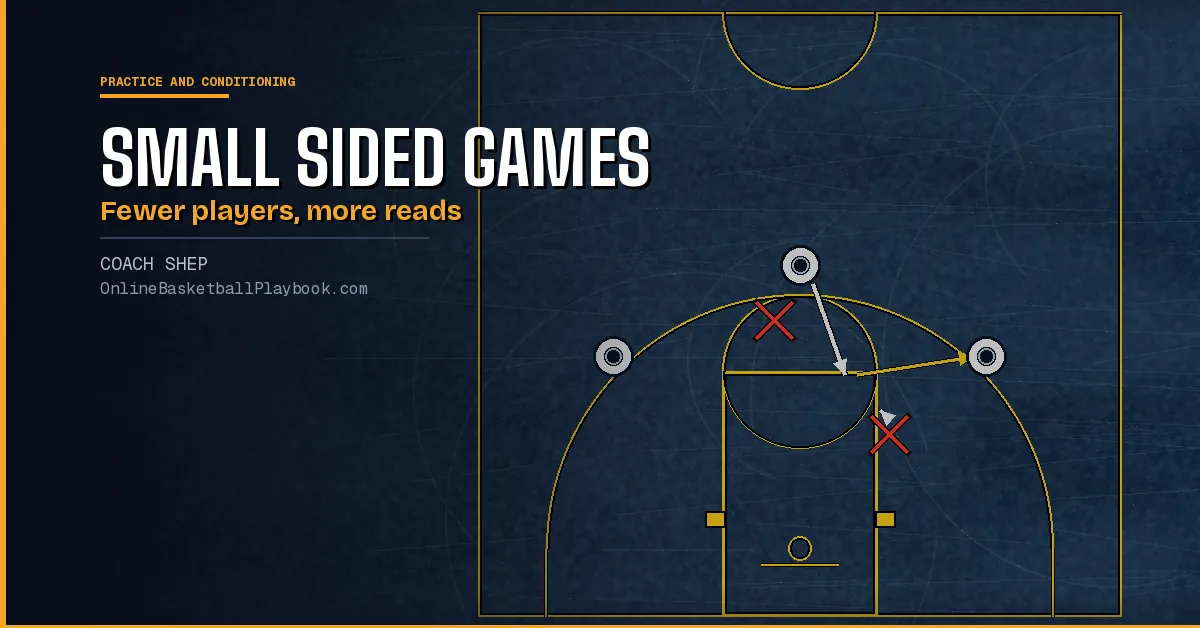
Small sided games are basketball with fewer than five players on a side, most often 2-on-2, 3-on-3 or an uneven 3-on-2 or 4-on-3. They give every player more touches, simpler reads and no place to hide, and the coach steers what they teach by changing one rule at a time.
This page covers why small sided games work for skill development, how to shape them, how to score them and four formats you can run tomorrow. Scored practice in general is on competitive basketball drills, and the reading side of the game is on teaching basketball decision making.
Why Small Sided Games Build Skill
Take players off the floor and each one left on it does more. That is the whole case, and it breaks into a few parts:
- More touches. Fewer players means each one handles the ball more often, and every touch is a live decision with a skill attached.
- Simpler reads. With fewer teammates and defenders to track, a young player faces a read he can actually solve.
- More chances to score. Young players enjoy scoring, and a small game gives each of them more chances to do it.
- More space. Less traffic lets a player try a move or take a shot without running into a crowd.
- No place to hide. In 5-on-5 a weaker player can disappear while two ball-dominant players take the shots. In 3-on-3 or 2-on-2 that hiding spot is gone.
- One teaching point at a time. A small game isolates one action, such as the pick and roll, screening away, a back cut or a v-cut, without a full floor of confusion around it.
- When, not just how. A technique drill with no defender teaches how to do a skill. It does not teach when to use it. A live small game supplies that.
Small games also take presses and zones off the floor, so players learn half-court decisions first and meet pressure defense later.
Static dribbling sits at the other end of the scale. The constraints-led approach gives it very little learning benefit and replaces cone and stationary ball-handling work with games that make the handler read space while he dribbles, such as team dribble tag.
A drill shows how. A game shows when.
Shape, Focus, Enhance
A small sided game is coached, not just played. The games approach names the coach's three jobs:
- Shape. Change the environment: the rules, the space or the number of players, so the skill you want shows up on its own.
- Focus. Tell the players the objective before the game starts, so they know what is being watched.
- Enhance. Stop the game and teach inside it when a teaching moment appears, then play on.
Its sample practices use focused minigames, such as a 3-on-2, a three-lane passing game and a defensive rebounding game, each built to train one or two skills in a game-like setting rather than as drill repetition.
Coach by questions where you can. Games-based camp cards carry guiding questions on every activity, such as "Where is the space?" and "Is it possible to overpass?", so the coach asks rather than tells.
Change the game, name the goal, and stop it only when there is something to teach.
Start With an Advantage
Many small games start the offense ahead and make it use the edge before the defense recovers. The coach sets the size of the edge:
- Place the ball. The coach hands the ball on the attacker's outside hip for a baseline drive or the inside hip for a middle drive, and a hi-5 releases the play. How close the defender starts sets how big the advantage is.
- Even game, then lopsided game. Play an even 3 v 3, then a lopsided 3 v 1 or 3 v 2, and shrink the advantage as skill grows.
- Give the learner the edge early. Start with the overload and play the fair fight later.
- Guide the defender. The defender's job is to give a different read each rep, not to stop the play. He picks one of three coverages, trail, cut-off or neutral, and the offense runs three reps so it sees all three. The idea is repetition without repetition.
A coach can dial the advantage up or down in real time by moving the ball or the defender, down to a near-even game.
The advantage is the coach's dial. Turn it down as the players get better.
Rules That Force the Skill
Pick the skill, then write the rule that makes it happen. Each rule below is named by what it forces:
- Paint off limits. No catch inside the paint except on a cut. For older players, no catch inside the three-point line except on a cut. It teaches spacing without a set offense.
- Get out after a cut. After a pass or a cut, the player without the ball has three seconds to get out of the paint, or it is a turnover.
- Back outside first. The first passer cannot get the ball back until he returns outside the arc after his drive and kick, so players get into space and back out of it.
- Rim or three only. The offense may score only a rim finish or a three. Younger players keep the mid-range.
- No pass and cut. The offense must create the advantage one on one from the perimeter or a post-up while teammates space.
- Catch and shoot or catch and pass. No fakes and no dribble, then add a third player who must penetrate.
- Weak hand only. In a 3-on-3 built for the weak hand, dribbling with the strong hand loses the ball.

Apply two rule changes to a game before switching to a new game, and keep an easier version of every game for younger players. Progression comes from tightening the rules on the same game, not from changing drills.
One rule, one skill. Add the next rule only when the first one sticks.
Score Both Ends
A small game with a score is a different game. Give both teams a way to win the possession:
- Stops count. The defense scores 2 points for a stop, meaning a defensive rebound or a forced turnover, the same as a made two. Passive defense stops paying.
- Make the turnover cost. Nate Oats scores every rep at Alabama: plus 3 for a made three, plus 2 for a made two, plus 1 for a putback and minus 2 for a turnover, charted, and the losing team runs.
- Pay for the shot you want. A closeout game pays 2 for a layup, 1 for a foul and 1 for a three.
- Play to a number. A 5-on-5 game to finish the session plays to three baskets, and the winner stays on.
Let the players keep and call the score. Then the game corrects itself and the coach is free to teach.
Whatever the point system, post it before the first possession and keep it the same all week.
Four Formats With Diagrams
Run the formats from small to large. Build the session from 1-on-1 reads to 2-on-2 advantage play, 3-on-3 spacing and decisions and 4-on-4 team reads, and close with 5-on-5 under the same rules.
3-on-3 half-court continuous. Teams of three, at least three and at most six teams per basket, 20 minutes.
- After a make. The team that was scored on sprints off, and a new defense comes on from the baseline and touches the three-point line before it guards.
- Restart. At the same time the offense brings the ball out and touches the half-court line to start the next 3-on-3.
- Rules to add. Paint off limits, rim or three only, or get out after a cut.

2-on-1, two passes. Groups of four with one ball, 16 minutes. It teaches the open shot off a 2-on-1.
- Setup. Two attackers set up outside the arc, corner and wing or slot and slot, and the lone defender holds the ball a short closeout away.
- Play. The defender passes the ball in. The offense may not move or dribble and has two passes at most to find an open shot.
- Rotation. The second defender waits on the side and takes the next rep. After six reps, offense and defense switch. Three groups can share a basket.
- Shot test. Ask whether the shot was in range, open and on balance.

3-on-2 burst. Groups of seven, three on offense, two on defense and two waiting on the baseline, 16 minutes.
- The burst. The offense must score a three or a layup in 10 seconds.
- Six bursts. The offense plays six bursts against changing pairs of defenders, then a new group takes the offense.
- Win. The side with more points wins, and a tie plays one more burst.
- Harder. Make it 3-on-2 plus one more defender, with the offense starting from a blind advantage. If the defense recovers and matches up, it is an instant turnover.

Scored scrimmage. Nate Oats runs 15-second shot-clock scrimmages both ways, and the losers run. Any small game can borrow the clock.
Start small, add players, and keep the same rules on the way up to 5-on-5.
Get the next coaching guide in your inbox
One email when a new guide or diagram set goes up. Free.
How Much Practice Time
Coaches who put a number on it give different floors and ceilings:
- A quarter of youth practice. At least 25 percent of a youth practice, 15 minutes of an hour, which matches the games block in a 50, 25, 25 practice split.
- Early in practice. Run 1-on-1 and 2-on-2 segments early, 10 to 15 minutes, to set the tone.
- Less 5-on-5. Play fewer 5-on-5 scrimmages and more 1v1 to 3v3 with rules that force touches.
- Whole camp blocks. Camp game activities run 16 to 24 minutes and warm-up games 10 minutes each.
- Summer. Make half-court 3-on-3 the main off-season activity, because it gives more shots, passes, rebounds, screens and defensive reps per minute than full court, with less wear on the legs.
- By stage. USA Basketball sets training-to-competition ratios that run from 70:30 at the Foundational level to 25:75 at the Performance level.
How the minutes fit around the rest of a session is on basketball practice plan and basketball practice structure.
Put the games on the plan first, then fit the drills around them.
Where Coaches Split
Coaches agree on the touches. They split on how much the game should do on its own:
- Games carry the camp. Every block is a small sided game with rules, and warm-ups are tag and knockout games with rules attached, never stretching in lines.
- Stations carry the camp. Four teaching stations a day, 20 minutes each, with a coach and a lesson plan at each, then competition.
- Some games train nothing. Knockout and dribble tag teach no skill, and a camper who only plays games ends up under-skilled. The games-first camps use both, with a skill built in.
- Defender in stages or live at once. Add the defender in stages, a foot only, then semi-active, then full, or go live from the first block as the games-first camps do.
More fun games for young teams are on fun basketball games, and the full camp day is on how to run a basketball camp. The offense built on these games is on concept based offense, and the part drills that sit beside them are on offensive breakdown drills.
Whichever side you take, every game needs a skill inside it and a score on top of it.
Questions Coaches Ask
What are small sided games in basketball?
Games with fewer than five players on a side, such as 2-on-2, 3-on-3, 3-on-2 or 4-on-3. They give each player more touches and simpler reads, and the coach shapes what they teach with rules, space and numbers.
Why use small sided games instead of drills?
A drill with no defender teaches how to do a skill but not when to use it. A small game adds a live defender, more touches and a score, and no player can hide behind two teammates.
How do you make a small sided game teach one skill?
Write one rule that forces it. Paint off limits teaches spacing, rim or three only teaches shot choice, no pass and cut forces one-on-one play, and a weak-hand rule forces the weak hand.
How long should small sided games run in practice?
Coaches differ. A youth floor of 15 minutes an hour, 1-on-1 and 2-on-2 segments of 10 to 15 minutes early in practice, and camp game blocks of 16 to 24 minutes are all in use.
Is 3 on 3 good for player development?
It is the most common small format. Every player is involved, the floor has room to drive and cut, and in the off-season it gives more shots, passes, rebounds and screens per minute than full-court play. The official 3x3 game has its own rules, covered on 3x3 basketball rules.
Want the printable playbook packs?
OBP Pro members get the premium playbook packs: the zone attack, out of bounds and practice plan PDFs, plus each new pack as it is finished. The membership page lists what is in each one. Or draw your own version free in PlayDraw.
See what OBP Pro includesMore Program and Practice Planning Guides
- Program Culture Case Studies: Four Programs, Four Models
- Transition First Program Model: Push, Defend, Compete
- Basketball Season Planning: The Four Phases of the Year
Back to Basketball Camp and every Practice and Conditioning page.
Keep Building
Related breakdowns
Guard Skill Development Drills for Practice
Guard Skill Development Drills for Practice
Competitive Basketball Drills: Scoring, Stakes and Formats
Competitive basketball drills explained: the scoring formats coaches use, what the losers owe, the validation free throw, and how scored reps carry into games.
Fun Basketball Games for Practice: Scored Games for Any Team
Fun basketball games for practice at any level: shooting games, defense-only scoring, rebounding contests and passing games, with scoring rules and records.