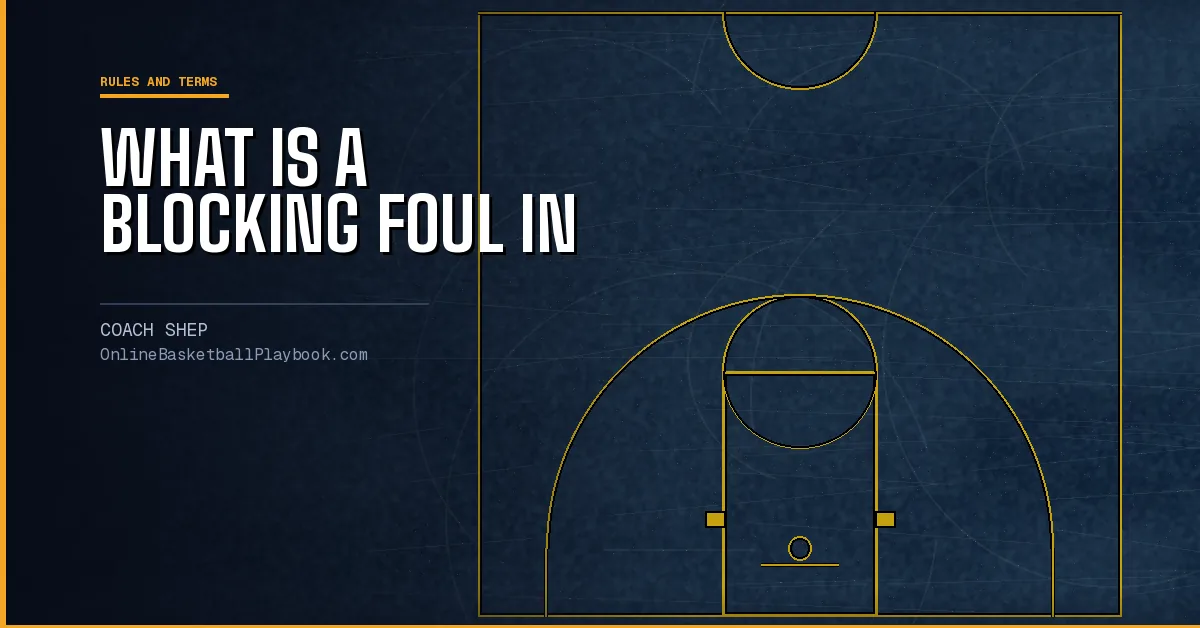
A blocking foul is personal contact called on a defender who hasn't established a legal guarding position before contact occurs. Unlike a charge, where the offensive player runs into a defender who got there first, a blocking foul happens because the defender was still moving into the ball-handler's path (sliding over late, reaching in, or failing to get in front before contact). It's the single most common way defenses draw whistles going for steals or trying to cut off dribble penetration, and understanding exactly what tips a play from "good defense" to "blocking foul" is essential for coaches teaching legal positioning.
What Legal Guarding Position Requires
A defender earns legal guarding position by meeting three conditions before contact happens. First, the defender must be facing the opponent they're guarding. A defender who is turned sideways or has their back to the ball-handler has not established position, no matter where their feet are. Second, both feet must be touching the floor. A defender who is still airborne, jumping to cut off an angle, has not established position; landing under a moving opponent almost always results in a blocking foul rather than a charge.
Third (and this is where most blocking fouls actually get whistled), the position has to be established before the opponent begins their upward shooting motion or their gather step into a drive. Once the offensive player has committed to that shot or drive, the defender can no longer step into their path and claim the spot. A defender is allowed to move laterally to hold position they already had, and is even allowed to move backward to stay in front, but is not allowed to move forward into the opponent's path after the offensive move has started.
Officials are also watching for verticality. A defender with legal position who jumps straight up, arms extended in their own vertical cylinder, is protected even if the offensive player initiates contact. But a defender who leans in, extends a hip or shoulder into the opponent's path, or drifts forward while contesting has left that vertical plane and is now the one responsible for the contact.
Blocking Foul vs. Charge: The Key Difference
Blocking and charging are the two sides of the same collision, and officials are making one binary judgment: who got to the spot first, legally. If the defender had two feet down, was facing the play, and was set before the offensive player committed to their move, the contact is a charge, a foul on the offense. If the defender was still sliding, rotating, or closing the gap when contact occurred, the contact is a blocking foul, a foul on the defense.
This is why the exact same collision can be called two different ways depending on timing. A help defender who beats the dribbler to the spot and plants before the drive begins draws a charge. That same defender arriving a half-step later, still in motion when the ball-handler makes contact, draws a blocking foul instead. The site's separate charge page covers the offensive side of this collision in detail. This page is about the defensive half and what a defender has to do, and fail to do, to be the one whistled instead.
A useful shorthand for players: charges are earned by arriving early and standing still; blocking fouls are earned by arriving late and still moving. Officials are trained to freeze the mental picture at the moment of contact and ask whether the defender's feet were already planted. If yes, charge. If the defender was still in motion, block.
The Restricted Area and Automatic Blocking Fouls
Under the basket, the legal-guarding-position rules get overridden entirely by the restricted-area arc, a semicircle painted on the floor extending out from directly under the basket. If a help defender's feet are inside that arc at the moment of contact with a player who is driving to the rim, it is automatically a blocking foul, regardless of how early the defender arrived or how set their position was.
The restricted area exists specifically to stop defenders from camping directly under the rim and drawing charges on drivers who have nowhere else to go. It does not matter if the defender got there first, was facing the play, and had both feet down for a full second before contact. Being inside the arc removes the ability to draw a charge on a drive to the basket. The one exception across rule sets is a defender who is airborne having jumped from outside the arc; landing position, not takeoff position, generally governs, so officials look at where the defender's feet actually are when contact occurs.
Key Point: The restricted area only applies to drives toward the basket. A defender can still draw a legitimate charge outside the arc, on the perimeter, or against a player who is not driving toward the rim. The automatic-block rule is specific to rim-attacking plays with the defender's feet under the circle.
Common Blocking-Foul Scenarios
The most frequent blocking foul in modern basketball is the late-rotating help defender. On a drive-and-kick or pick-and-roll, the help defender reads the drive and slides over to cut off the lane, but arrives a beat after the ball-handler has already started their gather. Contact on landing, or contact as the driver finishes through the space, is called on the defender because position wasn't set in time.
A second common scenario is the on-ball defender who reaches in rather than moving their feet. Instead of sliding to stay in front of a live dribble, the defender reaches across the ball-handler's body or extends a hand or forearm into their path. Any resulting contact that impedes the dribbler's progress is a blocking foul, separate from and often called alongside a reaching-in foul.
A third scenario shows up on closeouts and post defense: a defender who has position but starts leaning into the opponent instead of staying balanced and vertical. This is common when a post defender gets tired of being backed down and starts using a forearm or hip to hold ground rather than moving their feet to reestablish position legally. The lean itself, not just the initial positioning, is what turns it into a foul.
A fourth scenario is the defender who slides into the path of a jump shooter after the shooter has already left the floor. Once a shooter is airborne, a defender who moves underneath them to draw contact has not established position in time, and this is one of the most common calls resulting in shooting free throws.
The Penalty for a Blocking Foul
A blocking foul is a personal foul charged to the defender, and it counts toward that player's individual foul total and the team's foul count for bonus free-throw purposes. Possession stays with the offense in all cases. There is no turnover risk for the team that drew the block, unlike a charge, where the offense loses the ball.
If the contact occurred during a shot attempt, the shooter goes to the free-throw line: two shots if the attempt was missed from inside the three-point line, three shots if missed from beyond it, and one bonus shot (an "and-one") if the shot goes in despite the contact. If the blocking foul happened away from a shooting motion (for example, on a drive before the shooter left the ground), the offense is awarded the ball out of bounds, or free throws instead if the team is already in the bonus.
Blocking fouls also accumulate toward disqualification just like any other personal foul. Five fouls in most levels of play (six in the NBA) fouls a player out of the game, so a defender who repeatedly fails to establish position early can find themselves in foul trouble by the second quarter.
Coaching Tips to Avoid Blocking Fouls
The single biggest fix for blocking fouls is teaching defenders to beat the offensive player to the spot, not to the ball. Defenders who chase the ball are almost always still moving when contact happens; defenders who read the drive early and slide to a spot ahead of the ball-handler have time to plant, square up, and go vertical instead of leaning or reaching.
Drill defensive slides specifically for help-side rotations, not just on-ball closeouts. Most blocking fouls in a real game come from the second or third defender rotating over late, not from the primary defender. Practice reading the first pass or the initial drive and rotating on air time (while the ball is in flight or the dribbler is still gathering) rather than waiting to react to the finished move.
Coaching Cue: Teach players to keep their hands up and their base wide rather than reaching. A defender with active hands above the shoulders and a low, balanced stance is protected going vertical; a defender who reaches across the body with one hand is the one most likely to be the one whistled.
Finally, teach shot-contest timing directly. Contesting a shot is legal and encouraged, but a defender has to be going straight up, not sliding in from an angle, once the shooter has left the ground. Reinforce this with closeout drills that emphasize a controlled, balanced approach rather than a full-speed sprint that forces the defender to lean or reach to avoid running the shooter over.
- Legal guarding position needs two feet down, defender facing the play, and position set before the offensive move begins.
- Feet inside the restricted-area arc on a drive to the rim is an automatic blocking foul, no matter how early the defender arrived.
- The core test: defender still moving at contact = block; defender already set at contact = charge.
- Late help-side rotations and reaching in on the dribble are the two most common blocking-foul triggers.
- Contact during a shot attempt sends the shooter to the line; contact away from a shot gives the ball back out of bounds.
- Teach defenders to beat the player to the spot, keep hands up instead of reaching, and stay vertical on contests.
Get free play diagrams, drills, and coaching guides delivered to your inbox.
Draw this play free in the play drawer →
Membership: the full library, playbook packs, and Pro drawing tools →
Keep Building
Related breakdowns
Basketball Positions: What Each of the 5 Positions Does
The point guard, shooting guard, small forward, power forward and center, what each one does on offense and defense, and when to ignore the numbers.
High School vs College vs NBA Rules: What Changes for a Coach
High school vs college vs NBA rules: shot clock, three-point line, bonus, fouling out, timeouts, backcourt count and defensive three seconds, and what each changes.