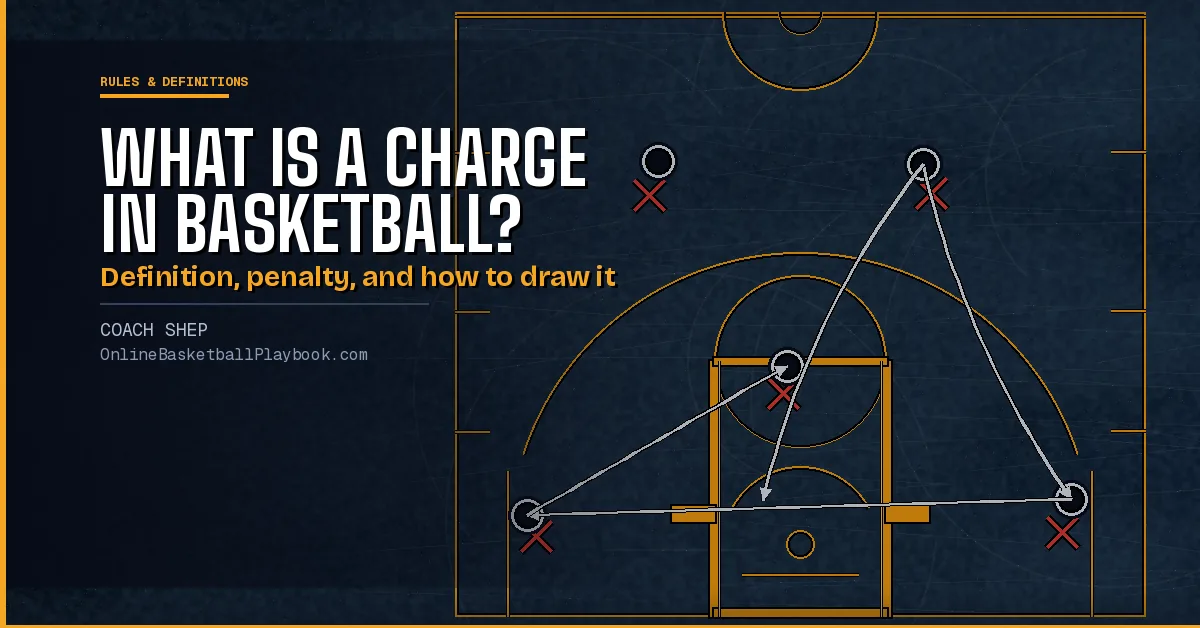
A charge is an offensive foul called when a ball handler drives into a defender who has already established legal guarding position. The ball goes to the defense, and the offensive player picks up a personal foul. It is one of the most momentum-shifting plays in basketball and one of the most misunderstood.
What a Charge Is (and What It Isn't)
A charge (also called an offensive foul or a player control foul) is the call when the ball handler runs into a defender who was already set in a legal guarding position. The signal depends on the level. The NBA chart shows a clenched fist pushed forward for charging. FIBA signal 42 is a clenched fist striking an open palm. The NCAA men's chart shows both open palms pushed forward for pushing or charging, and a hand behind the head then a point for a player-control foul. NFHS: check your state association's signal chart.
The result is a turnover: the ball is awarded to the defense. The offensive player also receives a personal foul, which counts toward team foul totals and can limit playing time.
A charge is not simply any collision between a ball handler and a defender. The critical question is which player got to the spot first. If the defender established their position before the ball handler committed to a path, it is a charge. If the defender moved into the ball handler's path after the ball handler was already going, that is a blocking foul on the defense.
The Two Requirements for a Legal Charge
For a charge to be called, two things must both be true at the moment of contact:
- The defender must have established legal guarding position. Both feet on the floor, facing the opponent, in position before the offensive player left the floor to attack or before the ball handler committed to a driving path.
- The offensive player must initiate the contact. The ball handler drives into the stationary defender. If the defender steps forward or sideways into the ball handler to create the contact, the defender committed the foul.
Timing is everything. A defender who slides into position as the offensive player is already airborne has not established position in time. That is a blocking foul because the offensive player had committed to their path before the defender arrived.
Charge vs. Blocking Foul: The Most Misunderstood Call
The charge/block call is consistently one of the most controversial in basketball because the difference is entirely about timing and timing happens in less than a second.
Charge: The defender established legal position before the ball handler committed to their path. Contact is the offensive player's fault.
Blocking foul: The defender did not establish legal position in time. They slid, stepped, or jumped into the path of a ball handler who was already committed. Contact is the defensive player's fault.
No call: If neither player was clearly at fault and the contact did not affect the play significantly, officials can let it go.
Against a player with the ball, no time and distance is required once legal guarding position is set (NCAA men Rule 4-17-4, NCAA women Rule 10-4-4, FIBA Art. 33, NBA Comments II.C). Against a player without the ball, the defender must give time and distance: never more than two strides in the NCAA books, never less than one normal step in FIBA.
At the youth and high school level, the call is often driven by which player falls down, which is not the correct standard. At the college and NBA level, officials watch feet and timing, not the drama of the fall. Teach your players the same standard.
The Restricted Area: When a Charge Cannot Be Called
Not every level has a restricted area. NFHS (high school) has no restricted-area rule, so legal guarding position can be set anywhere on the court. The NCAA men's book and the NBA use a 4-foot arc from the center of the basket. The NCAA women's book defines it as the area directly underneath the basket. FIBA has a no-charge semi-circle (Art. 33.10).
At NCAA men's and NBA games, a secondary (help) defender with his feet in the arc cannot draw a charge, and the contact is a blocking foul unless flagrant (NCAA men Rule 10-1-14, NBA Comments II.C, with an NBA exception for a player who catches in the Lower Defensive Box). The NCAA men's exceptions: the driver leads with a foot or an unnatural knee or wards off with an arm, or stops moving to the basket and then starts the contact, and a set help defender may jump straight up to block a shot. The NCAA women's book says a defender cannot obtain initial legal guarding position there to draw a foul on a player in control or one who has released a pass or try. In FIBA, contact by an airborne offensive player with a defender inside the semi-circle is not a team-control foul unless the offense uses hands, arms, legs or body illegally.
The restricted area exists to prevent defenders from camping under the basket and taking charges on players attacking the rim. It protects offensive players in the most dangerous zone on the floor.
A common situation: a defender retreats toward the basket as a ball handler drives, plants his feet inside the restricted area at an NCAA men's or NBA game. That is a blocking foul, however clean the contact looks.
How Officials Decide
Officials are trained to work through four checkpoints in sequence:
- Where are the defender's feet? At NCAA men's and NBA games, a help defender inside the restricted area is a block, with the exceptions above. NFHS has no restricted area.
- Were both feet on the floor? A defender still sliding or balanced on one foot has not established position.
- Was the defender facing the opponent? Legal guarding position requires squaring up to the ball handler. A defender turned sideways or backward does not have position.
- Did the defender arrive before the offensive player committed? If the ball handler was already airborne or had committed to their path before the defender arrived, it is a block.
All four conditions must favor the defense for a charge call. One failure means the defender did not have legal guarding position.
How to Draw a Charge: 4 Steps
Drawing a charge is a coachable skill. The full technique, falls and drills are on taking a charge. The sequence:
- Read the driving lane early. The defender needs to identify the ball handler's path before the attack begins. A late read means late feet, and late feet mean a blocking foul.
- Establish position outside the restricted area (at levels that have one). Both feet planted, facing the ball handler, body square and balanced. Get there before the ball handler leaves the floor.
- Hold still. The most common mistake at every level: the defender flinches or steps toward the ball handler when contact comes. Any movement at the moment of contact gives officials reason to call a block. Absorb the contact without initiating it.
- Go to the floor. Not dramatically, just don't fight the momentum. Let the contact carry you down naturally.
Run a "charge drill" in practice: a ball handler attacks at half-speed toward a stationary defender. The defender's only job is to get to the spot first, plant, and hold position without moving on contact. Gradually increase speed. Once players understand what "getting there first" actually feels like, they stop flinching and they stop drawing blocking fouls.
Coaching Tips for Teaching Players to Take Charges
A charge stops a scoring opportunity, gives your team possession, and puts a foul on an opposing player. Here is how to build that culture:
- Reward it immediately. Every time a player takes a legal charge in practice, stop play and acknowledge it. Hustle-stat culture starts in the gym, not the game.
- Teach the restricted area first. Before any charge drill, show every player the arc. Knowing the boundary prevents the most common mistake (players taking "charges" from inside the restricted area that become blocking fouls).
- Stillness is the skill. The best charge-takers are completely still at contact. Teach stillness, not the fall. Officials read feet. The fall only confirms what they saw.
- Arms down or crossed. Defenders instinctively reach arms out to brace. Hands out looks like the defender initiated contact. Arms down or crossed at the chest is correct.
- Identify your best charge-takers. Usually your toughest, most cerebral defenders. Feature them in drills and design your scheme to create charge opportunities for them.
Get free play diagrams, drills, and coaching guides delivered to your inbox.
Draw this play free in the play drawer →
Membership: the full library, playbook packs, and Pro drawing tools →
Keep Building
Related breakdowns
Basketball Positions: What Each of the 5 Positions Does
The point guard, shooting guard, small forward, power forward and center, what each one does on offense and defense, and when to ignore the numbers.
High School vs College vs NBA Rules: What Changes for a Coach
High school vs college vs NBA rules: shot clock, three-point line, bonus, fouling out, timeouts, backcourt count and defensive three seconds, and what each changes.