
Youth players don't need complex systems — they need reps on the right skills, in the right order. These fundamental drills build ball-handling, finishing, shooting form, and decision-making before any system is introduced.
Why Breakdown Drills Come First
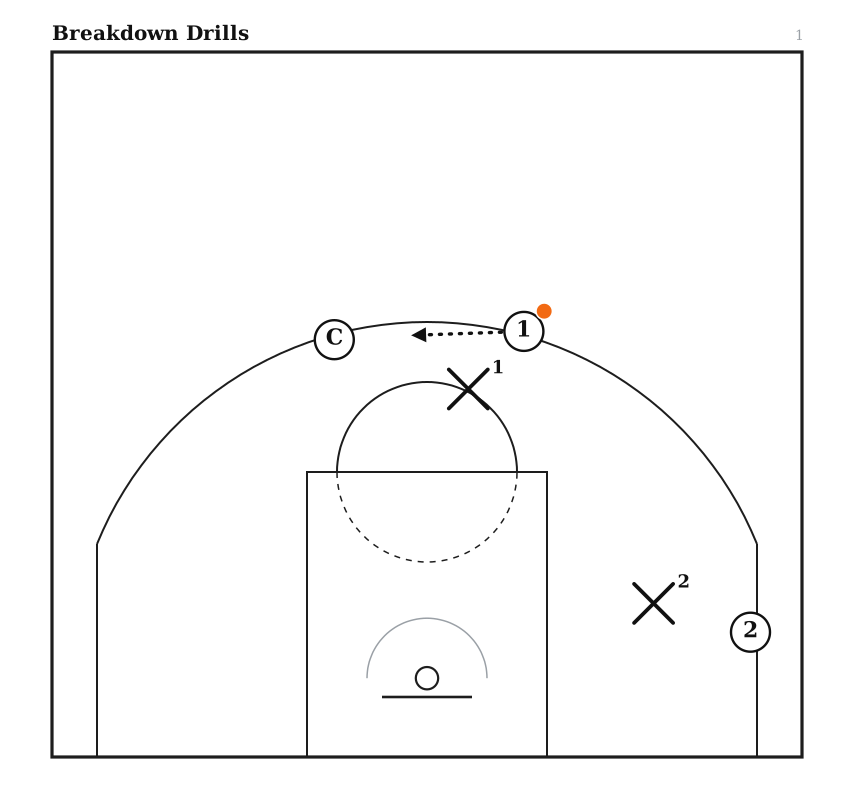
The most common mistake youth coaches make is running five-on-five too soon. Players who haven't earned the building blocks yet — catching in stance, making a one-dribble move, finishing with the correct foot — will just play chaotically, and the habits they form in that chaos are hard to undo.
The solution is the part-whole method: isolate one skill or one read in a drill, get your players competent at that piece, then connect it to the next piece. A player who has drilled the layup sequence on both sides with both hands, who can catch a pass in a shot-ready stance, and who knows how to read a closeout defender — that player is ready to play in a system. A player who hasn't done those things yet will struggle regardless of what play you run.
This is why elite college and NBA programs spend the majority of their practice time on breakdown drills, not scrimmages. Coaches like Nolan Richardson, Gregg Popovich, and Nate Oats all structure their practices around competitive, scored small-sided drills before any live full-court action. Youth coaches should do the same — just scaled to the right level of complexity for their players' ages and skill.
The principle that anchors everything: game shots, at game spots, at game speed. Even at the youngest levels, your drills should simulate the real situations your players will face in a game. That means catching on the move, not standing still. Finishing through contact, not unchallenged. Making a decision, not just going through a motion.
For young teams, turn a drill into a competition — track makes, jump-stops, and passes for points — and borrow childhood games like sharks-and-minnows, knockout, and red-light/green-light to drill dribbling, passing, and shooting under pressure. The "pizza waiter / cookie jar" cues install shooting form before the ball.
— Offensive Breakdown Drills (Coach Mac), Basketball Vault
Ball-Handling Drills for Young Players
Ball-handling is where you spend the first ten minutes of every youth practice. Young players need hundreds of weekly touches at varied angles and speeds before dribbling becomes automatic enough that they can think about anything else while doing it.
Stationary Dribbling Series
Start every player with a basic stationary series: right hand, left hand, alternating, crossover, between the legs, behind the back. Keep it short — two minutes maximum — and progress to moving faster than they're comfortable. The goal isn't clean technique at slow speed; it's automatic repetition under slight stress.
Cue your players to keep their eyes up, not on the ball. If they can't dribble without watching the ball, they're not ready to play in a game. Use a simple rule: any time you see a player looking down, the whole group does five push-ups together. A shared consequence builds awareness fast.
Dribble-Weave vs. Human Cones
One of the most underused youth drills is the dribble-weave against coaches or assistants acting as stationary human cones. The ball-handler must read the angle of the defender and choose the correct dribble move — crossover, spin, hesitation — to get by cleanly. This is not just ball-handling; it is the first introduction to reading a defender, which is the foundation of all offensive decision-making.
Run this drill for three minutes at full speed. Players should be uncomfortable. The 12-Second Drill — where a player must complete a specified sequence of moves in twelve seconds or restart — is a good competition format for older youth players who have the basic moves down.
Sharks and Minnows
Never underestimate childhood games as skill-builders. Sharks and minnows — where two or three players try to knock the ball away from dribbling minnows crossing the lane — is one of the best youth ball-protection drills ever designed. It requires keeping the ball low, protecting it with the body, changing direction under pressure, and keeping eyes up to navigate the court. That is every ball-handling skill in one game that eight-year-olds will beg to play again.
When you introduce any new dribble move to young players, use the underhand self-pass (a spin pass to yourself) to drill the catch-and-attack sequence solo. A player rolls the ball out, sprints to it, picks it up in stride, and drives to the basket. This mimics game-speed live-ball situations without needing a passer, and every player in your practice can work at the same time without waiting in line.
Finishing Footwork — The Foundation Everything Else Needs
Before you teach your players to read a defense, teach them to finish. The drive-and-kick, the pick-and-roll, the backdoor cut — all of those reads are only as good as what happens at the end of them. A missed layup erases a perfect read. A sloppy jump stop gives up the ball. Footwork comes before decisions.
The Layup Progression
Every youth practice should include a layup progression that covers both hands and both sides of the basket. Start without the ball: players simulate the footwork, the gather, the extension — all without dribbling or shooting. Add a one-step carry. Then add the full dribble-in from the wing. Then add a passer at the elbow. Then add a light defender trailing the play.
The sequence of finishes to drill: straight layup (both sides), reverse layup (both sides), crossover layup (opposite hand across the lane), and the jump-stop power finish (two-foot gather with a short-hop off the glass). If your players own all four, they are equipped to finish in any situation a game will present.
X-Layups
The X-Layups drill is a staple of elite practice for a reason: it trains full-speed finishing in a competitive format. Two lines, one at each elbow. Players alternate attacking the basket from opposite sides while the other line rebounds and outlets. The constraint: make a certain number in a row as a team before rotating. Misses reset the count. This builds finishing under fatigue — because by the fourth or fifth rep, players are tired — and it trains outlet passing and sprint-the-floor conditioning at the same time.
Crack Back Finishing
The Crack Back drill simulates a specific game action that young players almost never practice: curling back to a pass after having gone past the catch point. A player sprints to a touch-point on the wing, then cracks back toward the passer, who leads them to the inside shoulder. The player catches in stride and finishes at the rim. This single drill teaches correct spacing, reading a pass, and converting a non-stationary catch into a layup — all at once.
Shooting Drills That Build Real Habits
Youth shooting development fails for one consistent reason: players practice shooting in unrealistic conditions. Standing still, no defender, no fatigue, no decision before the shot. Then in a game, every shot comes off a catch on the move after a sprint or a dribble, with a hand in the face. The form they practiced doesn't transfer because the conditions don't match.
Form Shooting First
Start with form shooting close to the basket. The "pizza waiter" cue — hold the ball on one flat hand as if balancing a pizza tray — teaches proper ball position before release. The "cookie jar" cue — reach into the rim like a cookie jar on a high shelf — teaches the follow-through arc. These two cues work for players as young as six and still appear in coaching clinics at the college level because they're accurate and memorable.
After the form-shooting warm-up, move players back gradually — not all the way to the three-point line. Youth players who shoot from too far create bad habits: they compensate for the distance by changing their mechanics, adding a leg push, leaning, or shooting off one foot. Keep young players at a distance where they can maintain correct mechanics with good arc.
Five-Spot Shooting
Five-Spot shooting is the highest-return shooting drill in youth practice. A player works five spots around the arc (both corners, both wings, top of the key), taking a fixed number of shots from each. The constraint: they must catch in a shot-ready stance — squared before the ball arrives, not after. Any shot taken from a non-ready catch doesn't count. This single rule does more to fix youth shooting than any mechanical correction, because most young players' shot problems come from catching late and rushing the sequence, not from broken mechanics.
Olympic Shooting
Olympic shooting is a competitive format built for teams: two or more players compete to make a target number of shots first, starting from the same spot. The competition pressure simulates game conditions — the player's pulse rises, they feel urgency, they have to shoot under stress. Any drill that creates stakes and pressure transfers to games better than a drill without them. For younger players, use a lower target number and keep the distance close. For older youth groups, track team totals over the season to build long-term accountability.
Simple Decision-Making Drills for Youth Teams
The jump from skill drills to decision drills is the most important progression in youth basketball development. A player who can dribble and shoot but can't read a defender is not ready to contribute in a game. The bridge between the two is a category of drills that force a simple decision — and give the player real feedback when they make the wrong one.
Closeout 1-on-1
The Closeout drill is the simplest decision drill in the game: a passer at the top of the key throws to a wing player and then closes out. The wing player must read the closeout and decide — shoot if the defender is out of control, drive if they're late. This is the foundational read of all perimeter offense, and practicing it in isolation — before adding screens, cuts, or any other action — is how players learn to trust the read rather than defaulting to their comfort move.
Rotate positions. Every player should play both roles — the one who receives and decides, and the one who closes out and competes. Young players learn defense by playing offense and vice versa; the drill teaches both sides of the read at once.
Two-on-One Advantage Drill
The two-on-one — two offensive players attacking one defender — is the most common advantage situation in youth basketball, and most youth players handle it poorly. They either ignore the advantage and put their head down to drive, or they pick the wrong time to pass and turn it over. The fix is repetition in a structured drill: run the two-on-one from half-court, with a rule that the ball-handler must attack the defender's inside shoulder and force a committed step before making the pass. The constraint forces the right decision instead of hoping players figure it out on their own.
Three-on-Two Scramble
The Scramble (also called the 11-Man continuous three-on-two in many coaching systems) is the highest-value multi-player drill for youth teams. Three offensive players attack two defenders. After the possession ends — score or stop — one offensive player stays back as a defender, the two defenders become the outlet, and three new offensive players come from the other end. The drill is continuous, it runs the floor, and it teaches pace, decision-making, and transition spacing simultaneously. For youth teams, the key coaching point is: the ball-handler attacks the paint before passing, not the other way around.
Make Every Drill a Competition
The research on youth athlete engagement is consistent: kids stay focused and improve faster when there are stakes. Any drill without a score, a timer, or a consequence for failure is a drill that a twelve-year-old is mentally half-checked-out of after ninety seconds. The solution is simple: score every drill and post the results.
Knockout is one of the best youth shooting competitions because it requires making shots under pressure and creates natural consequence (elimination) without any complicated scoring system. Line up at the free-throw line. The first player shoots; if they make it before the player behind them catches up and makes theirs, they stay in. Miss and you chase your own rebound, trying to score before the player behind you beats you. Last player standing wins. Total practice time: four minutes. Total engagement: complete.
For non-competitive drills, create a shared team goal. "We are not moving to the next drill until we make fifteen layups in a row as a team." A team consequence turns individual effort into collective investment. Players who wouldn't push themselves to hustle for their own make will sprint after a rebound to keep their teammates from restarting. This is also how you introduce the concept of team accountability without a lecture about it.
Scoring breakdowns: assign point values that reinforce the behavior you want. If you want players to skip the mid-range pull-up in favor of a layup or a three, score the drill with +2 for a layup, +3 for a three-pointer, and zero for a mid-range shot. The scoring coaches behavior without stopping play to correct it. Young players will adjust their shot selection faster in response to a scoring rule than to any verbal correction.
How to Structure a Youth Practice with These Drills
A well-structured youth practice uses these drills in a specific order: individual skill first, then small-sided decision drills, then competitive full-team games. The individual skill work — ball-handling, finishing, shooting form — happens when players are fresh and focused. The decision drills — closeout reads, two-on-ones — come next, when they're warmed up but still able to process new information. The competitive team games come last, when energy is high and players can apply what they've drilled.
Sample 60-Minute Youth Practice Frame
Minutes 0–5: Ball-handling warm-up (stationary series + dribble-weave vs. coach).
Minutes 5–15: Layup progression — no ball footwork, then left hand, then right hand, then X-Layups competition (team target: 20 in a row).
Minutes 15–25: Shooting development — form shooting close-in, then Five-Spot shooting with catch-in-stance rule, then Olympic Shooting competition.
Minutes 25–35: Decision drills — Closeout 1-on-1 (both sides, both roles), then Two-on-One from half-court.
Minutes 35–50: Competitive games — Sharks and Minnows for ball protection (5 minutes), then Three-on-Two Scramble (10 minutes, continuous).
Minutes 50–60: Free throws and cool-down. Every player makes two free throws before leaving the court.
This frame adapts to any youth level. For younger players (grades 3–5), reduce the decision drill complexity and extend the game segments. For older youth players (grades 6–8), add the constraint layer — dribble limits, shooting windows, scoring rules — and push the pace of every drill to game speed.
The non-negotiable across all levels: every practice ends with a made shot. Hubie Brown's rule — "every drill ends with a make" — trains both the finish and the competitive mentality. A player who leaves practice having made the last shot carries a different feeling home than one who missed it. Over the course of a season, that difference accumulates.
- Layup sequence first, system second. Run the four-finish layup progression (straight, reverse, crossover, power) on both sides before any five-on-five scrimmage. If your players can't finish cleanly, your plays won't work.
- Score every drill. Assign point values that reinforce the shot diet and behavior you want — mid-range pull-up scores zero; layup scores two; kick-out three scores three. Players adjust their decision-making faster through scoring rules than through verbal correction.
- Catch-in-stance is the single highest-leverage shooting fix. Require players to be squared and ready before the ball arrives on every Five-Spot or Olympic rep. Most youth shooting problems are footwork problems, not mechanics problems.
- Use sharks and minnows, knockout, and red-light/green-light. Childhood competition formats keep young players fully engaged and drill real skills — ball protection, shooting under pressure, change of direction — without anyone checking out after ninety seconds.
- Force the read in decision drills, don't leave it optional. In the Two-on-One drill, add a rule: ball-handler must attack the defender's inside shoulder before passing. Constraints coach decisions; open-ended drills let players default to comfort moves and never build new reads.
- End every practice with a made free throw or a made shot. The last rep of practice is the one players carry home. Make it a success.
Want more basketball coaching strategies, drills, and tools?
See it drawn up
Related diagrams
Keep Building
Related breakdowns
Strength Training for Youth Basketball Players
Strength Training for Youth Basketball Players
Teaching Players to Adapt to Different Playing Styles
Teaching Players to Adapt to Different Playing Styles