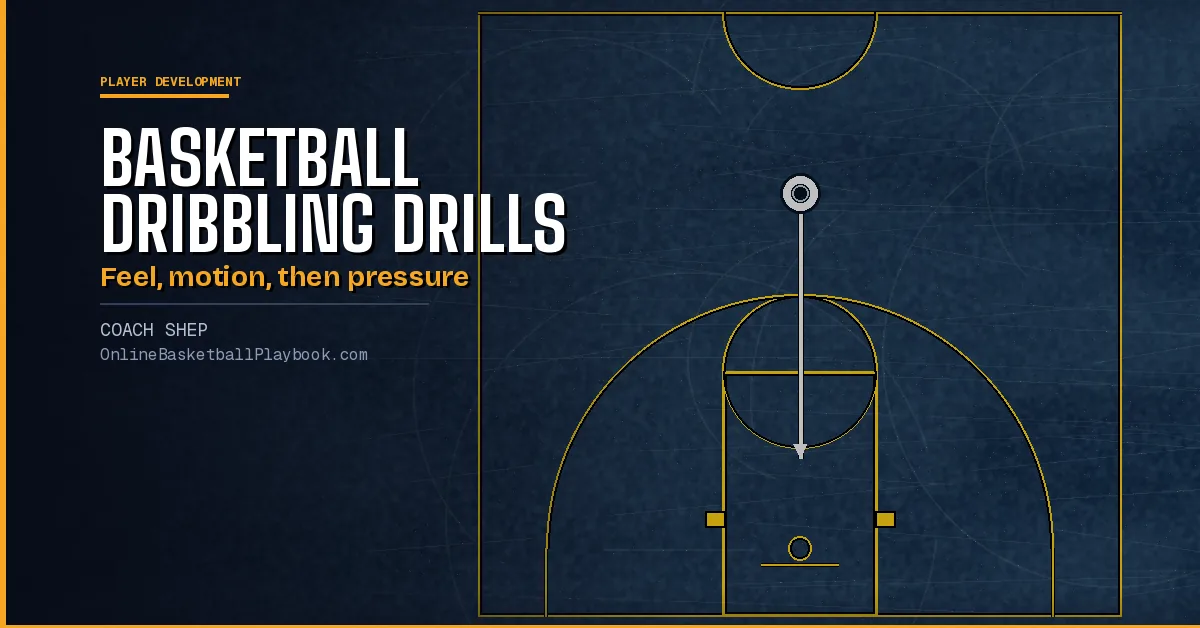
Basketball dribbling drills build a handle in layers. A player learns the feel of the ball first, then moves with it, then handles it against a defender. This guide covers dribbling drills for beginners, moving drills, two-ball work and pressure drills, plus how much time each one deserves and where coaches disagree.
Basketball Dribbling Drills at a Glance
| Stage | Goal | Drills |
|---|---|---|
| Beginner | Feel, control, eyes up | Slaps, tips, circles, pound it, kills, V-dribbles, Balloon Dribbling, Dribble Tag |
| Intermediate | Moves at speed | Sideline moves, stutter drill, tight chairs, dribble lines, moves against a token defender |
| Advanced | Handle under pressure | Two-ball series, Retreat Attack, Dribble Warfare, Piston, Pitch and Fire |
Basketball Dribbling Drills Start with Technique
- Fingertips. The pads of the hand touch the ball and the fingertips control it. The wrist and forearm do the work.
- Low and hard. Stay low with bent knees and pound the ball with the elbow extended and a wrist snap at the bottom. The ball spends less time exposed.
- Protect the ball. Keep the body between the ball and the defender. The off arm goes up as an arm bar for space and never pushes off. More is on how to protect the ball.
- Eyes up. Watching the ball is the basic dribbling error. A cue alone rarely fixes it, so give players something else to watch, such as numbers the coach holds up, a tagger or a partner.
- Both hands. A one-handed player is easy to overplay. Give the weak hand extra volume and make an opposite-hand-only round the default variation of a drill.
- Change of pace. Slow to fast and fast to slow keeps a defender from setting a rhythm.
Dribbling Drills for Beginners
Start with feel. Hold the ball with the fingertips spread and the palm off the ball. Practice slaps, finger grabs and tipping between the hands from overhead down to the ankles. Add circles around each leg, around both legs, around the waist and around the head, then join them into one flowing pass around the body. Drops, figure eights and the crab walk come next. Everything is done with the eyes forward.

Then run the one-ball series in a circle. The best dribbler leads from the middle and the group copies each move for 30 to 60 seconds.
- Pound It. Get into a triple-threat stance and dribble at waist height on each side. Then go as low as possible.
- Up and Downs. Start waist high, pound harder and higher without jumping, then work down to one knee close to the floor.
- Kills. Dribble waist high, kill the ball down as low as possible, hold it briefly and bring it back up.
- Circle Dribbles and Figure Eights. Dribble around one leg, then the other, then through both legs in a figure eight path with the eyes up.
- V-Dribbles. The front V-dribble rolls the hand over the top of the ball, which builds the feel for the in-and-out move. The side V-dribble pushes and pulls the ball with both hands.
- Crossover Dribbles. Bounce once on the right side, cross low and quick to the left and back again without stopping.
- Spider. A four-bounce rotation. Right hand in front of the leg, left hand in front, right hand behind, left hand behind. Learn it by touching the ball on the floor first.
- Windmill and Butterfly. Two figure-eight patterns around the thighs and through the legs, each the reverse of the other. Go fast only after the pattern is clean.
Use eyes-up games alongside them. In Balloon Dribbling players keep a balloon in the air while they dribble. In the Parrot Drill partners stand two meters apart and one leads while the other copies. Chaos Call Out puts one or two defenders in a small area while the dribblers call out the numbers the coach shows. Dribble Tag and Dribble Knockout work the same skill. A tennis ball tossed and caught by the free hand exposes a player who looks down. Younger players belong in games first, and kids' games and cone drills sorted by age are on youth basketball dribbling drills. See Best Basketball Drills for Kids and How to Dribble a Basketball. The hesitation move is taught on basketball hesitation dribble.
Moving Drills and the Base Moves

Sideline Moves. Pairs spread along the sideline. The first player dribbles across right-handed and back left-handed. The coach calls the move at the halfway point, and each move goes down and back twice. The list runs control to speed, speed to control, crossover, in-and-out, hesitation, pull-back and crossover, step-out and crossover, through the legs, behind the back and spin. Let players try the hard ones even when the ball rolls away.
Stutter Drill. Players dribble across right-handed. At the one-third mark a whistle sends them into a stutter dribble in place, bent at the waist with the knees bent, for a count of five. Repeat at two-thirds, then finish the crossing, pivot and repeat left-handed.

Tight Chairs. Place six chairs or cones in two rows. The dribbler makes the same move at each of the six chairs, first left-handed, then turns the chairs around and repeats right-handed. The order is crossover, in-and-out, hesitation, behind the back and between the legs. Run it up-tempo, attack the chair and keep the eyes forward. Posts run it too.
- Dribble Lines. Players go baseline to baseline and the coach calls a new move on each trip.
- Speed Change. A full-court loop with color-coded cones. Slow at yellow and explode at green.
- Dribble Course. A cone or chair slalom that mixes speed dribbles, reverse spins and retreat dribbles and finishes with a shot.
- Moves Against a Token Defender. An assistant stands at the arc and does not steal. Each player runs at him, makes the called move and finishes with a layup, or a jump stop and short jumper after a crossover into the lane.
The base moves. The crossover, in-and-out, hesitation, behind the back, between the legs and spin cover what most players need. For a crossover, fake with two or three hard dribbles, hesitate as the ball returns to the hand, cross low and wide, then decide. The in-and-out is the counter once defenders jump the cross. The rocker step rocks the head and shoulders back as if the dribble is stopping, then steps forward when the defender relaxes. Vary the setup or the cross gets scouted. After the cross, check that the hips end ahead of the defender's hips. See Crossover Basketball Move, Basketball Dribbling Moves and Euro Step.
Two-Ball and Pressure Drills
Two-ball work is deliberate over-training. A game uses one ball, so handling two makes one feel easy and doubles the reps. Run each pattern for 30 to 60 seconds. Good patterns are up and downs, two-ball kills, alternating piston (one ball up while the other is down), one high and one low, the side V-dribble push and pull, and the front V-dribble that looks like windshield wipers. A useful ladder runs same, alternating, front to back, chase and two-and-through.

Retreat Attack. The dribbler attacks a cone, protects with an arm bar, retreats two dribbles, crosses, goes behind the back or through the legs, then drives to the rim. It copies an escape from a trap.
- Dribble Warfare. Players attack full court against three defenders. The first two only slide side to side. The third is a live one-on-one to a finish.
- 1-on-2 Full Court. One dribbler faces two defenders on one side of the floor and must reach the three-point line and attack the rim.
- One-on-one move games. The offense works moves while the defender learns on-ball defense. A limit of two or three dribbles keeps the moves honest.

Piston. One partner speed dribbles the length of the floor for a layup. The other, who threw the inbounds pass, sprints to catch up and get in front. Swap roles each trip. In Pitch and Fire the dribbler speed dribbles to the free-throw line, jump stops and bounce passes to a partner cutting up the sideline, then finishes at the basket off the return. The rebounder inbounds quickly. Both drills run in reverse so the left hand gets the speed dribble and the finish.
Get the next coaching guide in your inbox
One email when a new guide or diagram set goes up. Free.
How Much and How Often
Ball handling opens practice. Most plans give it 5 to 15 minutes. One plan runs 5 to 10 minutes of stationary work and 5 to 10 minutes of moving work, with each drill about one minute. A leader in front lets a varsity player run the block so the coach can watch. If a drill is not working after about 10 minutes, move on and bring it back at the next practice.
Dribble less on purpose. A player who dribbles more in practice needs fewer dribbles in the game, and one dribble that beats the defender beats four. Assign a handful of drills as homework and add a count or a timer, because the drills themselves carry no targets.
Where Coaches Split
- Stationary first or games first. Some coaches open with stationary and timed work. Others argue skills belong inside a game after a very short introduction. The right mix for your team is your call.
- How many moves. Some say six basics are enough. Others drill ten moves for every player. One line drill calls a dozen.
- Pound dribble height. One list pounds at ankle, waist and shoulder height. Another starts waist high, goes as high as possible without jumping, then works down to one knee.
- Two balls for young players. Start two-ball work in first grade. Programs for ages 5 to 8 lean on games and a four-dribble cap.
Coach Cheatsheet
- Open practice with 5 to 15 minutes of ball handling.
- Give every drill a second task so the eyes stay up.
- Do every drill with the weak hand too.
- Move from feel to motion to a defender.
- Pair each move with a counter.
- Check the hips ahead of the defender after the cross.
- Cap a drill at about 10 minutes.
Questions Coaches Ask About Dribbling Drills
What are the best dribbling drills for beginners?
Slaps, tips, circles, pound it, kills, the V-dribbles and eyes-up games such as Balloon Dribbling and Dribble Tag. Run them in a circle for 30 to 60 seconds each.
How long should a dribbling workout be?
Five to ten minutes of stationary work and five to ten minutes of moving work is a common plan. Move on from a drill that is not working after about 10 minutes.
How do you teach a player to dribble with his head up?
Give him a second task. Numbers held up by the coach, a tagger, a balloon or a partner to copy all work.
Why use two balls?
Two balls over-train the handle. One ball then feels easy and the player gets twice the reps.
How many dribble moves should a player learn?
Coaches split. Six basics cover most needs. Add a counter to each move before adding new ones.
All skill pages sit under the Player Development hub and Basketball Dribble Moves. Related pages are Ball Handling Drills, Ball Handling and Dribbling Workout, Basketball Shooting Drills, Basketball Passing Drills and Triple Threat Position.
Want the printable playbook packs?
OBP Pro members get the premium playbook packs: the zone attack, out of bounds and practice plan PDFs, plus each new pack as it is finished. The membership page lists what is in each one. Or draw your own version free in PlayDraw.
See what OBP Pro includesMore Skill Development Guides
Back to Basketball Dribble Moves and every Player Development page.
Keep Building
Related breakdowns
Youth Basketball Dribbling Drills: Cone Drills and Games by Age
Youth basketball dribbling drills for kids: finger-pad work, eyes-up games, cone dribbling drills, line drills and harder drills by age.
Basketball Drills for 12 Year Olds: Dribbling, Passing and Games
Basketball dribbling drills for 12 year olds, passing and cutting drills, decision games and a 90-minute practice, all written for players this age.
Basketball Dribbling Drills for Beginners and Other Basics
Basketball dribbling drills for beginners first, then the shooting, passing, footwork and finishing drills new players need, with how each runs.