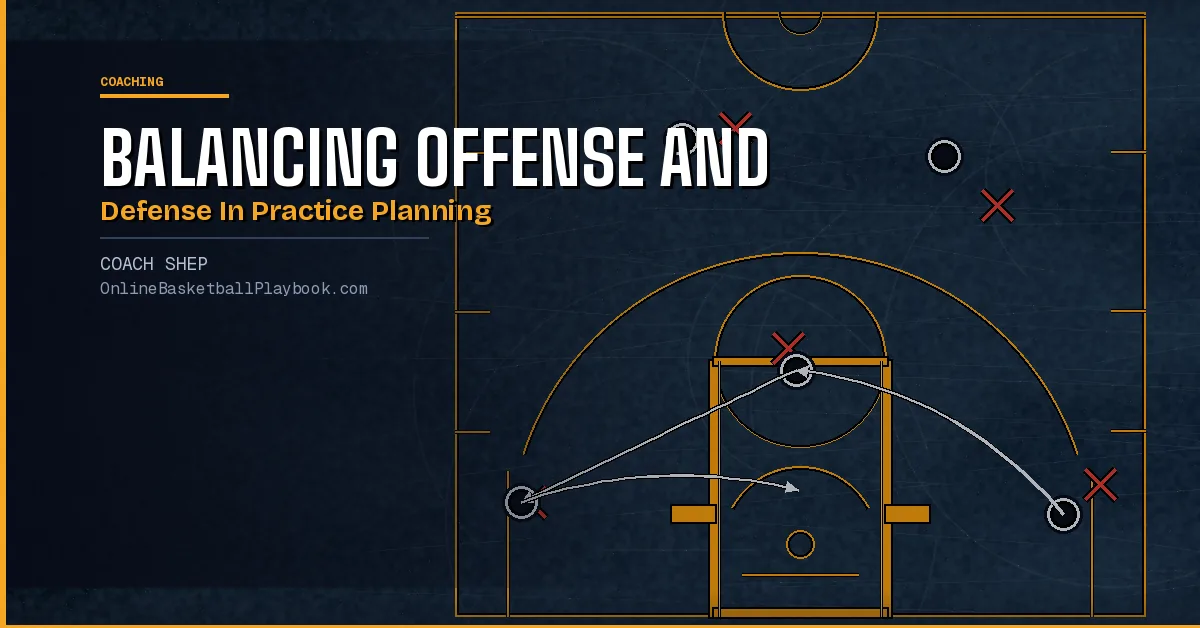
Most coaches know what they want their team to do offensively. Far fewer have a system for making sure defense gets equal time, equal intensity, and equal teaching, every single practice.
Why Balance Is Harder Than It Looks
Every coach says they value defense. The practice plan often tells a different story. You run your favorite offensive sets, work your transition game, and spend twenty minutes on shooting. Then with fifteen minutes left you squeeze in some shell drill and call it defense.
That pattern happens for a straightforward reason: offense is concrete and sequential. You can teach a play in steps: here is the cut, here is the read, here is the finish. Defense is reactive. It asks players to respond to something they did not script, and teaching that responsiveness takes repetition that feels less satisfying in the short run. There is no diagram for "get a deflection."
The consequence is programs that run terrific offensive systems but fall apart when a good opponent hunts a mismatch, presses at the end of the half, or attacks a ball screen consistently. The players have drilled offense to automaticity and defense to awareness. Awareness is not enough.
Balancing a practice does not mean splitting time exactly fifty-fifty every day. It means knowing what you are developing over a week, a month, a phase of the season and building a practice architecture that delivers that development on both ends without either one cannibalizing the other.
The Practice Block Framework
The most useful structural move is to stop thinking of practice as one long session and start thinking of it as a series of blocks, each with a declared purpose. A typical ninety-minute practice might run: individual skill (fifteen minutes), team defense (twenty minutes), offense versus defense (twenty-five minutes), transition game (fifteen minutes), free throws and closing work (fifteen minutes).
The key word is "declared." Each block has a defensive or offensive primary aim, stated out loud to players at the top of the segment. "This next twenty minutes, we are teaching pick-and-roll coverage: the ball, the roller, and protection. Offense, your job is to stress the coverage. Defense, your job is to execute the system." When players know what is being evaluated, they compete on the right thing.
The biggest structural mistake is using competitive segments exclusively to run offense and then calling it "live work." Live work develops whatever players are competing to win. If your live five-on-five has no defensive accountability (no team scoring, no tracking stops), players will compete offensively and drift on the other end. Add defensive team scoring (a stop earns a point; a basket surrendered costs one) and suddenly the drill develops both ends simultaneously.
The secondary mistake is stacking defensive blocks at the end of practice when players are tired and the clock is short. Put your highest-teaching defensive work in the first third, when players are fresh and the coaching is richest. Save the competitive live work for the middle, when legs are warm and the lesson has been set. Use the end of practice for conditioning-adjacent work (transition, shooting off movement, free throws under fatigue) that naturally involves defensive effort without requiring heavy cognitive load.
Defending the Pick-and-Roll: Your Defense's Most Contested Ground
If there is one area of the game where defensive practice time pays off disproportionately, it is pick-and-roll coverage. Ball screens involving passes account for roughly thirty to forty percent of all half-court possessions in the modern game. Add transition ball screens and drag screens and you are looking at the majority of defensive decisions your players will make in any given game.
That statistic alone should shape how you allocate practice time. A team that has rehearsed three or four coverage answers to the ball screen and knows when to deploy each one is genuinely harder to score against than a team that runs more complex offensive sets but has never answered the question of what happens when an elite handler gets a downhill look off a slow hedge.
The coverage menu does not need to be large. It needs to be clear. Teach your players the base decisions first: if the handler catches high or has initial separation, the big drops (heels near the arc, tracking the roller's passing lane). If both defenders are attached at the arc as the screen arrives, the big shows (arriving with the screen, staying synchronized, never getting hit). Those two reads alone handle the majority of ball screens your team will face at the high school and college levels.
Add a blitz answer for late-game situations and an elite handler, and a switch option if your personnel allows it. That is a full coverage menu. Four options, each with a clear trigger, each practiced until the decision is automatic. The word is the behavior (drop, dance, early, switch) and players should be able to call and execute those words in the first possession of a game without thinking.
Protection is the piece most coaches skip. Coverage is two players on the ball. Protection is the three off it. Name the low man's job (the roll, the pop, now the flare if your opponent's screener is sophisticated) and name the X-out man who takes the first pass out of coverage. If you do not name those roles, players freelance. Freelancing loses games.
Teaching Off-Ball Defense Without Losing Your Offensive Reps
Off-ball defense is where most teams give up the easy points they cannot explain after the game. A rotation that arrives a half-step late. A closeout that turns into a reach foul. A help defender who over-helps and leaks a corner three. These are not talent problems. They are repetition problems. The team has never walked through what the rule is in that situation.
The efficient way to build off-ball defensive habits without cutting offensive reps is to use your offensive drills as the delivery mechanism. When you are running your motion offense three-on-three, add a constraint: the defense must X-out on the flight of every skip pass. Offense runs normally. Defense adds one accountability layer. You have just doubled the teaching density of that segment without adding a minute of practice time.
Similarly, your half-court offensive sets can be run with live defense rather than token resistance. The offense is learning reads and spacing. The defense is learning to protect the nail, cover the roll, rotate on a kick-out. Both groups get quality reps. The only cost is that the defense must be coached during the segment and the defensive mistakes need to be named and corrected in real time, not saved for film.
Closeout technique belongs in the individual block, not the team block. Fifteen minutes of pre-practice footwork (push to the weak hand, short closeout versus long, the bluff close that fakes the shooter into a drive) transfers directly to every live rep that follows. Players who can close out without fouling do not get their team in foul trouble. That is a practice investment with a direct box-score return.
How to Use Competitive Segments to Train Both Ends at Once
The highest-leverage segment in any practice is the competitive live-play block. It is also the easiest block to misuse. Most coaches let the offense set the terms: a shot attempt ends the possession, offense scores or defense scores, move on. That structure trains offense almost exclusively. The defense is just a resistance level.
Reframe the segment with a dual objective. Both units have something to win. The offense is trying to score on a disciplined, coordinated defense. The defense is trying to execute a stop, not just contest a shot, but run the full possession from pick-up to defensive rebound or live-ball turnover. A stop earns defensive team points. A basket surrendered costs one. After five stops, the defense becomes the offense.
This structure forces players to care about defensive communication, transition responsibility, and shell rotation in the same way they care about making the right read on a drive-and-kick. It is not a drill that develops one skill. It is a competitive environment that develops competitive defense, which is the only version that shows up in games.
Add constraints to target specific defensive concepts. Force the ball handler to use a ball screen on every possession and you have made your coverage practice live and contested. Put a designated shooter in the corner and tell the defense the corner-three is the worst outcome. Now the protection and rotation are incentivized. The offense knows the rules too and will hunt the weakness. That adversarial tension is what makes a practice competitive in the way games are competitive.
The segment should end with a brief debrief, sixty seconds, not five minutes. Name one defensive execution that worked and one that broke down. Assign the breakdown a name. "We leaked the corner three twice because the X-out man was late. That is the focus for tomorrow." Players leave knowing what they are practicing next time, which means they arrive more attentive when the situation comes up again.
When you blitz an elite ball handler in practice, train the recovery just as hard as the initial trap. A sophisticated offense has five named counters to the blitz, and your defenders need to practice rotating out of it as deliberately as they practice rotating into it. The coverage earns the stop; the recovery keeps it.
Weekly Planning: Mapping Emphasis Without Drift
A single practice can be balanced. A week of practices can drift without a map. Monday's defensive emphasis gets replaced by Tuesday's offensive install, and by Thursday you have run four days of offense and one day of a shell drill. That is not a balanced week. That is a good week with one afternoon of defense.
Plan the week with a declared primary end for each day. Monday: defensive system emphasis (pick-and-roll coverage and off-ball rotations). Tuesday: offensive installation (new set or personnel adjustment). Wednesday: dual-emphasis live work (no primary end, both units compete). Thursday: individual skill and special situations. Friday: pre-game simulation at game speed, both ends.
That template gives you two days weighted toward offense (Tuesday, Thursday), one weighted toward defense (Monday), and two genuinely competitive days that develop both ends simultaneously. It does not shortchange offense. It gives defense its own protected block rather than whatever time remains after the offensive priorities are met.
Track the balance explicitly. At the end of each week, note how many minutes were spent in deliberate defensive teaching versus deliberate offensive teaching. If the ratio is worse than 40/60 defense-to-offense over two consecutive weeks, the next week's plan gets adjusted. This is not about equal time. It is about intentionality, making sure defensive development is scheduled rather than squeezed.
The teams that defend best in March are the ones that drilled defense in October with the same specificity they drilled offense. They named the coverage, named the protection role, named the recovery rule, and then ran live reps against an offense trying to beat them. Their defense is not a posture or a principle. It is a system, and a system only exists if it has been practiced.
- Name every block: declare the primary defensive or offensive aim at the start of each practice segment so players know what they are being evaluated on and compete on the right thing.
- Put your heaviest defensive teaching first: Schedule pick-and-roll coverage work and off-ball rotation reps in the first third of practice when players are fresh and coaching is richest, not at the end when time is short.
- Score defensive stops in live segments: A stop earns team points, a basket surrendered costs one. This single rule makes competitive play develop both ends simultaneously instead of only the offense.
- Name the protection roles explicitly: the low man owns the roll, pop, and flare; the X-out man takes the first pass out; unnamed roles produce freelancing that breaks coverages in games.
- Track weekly balance: log defensive teaching minutes versus offensive teaching minutes each week; if the ratio falls below 40/60 two weeks running, adjust the next week's plan before the drift becomes a habit.
Want more basketball coaching strategies and drills?
Join the Online Basketball Playbook newsletter →
Draw this play free in the play drawer →
Membership: the full library, playbook packs, and Pro drawing tools →
Keep Building
Related breakdowns
Fun Basketball Games for Practice: Scored Games for Any Team
Fun basketball games for practice at any level: shooting games, defense-only scoring, rebounding contests and passing games, with scoring rules and records.
Basketball Conditioning Drills for Teams: Runs, Games and Tests
Basketball conditioning drills in three styles, timed runs, conditioning inside skill drills and scored games, with the tests and yearly plans coaches use.
Basketball Agility Drills: Cone, Reaction and Ladder Drills
Basketball agility drills from timed cone tests to reaction, mirror and ladder drills and defensive circuits, with schedules and where coaches differ.