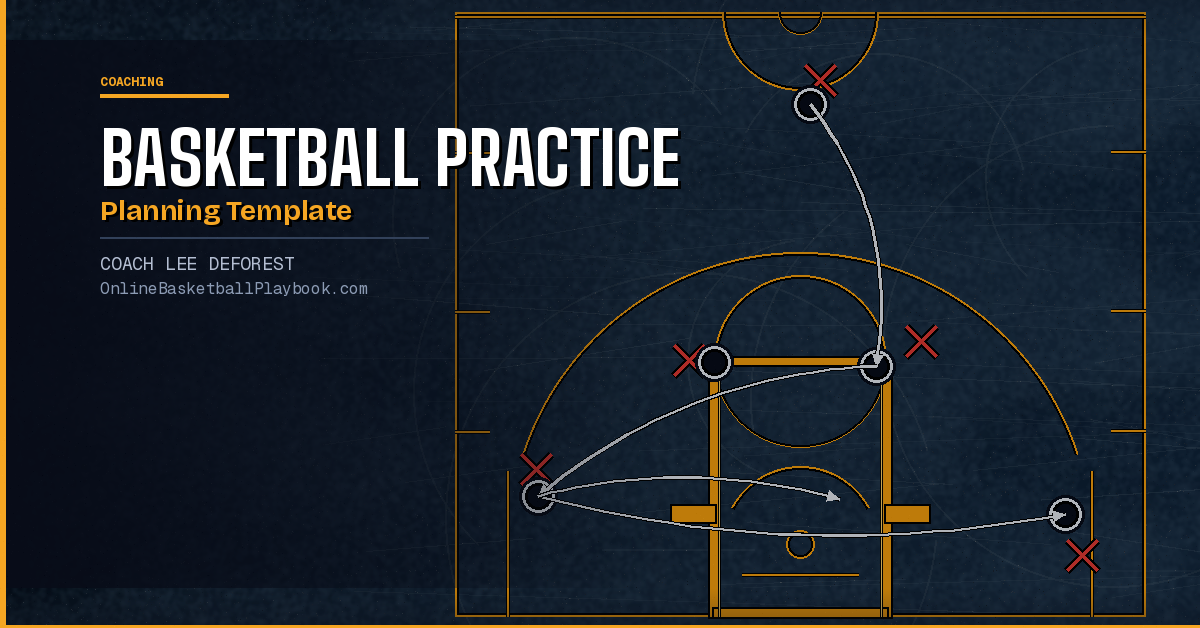

A great basketball practice doesn't happen by accident. Coaches who plan on purpose — with a clear structure, timed segments, and defined teaching points — develop players faster and waste far fewer reps.
Why Practice Structure Matters
Most coaches know what they want to teach. The harder problem is sequencing it — putting the right thing in the right order at the right intensity so players can actually absorb it.
Unplanned practice looks busy but produces slow development. Players run drills without understanding why. Coaches call out corrections without a system to anchor them. At the end of two hours, everyone is tired, but nothing transferred.
Structured practice flips that equation. Every drill has a purpose tied to a game situation. Transitions between segments are fast. Players know what's expected before the whistle blows. The coach's corrections land because the framework is already in place.
The research backs this up. Players in structured practice environments reach skill benchmarks faster than those in loosely organized sessions — not because they work harder, but because every rep has context. That context is what coaches provide through a written plan.
Writing the plan also forces clarity. When you put times on paper, you find out quickly that your "quick" defensive drill was going to eat 25 minutes. You discover you planned six things for a 90-minute practice. The plan reveals the mismatch before it happens on the court.
The Core Practice Template
Here is a repeatable template for a 90-minute practice. Adjust the times by level and in-season vs. pre-season demands, but keep the sequence intact.
Warm-Up (10 minutes)
Dynamic movement, not static stretching. Defensive slides, skip passes, form shooting from close range. The goal is to raise heart rate and get eyes on the ball before any teaching starts. Coaches should be watching movement mechanics during this window — it's free film.
Skill Development — Individual (15 minutes)
Drill one or two skills in isolation. Ballhandling, finishing, shooting off the catch. Keep the groups small so players get real reps. This is not the time for live defense — that comes later. Focus is on mechanics and repetition.
Team Skill — 2-on-2 / 3-on-3 (20 minutes)
Scale up the individual skills into small-group situations. Pick-and-roll reads, cutting actions, closeout defense. Three-on-three is the most efficient teaching format in basketball — every player is involved on both ends, and the situations mirror real game reads without the noise of five-on-five.
Team Offense or Defense — 5-on-5 Teaching (20 minutes)
Install or reinforce your system. Run sets, scout-team preparation, or half-court defensive schemes. This is the high-attention window of practice — players are warmed up but not yet fatigued. Put your most complex teaching here.
Competitive Segment (15 minutes)
Controlled scrimmage, shell drill under pressure, or a competitive drill with consequences. The goal is game-speed decision-making. Coaches observe more than they teach here. You learn what actually transferred from the teaching window.
Conditioning and Close (10 minutes)
Finish with conditioning tied to game situations — shell rotations at speed, transition sprints, or live-ball closeouts. End every practice with the same brief team meeting: one thing done well, one thing to improve, and the focus for next session.
Building Your Teaching Progression
The template tells you when to teach. The progression tells you what to teach and in what order over the course of a season.
Most coaches build their season backward. Start with what you need your team to do in the last two minutes of a close game. Then ask: what skills and concepts does that require? Now build your practice calendar so those skills are installed and drilled before the moment demands them.
A teaching progression for a pick-and-roll-based offense might look like this:
Week 1–2: Individual ballhandling, two-ball dribbling, finishing at the rim. No defense. Players build the handles they'll need before you add a screener.
Week 3–4: Two-man game. Ball-handler reads the coverage — drop, show, blitz. Roller reads the help defender — roll vs. pop vs. flare. Teach one coverage at a time so players understand the logic, not just the footwork.
Week 5–6: Five-man integration. Add the corner players and practice the protection layer — what the off-ball defenders do when the two-man game unfolds. This is where most offenses break down: the two-man game is there, but the spacing collapses because the other three haven't been taught their reads.
The same backward progression applies to defense. Install your coverage menu in phases. Each phase should be teachable in one or two practices, then repeatable at speed before the next phase is added.
Write your progression on a single page before the season starts. Pin it somewhere visible. When practice plans drift from it, that drift is a decision you are making consciously — not something that just happened because a drill ran long.
Defense: The Segment Coaches Skip
Defensive practice is where structure matters most and where it is most often abandoned.
The typical failure pattern: a coach spends 40 minutes on offense, runs out of time, and squeezes in 15 minutes of live defensive scrimmage. Players never get the framework. They rely on instinct. And instinct at the high school level mostly means over-helping, losing their man, and not knowing where to be when the ball moves.
The fix is simple: put defensive segments on the plan before offensive ones. Not because defense is more important, but because it requires more repetition to install and is more likely to get cut when time runs short.
A structured defensive teaching block has three parts. First, the concept — explain the coverage in plain language, walk through it without defense. Second, the drill — two-on-two or three-on-three with live reads. Third, team execution — five-on-five at game speed with corrections.
Each coverage in your menu gets drilled this way before you stack another one on top. Defense is a decision-making problem, and players can only make good decisions when they know which choice belongs to which situation.
Coverage is a decision, not a default — ball caught high or with initial separation means drop; both men attached at the arc means show and arrive with the screen, stay in sync, never get hit, bully through.
— PnR Defense Coverages, Basketball Vault
That one principle — drop vs. show based on the catch position — is the kind of teaching that transforms a defense. Players who understand the decision logic can adjust during the game. Players who only learned footwork cannot.
Managing Time and Energy
Practice time is fixed. Player attention is not. The best plan accounts for both.
Energy peaks in the first 45 minutes of practice. This is when players are alert, muscles are warm, and the brain is receptive. Put your hardest teaching here. Complex scheme installation, new reads, defensive concepts that require multiple decisions — all of it belongs in the first half of practice.
The second half of practice is for competition and conditioning. Players are tired. They are relying on habit, not thought. That is exactly the right environment to find out whether your teaching actually stuck. Runs that break down, coverages that collapse, reads that disappear under fatigue — those are your coaching targets for the next session.
Timing Rules That Work
Give every drill a hard stop time. Write it on your plan. When the time ends, blow the whistle regardless of where the rep is. This creates urgency, eliminates the dead time that accumulates when coaches talk too long between reps, and signals that practice is a focused environment.
Transitions between segments should take under 60 seconds. If players are wandering for two minutes between drills, you've lost 10 minutes in a 90-minute practice. Pre-assign groups, pre-set your cones, and have the next drill instruction ready before the current one ends.
Water breaks are a coaching tool. Take them intentionally, not reactively. A short break after the individual skill segment and again after the team teaching window gives you a natural reset and a moment to address the full group before energy levels drop further.
The Over-Planned Practice
One of the most common planning mistakes is building a practice that would require two hours to execute but scheduling it for 90 minutes. Coaches discover this on the court and begin cutting — usually from the end, which means conditioning and team review disappear.
The rule: when you finish writing your plan, cut one segment. You will almost always find a way to use the time. If you genuinely cannot cut anything, that is a sign you are trying to teach too much in a single session. Pick the one or two most important teaching points and build the whole practice around those.
Evaluating and Adjusting Your Plan
The practice plan is a tool, not a contract. What you learn during practice changes what you need to do next session.
End every practice with a coaching debrief — even a five-minute one. Ask three questions: What did players execute well enough to move forward? What broke down and needs to be drilled again before it's added to game situations? What did I teach that players clearly did not understand, meaning my explanation needs to change?
Write the answers on your practice plan before you put it away. This becomes your coaching log. Over the course of a season, you will see patterns — skills that consistently break down, teaching sequences that land versus ones that don't, physical windows where your team is sharp versus depleted.
Building a Practice Library
Every drill you run should live in a written library with a name, a setup, a coaching cue, and a time estimate. When a drill appears on your plan by name, every assistant and every player knows what it means without a lengthy explanation.
A drill library also makes practice planning faster. Instead of building from scratch every week, you are selecting from a proven set and sequencing them according to your teaching progression. Ten minutes of planning yields a sharper practice than 45 minutes of starting fresh.
Most coaches develop their best 20 to 30 drills over years of trial and error. The library formalizes what you already know and makes it accessible to assistants who may one day run a segment without you.
Scout-Specific Adjustments
In-season, your practice plan needs to account for opponent preparation. Reserve one segment — usually the team teaching window — for scout-team work or specific scheme adjustments. The rest of the plan stays consistent with your progression. Consistency in the structure protects player development even during a heavy scouting week.
The common trap is turning every in-season practice into a film-and-scout session. Players stop developing individual skills because every minute goes to opponent preparation. The best programs keep both tracks running simultaneously: the season-long development plan continues, and scout work gets its own dedicated window inside the structure.
- Write times on your plan, not just segments — assign a start and end time to every block so the plan is a real schedule, not a wish list that expands to fill the gym.
- Put defense before offense on the clock — defensive teaching gets cut when time runs short; protecting it on the front end of practice guarantees it actually happens.
- Name every drill in your library — a shared vocabulary eliminates the transition dead time that costs 10–15 minutes of every unplanned practice session.
- Cut one segment before you walk into the gym — over-planned practices drift; a plan that fits the clock with room to breathe produces cleaner reps and fewer rushed transitions.
- Write your post-practice debrief on the plan before you leave — what transferred, what broke down, what your explanation missed — those three answers are your starting point for the next session's plan.
Want more basketball coaching strategies and drills?
Keep Building
Related breakdowns
Balancing Offense and Defense in Practice Planning
Balancing Offense and Defense in Practice Planning
Where to Practice Basketball: Complete Guide to Finding Courts and Training Spaces
Where to Practice Basketball: Complete Guide to Finding Courts and Training Spaces