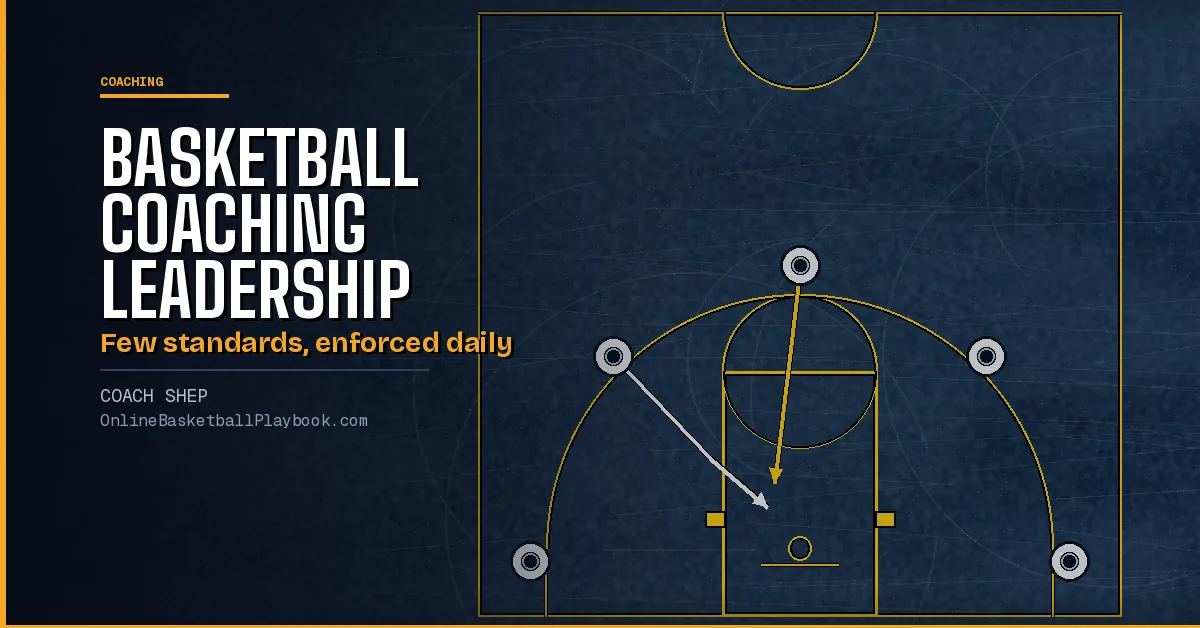
Basketball coaching leadership is the off-court half of winning. It covers how a program says who it is, which standards it enforces, how it uses practice, how it treats roles and who helps carry the culture besides the coach. This page lays out five of them and the points where good coaches disagree. For the player side of the same subject, see Building Team Chemistry in Basketball.
Basketball Coaching Leadership at a Glance
| Strategy | What it looks like |
|---|---|
| Identity | A few words, said in public, that every later rule ties back to |
| Standards | A short list, written before the first problem and enforced the same every day |
| Practice | Scored drills, assigned communication jobs and a few shared words and rituals |
| Roles | Declared before players play and written down so the player is accountable to it |
| Player leaders | Behaviors written down, jobs rotated and accountability earned by example |
1. Say Who You Are Before You Teach Anything
A known, public philosophy does the recruiting. The way a program plays and the values it stands for attract the right additions. The shared move across programs is to state the identity in a few words, in public, and tie every rule back to it.
A program can keep five principles that never change with the roster or the record.
- A wholesome environment. It supports whole-person development.
- Be the coach you would want for your own child.
- Never put winning ahead of the individual.
- Teach life decisions. Use basketball as a classroom.
- Make the experience as rewarding as possible.
The daily team objectives are to play hard, play smart, play together and have fun, and pregame talks did not use the word win.
Identity also guides who you pick. Look for self-discipline, competitive fire and self-belief, and let coachability rank above talent. A careful approach gathers four kinds of information before committing to a player.
- Film. Watch several seasons.
- Past coaches. Include ones with a different philosophy.
- The player's network.
- A direct conversation. Talk with the player.
How a team is assembled matters more than how it is coached, and a coach with a clear identity has a filter to assemble with.
Say it out loud before the first practice.
2. Keep Standards Few and the Same Every Day
Standards work when they are short, written down and enforced identically. People remember rules in groups of two, three or four, so a long list does not survive a season. Successful programs offer two examples.
- Attitude and effort. Hold them the same every day.
- Four rules for players. Be on time, play hard, know your job and know when to pass or shoot.
Set the expectations up front, on punctuality, respect and effort, before anyone is held to them.
- Explain the why first. Tell players what the standard is and why it exists before you hold anyone to it. Let players help write the rules and post them where everyone sees them.
- Apply it evenly. Hold the best player and the last player to the same standard. Inconsistency erodes trust faster than any missed correction. A star who misses practice without notice should lose minutes like anyone else.
- Correct quickly and privately. Address discipline at once and out of sight, and give recognition in the moment.
- Give one chance, then act. Ask a player who is dogging it what is wrong, give him one chance and then sit him.
- Attach the standard to the reason. Punctuality matters because lateness says your time matters more than other people's time.
For more on discipline, see Coaching Strategies for Improving Team Discipline.
Few standards, enforced the same every day.

3. Build the Culture in Practice
Culture is made in the daily structure of practice and not in a preseason speech. Five devices build it.
- Adversity on the schedule. A fixed block of 15 to 20 minutes of no-dribble work each day puts adversity in every practice. It teaches cutting and communication, and it helps you identify personalities.
- Scored competition with a real loser. Split the team into two groups that start even and score every live drill with a point key, so a charge earns points and a turnover or silence costs them. The losing group runs. The logic is peer pressure, because everyone pays for one player's mistake. Announce the consequence before the drill starts.
- Charts. A chart of practice breakdowns makes accountability measurable, and a posted running count makes effort visible.
- Assigned communication. Someone echoes every start, stop and turn in a drill, and a player who does exactly that and nothing more hears the coaching point: what can you add?
- Shared words and rituals. Short, sticky terms become the culture. Examples include a huddle call that every group breaks with, a thought for the day before and after practice, and pointing to the passer after a score.
A mental error in the game is also information about practice. Coaches who treat a mistake under pressure as a sign that the player was not fully prepared ask first whether the action was drilled until it was automatic.
Build the culture in practice, not in a speech.

Get the next coaching guide in your inbox
One email when a new guide or diagram set goes up. Free.
4. Declare Roles and Be Fair
Before players play, they need to know their role, and role declaration is huge. Walk a player through four steps: define the role, understand it, accept it and fulfill it, and write it down.
- Make reserves predictable. Send players eight through twelve in as a unit, always in the first half, for a minute or two together. That gives them a role they can rely on.
- Name the role and sell it. Equal opportunity is not equal minutes. Named and reinforced jobs such as the sixth person, the defensive stopper or the designated inbounder give players who will not lead in scoring a clear, valued job.
- Protect chemistry with fairness. At the pro level, overpaying one player relative to the group corrodes a locker room. The rule is that it is sometimes impossible to be absolutely fair, so be as fair as possible.
- Schedule the relationship. Hold a 15 to 20 minute conversation each day with one player, which reaches a 14-player roster 10 or 11 times in a 22-week season. Read about it in Developing Coach-to-Player Relationships: The One-Per-Day Rule.
- Correct in a way players can use. Corrections should be immediate, specific, short and encouraging.
Tell every player his job before the game, and be as fair as you can.
5. Develop Player Leaders on Purpose
A title does not create a leader. Behavior does. Write down what a good leader does in your program so players have something checkable, such as doing what is right instead of what is easy, words that match actions and being first in and last out.
- Use more than one type. Vocal leaders and leaders by example both matter. The point guard is the assigned exception, and point-guard teaching asks for a vocal floor leader whatever his personality.
- Spread the jobs. Captains by area such as offense, defense and morale, rotating drill leaders and small practice jobs give more players a stake. Piling too much on eager players risks burnout.
- Coach the act. Teach leaders to lead with hand and mouth. The loop for a quiet player is praise, prompt, walk away. You praise the behavior, prompt the leadership act and step back. Pre-coach introverts into the huddle before practice.
- Meet with your leaders. Regular captains' meetings carry information up and the coach's message down, and players sometimes tell a peer about a problem before they tell the coach.
- Let accountability be earned. A leader earns the right to hold teammates to the standard through consistent daily attitude and effort.
- Hand over ownership. Seniors can be held responsible every day because it is their team. When one player errs, the whole team runs, and teammates talk to each other instead of to the coach.

See How to Foster Leadership Skills Among Your Players and Ten Ways to Transform Your Basketball Players Into Team Leaders for practice-level ideas.
Give leaders real jobs, and teach them how to lead.
The Coach Goes First
Every strategy above depends on what the coach does. A team takes on its coach's personality, so the coach's punctuality, energy and body language set the ceiling, and when a coach breaks his own standard, player leadership steps back.
- Take the blame. Take it when things go badly and hand the credit to the players when things go very well.
- Audit yourself. Check whether what you actually do matches what you intend to do.
Go first, every day.
Where Coaches Split on Leadership
Emerge or engineer.
- Let leaders emerge. You can pick captains but you cannot pick leaders, so you build conditions and wait.
- Engineer them. Leadership has to be coached, with roles, captains by area and captains' meetings.
One voice or many.
- One voice. Keep one clear voice in the gym, the head coach's, and let players sustain the culture under it.
- Many voices. Rotate leaders across drills and jobs.
Punishment or pride.
- Pride. Ban teammates yelling at each other, run sprints for pride instead of punishment and do not substitute on an isolated mistake.
- Removal. Remove a player with a bad attitude or sit a selfish star.
Fixed or random consequences.
- Announce the consequence. Say it before the drill starts.
- Make it random. A consequence for not doing your job should be random, so a player cannot price the penalty against skipping.
Team-run or individual. Pick one and stay consistent.
- Shared consequence. It forces teammates to hold each other accountable.
- Individual consequence. A private consequence applied the same way to everyone avoids punishing the whole group for one player.
Who writes the rules.
- The coach sets them early.
- Players help write them. Rules work better when players help write them and commit to them in public.
Pick your side of each fork and stay consistent.
Questions Coaches Ask About Coaching Leadership
What is coaching leadership in basketball?
It is how a coach sets identity and standards, builds culture through practice, assigns roles and develops players who carry the standards when the coach is not the only enforcer.
How many team rules should a coach have?
Keep the list short. People remember rules in groups of two, three or four, and a short list is easier to enforce the same way every day.
What makes a good team captain?
Consistent behavior. A captain does what is right instead of what is easy, matches words to actions and is first in and last out. He earns the right to hold teammates accountable through daily attitude and effort.
How do you hold your best player accountable?
Explain the standard and the reason first, then apply the same consequence to the best player as to the last one. A star who misses practice without notice loses minutes like anyone else.
How do you explain a role to a player?
Declare it before he plays. Walk him through defining the role, understanding it, accepting it and fulfilling it, and have him write it down so he is accountable to it.
All coaching pages sit under the Coaching hub. Related guides include How to Build a Basketball Team Culture, Winning Cultures in Basketball, Leadership Within Your Basketball Program and Basketball Coaching Philosophy.
Want the printable playbook packs?
OBP Pro members get the premium playbook packs: the zone attack, out of bounds and practice plan PDFs, plus each new pack as it is finished. The membership page lists what is in each one. Or draw your own version free in PlayDraw.
See what OBP Pro includesMore Coaching Guides
- Game Plan Against a Press Defense: Scout, Roles and Rules
- Strategies for Coaching Against Zone Press Defenses
- Dribble Drive Motion Offense: Spacing, Reads and Install
- How to Run the Fast Break: Lanes, Reads and Drills
Back to Basketball Team Culture and every Coaching page.
Keep Building
Related breakdowns
Basketball Leadership: Captains, Accountability and Toughness
Basketball leadership for coaches: how captains are picked, standards and consequences, accountability systems, mental toughness tools and named coach frameworks.
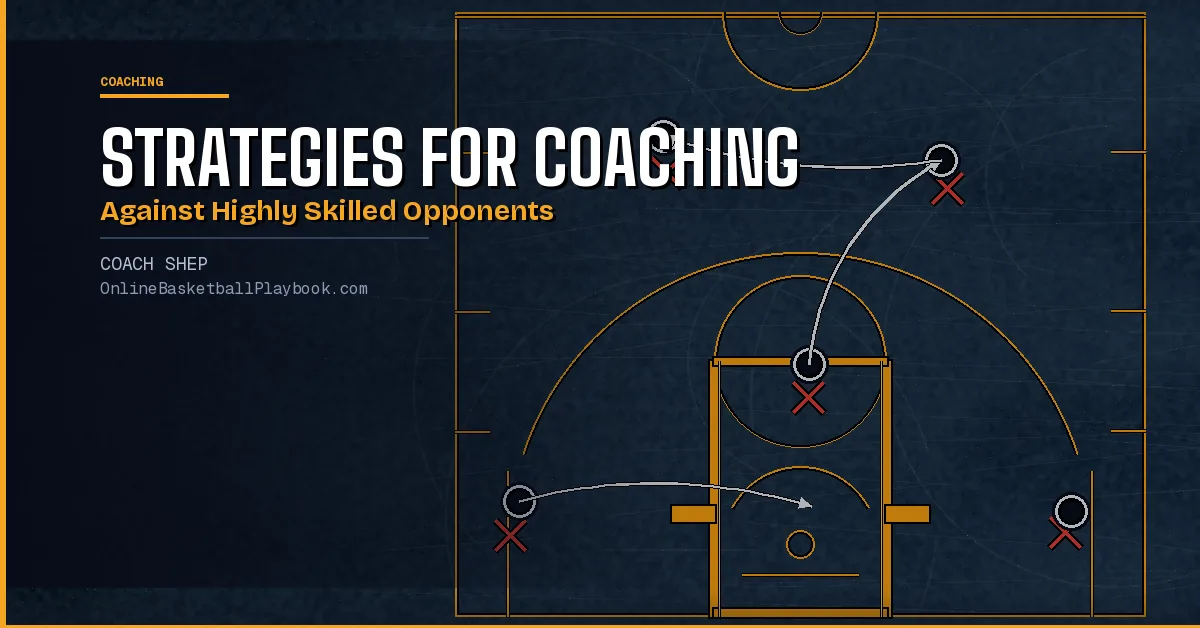
Strategies for Coaching Against Highly Skilled Opponents
Strategies for Coaching Against Highly Skilled Opponents
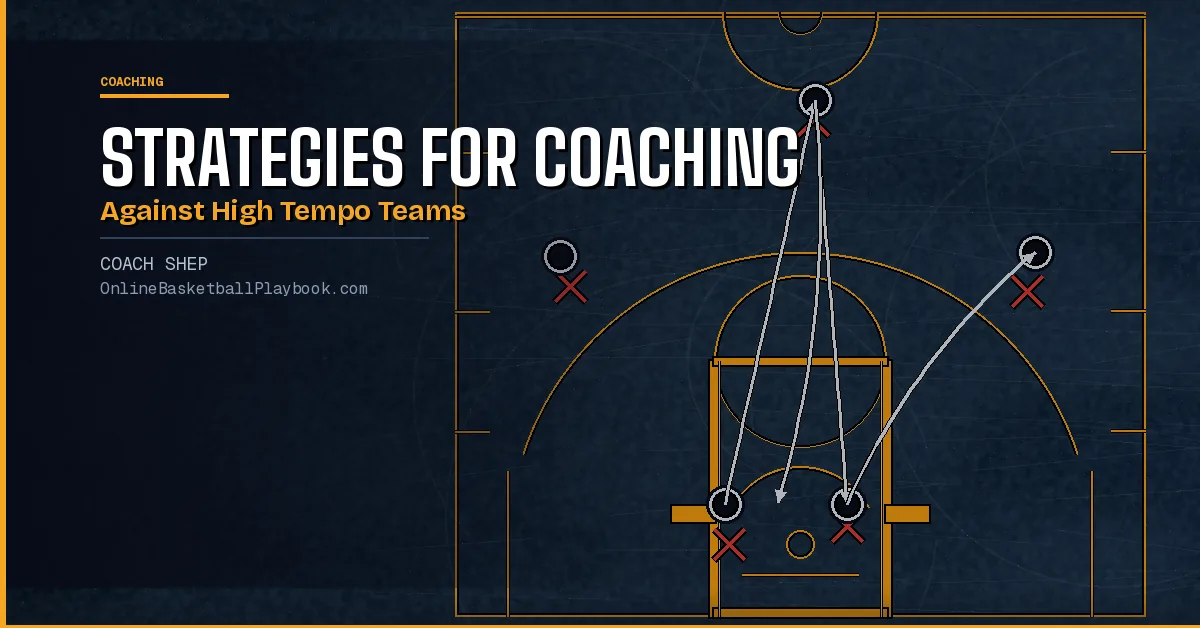
Strategies for Coaching Against High-Tempo Teams
Strategies for Coaching Against High-Tempo Teams