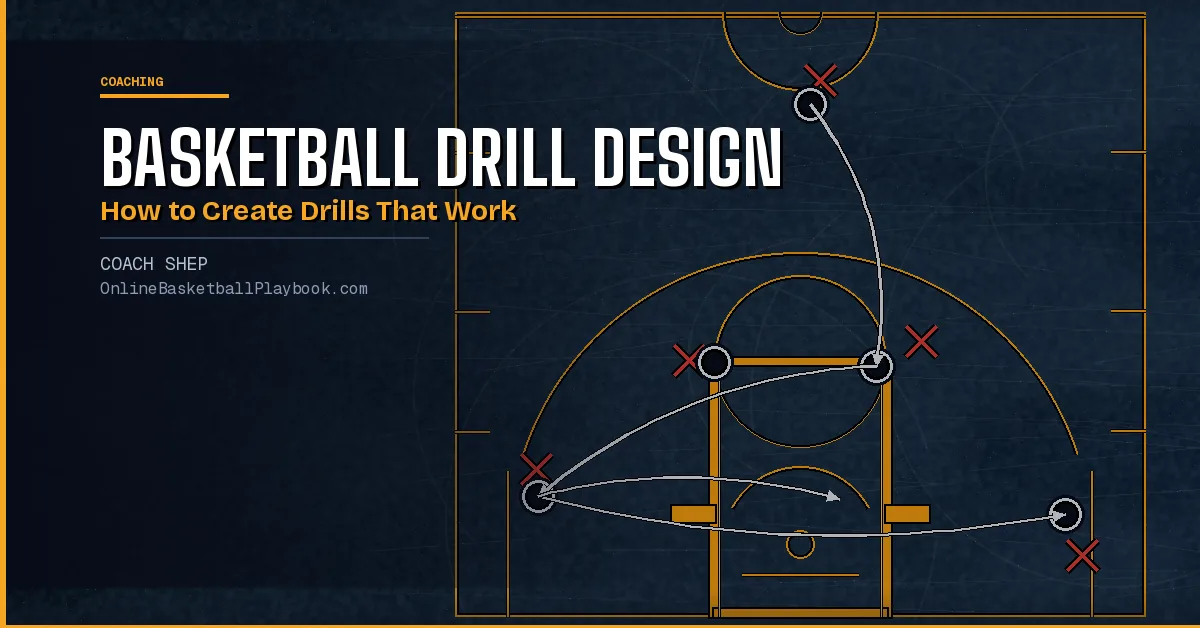
Most practice drills don't transfer to games because they skip the read. Here are the principles the best coaches use to design drills that actually build players who make the right decision under pressure.
Isolate One Read Per Drill
The single biggest design flaw in most basketball drills is trying to teach everything at once. A drill that asks players to read ball screens, make the right pass, and finish through contact is not teaching any one of those things well. It is confusing players, and confusion at game speed becomes hesitation.
The foundation of sound drill design is the part-whole approach: break the offense into its individual reads and skills, train each one in isolation, and then recombine them in live play. This is not a new idea. Every elite program (from John Wooden's practice plans to the 101-drill encyclopedia used by the Seattle SuperSonics under Karl and Stotts) is organized around this principle.
When you design a drill, start by asking one question: what is the single decision this drill is teaching? If you can't name it in one sentence, the drill is doing too much. It should be: "This drill teaches the ball handler to read the defender's hip on the drive-and-kick." Or: "This drill trains the screener to read the defender's position and choose between the roll and the pop." One read. One drill. High reps.
The advantage of isolation is that it compresses the feedback loop. The player makes a choice, the coach evaluates it, and the rep is validated before the next one begins. In a live 5-on-5, a wrong read might not even be recognized as a mistake. In a targeted 2-on-1 breakdown drill, the mistake is immediately visible and correctable.
Use Constraints to Coach Behavior
Telling players what to do is the least efficient way to change what they do. Constraints (rules embedded in the drill itself) are far more powerful because they force behavior without requiring the coach to stop play and lecture.
The Memphis offense made this famous with the Blood series. In Blood 4, any mid-range shot counts as a turnover. The coach does not need to yell "attack the basket." The rule does the coaching. Players naturally begin to attack the paint because the alternative carries a penalty. The behavior is trained through structure, not instruction.
Dribble limits are another constraint that works at any level. When you cap a player at two dribbles, they are forced to move without the ball, set up their catches, and make quicker decisions. "Complete ten passes before any shot attempt" forces ball movement and spacing. "Validate every score with a made free throw" ties the drill to the mental discipline of finishing under pressure.
The most sophisticated constraints go further: they engineer specific reads. Alex Sarama's CLA small-sided games use the ball position on the ball handler's hip to signal a read, inside hip means middle drive, outside hip means baseline drive. The rule is built into the starting position. The defender's placement is controlled. The offense reads the constraint and executes. The coach controls the advantage and therefore controls the read being trained, rep by rep.
When you design a drill with a constraint, you are writing a silent coaching script. Choose the constraint that produces the exact behavior you want to see in the game.
Advantage and Disadvantage Games
One of the most underused tools in drill design is the deliberate mismatch. Advantage and disadvantage games (where the offense or defense begins with a numbers edge) teach decision-making under pressure in ways that equal-numbers drills cannot replicate.
The Texas series (2-on-2, 3-on-3, 4-on-4) and the Scramble (3-on-2) are classic examples from the Memphis breakdown drill library. In the Scramble, the offense has a numbers advantage and must convert it. The defense is scrambling to recover. The decisions players face (when to attack, when to kick, when to set a screen) are real game decisions made under real pressure, not choreographed in a walk-through.
Disadvantage games do the opposite. Duke 21, where the scorer sprints back to half-court to defend after scoring, trains transition defense and finishing under fatigue simultaneously. The North Carolina 32 fast-break drill pushes the outlet pass and the fill lanes against numbers disadvantage. These drills produce toughness and conditioning because the challenge is built into the structure.
One breakdown philosophy takes advantage games to their logical endpoint: start 1-on-1 with a single clean read, then add a second defender who changes the read, then connect two or three actions so the player must keep playing after the first option is covered. Each rep is a decision ladder, not a choreographed move. The player learns to read, not to run a pattern.
For a well-designed advantage game: decide the starting edge (numbers, position, or distance), set the constraint that focuses the read, and keep the game short enough that reps stay competitive and coaching stays tight. Three to five possessions per game, then rotate and restart.
Score Every Drill. Losers Run the Difference.
A drill without stakes is a drill without effort. Competitive scoring is not about punishing players. It is about creating the game-speed pressure that exposes what players actually know how to do, as opposed to what they can execute when relaxed and unchallenged.
The Alabama system under Nate Oats provides a clean scoring template: a drive-and-kick possession earns +3 for a made three, +2 for a made two, +1 for an offensive rebound and put-back, and −2 for a turnover. Losers run the point difference. This scoring system is not arbitrary. Each value reflects a real-game hierarchy of outcomes. The players learn to prioritize good shots over quick shots, and to protect the ball, because the scoring does the coaching.
A 4-on-2 transition drill uses the same principle with a twist: +3 for drawing a charge, +2 for an offensive rebound, +1 for a score, −2 for a turnover. The charge value is three points because it is the highest-difficulty, highest-value play. The drill teaches players that taking a charge is worth more than scoring. No lecture required.
Hubie Brown's principle is even simpler: every drill ends with a make. Not a miss, not a shot. A make. This conditions the mind to finish. Players who train to finish even after a long drill sequence carry that mindset into the fourth quarter. The scoring structure is the mental conditioning.
When you design a drill, build the score sheet before you run the reps. Decide what behavior is worth what point value, set the penalty for the mistake you most want to eliminate, and let the scoring teach while play continues. Stop the action only to enforce the score, not to re-explain the concept.
Progress From Part to Whole
Every offensive system (motion, pace-and-space, Princeton-style read offense) is installed through a progression from simple to complex, not by running 5-on-5 until players figure it out. The part-to-whole approach is the structural backbone of every well-designed practice plan.
The standard progression starts without a defender: 1-on-0 to build footwork and muscle memory, 2-on-0 for timing and spacing, 3-on-0 for reads between three players. Each layer is mastered before the next is added. Bruce Weber's 5-out motion installation begins with a 5-on-0 walk-through of the motion rules, then adds one option at a time (the skip, the dribble-at, the backdoor) before any live defense enters.
Then defense is introduced in the simplest possible form: one defender, one read, one action. From there the progression builds: a second defender who changes the first read, then a constraint game at 2-on-2 or 3-on-2, and finally a live 5-on-5 segment where the reads trained in the breakdown drills are now expected to appear in live play. If they do not appear, the coach does not stop the scrimmage and explain. The coach returns to the breakdown drill the next day and adds more reps.
The key discipline is patience. Coaches who skip steps (moving to 5-on-5 before the part-drills are owned) end up with players who cannot execute the read under pressure. The reads were never isolated. They were never repeated at high volume. They were never scored and competed. When the game speeds up, the player reverts to habit, and the habit was never built correctly.
Map your drills to your progression. Know which drill installs which read, and in what order those reads must be learned before the system runs itself.
Build the Finish Before You Build the Read
Here is a principle that separates sophisticated drill design from average practice planning: the read is only as good as the finish. A player can read the drive-and-kick perfectly, attack the paint on cue, and still miss a contested layup because the footwork was never drilled at game speed. The skill underneath the read must come first.
Walberg and Welling both ground their breakdown progressions in a layup sequence that precedes any team-drill work: both hands, both sides, straight layups, reverse layups, crossover layups, hesitation layups, and the jump-stop power layup (all at game speed, all under some form of pressure or time constraint). Players who have owned this sequence in isolation can execute it when a drive-and-kick opens a path to the basket in live play. Players who have not drilled it separately will choose a pull-up jumper instead, or get blocked, or miss at the rim under contact.
The same principle applies to catch-and-shoot footwork. The Krause/Meyer/Meyer skill circuit insists on game-speed footwork before any live defender is added: the hop from the basket-side foot, the squared-before-the-catch positioning, the "lock and load" ready stance. This footwork is drilled solo, at high volume, before the drill ever includes a passer. When the passer arrives, the footwork is automatic. The player's mental bandwidth is fully available for the read, not the mechanics.
Design your drills with this sequence: skill first, read second, live defense third. If players are struggling with a decision, check whether the underlying skill was ever isolated and drilled to automaticity. The read is not the problem. The finish is.
Add Connected Actions as Players Improve
The final layer of drill design (and the one that produces truly game-ready players) is the connected-action drill. Once a player owns a single read, they must learn to keep playing after that first read is covered. This is where most practice drill libraries fall short: they stop at the first action and never train what happens next.
A 38-drill decision bank is built entirely around this principle. It starts at 1-on-1 with one read (getting open, veering off a screen, reading a downed ball screen) and then progressively adds the second defender who changes that first read. Finally, two or three actions are connected so the player must keep processing: the ball screen turns into a short roll, the short roll triggers a kick to the corner, the corner catch requires a read of the closeout. The player is not running a pattern. They are reading the defense and choosing, action by action, at game speed.
Sarama's CLA framework names this the Dominoes chain: drive-and-kick triggers the kick receiver's read, which triggers the third player's movement, which triggers the finish. Every action causes the next one. Players trained in Dominoes-style connected drills do not stall when the first option is taken away. They keep playing because they have been trained to keep playing.
Add one connected-action drill per week for your more advanced groups. Let players master the first link before adding the second. A player who owns three connected actions (ball screen into short roll into skip) brings something to a live game that no amount of 5-on-5 scrimmage can teach on its own.
Before your next practice, pick one read your team consistently gets wrong (the kick out of the drive, the backdoor cut when the defense denies, the roll after setting the ball screen) and build a single 10-minute breakdown drill around that read only. Run it scored, with losers running the difference, before any 5-on-5 work. Track whether the read appears in live play by the end of practice. That single habit (targeted isolation before live play) will improve your offense faster than any new scheme.
- Name every drill and state its purpose out loud: If you cannot say "this drill teaches [specific read]" in one sentence, redesign it before running it.
- Build the constraint into the drill structure: Mid-range shots count as turnovers, dribble limits force ball movement, validate scores with free throws. Rules teach without lectures.
- Score every competitive drill with a point value for each behavior: Assign a negative value to the mistake you most want to eliminate, and make losers run the point difference.
- Drill the finish before the read: Run the layup sequence (both hands, both sides, straight/reverse/crossover, jump-stop) at game speed before any drive-and-kick or read drill begins.
- Add one connected-action drill per week: Once players own a single read, train them to keep playing after it: ball screen into roll, roll into kick, kick into closeout read, finish.
- Progress part to whole and never reverse: 1-on-0 footwork, then 2-on-0 timing, then 2-on-1 advantage, then 3-on-2, then 5-on-5. Moving forward before the part is owned is the most common practice-planning mistake.
- Use advantage and disadvantage mismatches: 3-on-2 Scramble drills, Duke 21 score-and-recover, and outnumbered transition games force real decisions under real pressure that equal-numbers drills cannot replicate.
Want more basketball coaching strategies, drills, and tools?
Join the Online Basketball Playbook newsletter →
Draw this play free in the play drawer →
Membership: the full library, playbook packs, and Pro drawing tools →
Keep Building
Related breakdowns
Fun Basketball Games for Practice: Scored Games for Any Team
Fun basketball games for practice at any level: shooting games, defense-only scoring, rebounding contests and passing games, with scoring rules and records.
Basketball Conditioning Drills for Teams: Runs, Games and Tests
Basketball conditioning drills in three styles, timed runs, conditioning inside skill drills and scored games, with the tests and yearly plans coaches use.