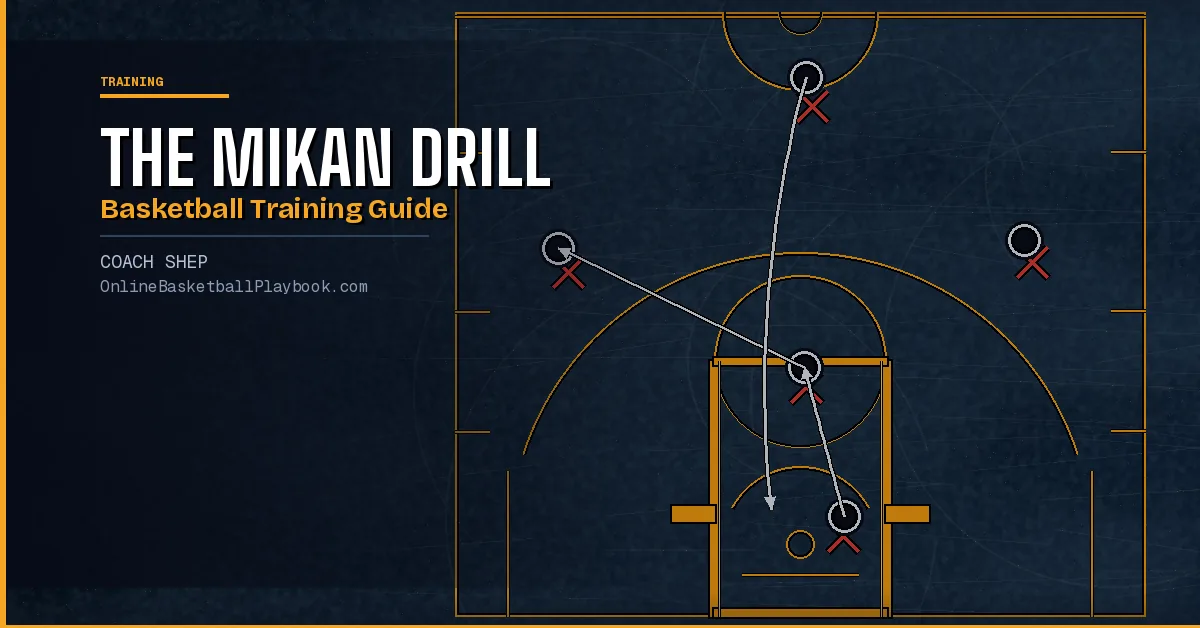
The Mikan Drill is the single best finishing drill in basketball. Two minutes a day, both hands, alternating sides, no dribble, no excuses. Every level of the game uses it because it works.
What Is the Mikan Drill?
Named after Hall of Fame center George Mikan, this drill is deceptively simple: a player starts on one side of the basket, shoots a baby hook or power layup with the near hand, catches their own rebound before the ball hits the floor, steps to the other side of the lane, and repeats with the opposite hand. Back and forth, continuous, no dribble, no interruption.
The goal is rapid, rhythmic repetition of the finishing action: gathering the ball at its lowest point, using the backboard, and finishing with the hand closest to the rim. Most coaches run it for 30 seconds to two minutes, tracking makes rather than attempts. The drill trains the exact skill that separates good post players from great ones: the ability to finish with either hand, under the basket, in traffic, without thinking.
George Mikan himself was coached to shoot baby hooks from both sides of the lane long before the drill carried his name. His coach at DePaul, Ray Meyer, drilled him relentlessly on finishing with both hands because bigs who can only use their dominant hand are easy to guard. The same principle applies today at any position. Modern perimeter players who attack the basket face contested finishes constantly. The Mikan Drill trains the short-range touch that makes those plays automatic.
What makes the drill durable across 80 years of basketball evolution is that it isolates one skill and forces both hands equally. There are no shortcuts. A right-handed player cannot favor their right side. The structure of the drill enforces balance. After 200 repetitions of a left-handed hook, the shot starts to feel natural. That is the entire point.
Why It Works: The Science Behind the Reps
The Mikan Drill accumulates a high volume of finishing reps in a short time window. A player who runs the drill for 90 seconds can generate 25 to 35 attempts. Run three sets across a practice week and that player has 75 to 100 close-range finishing reps before a 5-on-5 rep has even started. The volume is the mechanism. Skill builds through repetition, not explanation.
The drill also enforces the correct finishing mechanics every single time. Because the player catches their own rebound and goes directly into the next shot, there is no time to reset bad habits. The catch has to be clean. The footwork has to be right. The release has to be soft enough to use the backboard. Bad mechanics produce missed shots, which forces immediate correction. The feedback loop is instant.
From a motor learning standpoint, the Mikan Drill creates what coaches and researchers call "repetition without repetition". The player performs the same action over and over, but the exact body position and angle changes slightly with each rep because the rebound comes off at a different spot. This variability within a constrained pattern is exactly what builds durable skill. The player learns to finish from multiple angles, not just one perfect setup.
The continuous nature of the drill also builds conditioning specific to interior finishing. Post play and drive-and-kick finishes often come at the end of a possession when players are already fatigued. Running the Mikan Drill at full pace for 60 to 90 seconds simulates that physical state. The player learns to execute the finishing mechanics when their legs are tired, which is when it matters most in a game.
Championship programs across every level incorporate the Mikan Drill because the return on time invested is almost unmatched. Two minutes of Mikan reps before practice delivers more finishing improvement than 20 minutes of passive shooting in a line. One scored drill library lists the Mikan, Reverse Mikan, and extended layup as its standard 20/20/20 shooting battery. That combination alone covers close-range finishing from every practical angle.
How to Run It: Step-by-Step Instructions
Set up is a single player under the basket with a ball. No cones, no partners, no equipment beyond the rim. Here is the full sequence:
Starting Position
Stand on the left block with the ball held at chest height in both hands. Face the basket at a slight angle so your right shoulder points toward the rim. This is your launch angle for the first shot.
The Shot
Step toward the basket with your left foot, extend your right arm, and release a soft baby hook off the backboard. Use the square on the backboard as your target. Aim for the top-right corner of the square when shooting from the left side. The ball should roll gently off your fingertips, not be pushed or thrown. Your off-hand guides the ball; your shooting hand does the work.
The Catch
Do not let the ball hit the floor. As the shot comes off the backboard and through the net (or off the rim if missed), step under the basket and catch the ball with both hands before it bounces. This is the part most players skip in a lazy version of the drill. Catching the live ball is where the footwork conditioning happens. Catches that happen after a bounce create gaps in the rhythm and reduce the rep count.
The Transition
As you catch the ball on the right side of the lane, immediately square your left shoulder to the rim and prepare to shoot the baby hook with your left hand. The movement is continuous: catch, pivot, shoot. There is no stop between catches and shots. The drill should look fluid, almost like a dance under the basket.
The Count
Track makes, not attempts. A coach or partner calls out makes as they happen. A good target for a high school player is 15 makes in 60 seconds. An elite post player can hit 20 or more. Set a standard for your team and post it. Competition sharpens effort.
Progressions: From Basic to Game-Speed
The Mikan Drill is a foundation, not a ceiling. Once the basic version is clean (both hands, soft release, backboard touch, ball caught before the bounce), the drill can be advanced in several directions.
Timed Sets
Start with 30-second sets for younger players. Build to 60 seconds for middle school and JV players. Run 90-second sets for varsity and above. Track and post makes per set. Let players compete against their own best score. Personal records create buy-in.
The Power Mikan
Instead of a one-foot baby hook, gather the catch with a two-foot jump stop and explode into a power layup. The power version adds lower-body strength and simulates the finish off a post feed where a player must absorb contact and still lay it in. This is the most game-realistic version of the drill for bigs who catch in traffic.
The Eyes-Up Mikan
A coach stands at the three-point line and holds up fingers: one, two, three, or four. The player calls out the number on each catch. This forces the player to keep their head up and develop court vision while finishing. It is a simple add-on that pays dividends in transition when a player can finish at the rim while seeing a trailer or a cutter.
The Double-Speed Mikan
Run two players simultaneously, one starting on each block, alternating catches. The two players have to communicate and time their shots so they do not collide. This version builds the spatial awareness and timing that post players need when two bigs are working the paint at the same time.
Full-Speed Conditioning Version
Set a goal: 50 makes in two minutes. Most players cannot do it the first time. The failure is instructive. Running a timed make-goal version of the Mikan Drill (scored as "make 50 in 2 min") reveals exactly how many reps a player is losing to poor mechanics, slow transitions, or weak off-hand finishes. Chase the number until it is reached. Then raise the number.
Common Mistakes and How to Fix Them
The Mikan Drill looks simple, which is why players rush through it without correcting the errors that undercut its value. Here are the five most common mistakes and their fixes.
Shooting Too Hard
Players who shoot the baby hook with too much force send the ball off the backboard at a wide angle, forcing them to chase rebounds and breaking the rhythm of the drill. Fix: use a soft touch and aim specifically at the top corner of the square. The ball should barely kiss the board and drop through.
Letting the Ball Bounce
If a player lets the ball hit the floor before catching it, they are losing half the conditioning value of the drill and allowing bad habits to form. In a real game, a missed shot that bounces gives a defender time to box out. Fix: demand catches before the first bounce in practice. Make it a rule. If the ball bounces, the rep does not count.
Favoring the Strong Hand
Most players will subconsciously shoot with more arc and more confidence from their dominant side. The weak-hand shot becomes tentative or flat. Fix: isolate the weak hand. Run two sets of left-only Mikan reps before allowing both hands. Once the left hand catches up, return to the alternating drill.
Not Using the Backboard
Players who shoot straight at the rim instead of the board miss more shots and get worse practice value. The backboard is the tool. Fix: put tape on the top corner of the square and make hitting that spot the explicit goal, not the net.
Drifting Away From the Basket
As fatigue sets in, players start catching the rebound further and further from the rim and shooting from further out. The whole drill shifts outward and loses its close-range specificity. Fix: place tape marks on the lane at the block positions. Players must catch within those marks. If they drift, reset and restart.
The Reverse Mikan and Extended Mikan
Once the standard Mikan is clean, add the two most valuable variations: the Reverse Mikan and the Extended Mikan. Together with the original, these three drills form the 20/20/20 finishing battery (20 reps of each, scored and timed) that should be a daily staple in any program that values interior finishing.
Reverse Mikan
The setup and footwork are identical to the standard Mikan, but the player now shoots the reverse layup, going under the rim and finishing on the opposite side of the backboard. From the left block, the player steps underneath the basket and finishes on the right side of the rim with a left-hand reverse. From the right block, they reverse finish on the left side with the right hand.
The Reverse Mikan is harder than the standard version because the player must maintain control of the ball while moving under the basket, judge the reverse angle off the backboard, and release at the correct height. Players who master the Reverse Mikan become nearly impossible to block from behind because the ball is on the far side of the rim from any help defender.
Run 20 makes of Reverse Mikan with the same standards as the original: both hands, ball caught before the bounce, backboard used on every shot.
Extended Mikan
The Extended Mikan moves the starting position out to the elbow (the junction of the lane line and the free-throw line) and has the player drive into the finish each time. Instead of standing at the block and going directly up, the player takes one or two explosive dribbles from the elbow, gathers, and finishes with a baby hook or power layup at the rim.
This variation adds the footwork and approach angle that matches real game situations. Drives from the elbow are among the most common scoring opportunities in modern basketball, and the Extended Mikan trains the finish off that specific approach. The drill teaches players to maintain their dribble through traffic, gather at the right spot, and convert the finish under control.
Because the Extended Mikan covers more ground, the pace is slower than the standard version. Focus on the gather (two feet for a power finish, or a controlled one-two step into the hook) and the release. Do not rush the approach at the expense of the finish.
Fitting the Mikan Into Your Practice Plan
The Mikan Drill belongs at the beginning of practice, not the end. Coaches who save finishing drills for the end of a session run them when players are most fatigued and least able to execute clean mechanics. Bad-habit reps at the end of practice undo good-habit reps from earlier. Front-load the skill work.
A practical entry point is a five-minute finishing block at the very start of practice, before any team work begins. Run it in this order: standard Mikan (60 seconds), Reverse Mikan (60 seconds), Extended Mikan (60 seconds). That is three minutes of active finishing work. Add a power Mikan set for post-heavy rosters. The whole block runs under five minutes and delivers 60 to 80 finishing reps per player before the first team drill of the day.
For coaches managing large rosters, the Mikan block is also a natural solution to the "too many players, not enough baskets" problem. Put one player per basket on the Mikan, two players per basket on the Reverse Mikan, and run them simultaneously. Every player gets reps at once. There is no line. There is no standing around waiting. The Livsey simultaneous shooting battery (built specifically for squads of 15 or more) uses this principle: design drills so every player is working at the same time.
Track makes over time. Post a leaderboard in the gym (weekly Mikan make totals for each player). The players who move up the leaderboard are the ones putting in extra work. The leaderboard makes that work visible and creates social motivation for players who might otherwise skip finishing work on their own.
Finally, use the Mikan Drill as a window into a player's work ethic between practices. Any player who arrives at the gym early and spends 10 minutes on Mikan reps is telling you something about how they approach the game. Those players tend to be low-maintenance and high-production. The drill is simple enough to run alone, requires no partner, and generates clear measurable results. It is one of the few drills where a player can coach themselves: count the makes, notice the misses, adjust.
Run the Mikan Drill before every practice as part of your pre-practice individual warm-up block. Give each player a personal make goal that is slightly above their current average, post results weekly, and let the competition drive the reps. Players who chase their own numbers improve faster than players running the drill without a target to beat.
- Start every practice with a five-minute Mikan block: standard, Reverse, and Extended (60 seconds each, track makes not attempts).
- Demand catches before the first bounce on every rep. If the ball hits the floor, the rep does not count toward the total.
- Isolate the weak hand at least once per week: run two consecutive sets with the off hand only before returning to the alternating drill.
- Set a team make standard and post it publicly. 15 makes per 60 seconds for high school players is a solid starting benchmark to chase.
- Use the Reverse Mikan to train under-the-basket finishes that defenders cannot block from behind; it is the hardest and most underused variation.
- For large squads, run all three Mikan variations simultaneously at every basket: no lines, everyone working at once, maximum reps per minute.
Want more basketball coaching strategies, drills, and tools?
Join the Online Basketball Playbook newsletter →
Draw this play free in the play drawer →
Membership: the full library, playbook packs, and Pro drawing tools →
Keep Building
Related breakdowns
Basketball Drill Design: How to Create Drills That Work
Basketball Drill Design: How to Create Drills That Work
Fun Basketball Games for Practice: Scored Games for Any Team
Fun basketball games for practice at any level: shooting games, defense-only scoring, rebounding contests and passing games, with scoring rules and records.
Basketball Conditioning Drills for Teams: Runs, Games and Tests
Basketball conditioning drills in three styles, timed runs, conditioning inside skill drills and scored games, with the tests and yearly plans coaches use.