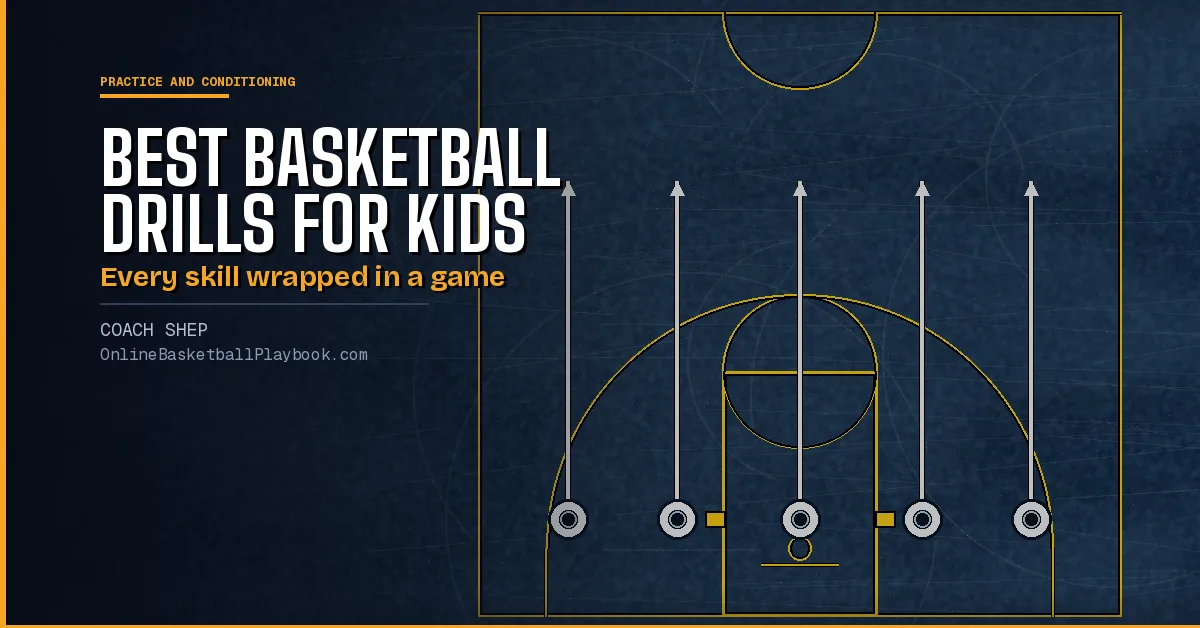
The best basketball drills for kids look like games. Every child has a ball, the rules fit on one breath, and the skill hides inside the fun. This guide sorts basketball drills for kids by age and by skill, then covers dribbling, passing, shooting, footwork and small-sided games. Each one is a fun basketball drill for kids that still teaches something a coach can name.
Best Basketball Drills for Kids at a Glance
| Skill | Drills that work for kids |
|---|---|
| Dribbling | Sharks and Minnows, Red Light Green Light, Dribble Tag, Dribble Knockout, Balloon Dribbling |
| Passing | Partner passing, Triangle Passing, Monkey in the Middle, Ultimate Basketball |
| Shooting | Perfects, Knockout, 21 Cones, Around the World, Home Run |
| Footwork | Red Light Green Light, Go Stop jump stops, pivot calls |
| Finishing | The four-stage layup progression, Chair Change |
| Game sense | 3-on-3, Flat Ball, Steal the Bacon, War |
Basketball Drills for Kids by Age
- Ages 5 to 6. Run 30 to 45 minutes of pure games with a ball in every hand. Follow the Leader, Red Light Green Light, Sharks and Minnows and partner passing cover the session. Skip laps, long lines and lectures.
- Ages 6 to 8. Plan 45 to 60 minutes. Teach movement first, then simple basketball skills, then two-choice decisions such as shoot or pass and dribble right or left. A 60-minute template runs 5 to 10 minutes of warm-up, 35 to 40 minutes of skills through games, 10 to 15 minutes of small-sided play and 5 minutes to cool down.
- Ages 7 to 10. Give each practice one stated goal, such as bringing the ball up against pressure. Build it with a dribbling drill, a one-on-one game and a 3-on-3 closer. Set plays are unnecessary under age 10.
- Ages 11 to 14. Give each practice two goals, such as passing decisions and transition defense. Games like Call Names 3-on-3, where a player must call a teammate's name before passing or picking up the dribble, add decisions. Basic strategy and simple reads start to fit here.
How to Run Basketball Drills for Kids
Fun comes first. A child who enjoys practice comes back, and a child who comes back keeps improving. Set goals every child can reach so success does not belong only to the best player.
- Plan the practice. Write it down. Put the new skill first while attention is highest.
- Keep it short. Young groups change activities every 3 to 5 minutes. Older groups run 4 to 6 drills of 8 to 12 minutes. If a drill is not working after about 10 minutes, move on and bring it back at the next practice.
- Use the 50-25-25 split. Half the session goes to skill work, a quarter to team strategy at most and a quarter to small-sided games.
- Keep directions short and use water breaks. Explain a skill in two minutes or less, then play it.
- Make the fun train a skill. A player who only plays games never learns the fundamentals. A player who only does drills burns out. Mix both and bring real energy to every drill.
Dribbling Games for Kids

Sharks and Minnows. Two sharks wait at half court. Every minnow dribbles across the floor and tries to get past. A tagged minnow becomes a shark. The last minnow wins. The game forces kids to keep their heads up.

Red Light Green Light. Players dribble on green and stop legally on red. Anyone still moving goes back to the start line. It is one of the best jump stop and pivot teachers for kids. Once the stops are clean, add a front pivot, then a reverse pivot.
- Dribble Tag. Every player dribbles inside a half court. One player is it and tags others while keeping a live dribble. A player who stops the dribble, double dribbles or leaves the area becomes it.
- Dribble Knockout. Players dribble in a small space and try to knock away other balls while they protect their own. Shrink the space as players go out. The last dribbler wins.
- Balloon Dribbling. Each player dribbles and keeps a balloon in the air. A balloon on the floor or a lost ball means out. Kids look up because the balloon demands it.
- Chaos Call Out. One or two defenders try to steal balls while the coach holds up fingers and the dribblers call out the number.
Add an opposite-hand-only round to any of these games. A player who only uses one hand is easy to overplay. For the youngest players, cap the dribble at four. See How to Dribble a Basketball and Sharks and Minnows.
Passing Games for Kids
Never assume kids can pass. Teach the chest pass, the bounce pass and the two-handed overhead pass with partners 12 to 15 feet apart. The passer steps into the throw and hits the receiver in the chest. The receiver shows two hands as a target. The catching cue is two hands, two eyes, two feet.

Triangle Passing. Make three lines about 12 to 15 feet apart, one at the top of the key and one in each short corner. The ball moves around the triangle in one direction. Each passer sprints to the next line after the pass. After a few rounds, switch direction and change the pass type. Kids get many touches without the timing demands of a full-court drill.

Monkey in the Middle. Two passers work around a live defender with pivots and fakes. No lob passes and no dribbling. It teaches the fake before the pass, which a technique drill does not.
- Ultimate Basketball. A scrimmage where the ball never touches the floor. Passing the ball past the opponent's baseline scores a touchdown.
- Piggy Circles. A circle keep-away with one defender in the middle.
- Find the Receiver. Kids often throw before they see the target. The passer speed dribbles, jump stops and pivots while a partner sprints to a corner, so the passer must find him first.
More ideas are on Basketball Passing Drills.
Get the next coaching guide in your inbox
One email when a new guide or diagram set goes up. Free.
Shooting Games for Kids
Teach form first. Use two cues kids can check for themselves. The pizza waiter is the shooting hand flat under the ball with the elbow under it. The cookie jar is the arm reaching up with the wrist bent and the fingers pointing down at the finish. Learn the motion without a ball, then shoot to a wall, then shoot at the hoop. Lower the rim and use a smaller ball so nobody has to heave the ball from the hip.

- Perfects. Three players share a basket and rotate through three spots. They work on release and arc with no jumping.
- Knockout. Two players race to make a shot before the player behind them. The loser is out. In the Lightning version, a player who is out can get back in.
- 21 Cones. Two teams shoot from matched spots. Each make earns a cone from a supply of 21. Most cones wins.
- Around the World. Nine spots, and a player moves on only after a make. Bring the spots closer for younger kids. The All or Nothing rule lets a player gamble on a second shot at the same spot and go back to the start if it misses. More in Around the World and Knockout.
- Home Run. One team dribbles a lap while the other shoots. The dribblers are out if a shooter scores first. Teams swap roles each inning.
- 40 and a Half. Teams shoot in turn from the block, the elbow, the top of the key and finally half court. The game ends when a team hits the half-court shot.
Footwork and Finishing for Kids
Kids who cannot stop under control travel. Teach the jump stop in four steps with a drill called Go, Stop. First practice the triple-threat stance. Then jog without a ball and jump stop on the whistle. Then do it after a dribble. Then do it while catching a pass. Coach three points. Bend the knees, keep the head up and take small jumps, because big jumps throw kids off balance. See Basketball Triple Threat Position and Pivot Foot.
Teach the layup in four stages. Start with a one-step layup from the low block. Move to a two-step layup from one step back. Add one dribble. Finish with several dribbles starting behind the three-point line. Be patient at each stage. Chair Change is a fun finisher. Kids dribble toward a chair about 21 feet out and finish with only one dribble past it. More layup work is on Layup Drills.
Small-Sided Games and Closers
Three-on-three gives every child more touches and a simpler read than five-on-five. A weaker player cannot hide. The smaller floor also leaves no room for zones or full-court pressure, so kids learn half-court decisions first. You can isolate one teaching point such as a v-cut or a back cut. Read more on Small-Sided Games.
- Flat Ball. 3-on-3 with no dribble allowed.
- No Hands. Players pass and catch only, and use their hands on the ball only to grab a rebound.
- Steal the Bacon. The coach calls numbers. The matching players race to grab the ball, pass to teammates and score. The first team to score earns the point.
- War. The coach calls numbered players from each team to fight for a thrown ball in a small-sided game.
Where Coaches Split
Coaches split on how much kids need special drills. Some say drills are the same at any age, so pick from the general library and do not hunt for kid versions. Others teach the youngest players only through games with no score and no full-court defense. Coaches also split on length. Some plans run 30 to 45 minutes for ages 6 to 10, and others run 45 to 60 minutes for ages 6 to 8. Choose the shorter plan if attention fades.
Coach Cheatsheet
- Give every child a ball and keep lines short.
- Teach a new skill at the start of practice.
- Turn each drill into a game with a winner.
- Reduce choices to two, such as shoot or pass.
- Use the pizza waiter and cookie jar cues for form.
- Run dribble games with the weak hand too.
- Finish with a small-sided game.
- End on something the kids enjoy.
Questions Coaches Ask About Basketball Drills for Kids
What are the best basketball drills for kids?
Sharks and Minnows, Red Light Green Light, Triangle Passing, Monkey in the Middle, Perfects and Around the World. Each one is a game that gives every child a ball or a job.
What are fun basketball drills for kids?
Dribble Tag, Dribble Knockout, Balloon Dribbling, Knockout, 21 Cones, Home Run and Steal the Bacon. All of them have a winner and keep children moving.
How long should a youth basketball practice be?
Ages 5 to 6 do well with 30 to 45 minutes of games. Ages 6 to 8 handle 45 to 60 minutes. Change the activity every few minutes.
How many drills should I run in one practice?
Young groups run several short activities of 3 to 5 minutes each. Older groups run 4 to 6 drills of 8 to 12 minutes.
Should young kids run plays?
No. Set plays are unnecessary under age 10. Teach skills and how to play instead.
All youth pages sit under Practice and Conditioning and the Youth Basketball Coaching Guide. For a solo or small-group session plan see Kids Basketball Training Workout. Related pages are Basketball Practice Plan, Basketball Warm-Up Drills, Coaching Youth Basketball, Basketball Shooting Form and Basketball Dribbling Drills.
Want the printable playbook packs?
OBP Pro members get the premium playbook packs: the zone attack, out of bounds and practice plan PDFs, plus each new pack as it is finished. The membership page lists what is in each one. Or draw your own version free in PlayDraw.
See what OBP Pro includesBack to Youth Basketball Coaching Guide and every Practice and Conditioning page.
Keep Building
Related breakdowns
Fun Basketball Drills for Kids: Team Games, Relays and Contests
Fun basketball drills for kids built as contests, relays and elimination games, with the rules, the changes that keep every child playing and where coaches differ.
The Best Basketball Plyometric Exercises for Explosive Power
The Best Basketball Plyometric Exercises for Explosive Power
Best Knee Sleeves for Basketball: What to Look For
A knee sleeve is a compression garment, not a brace. Here's what a sleeve actually does, how to size it correctly, and when persistent pain means it's time to see a professional instead.