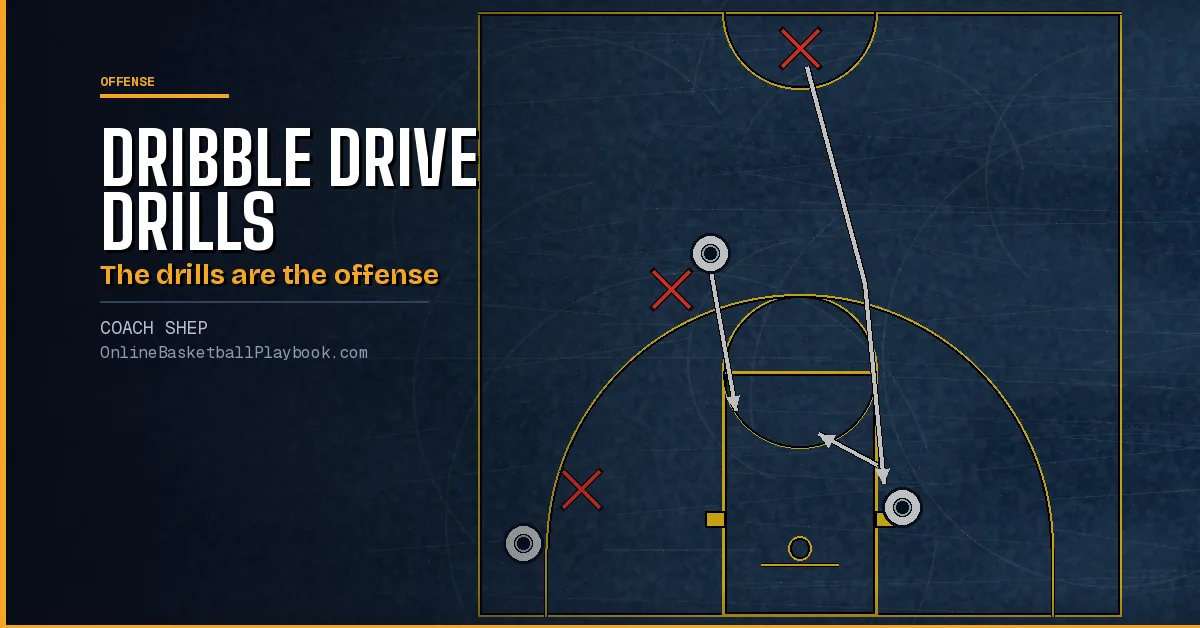
Dribble drive drills are how the offense is taught, because the offense itself has almost no called plays. Vance Walberg, who built it, says every drill in his practice is a building block for the offense and that the offense means nothing without the drills.
This guide covers the drills that build it, from finishing footwork and breakdown drills for the Drop and Rack zones to live read drills, passing drills, the transition games Walberg runs every day and scored shooting. The setups are drawn. The offense is on the dribble drive motion offense hub, the decisions the drills train are on dribble drive reads, and the reasons behind the scoring rules are on dribble drive system.
How Dribble Drive Drills Fit a Practice
Walberg's practices open with four blocks: shooting, layups, game-type drills such as Texas, Cardinal and Scramble, and the Blood series. An install of the offense picks one or two drills from each block for every practice. The time spent differs. The Blood drills are the bread and butter, at 15 to 20 minutes a day. Walberg never runs one drill for more than 6 minutes and runs Blood twice early in the season.
Coaches also split on the order of teaching:
| Approach | Order |
|---|---|
| Footwork first | Finishing moves and the jump-stop power layup, then two-man drills, then the Blood series |
| Reads first, drills last | The basics, the early break, the secondary break, the Rack and Drag reads, middle penetration and the kick back, then the Drop zone backdoor, and only then the drills. The kick up comes later, and it advises against running patterns 5 on 0 |
| Shell up | Perimeter work from 2 on 0 to 3 on 0, 4 on 0 and 5 on 0, with four X's marked on the floor and a box at each elbow for the Drop zone |
| Whole, part, whole | X's on the floor to show the gaps, the principles taught, the drills, then options added as players understand them |
Walberg also runs a 5-on-0 shell every day in which the coach calls each action, such as a Drop zone back cut, a Drag zone drift or a reversal into the post, and he uses it to teach offensive rebounding coverage too. The general case for breaking a system into parts is on breakdown drills, part to whole. Pick one order and teach it the same way every day.
Finishing and Footwork
Start with a numbered stack of finishes before any team drill: a stop and go into a jump-stop power layup, a crossover into a shot fake and layup, a between-the-legs move with a pivot and shot fake, and a behind-the-back move into a jump stop and a jump hook. The point is that the offense needs shooters, so shoot a lot in practice.
Walberg's layup routine runs on one side of the floor each day: seven layups and two threes. The layups go in order, regular, reverse, a crossover into a left-hand semi-hook, a hesitation, and around the back. Four more shots follow from the offense itself: a backdoor layup, a quick three, a kick-up drive to a layup, and a kick-up drive with a step back and a pass to the corner for a three.
Contact is part of the footwork.
- Teach the driving cues. In the approach Walberg taught with Calipari, the driving cues are clip the hip, sell your shot, take the hit and finish, and a coach at the elbow bumps the driver with a pad.
- Give the bigs ball handling. The bigs do ball-handling work too.
- Jump stop daily. Run a jump stop drill almost every day with a coach holding a blocking pad.
- Fix the early pitch. Fix players who pitch the ball out too early with 1-on-0 finishing against a contact pad in the lane.
All of this serves the stop rule on the hub page. If the driver's shoulders are not past his defender's by the Drop zone, he picks up the ball, uses a 360 pivot and finds the kick-out. More finishing work is on basketball layups and basketball footwork drills. Finish through contact and rep it every day.
Breakdown Drills for the Drop and Rack Zones
These drills run from two lines at the top and two in the corners, with no defense. The guards are the 1 in the right slot and the 4 in the left, each with a ball, and the shooters are the 2 in the right corner and the 3 in the left.
The slot is the lane each guard drives, along the lane line. A drive that reaches the rim is in the Rack zone, and a drive that stops above the free-throw line is in the Drop zone. Players stay about 15 to 18 feet apart.
Pass to the corner. When the drive gets below the free-throw line, the corner players stay where they are. Players then rotate. The driver moves to the corner line and the shooter takes the ball to the top.

Pitch from the Drop zone. Now the driver stops short. His stop is the cue for the corner player to loop up to the wing for a pitch and a shot.

Wing back cut. The same stop, but the corner player sells the loop, getting high enough to look real, then back cuts to the rim for a layup. A variation has the back cutter drive in and kick to the opposite corner instead of finishing.

Four more reps use the same lines. The first two train a second drive after the kick, the third trains moving the ball, and the last trains shooting off a screen:
- Baseline drive, kick back. The corner player comes up only part way for the pass, drives the baseline, reverse pivots and passes back to the corner.
- Drive from the wing. After the pitch, the wing drives the top seam, pivots in the lane and kicks to the guard, who has gone to the corner.
- Ball reversal. The guard drives into the Rack zone, kicks to the corner and cuts to the far corner while the ball goes around the outside to him for the shot.
- Blur screen shooting. A guard passes across and sets a blur screen, a soft brush screen rather than a hard one, and the receiver dribbles off the screener's back and shoots.
The shell works the same reads with more players. At 2 on 0, the 2 kicks up and catches to shoot, drives the middle, or throws back to the 1. Players are added up to 5 on 0, and the key point is getting throwbacks into a post-up. Let the driver's stop tell the corner what to do.
Live Read Drills: Blood and the Drop Zone
Blood, or Gaps. Walberg calls Blood 22, 33 and 44 the core drill of his system.
- Fill the spots. The 2, 3 and 4 spots are filled against defenders, and a defender in the half-court circle guards the 1.
- Start with the coach. The coach starts it with the ball, and the circle defender cannot move until the 1 reaches the edge of the circle.
- Play live. The offense plays its principles live, gets one shot, and earns a point for an offensive rebound.
- Outlet and switch. Whoever ends with the ball outlets to the coach, and the attack goes the other way.
- Score by the clock. One team attacks for 2 minutes, then the other, scored by baskets, steals and rebounds.
- Count the players. Blood 44 needs at least 14 players.
- Check the write-up. In Walberg's 2008 write-up the games go to 8 instead, and in Blood 33 and 44 the offense keeps the rebound and plays on.
- Train the decisions. His primary ball handlers make many decisions in a short time, and the other spots learn the off-ball rules.
The drop-zone read drill. A 3-on-3 drill, run by two teams at their own ends, builds the driver's read order. In this drill the 5 is the post:

- Read the corner defender. If the corner defender sags off, the corner shooter steps up one step and looks to shoot. If he denies, the guard keeps his dribble and goes to the rim, or the corner man goes backdoor.
- Read the post's defender. If the post's defender stays home, the guard shoots. If he steps up, the guard dishes to the post.
- Reward the early leave. If X5 leaves the jump circle early, the offense gets a point. The game goes to 13, then the bigs and wings switch between offense and defense.
Calipari's Memphis staff moves the touch rule to the ball. The point guard's defender must touch the dribbler in the half-court circle before he can stop him. The read order is the corner defender, then the post's defender, then the rim. After each score or stop the teams switch, with a new point guard on defense each time.
2-on-1 power drill. A guard starts at half court against a token defender, and a post starts on the far baseline with one live defender in the lane. The guard fakes past the token defender and attacks downhill. If the lane defender steps up, he passes to the post. If not, he finishes. The drill wants a layup or a foul every time, never a jumper.
The read order. Teach the driver five levels in a fixed order: finish at the rim, draw the foul, dish to the roll man if there is one, kick to the open corner, skip to the weak side. Train the read order until the driver does not have to think.
Kick-Out and Extra-Pass Drills
The kick-out is a known turnover point in this offense, so it gets its own reps. A Calipari passing drill teaches the driver to reach the help line in the middle of the paint before he passes, never from the far lane line.

Drift drill. A guard drives the baseline from one wing, and the player on the other wing drifts down to the corner as soon as he sees the drive. He catches, shot-fakes, drives the middle gap, and passes to a teammate who drifted a few steps, who makes one more pass to restart the drill.
Skip 2-on-1. Two offensive players start on opposite sides and must skip the ball across before they attack a lone defender, who starts in the middle and has to touch half court once the ball is in play. The shooter, make or miss, sprints back to touch half court. More passing work is on basketball passing drills. Make the extra pass a habit.
Get the next coaching guide in your inbox
One email when a new guide or diagram set goes up. Free.
Scramble, Texas and Cardinal
Most of Walberg's drills are full-court transition drills, because wearing the opponent down is a key of the system. These are his daily game-type drills:
| Drill | Setup | Rules |
|---|---|---|
| Scramble | A continuous 3 on 2, with two defenders at each basket and four lines | One shot per trip. Outlet players sweep to the ball and banana cut when the rebounder turns. A no-dribble version makes any dribble a turnover. The scored version goes to 8, with 1 point for an offensive rebound, and needs at least 14 players |
| Texas | Attackers against defense with a chaser coming from behind, from 1 attacker up to 4 | In the 2-on-1 version the half-court defender is frozen until the guard reaches the center circle, the offense gets one frontcourt pass and one shot, and only layups count. After a score the group becomes the press, with full denial of the inbounder |
| Cardinal | A continuous 2 on 1 | Games to 8, twos only. The shooter sprints to half court, touches the center and comes back to defend |
Walberg calls Scramble his best drill. He adds two transition games:
- The chase 2-on-1. One offensive player catches at the free-throw line and speed-dribbles at the basket. A defender in the jump circle must touch him first and then slow him, while a baseline defender chases. After a score the scorer defends a 2 on 1 the other way. The winning basket must be followed by a made free throw, or both teams run.
- 4 on 3 plus a chaser. Four attack three defenders while a fourth enters through the jump circle. Teams press after every make and miss but may not press past half court. Games go to 8, and the first minutes are expected to be confusing.
The break these drills feed is on fast break and transition offense. Run them at full speed and keep the score.
Scored Shooting Drills
The offense lives on threes, so shooting is scored like everything else:
- Olympic shooting. Three players and two balls at a basket, threes only. The shooter rebounds his own shot and passes to the player without a ball, and nobody makes a negative pass, a pass to a receiver whose weight is moving away from the basket.
- Five-spot shooting. Four minutes on the clock, five spots around the arc, and the group must make 10 at each spot. High school groups make 8 a spot. Groups move up a basket by beating the group ahead by 10 or twice in a row, and Walberg named the baskets hell, purgatory and heaven.
- Two in a row. Two minutes, and a player moves to the next spot only after two straight makes.
More shooting work is on basketball shooting drills. Give every shot a number to beat.
What the Drills Fix
The offense has known failure points, and most have a drill above:
- Over-dribbling. A player dribbles in place instead of relocating. The cue is pass and move. The AASAA rule, Attack, Attack, Skip, Attack, Attack, says a player who cannot attack skips the ball.
- Kick-out turnovers. Drilled with the extra-pass and skip drills.
- Lane drift. Young players drift toward the driver and close his lane. The breakdown drills keep the corners in the corners.
- Pitching out too early. 1-on-0 finishing with a contact pad.
- The kick up taking over. Teach it last, because it can turn the offense into a dribble weave.
- Settling for quick threes. A quick three ends an attack that could have become a layup. The drive-first finishing work and the 2-on-1 power drill train the other choice.
- Mid-range shots. Walberg makes players run for them and counted them as turnovers in practice.
Two scoring rules from Walberg sit over every drill. The loser sprints the floor in 10 seconds, and the winner shoots one free throw to validate the win, with a miss sending the winners to run too. Name the failure, pick the drill and fix it.
The defense's side of these drills is on how to stop dribble drive motion, and the penetration skills for guards are on teaching dribble penetration reads.
Questions Coaches Ask About Dribble Drive Drills
What is the Blood drill in dribble drive?
Walberg's core live drill, also called Gaps. Two, three or four offensive players read a live defense while a defender guarding the ball handler waits in the half-court circle until the ball handler reaches its edge. One shot, points for offensive rebounds, then the attack goes the other way.
What drills do you use to teach the dribble drive offense?
Finishing footwork, breakdown drills for the Drop and Rack zones, live read drills such as Blood, extra-pass and skip drills, transition games such as Scramble, Texas and Cardinal, and scored shooting.
What is the Scramble drill?
A continuous 3-on-2 fast break drill with two defenders at each basket and one shot per trip. Walberg calls it his best drill.
How long should each dribble drive drill last?
Walberg never stays on one drill for more than 6 minutes, and he runs the Blood drill twice early in the season.
Should you run the dribble drive 5 on 0?
Coaches split. Walberg runs a coach-called 5-on-0 shell every day, while a reads-first install advises against running patterns 5 on 0 and teaches the reads through drills instead.
Want the printable playbook packs?
OBP Pro members get the premium playbook packs: the zone attack, out of bounds and practice plan PDFs, plus each new pack as it is finished. The membership page lists what is in each one. Or draw your own version free in PlayDraw.
See what OBP Pro includesMore Dribble Drive Guides
- Dribble Drive System: Walberg's Pressure, Pace and Shot Diet
- Dribble Drive vs Princeton Offense: Compared by Principle
Back to Dribble Drive Motion Offense and every Offense page.
Keep Building
Related breakdowns
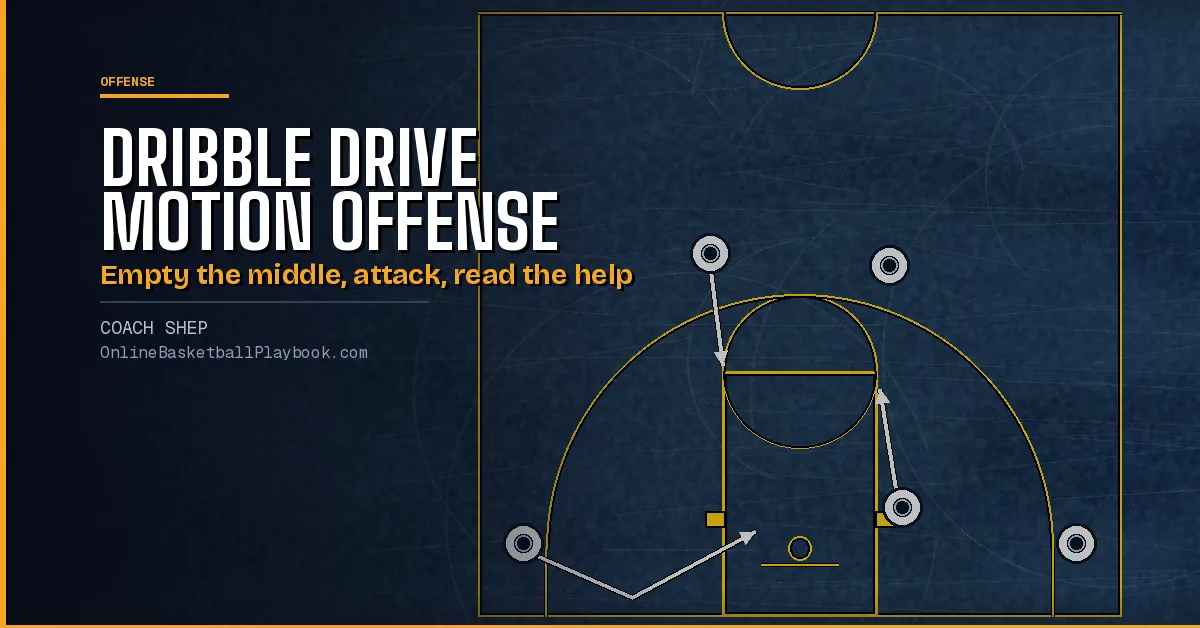
Dribble Drive Motion Offense: Spacing, Reads and Install
The dribble drive motion offense explained: 4-out 1-in spacing, the Drop, Drag and Rack zones, the read off a drive, shot diet, weak spots and the install.
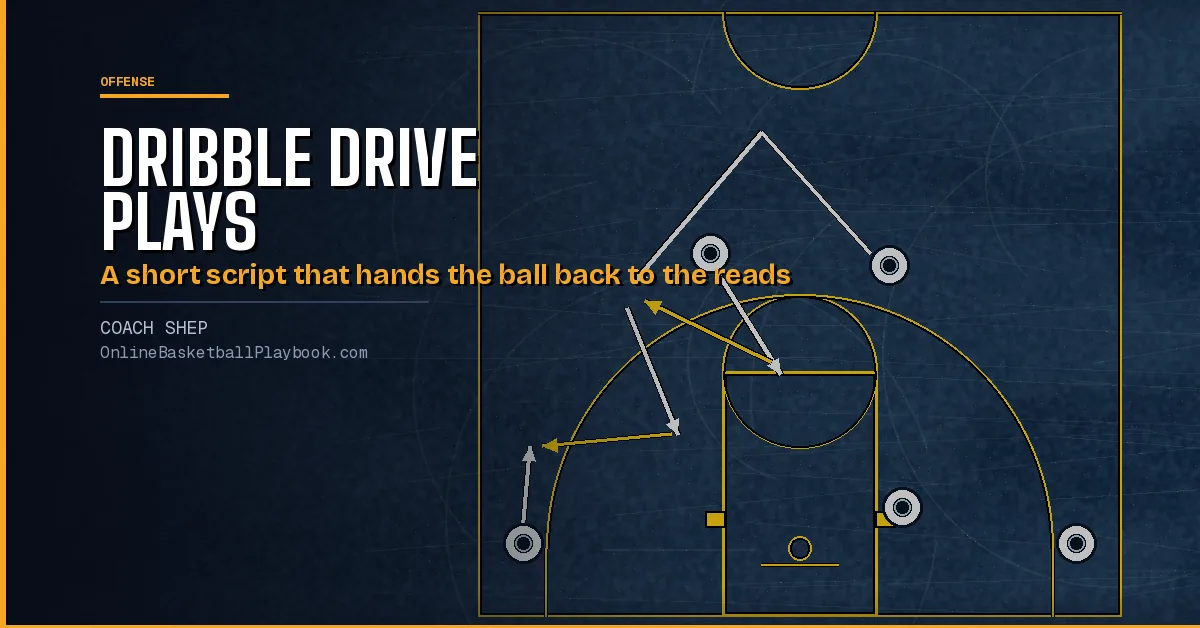
Dribble Drive Named Plays: Drop, Quick, Pop and Corner Sets
Dribble drive named plays, each drawn: Drop, Drag, Quick and Pop calls, a corner ball screen set, one entry with four finishes, the numbering and when to call one.
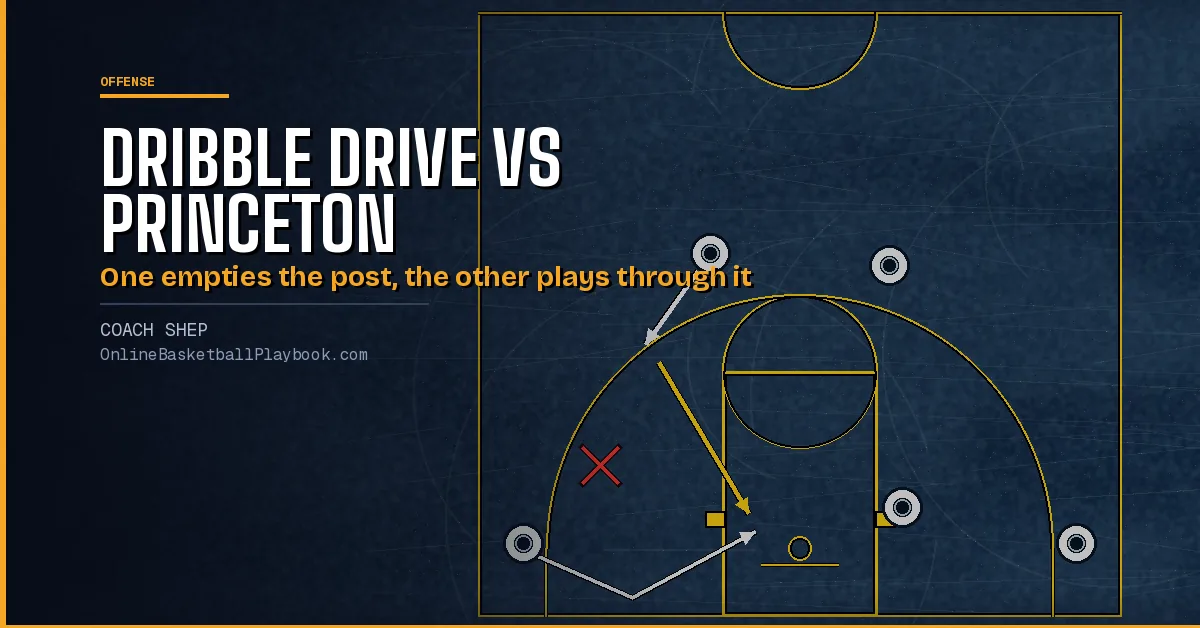
Dribble Drive vs Princeton Offense: Compared by Principle
Dribble drive vs Princeton offense, side by side: the post, spacing, dribble or cut, the backdoor read they share, screens, shots, tempo, personnel and borrowing.