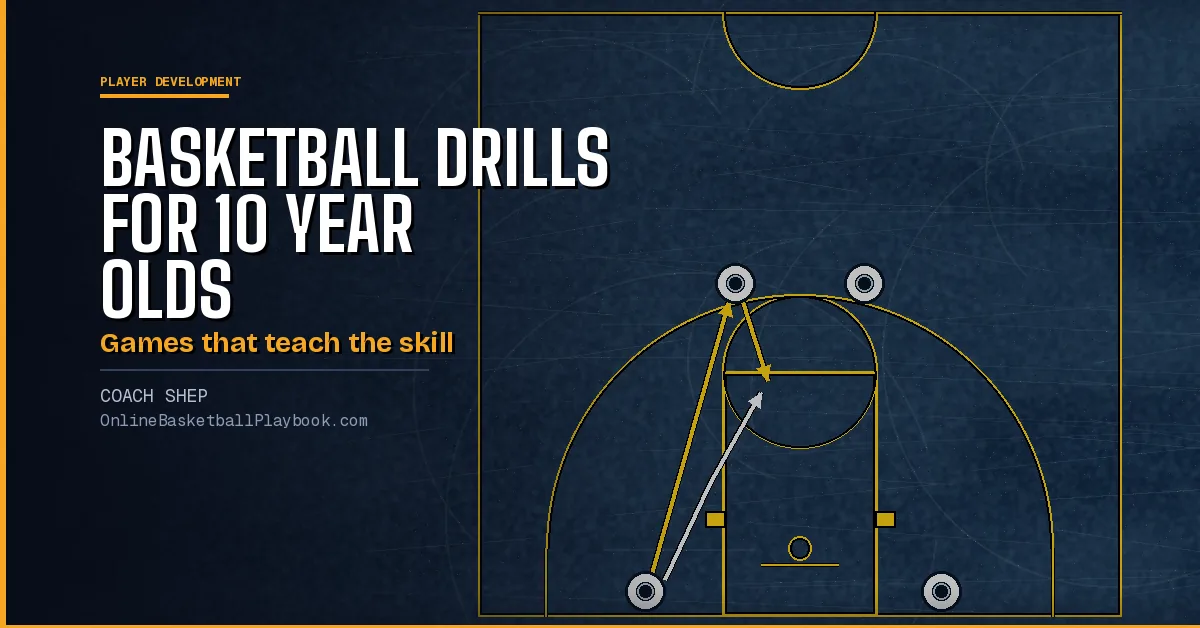
Basketball drills for 10 year olds sit on a line where youth age schemes meet. Youth bands put 7 to 10 together as youth and beginners and start middle school at 11. A grade split divides drill lists at grades 2 to 4 and grades 5 to 8, so a ten-year-old in fourth or fifth grade lands right on the seam. The Learn to Train stage puts boys 9 to 12 and girls 8 to 11 together.
This page uses only drills written for players around this age or for beginners, and says which band each one fits. It covers shooting first, then ball handling, passing, footwork and layups, a simple offense, defense and practice plans. Younger and older players have their own pages: basketball drills for 8 year olds and basketball drills for 12 year olds.
What Changes at This Age
Fun and touches come first at this age, and skill, not age, moves a player up.
- The age bands. The youth band (ages 7 to 10) focuses on comfort with the ball and fun: dribbling games, basic passing in pairs and shooting close to the basket, with everything kept moving because attention spans are short. The middle school band (11 to 14) adds drills that combine skills, transition offense, help defense, spacing and more competition.
- Training mix. The Learn to Train stage splits time at 40 percent fundamentals (half movement skills, half basketball skills), 50 percent technical work (30 individual, 20 with teammates) and 10 percent basic offense and defense. It recommends about four practices for every game and 90-minute sessions.
- Skill over age. USA Basketball's curriculum moves players up its levels by mastery of skills, not by age or grade, and says to avoid actual 5-on-5 competition in its first levels until fundamentals develop.
- Practice time. Plan about one hour a week for players 10 and under when the league sets no rule.
- Under 10. Fun, both hands, and the start of man-to-man defense.
The wider rules for coaching this age (fun first, a win for every child, praise in public and correction in private) are on coaching youth basketball and how to develop youth basketball players. Keep it fun and keep every player moving.
Basketball Shooting Drills for 10 Year Olds
Set up the shot before the drill
The equipment decides the form, so set the rim and the ball before the drill.
- Jr. NBA rim heights. An 8-foot rim for ages 7 and 8, a 9-foot rim for ages 9 to 11 and a 10-foot rim from 12 up. The wrong height ties to habits like shooting with two hands to reach the rim.
- Lower for third and fourth graders. Third and fourth graders shoot on an 8-foot rim and fifth graders on a 9-foot rim.
- Nine feet for fourth and fifth. Fourth and fifth graders shoot on a 9-foot rim, with a 27.5-inch ball in fourth grade and a 28.5-inch ball in fifth.
- FIBA Mini. It uses its own heights, so check the FIBA Mini rules or your league.
- Your age in feet. Shoot no farther from the basket than your age in feet, which for a ten-year-old is 10 feet.
- Do not rush deep shots. Let younger players use closer baskets or lighter balls.
- Shots in practice. A team practice gives each player only 25 to 30 shots, so most form work has to happen outside practice.
Use a few beginner cues.
- BEEF. Balance, eyes, elbow, follow-through. It is a four-point checklist, a beginner tool to move past once the basics are set.
- Three grade cues. "Elbow in," "fingertips, not palm" and "hold your follow-through like a photo."
- Two pictures for younger children. A waiter's tray (palm up, elbow under the ball) and a hand reaching into a jar (fingers pointing down at the finish), first without a ball, then against a wall, then at a hoop.
Form itself is on basketball shooting form. Pick one cue and repeat it until it is automatic.
Shooting Lists by Grade
| Grades 2 to 4 | Grades 5 to 8 |
|---|---|
| Form shooting at close range | Catch and shoot off movement |
| Spot shots with no jump yet, focused on mechanics | One-dribble pull-ups |
| "Make 5 in a row" challenges | Free-throw routine reps |
| One-minute partner shooting, tracking makes | Drive, kick and re-shoot |
A fourth grader falls in the first list and a fifth grader in the second. Repeat one or two drills and build on them rather than run five new ones each practice.
Swish Shooting
Three lines a couple of feet from the basket, every player with a ball. Each player tries to swish the shot, because the swish teaches enough arc, and holds the follow-through until the shot is made or missed. Players then go to the back of the line or rotate lines.
- Watch from different angles. Each angle shows a different part of the shot.
- Stay close. The distance can move out a little, but the drill is about perfect form close to the rim.
- Three per basket for beginners. Run three players per basket at three spots with no jump on the shot.
Pivot Shooting
Two lines on the baseline, a coach or parent at the top of the key in front of each line, every player with a ball. The player passes to the coach, sprints to the free-throw line, catches the return pass in a jump stop, pivots to face the basket and shoots or attacks the rim, whichever move the coach calls. The coach checks every jump stop, keeps players low through the pivot and mixes up the finishes.

Cone Race Shooting
Two teams, one ball each, 21 cones on the far baseline. Every make earns the shooter a sprint to the other end to bring back a cone, and the team with more cones wins. Everyone shoots, not only the best shooters, and tennis balls work if there are no cones.
Free-Throw Elimination
An end-of-practice free-throw game. One line at the free-throw line and one ball. When a player makes his shot, the next shooter is under pressure: a miss puts him out. The pressure stays on until someone misses, and the last player left wins. Nobody is allowed to put a shooter off, and every shot goes through the full free-throw routine.

Shooting with a read
- 4-on-3 shot hunt. Four offensive spots against three defenders, no dribbling, so players learn to pass up a good shot for a great one.
- Hand-signal partner shooting. A partner drill in which the passer's hands tell the shooter what to do: target hands up means pass it back, hands down means shoot.
Both are beginner drills. More shooting work is on basketball shooting drills, and the free-throw routine is on free throw shooting.
Ball Handling Games
The ball-handling lists split by grade the same way as the shooting lists:
| Grades 2 to 4 | Grades 5 to 8 |
|---|---|
| Stationary dribble series: right, left, crossover, low | Full-court zig-zags with a change of pace |
| Red Light, Green Light | Two-ball dribble series |
| Cone slalom | 1-on-1 in a small box |
| Mirror dribble with a partner | Escape dribble and pass |
The cues are "pound the ball, don't pat it," "dribble low, wide and strong" and eyes up. Avoid long dribbling lines and use stations so every player gets touches.
Three tag games fit ages 7 to 10:
- Sharks and Minnows. One or two sharks with no ball. Everyone else (the minnows) starts on the baseline with a ball and tries to dribble to the other baseline without being tagged. A tagged minnow stands where he was caught with the ball between his feet and becomes a scarecrow who can tag anyone who comes within reach. The last minnow wins. A dribbling violation puts a minnow out, and a time limit keeps the game moving.
- Dribble Tag. Everyone dribbles, the taggers too. A tagged player sits out until one dribbler is left. If the taggers cannot catch anyone, let them run without a ball.
- Freeze-tag dribbling. Two taggers without balls. A tagged dribbler freezes with legs wide and the ball on his head until a teammate rolls a ball through his legs. Switch taggers every couple of minutes.

A 7-to-10 session adds pressure drills.
- Retreat Dribble. A partner suddenly steps in front of the dribbler, who plants, pushes off, hops back to make space and changes direction. The partner is only a cue, not a real defender, and the players switch every 30 to 45 seconds.
- 1v1 Dribbling. The dribbler has to get the ball across half court against a partner, a steal goes back to the dribbler, and a lost ball restarts from where he last had control.
- Dribble Knockout. Everyone dribbles in a shrinking area and tries to knock other balls away.
More are on Sharks and Minnows and how to dribble a basketball. Keep the ball low, the eyes up and every player moving.
Passing and Catching
| Grades 2 to 4 | Grades 5 to 8 |
|---|---|
| Partner passing challenge: 10 perfect passes in a row | Pass and relocate |
| Circle pass and cut | Drive and kick series |
| Monkey in the Middle in small groups | 3-person weave |
| Passing relay races | Pressure passing, 3v2 keep away |
Pass to a target, make the pass catchable and add pressure in steps.
- Pass cues. "Step to your target," "snap it" and fake one way to pass the other. Praise catchable passes.
- Add pressure in steps (grades 4 to 6). Partner passing for form, a defender shadowing the passer, passing with movement, then live 3v3 with an emphasis on ball movement.
- Call the pass. In partner passing, the coach names the pass (chest, bounce, one-hand push), changes it every minute or so, and moves the partners apart when it gets too easy.
- Two hands, two eyes, two feet. A catch standard worth keeping at any age.
The passes themselves are on basketball passing drills and the chest pass. Throw to a target and catch with two hands.
Footwork and Layups
One footwork list serves every age.
- Jump stop to pivot. No ball at first.
- Pass, pivot and rip. Then cut and replace.
- 1-on-1 in a close space. Use the cues "land on two," "pivot like you're squishing a bug" and "cut with purpose, don't drift."
- Teach the jump stop in four steps. One go-and-stop drill: the landing stance, then with no ball, then after a dribble, then on a catch.
Pivoting is on basketball pivot footwork.
Layups come in stages.
- Step by step. One-step, two-step, one dribble, then several dribbles.
- Spread it over four practices. Start with one-foot hops and air layups. Made shots are not the point early.
The full progression is on how to do a layup and layup drills. Land on two feet and finish with patience.
Get the next coaching guide in your inbox
One email when a new guide or diagram set goes up. Free.
A Simple Offense for 10 Year Olds
Keep the system small.
- No set plays under 10. Skip them entirely.
- Read the defense. Teach players to read the defense instead of running plays.
- No plays beyond one out-of-bounds play. For first through sixth grade, use a spacing set only to stop bunching, plus a first-shot mentality, because passing up shots at this age ends in turnovers more often than better looks.
Run the 5-out with every youth team: all five players start outside the three-point line at five spots (two corners, two wings and the top of the key), and because it is positionless, all five pass, cut, dribble, shoot and screen. The youth rules are three:
- Cut after every pass. The passer cuts hard to the basket.
- Fill toward the ball. Teammates fill the open spot nearer the ball.
- Back cut when denied. A player whose defender is in the passing lane cuts behind him to the rim.
In the first progression, a pass from the top of the key to a wing sends the passer cutting through the lane to the opposite corner while the two players on the far side fill up toward the ball. Start the progression 5-on-0 with cones on the five spots.


A game that teaches the same reads is 4-on-4 with no dribbling. The full offense is on 5-out motion offense and pass and cut motion offense, and the cuts on cutting in basketball. Cut after every pass and fill toward the ball.
Defense
Teach man-to-man at this age. The Learn to Train game rules call for player-to-player defense.
- Man-to-man only. Most youth plans here teach only this at this age.
- No zone. Zones beat kids only because they cannot yet shoot from outside or throw the skip pass, so the win teaches nothing.
- Zone at 10. Save zones for ages 10 and up, which allows one sooner than most.
- The pistol cue. For younger children, one finger pointing at the ball, one at your player.
More on the choice is on the best defense for youth basketball. Know where the ball is and where your man is.
Practice Plans for This Age
| Plan | Length | Shape |
|---|---|---|
| Grades 4 to 8, five blocks | 60 min | Warm-up 10 (ball handling and movement), skill work 20 (one or two fundamentals), game situations 15 (1v1, 2v2, 3v3), team concepts 10, wrap-up and free throws 5 |
| Ages 7 to 10, small-sided finish | 60 min | Warm-up 10, skill work 25, team strategy 10 (a 1-4 press break, man-to-man or 5-out motion), small-sided game 10, cool-down 5. Practice goal: bringing the ball up against pressure |
| Learn to Train, 90 minutes | 90 min | Introduction 2 to 3, warm-up 5 to 12, teaching progression 30 to 45, games 20 to 30, debrief 5 to 12. New skills early while players are fresh |
| Grades 3 to 5, fundamentals first | 90 min | Fundamentals 45, defense 20, offense 20, flex 5 |
Build the session around one theme and short, coached games.
- Defense and communication (grades 4 to 6). Ball tag warm-up, a closeout drill, mirror slides, a 4v4 shell drill, 3-on-3 scramble, a free-throw challenge, a fast break drill and a closing huddle.
- Short scrimmages. Keep scrimmages for grades 2 to 4 to four to six minutes, coached in real time.
- 3-on-3 place and attack (ages 7 to 10). The offense inbounds from the baseline and dribbles and passes the ball to half court, places it on the line, and a teammate who did not place it picks it up and attacks the basket while every defender must first touch the baseline.
- Coach quietly. Say little during the game and use what happens to plan the next practice.
The case for small-sided games (more touches and simpler reads) is on reasons for small-sided games, and more youth practice material is on basketball practice drills for youth. Plan one theme, keep the games short and let the players play.
Questions Coaches Ask
What are good basketball drills for 10 year olds?
Drills for this age include dribbling tag games (Sharks and Minnows, Dribble Tag, freeze-tag dribbling), partner passing, close-range form shooting, Pivot Shooting, jump stop and pivot work, staged layups and small-sided games such as 3-on-3.
What are good shooting drills for 10 year olds?
Close-range form shooting, swish shooting, spot shots without a jump, make-five-in-a-row challenges, one-minute partner shooting, Pivot Shooting, cone race shooting and free-throw elimination. The age-in-feet rule is to shoot no farther out than your age in feet.
What rim height should 10 year olds shoot at?
Plans differ: 8 or 9 feet for fourth graders and 9 feet for fifth graders, and leagues set their own rules, so check yours.
What is a simple basketball offense for 10 year olds?
The youth 5-out has three rules: cut after every pass, fill toward the ball, and back cut when denied. Skip set plays entirely under age 10.
Should 10 year olds play zone defense?
Most youth plans teach only man-to-man at this age. Zone can start at ages 10 and up.
Want the printable playbook packs?
OBP Pro members get the premium playbook packs: the zone attack, out of bounds and practice plan PDFs, plus each new pack as it is finished. The membership page lists what is in each one. Or draw your own version free in PlayDraw.
See what OBP Pro includesMore Guides From This Batch
- Run and Jump Press Basketball: Rules, Rotations and Drills
- Early Offense Basketball: Pace, First Actions and Drills
- How to Beat a 3-2 Zone Defense: Sets, Screens and Reads
Back to Youth Basketball Coaching Guide and every Player Development page.
Keep Building
Related breakdowns
Basketball Drills for 12 Year Olds: Dribbling, Passing and Games
Basketball dribbling drills for 12 year olds, passing and cutting drills, decision games and a 90-minute practice, all written for players this age.
Basketball Shooting Form: Step-by-Step Mechanics
Basketball shooting form step by step, from the ready stance and grip to release and follow-through, with drill progressions and where coaches disagree.
Free Throw Shooting: Routine, Form and Drills
Free throw shooting starts with a routine the player never changes. Form cues, the mental side and drills that copy the fatigue and pressure of a game.