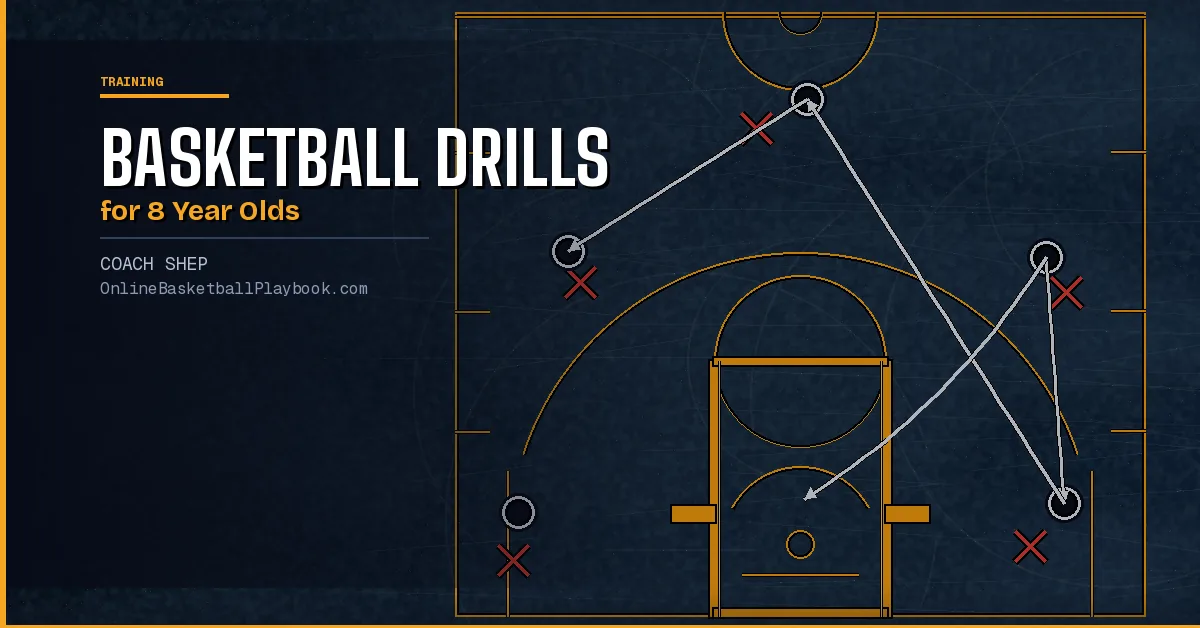
Eight-year-olds learn basketball best through games, not lectures. These drills are short, competitive, and built around one skill at a time, so kids stay engaged and actually improve.
Why Simple Drills Work for Young Players
The single biggest mistake youth coaches make with 8-year-olds is trying to teach too much at once. At this age, the brain is wiring new motor patterns, and that wiring takes repetition of one thing, not five things at the same time. A drill that isolates one read or one skill gives the brain a clear signal. A drill that asks a child to dribble, pass, set a screen, and cut simultaneously gives it noise.
The best coaches at the youth level understand that every drill should enforce a single decision or a single skill. You are not teaching the whole game in one practice. You are installing one piece at a time, then connecting them as the season progresses. This is called the part-whole method, and it works at every level from third grade to the NBA.
For 8-year-olds specifically, the drill also needs to feel like a game. Kids this age do not practice well in lines. They do not respond to long explanations. They respond to competition, scorekeeping, and the feeling that something is on the line. That is why the most effective youth coaches borrow from childhood games (sharks and minnows, knockout, red-light green-light) and use them to drill real basketball skills under pressure without the kids knowing they are being drilled.
The framework below follows that principle throughout. Each section gives you a drill that is simple enough for an 8-year-old to understand in 30 seconds and engaging enough to hold a gym full of third-graders for 10 minutes.
Dribbling Drills They Will Actually Do
Sharks and Minnows
Every player has a ball and starts on the baseline. One or two coaches (or older players) are the "sharks" in the middle of the court. On "go," the minnows dribble from baseline to baseline without getting their ball knocked away. If a minnow loses their ball, they become a shark. Last minnow standing wins.
Why it works: kids are dribbling the whole time, they are protecting their ball under pressure, and they are watching the floor for sharks, which is exactly the kind of court awareness you want them building. No one is standing in line waiting for their turn.
Red Light, Green Light Dribble
Players spread across the court, each with a ball. The coach calls "green light" and everyone dribbles in place at full speed. "Yellow light" means slow dribble. "Red light" means stop (ball held still, feet planted). You are drilling ball control, listening, and the ability to change pace on command. Add a "purple light" for crossover to mix things up once players get comfortable.
Dribble Tag
Set up a half-court grid. Every player dribbles. Two players are "it." They must stay dribbling while trying to tag other dribblers with their free hand. Tagged players sit out until the next round. This keeps the head up (you cannot tag someone you are not watching) and forces controlled dribbling under lateral movement, two skills that transfer directly to game situations.
Passing Drills That Build Court Vision Early
Partner Chest Pass Race
Pair players up facing each other about 10 feet apart. On "go," each pair completes 10 chest passes as fast as possible. First pair to 10 wins. Then move to bounce passes. Then overhead passes. Short rounds, instant results, clear winner. Kids get 30 or 40 passes in the time it would take to explain a complex drill, and the competition locks in their focus.
Three-Man Weave (Simplified)
Start with three lines at the baseline. The middle player passes to one side, cuts behind the receiver, who then passes to the third player, who passes back to the cutter. Work your way up the court and finish with a layup. For 8-year-olds, slow this down to a walk first. The footwork pattern matters more than the speed. Once they have the pattern, speed it up. The weave teaches spacing, passing on the move, and reading where teammates are going.
Circle Passing
Five or six players form a circle about 12 feet wide. One player is in the middle. The ball moves around the circle while the middle player tries to deflect or intercept it. If they touch the ball, the passer who made the mistake goes in the middle. This builds quick decisions, short accurate passes, and the habit of finding an open teammate, a skill that pays off at every level of the game.
Shooting Drills for Young Players
Form Shooting: The Pizza Waiter Cue
Before any 8-year-old shoots from distance, get their form right up close. Have them hold the ball on one hand as if they are carrying a pizza on a tray: elbow under the ball, wrist cocked back, palm facing up. That hand is the shooting hand. The other hand is just a guide on the side. Now they "serve the pizza" to the basket: push up and out, let the wrist snap forward, and hold the follow-through until the ball hits the net.
Do this without shooting first. Just the motion, 20 times, standing two feet from the basket. Once the elbow-up / pizza-tray position is locked in, start shooting from three feet. Move back only when they are making most of their attempts. Getting form right at close range will pay off for years. Letting kids heave from the three-point line with poor mechanics will make those mechanics harder to fix later.
Around the World
Mark five or six spots around the key: both sides of the block, both elbows, the free throw line. Players shoot from each spot in order. Make it, move on. Miss it, stay. First player to complete the full circuit wins. This is competitive, it enforces game-speed shooting from specific spots, and it keeps the drill moving. If a player is struggling, quietly give them the "pizza waiter" cue and let the drill correct the form without singling them out.
Beat the Star
One player is the "star" and shoots from a spot on the floor while everyone else in line also shoots from the same spot simultaneously (if you have multiple balls). Whoever makes more shots in 60 seconds replaces the star. If you only have one ball, keep a running tally and rotate on makes. The competition is what matters. Kids who play against a standard shoot harder and focus more than kids shooting in a pressure-free environment.
Lower the hoop if you can. Eight-year-olds shooting at a regulation 10-foot basket will naturally develop compensation habits: throwing the ball up instead of pushing it, leaning backward, and losing the elbow alignment they just learned. A basket set at 8 or 8.5 feet lets them shoot with proper mechanics and see success, which builds confidence and locks in the right muscle memory faster than any coaching cue.
Layup Drills and Finishing Foundations
The layup is the most important shot in youth basketball, and it is the most commonly drilled badly. Most youth layup lines have kids standing and waiting for long stretches, then taking one attempt, then going back to the end of the line. That is 8 reps in 10 minutes when they could have 40.
Two-Minute Team Layups
Set up two lines: one at the right elbow with balls, one under the basket to rebound. On "go," the shooting line dribbles in and shoots. The rebounding line grabs the ball and passes back to the shooting line. The shooting line then moves to the right and shoots again. Run it for two minutes and count makes as a team. Try to beat your record the next practice. This keeps everyone moving, and the competitive element of chasing a team record creates urgency without any player being singled out.
Right and Left Progression
Most 8-year-olds only practice right-hand layups. Run the same drill from both sides. When shooting from the right side, use the right hand and step off the left foot. When shooting from the left side, use the left hand and step off the right foot. Do not introduce footwork verbally. Demonstrate it, then walk alongside players as they approach and count "one, two, up" to cue the two-step rhythm. The goal is automatic footwork, and that takes repetition from both sides, starting at the first practice.
Mikan Drill
One player, no dribble. Stand under the basket and shoot a left-hand layup from the left side, catch the net before the ball hits the floor, move to the right side, and shoot a right-hand layup. Back and forth, 20 reps. This isolates the finish (the catch-in-the-air and soft touch off the glass) without the complexity of a full approach. It also conditions the player to use both hands without making a big deal of it, because both hands are required to complete the drill.
Making Every Drill More Effective: The One-Read Rule
Every drill in this guide follows a principle from our coaching research library's offensive breakdown drill framework: isolate one read or one skill at a time. The shark who is looking for your ball, the circle passer who might intercept, the clock running on your layup count. These are all single constraints that force a single decision. The moment you add a second constraint before the first is automatic, you lose 8-year-olds.
As the season progresses and individual skills become more natural, you can connect two actions (dribble into a pass, receive a pass and finish) but only after the individual pieces are solid. This progression approach is how coaches at every level install offense, from youth recreational leagues all the way to the NBA. The 8-year-olds who learn it in layers will be the ones who understand the game by the time they reach middle school.
Making Every Drill a Competition
The fastest way to improve the quality of any drill with young players is to keep score. Kids who are competing try harder, focus longer, and move faster. A drill that has a winner and a loser is more intense than the same drill without stakes, and more intensity means more repetitions at game speed, which is where learning actually happens.
Here are simple ways to add competition to any drill:
- Track team makes against a target number and try to beat it next time.
- Race two groups doing the same drill simultaneously. First to finish wins.
- Award points for each make and subtract points for turnovers or bad passes.
- Put a 60-second clock on everything. Urgency changes the energy in the gym immediately.
Knockout is one of the best competitive shooting games for 8-year-olds and requires almost no setup. Players line up at the free throw line, each with a ball. The first player shoots. The second player shoots immediately after. If the second player makes their shot before the first player does, the first player is knocked out. Last player standing wins. This drill creates enormous pressure on every single shot (pressure that mirrors what players feel in games) and it is genuinely fun to watch and play. Run two or three rounds at the end of every practice as a reward and a finisher.
Red-light green-light dribbling works on the same principle. When there is a consequence for stopping at the wrong time or losing your dribble, players pay closer attention than they would in a line drill where mistakes cost them nothing.
The goal is not to make every child feel like a winner all the time. The goal is to put them in situations where they care about the outcome, because caring about the outcome is what teaches them to perform under pressure. That skill transfers directly to game situations, and it starts at age 8.
- Start every drill with a 30-second explanation maximum. If it takes longer than that to explain, the drill is too complicated for this age group.
- Use "pizza waiter" to cue shooting hand position (elbow under the ball, palm up, wrist cocked) before any player shoots from distance.
- Run layup drills from both sides every practice, using a verbal "one, two, up" count to install the two-step footwork automatically.
- Add a scoreboard or time clock to every drill because competition raises intensity and gives you game-speed reps without extra effort from the coach.
- Sharks and Minnows is your best dribbling drill: everyone is moving the whole time, heads stay up, and ball protection is rewarded naturally by the game structure.
- Lower the basket when possible because proper form at 8 feet beats bad habits built reaching for 10 feet, and early success builds the confidence that keeps kids coming back.
Want more basketball coaching strategies, drills, and tools?
Join the Online Basketball Playbook newsletter →
Draw this play free in the play drawer →
Membership: the full library, playbook packs, and Pro drawing tools →
Keep Building
Related breakdowns
Fun Basketball Games for Practice: Scored Games for Any Team
Fun basketball games for practice at any level: shooting games, defense-only scoring, rebounding contests and passing games, with scoring rules and records.
Basketball Conditioning Drills for Teams: Runs, Games and Tests
Basketball conditioning drills in three styles, timed runs, conditioning inside skill drills and scored games, with the tests and yearly plans coaches use.