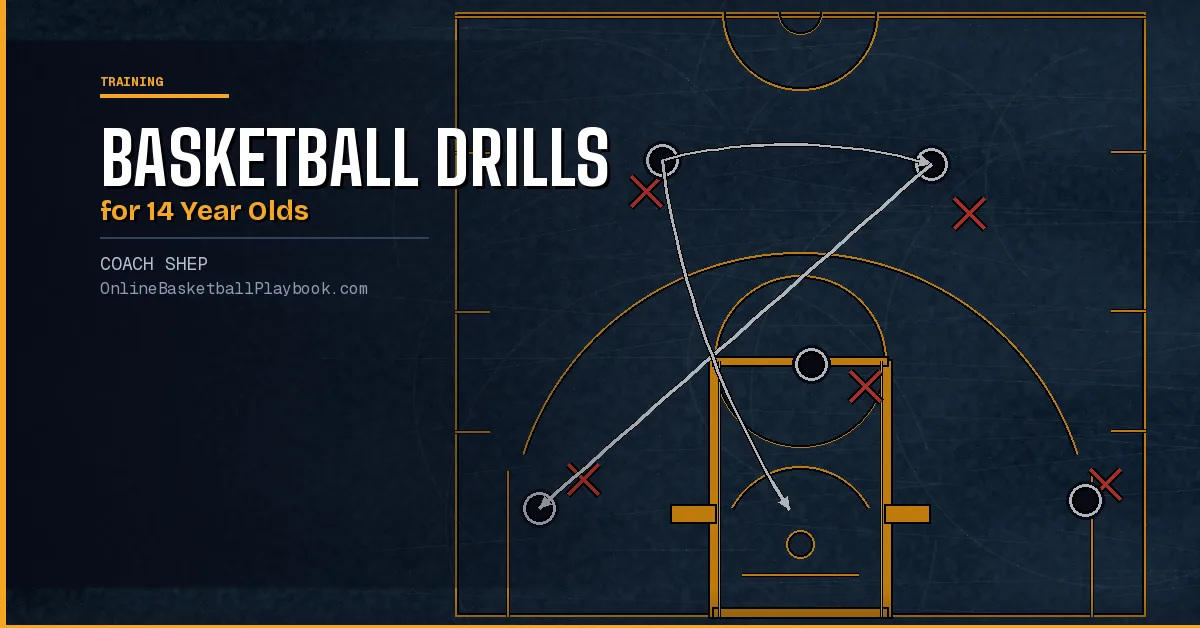
At 14, players are ready for real reads, not just reps. The drills below build finishing footwork, shooting under pressure, and 1-on-1 decision-making, the skills that separate players at the next level.
Why Breakdown Drills Beat Scrimmage-Only Practice
Most 14-year-old teams run too much 5-on-5 too early. Scrimmage hides individual weaknesses under team chaos. A player who can't finish with his left hand just stops going left in a game. A player who can't read a closeout just pull-up mid-ranges every time. Neither player gets better because the live-game pace never isolates the skill that needs work.
Breakdown drills fix this. The concept, sourced from coaches at every level from high school to the NBA, is simple: isolate one read or one skill at a time, drill it at game speed, then scale up to full offense. You don't run 5-on-5 Princeton offense until players own the backdoor cut in 2-on-2. You don't run drive-and-kick sets until players own the finish.
At 14, players are physically capable of game-speed reps and mentally ready to process reads, but only if the drill strips the situation down to one decision. Give them that, score it competitively, and you'll see faster development than a month of unstructured scrimmage.
The other advantage: breakdown drills create equal reps. In a 5-on-5 scrimmage, the point guard handles the ball 70% of the time and your wings develop slowly. In a 2-on-2 drill rotating through four players, everyone touches the ball, everyone reads, everyone finishes. That matters especially in youth development where roster depth and playing time vary widely.
Finishing Footwork: The Foundation Every Drill Needs
Before running any of the drills below, your players need a finishing footwork base. Coaches from Walberg to Welling to the Kentucky/NBA level agree on this sequence: build the layup before you build the offense. If players can't finish with both hands, on both sides, at game speed, every drive-and-kick drill you run will break down at the rim.
The Layup Progression
Run this daily as a warm-up before any skill work. Start with no ball, then add a carry, then a one-dribble drive, then a two-line chase pairs drill. The goal isn't to go fast immediately. It's to build correct footwork patterns that survive game speed later.
The full progression includes: straight layups (both sides), reverse layups, crossover-step layups, and hesitation finishes. Add the jump-stop power layup once the running layup footwork is clean. At 14, players should be able to finish all four types with both hands before your first competitive drill of the season.
The X-Layup Drill
Two lines at opposite elbows, two balls. Player 1 dribbles baseline, passes to Player 2 cutting to the opposite elbow, then sprints to fill Player 2's spot. Player 2 attacks the basket with the pass and finishes, then resets. The drill runs continuously. It's conditioning and finishing combined. Score it: how many makes in two minutes? That number goes up as footwork sharpens.
Crack Back
A player sprints to a touch-point at the three-point line, cracks back hard toward the basket, and receives a lead pass to the inside shoulder. The passer must throw to where the player is going, not where they are. This drill trains the catch-while-moving layup and teaches passers to lead cutters. Two skills in one rep. Use it as a pre-scrimmage warmup and watch your team's cutting and finishing both improve within a few weeks.
Game-Speed Shooting Drills
The principle that applies to every shooting drill: game shots, game spots, game speed. Stationary spot shooting has its place in form work, but once form is established, every rep should replicate how the shot happens in a game.
Five-Spot Shooting
Five spots around the arc. Player catches and shoots from each spot. No dribble unless the drill specifies one. The key coaching cue: "ready before the pass." Players must be squared up, feet set, and hands ready before the ball arrives. A player catching with their feet wrong is already late. Track makes from each spot and track it over time. Progress only when players can reliably hit a target percentage from each spot.
Olympic Shooting
High-volume competitive shooting with a partner and two balls. One player shoots, one rebounds and passes. Count made shots in a set time, switch roles, compare. Add a conditioning layer: miss a shot, you run a designated touch before the next rep. The scoring keeps intensity up; the touch-run keeps players accountable for misses without a long stoppage.
Backpedal Shooting
Player backpedals to half-court on the coach's signal, sprints to the baseline, then receives a pass at the wing or corner and shoots. The sprint before the catch simulates transition basketball. Players must gather their footwork coming out of a dead sprint, which is exactly what happens in live games after a defensive rebound and outlet pass. This is the drill that separates players who can only shoot when standing still from players who shoot well in transition.
Shot Fake to Side Dribble
From the three-point line, player catches, shot-fakes, takes one dribble to either side, and shoots the pull-up. Rotate the direction each rep. This drill is common in high-level NBA skill work because it replicates one of the most frequent scoring actions in any offense. At 14, most players can't execute it cleanly at game speed. Running it weekly builds an advanced skill before players enter high school.
1-on-1 and 2-on-2 Decision Drills
At 14, 1-on-1 and 2-on-2 drills are where decision-making actually develops. Full-court 5-on-5 moves too fast for a player to isolate and process a single read. Small-sided drills slow the situation down to one choice, let players feel the consequence immediately, and build habits that hold up when you add players and speed.
1-on-1 from 15-20 Feet
Player starts with the ball at a guard or wing position, defender is live. The offensive player must read the defender's positioning: is there a gap to drive? Is the defender sagging enough to take the shot? Run this drill in short sets. Three reps, rotate. Keep it competitive: track who wins. When players are just playing 1-on-1 without a purpose, the defense gets lazy and the offense gets bad habits. When it's scored and rotated, both sides compete.
Add the constraint for more advanced groups: no mid-range pull-ups unless the drive is cut off. Force the player to either finish at the rim or shoot a three. This is a version of the Blood drill concept. The constraint coaches the shot diet without a lecture.
2-on-2 Closeout
Post-under pass, two defenders sprint to close out, offense reads the approach. If the closeout is long, shoot. If it's tight, drive. If the driver is cut off, kick to the weak side for the open three. This is a full decision chain in a 2-on-2 format. It installs drive-and-kick reads faster than any amount of chalk talk. Run it with a rotation. Winners stay, losers go to the end of the line.
Partner Penetrate and Pitch
Two players, 20-25 feet out. One drives baseline or middle, one holds their position as the release valve. The driver reads the help and either finishes or kicks to the partner. The partner must be "ready before the pass." Feet set, hands up. This is the core drive-and-kick skill that every high-level offense runs. Mastering it in a 2-on-0 format before adding defenders lets players build the habit of looking for the kick without feeling pressure first.
Small-Sided Games with Built-In Reads
Small-sided competitive games are the bridge between isolated breakdown drills and full 5-on-5 scrimmage. They preserve the advantages of drills (small groups, focused reads, high reps) while adding live defense and real consequences. Every drill in this section ends with a competitive result: someone wins, someone loses, and the score is public.
3-on-2 Advantage (Scramble)
Three offensive players attack two defenders in a half-court or short-court format. The offense has the numbers advantage. They should score almost every time if they make correct decisions. The drill teaches players to recognize the open man quickly, pass ahead of the defense, and trust their reads. If the offense turns it over or takes a bad shot from an advantage position, they run. The consequence eliminates lazy decision-making faster than any verbal correction.
No-Paint Constraint Game
3-on-3 or 4-on-4 with one rule: no shots inside the paint. Every bucket must come from a kick-out three or a mid-post jump shot. This forces spacing, ball movement, and drive-and-kick execution. Players who reflexively attack the basket without reading the defense suddenly have to adjust. Within two or three runs of this game, you'll see improved perimeter spacing and sharper kick-out recognition. Remove the constraint and watch those habits carry into open scrimmage.
Make-It-Take-It with Free-Throw Validation
Small-sided scoring game where the team that scores keeps possession, but only after the scorer makes a free throw. Miss the free throw and possession switches. This teaches two things simultaneously: composure at the line and competing for offensive rebounds. The free-throw validation component comes directly from the Blood drill philosophy: "constrain to coach the diet." The rule teaches without a stoppage.
When running small-sided games, keep the scoring visible and public. Write it on the whiteboard, track it over multiple practices, and post the results. Players who know their performance is recorded compete harder, which means better habits form under more realistic pressure. A drill that feels like a practice game develops better than one that feels like an exercise.
Full-Court Drills That Build Conditioning and Skill Together
At 14, conditioning and skill development should not be separate parts of practice. When you run players for conditioning and then drill separately, you're wasting time. Full-court drills that score skill while demanding conditioning are the highest-leverage use of practice time. Players get fit, they get reps, and they build finishing skills at the end of sprints, which is when games are actually won and lost.
Full-Court Speed Layups
A target: make 50 layups in two minutes. Two lines, two balls, continuous full-court. Both lines are shooting simultaneously, so missed layups don't stop the drill, players rebound and pass back. Track the total over time. Improvement on this drill metric directly correlates with improved conditioning and finishing. It also builds team accountability. Every player's miss affects the group's count.
11-Man Continuous 3-on-2
Three attackers, two defenders, six players waiting. The offense attacks, the defense tries to stop them. After the possession ends, the two defenders become three attackers the other way, joined by one new player from the line. The rebounder on the original possession sprints back to defense. The drill never stops. It teaches fast-break decisions, transition defense, and conditioning simultaneously. Players must communicate, sprint lanes, and read on the fly. There's no time to set up a play.
The Chase Drill
Player drives full-court with one dribble per designated zone. A chasing defender closes from behind. The offensive player must finish at the rim through contact or over the defender. No slowing down, no protecting the ball. Miss the layup under pressure, you do pushups. Make it, the defender runs. This drill teaches courage at the rim and builds the finishing habits players need when defenses recover. Most 14-year-olds will slow down unconsciously when a defender closes in. This drill trains through that hesitation.
Kentucky Shooting Series
A continuous sequence: weave layups, two threes from designated spots, repeat to a team target. The transition from weave to spot to weave creates game-realistic fatigue before shooting. Players who can only shoot well when fresh are not prepared for real games. The Kentucky series is a standard high-school and college conditioning-and-shooting benchmark. Running it regularly gives coaches a measurable standard to track team shooting fitness over a season.
How to Structure a Practice Around These Drills
The biggest mistake youth coaches make is running drills in isolation without connecting them to a practice arc. Each drill should build toward something. Here's a framework that works at the 14-year-old level:
Opening segment (10-15 min): Finishing footwork. X-Layups, Crack Back, the full layup progression. This is conditioning and skill simultaneously. No wasted time.
Shooting block (10-15 min): Five-Spot or Olympic Shooting. Get every player 20-25 game-speed makes before any team work begins.
Breakdown skill (15-20 min): Pick one skill for the day: 1-on-1 reads, 2-on-2 closeouts, or the Partner Penetrate-and-Pitch. Run it in short, competitive sets. Keep score. Rotate quickly so reps stay high.
Small-sided game (15-20 min): 3-on-3 or 4-on-4 with one constraint that ties to the day's skill. If you drilled closeout reads, the constraint forces a drive-and-kick decision. If you drilled finishing footwork, the constraint removes dribbles so players must attack off the catch.
Full-court finish (10 min): Speed Layups or the Chase Drill. Players are tired here. That's the point. Finishing under fatigue at the end of practice is exactly what the end of close games demands.
This structure gives every player individual development reps, decision-making reps, and conditioning in a single 60-70 minute practice. Nothing is wasted. Every drill connects to the next.
One last principle: make every drill end with a make. Hubie Brown has said this for decades and it holds at every level. When players finish a rep on a missed shot, the final image they carry out of the drill is a failure. When every rep ends on a made basket (even if it takes an extra attempt), players leave the drill with a success pattern in their muscle memory. Over a season, that matters.
- Isolate one read per drill. Don't run complex sets before players own the individual skill. Teach the backdoor cut in 2-on-2 before installing it in 5-on-5 Princeton.
- Score every competitive drill and post results. Public scoring makes players compete harder and builds the pressure habits that transfer to real games.
- Build finishing footwork first. Run the layup progression (both hands, both sides, straight/reverse/crossover) before any offensive drill every single practice day.
- Use constraints to coach shot diet without lecturing. "No mid-range" or "make a free throw to validate the score" changes behavior faster than stopping play to explain it.
- Combine conditioning and skill in full-court drills. Speed Layups, the Chase Drill, and 11-Man 3-on-2 all build both simultaneously. Never run sprints separate from basketball work.
- End every rep on a make. The final action of every drill rep should be a made basket, the success pattern that carries into game-time finishing.
Want more basketball coaching strategies, drills, and tools?
Join the Online Basketball Playbook newsletter →
Draw this play free in the play drawer →
Membership: the full library, playbook packs, and Pro drawing tools →
Keep Building
Related breakdowns
Fun Basketball Games for Practice: Scored Games for Any Team
Fun basketball games for practice at any level: shooting games, defense-only scoring, rebounding contests and passing games, with scoring rules and records.
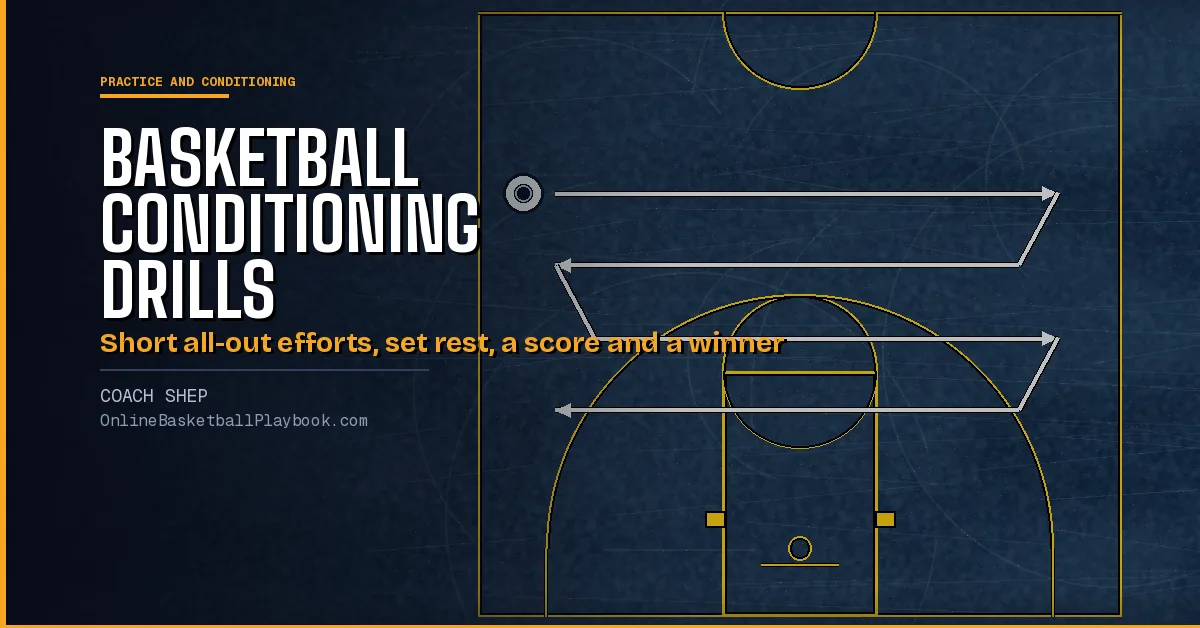
Basketball Conditioning Drills for Teams: Runs, Games and Tests
Basketball conditioning drills in three styles, timed runs, conditioning inside skill drills and scored games, with the tests and yearly plans coaches use.