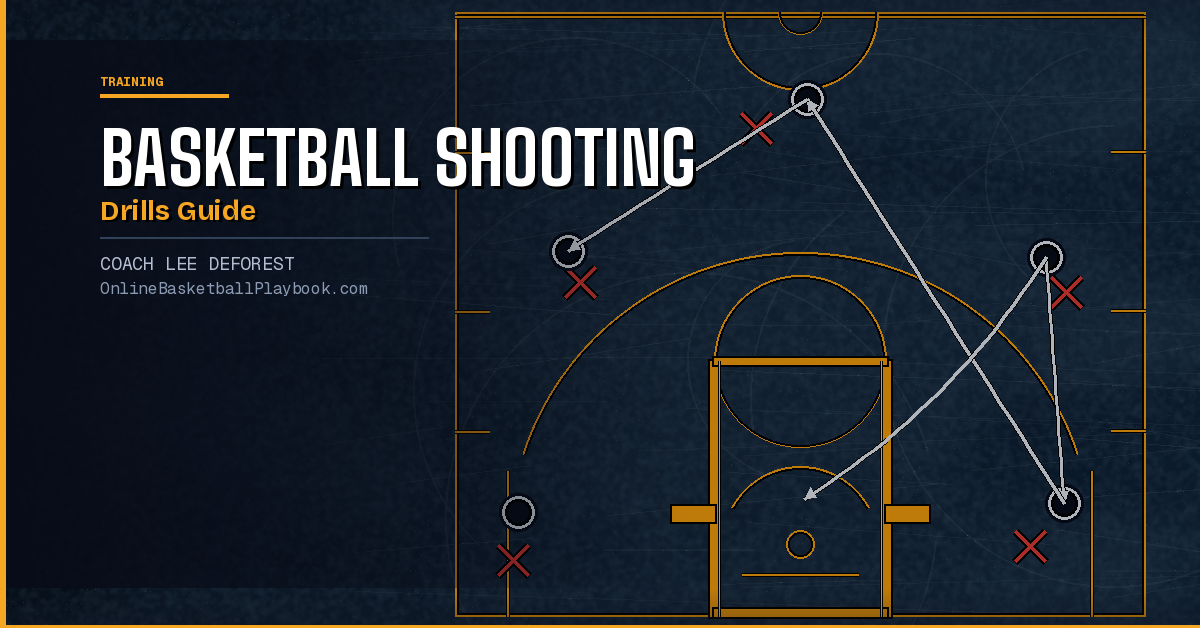

Most shooting drills make players better at standing still and catching — not at scoring in games. These drills fix that: form first, then scored reps with movement, competition, and game-speed actions before every shot.
Why Most Shooting Drills Fail
Walk into any gym before practice and you'll see the same thing: players standing on a spot, catching a clean pass, and shooting a clean look. Over and over. The problem is that none of those conditions exist in a game. In games, players catch off a cut or a screen. They shoot off a pull-up. The pass is late, the defense is closing out, and they're already a little tired.
Aimless volume — catch, shoot, catch, shoot — grooves form only if form was already right. For most players, it just bakes in the same flawed mechanics at higher volume. Kevin Eastman's framework cuts to it directly: train game shots, from game spots, at game speed. Every drill design decision flows from that standard.
Three habits separate shooters who improve from those who don't: they keep score on every rep, they add a competitive element (a timer, a partner, a record to beat), and they earn the shot with an action before they catch the ball. When those three conditions are present, shooting practice transfers to games. When they're absent, players get comfortable in practice and struggle in games.
Form First: Building the Foundation
Before volume, build form. Before form with a ball, build form without one. This sequence is used by Jay Wright at Villanova, John Beilein at Michigan, and Jay Hernandez in competitive shooting clinics — not because they all read the same book, but because it actually works.
The Youth On-Ramp: Pizza Waiter and Cookie Jar
For younger players or anyone rebuilding mechanics, start with two cues. "Pizza waiter" means the shooting hand goes under the ball with a flat palm, as if carrying a pizza. The elbow sits under the hand, the hand sits under the ball, and the whole stack is directly over the shooting knee. "Cookie jar" is the follow-through — the arm finishes high with fingers dangling down, reaching into the cookie jar on the top shelf. Run these cues against a wall before adding a rim.
Set Lifts (Villanova)
Jay Wright opens every Villanova practice with Set Lifts. The player holds the ball in shooting position, lifts straight up without jumping, and holds the follow-through — full arm extension, fingers pointing down at the rim, elbow above eye level — until the ball lands. No rim contact. Just the lift and the hold. The goal is training the elbow-under position and a high, extended release before any competitive pressure is added.
Wright's teaching rhythm: "jumping and lifting / shooting on the way up." Players who rush the release and shoot on the way down lose arc and consistency. The ball should leave the hand at or near the top of the jump, not on the descent.
Inside Foot on Every Catch
Both Wright and Beilein teach this as a fundamental footwork rule, independent of any offensive system: on every V-cut or screen-catch, plant the inside foot first. During technique work, players say the sequence out loud — "1-2, lift, follow through" — so the footwork becomes automatic before it needs to be fast. Footwork is the platform the shot is built on; if the feet are wrong, the upper body compensates and the shot is inconsistent.
Scored and Competitive Shooting Drills
Every shooting drill should have a winner. That might be a time limit, a make target, a record to beat, or a consequence for missing. Here are the most effective formats.
Personal Best / 30-30
The player shoots for 30 seconds from a single spot, counts makes, records the number, and tries to beat it next time. Simple, self-competitive, and instantly scalable — add a clock and a scoreboard and you have a culture. Jay Hernandez uses this as a baseline workout format because it requires zero setup and produces immediate buy-in from players who are competitive with themselves.
Star Shooting
Five spots on the arc or mid-range. The player shoots from each, moving to the next spot after every shot — makes or misses. Set a time limit and count makes. Hernandez's variation adds a screen or a DHO before each catch to make the drill game-real. The rule Shaka Smart uses at Texas applies here too: you can't shoot the same spot twice in a row. You must relocate before shooting again. That one constraint turns a block drill into a movement drill.
Purdue Drill
Make four three-pointers in one minute with a rebounder and a passer. The shooter sprints from baseline to half-court between each shot. Miss a target? The shooter runs for each point below four. Tom Billeter (Augustana) uses this format from his POWER Clinic series — the scored consequence layer is what makes it transfer. Players who know they're running if they miss four focus differently than players shooting with no stakes.
3-Minute Shooting (Texas)
Shaka Smart's Texas program tracks a named drill called "3-Minute" with an explicit team record posted in the gym: the record is 157 makes. There's also an Evans drill with a record of 219. Players shoot, move, and chase posted records rather than abstract make percentages. Naming drills and posting records turns shooting into a team culture — players compete against the record board, not just each other.
Beat the Pro
Head-to-head against a "pro" opponent. When the player makes a shot, they score one point. When the player misses, the pro scores two. First to a target wins. The asymmetric scoring — your miss costs double — trains players to value high-percentage looks and builds the discipline to restart an action rather than force a contested shot.
Make every rep competitive — against the clock, an opponent, or yourself. A shooting workout should have a winner. The most dangerous person is the one who is continually improving.
— Shooting Development, Basketball Vault
Game-Speed Movement Drills
The principle from Larry Brown's SMU drill bank is clear: every drill should include a realistic offensive action before the shot. Players are always responding to a read — a closeout angle, a roll-or-pop decision — before pulling the trigger. Standing still and catching is not a game-realistic event for most of your shots.
Zipper Cut Into Catch-and-Shoot
The player starts at the low block, cuts straight up to the elbow (zipper cut), catches at the elbow, and shoots the mid-range jumper. The rebounder delivers a pass timed to the cut. The action before the shot mirrors a common game action, so the read and the footwork are trained together, not separately.
Baseline Drive and Throwback
Player attacks baseline, the defense shows, and they throw back to a shooter relocating on the weak side. The shooter catches off movement and fires the three. This drill trains two players simultaneously — the driver reads the defense, the shooter reads the kick — and the shot comes off the catch with momentum, not a clean standing catch.
Series 5 and Series 7 (Billeter)
Tom Billeter's scored shooting series feed shots off a single passer. Series 5 progressions include a jab-step into a curl, wing jumper, wing three, flare, and ball-fake drive. Series 7 adds progressions off screens. The key rule: never miss a shot the same way twice, and add bad passes so reps mirror what actually happens in games. Two-ball shooting variations with 3-4 players add constant communication and relocation after every shot.
Pull-Up and Hesitation
Coaches underinvest in the pull-up. A player who takes one or two dribbles and pulls up around the free-throw line is as valuable as a pure three-point shooter — and the defense has to account for that threat to keep the three-point line open. Drills from the Rumjahn complete motion guide emphasize "catch ready to attack" as the default posture: players read the defense's depth on the catch and decide whether to shoot, drive, or pull up, not whether to catch and reset.
Diagnosing and Fixing Shot Errors
Volume doesn't fix mechanics. If a player misses consistently in the same direction, adding more reps bakes in the error. Dr. Hal Wissel's error-correction framework gives coaches a diagnostic pathway: identify the mechanical cause of the miss first, then prescribe the specific drill. Don't repeat a generic cue until you know what's wrong.
Short Shots
Cause: release point is too low; the ball leaves the hand before full arm extension. Correction: hold the follow-through with the arm fully extended, fingers pointing down at the rim, until the ball lands. Don't let the elbow drop early. Run form shots against a wall and hold the follow-through for three full seconds on each rep.
Wide Right or Wide Left
Cause: the guide hand thumb pushes across the ball at release. This is the most common error in developing players and the hardest to feel without a coach or video. Correction: thumb-lock drill — hold the guide-hand thumb up and away from the ball, then shoot one-handed form shots until the ball tracks straight. Film from behind the player makes the thumb push visible immediately.
Flat Arc (Line Drive)
Cause: flat wrist at release; elbow not finishing above eye level. Correction: pick a point on the gym ceiling above the front of the rim and aim the arc there. This ceiling-target cue immediately adds four to six inches of arc on most players. The physical target gives the brain something concrete to aim for instead of the abstract instruction to "get more arc."
Inconsistent Release Timing
Cause: rushed release — shooting before the natural rise of the jump peaks. Correction: the "Sight-Set-Shoot" rhythm protocol. Establish the target (sight), pause momentarily at the set-point with the ball above the shooting shoulder (set), then release on the way up (shoot). Three distinct beats, not one continuous motion. Players who rush the release often describe it as trying to "get the shot off" rather than "letting the shot go."
Contested Shot Rate (Pitino's Rule)
Rick Pitino measured Louisville's contested-shot percentage at 22% — compared to the NBA baseline of roughly 42%. His practice rule: if a shot would be challenged, pass it back and restart the action. No exceptions. This is teachable as a number, not a feeling. Pair this rule with George Karl's "no tough twos" mandate and you have a practice-to-game framework that builds shot selection alongside shooting mechanics.
When a player misses consistently in the same pattern, resist the urge to just say "bend your knees more" or "follow through." Work backward through the diagnostic: check arc angle first, then hand position, then elbow alignment, then foot balance. The root cause is rarely what the player or coach first suspects, and prescribing the wrong correction drill wastes reps and builds false confidence.
Free Throws Under Fatigue
Free throws in games happen when players are tired — after a hard drive, late in a close game, after guarding full-court. Most teams practice free throws fresh: at the start or end of a dead period, with full rest. That gap between practice conditions and game conditions explains why players who shoot 80% in warmups shoot 65% in the fourth quarter.
The fix is simple: bake free throws into the workout at points of fatigue, not at rest. Jay Hernandez shoots ten after the second turn in a workout and ten after the last set. Rick Pitino ends 1-on-1 live games with free throws and tracks the percentages — game free throws happen when players are exhausted, so that is when you train them.
Dr. Hal Wissel's free-throw protocol includes eyes-closed sets after eyes-open sets to build feel and muscle memory independent of the visual target. One hundred free throws per day, tracked, with half shot fatigued. Ball and head should be positioned over the free-throw line at the moment of release to project the ball toward the rim — not behind the line.
Michigan's qualifying standard connects conditioning to shooting directly: players run 17 sidelines in one minute before earning practice reps. The logic is explicit — practice is a reward for fitness, and shooting under fatigue is only trainable if players are fit enough to reach that fatigue level and still function technically.
Building a Shooting Culture With a Record Board
The cheapest coaching tool in the gym is a record board. Name three or four drills. Post the records. Let players sign their names next to their marks. That one change turns shooting from a chore into a competition — and players practice differently when they know a record is there to beat.
Shaka Smart's Texas program is the clearest example of this at scale. Named drills with posted team records — 3-Minute (record 157), Evans (record 219) — create a shared standard that outlasts any individual practice. Players who weren't there when the record was set still know about it and shoot toward it. The record board is institutional memory for your shooting culture.
Jay Hernandez's named drill bank includes Streak, Star, Around the Horn, M Drill, Personal Best, Burner, Doubles, and Over-and-Back. You don't need all of them. Pick two that fit your practice structure and your players' level, post the records, and enforce the rule: there's always a winner and a recorded number. "The most dangerous person is the one who is continually improving" — the record board makes improvement visible and gives it stakes.
For programs with multiple teams (or age groups), run a board per team. Younger players competing against younger players' records still feel the culture — they don't need to beat a varsity record to care about beating their own.
- Start with form, not volume: One-handed form shots against the wall, then Set Lifts without jumping, before any competitive shooting — this sequence is used by Wright, Beilein, and Hernandez independently.
- Score every rep: Assign a make target or a time limit to every shooting drill. "Shoot around" with no score doesn't build shooters; it just burns time. A winner and a number change how players focus.
- Earn the shot with an action: Add a zipper cut, a DHO, a screen-catch, or a pull-up trigger before every competitive shooting drill so players practice reading a situation, not just catching a clean pass.
- Shoot free throws tired: Bake 10 free throws into the middle and end of every workout — never only at the start when players are fresh. Track makes and post them alongside other drill records.
- Post a record board with named drills: Three named drills with signed records per team is enough. It turns shooting culture from a coach's talking point into something players compete for on their own.
Want more basketball coaching strategies and drills?
See it drawn up
Related diagrams
Keep Building
Related breakdowns
The Best Basketball Plyometric Exercises for Explosive Power
The Best Basketball Plyometric Exercises for Explosive Power
Basketball Agility Training: Best Drills for Court Movement
Basketball Agility Training: Best Drills for Court Movement
Why Sending Your Child to Basketball Camp is One of the Best Decisions
Why Sending Your Child to Basketball Camp is One of the Best Decisions