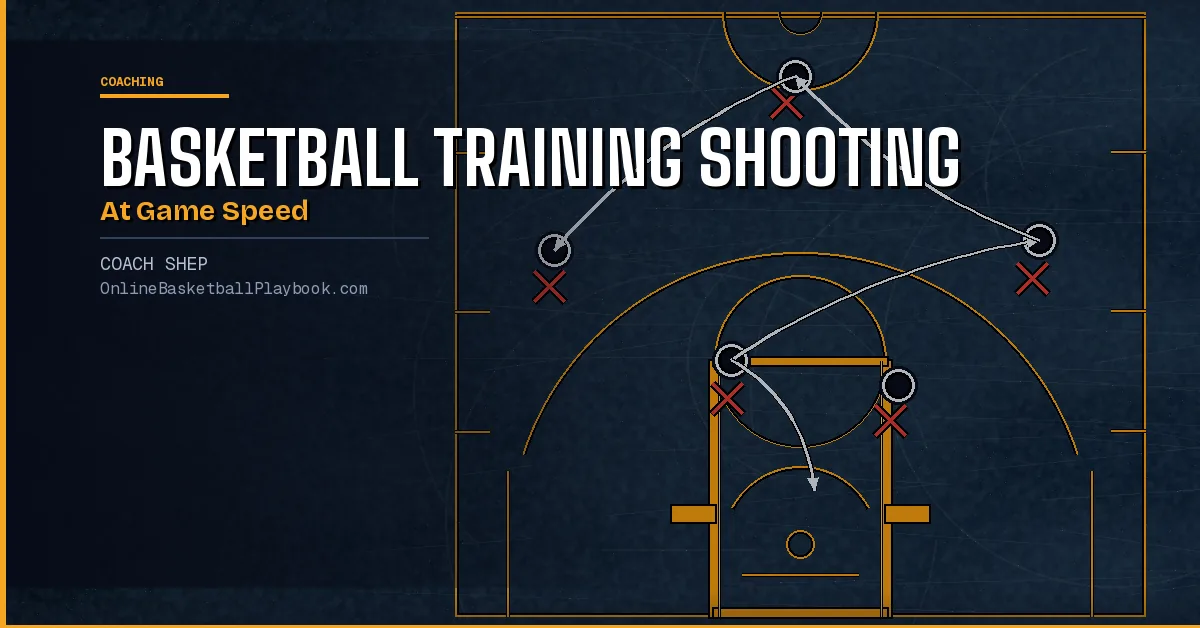
Most players shoot thousands of reps and never get better. The reason is almost always the same: their training does not look anything like a real game. Here is how to fix that.
Why Game Speed Training Changes Everything
There is a gap between the gym and the game that most shooting workouts never close. A player can make 80 percent of their shots in isolation, standing still, fresh, with no defense and then go 3-for-12 in the first half because nothing in practice looked like what the game presented.
The principle behind game-speed training is simple: practice must create the same demands the game creates. That means movement before the catch, a defender closing out, a clock ticking, and a score being kept. When Kevin Eastman talks about "game shots, game spots, game speed," he is describing exactly this alignment between training environment and competitive environment.
The brain and body learn what they repeatedly experience. A player who spends hours standing at the wing catching stationary passes trains themselves to be a stationary catcher. A player who catches off cuts, screens, and drive-and-kick reads (and trains those catches under time pressure with a score posted) develops the actual skill the game demands. The gap between those two players widens every practice.
Game-speed training does not mean sloppy training. Jay Wright at Villanova built one of the great offensive programs in college basketball history on a single principle: "Sloppy drills create bad habits." The speed is real, but the execution standard is non-negotiable. Run fewer drills at full discipline rather than more drills carelessly. That combination (genuine competitive pressure plus locked-in form) is where shooting actually improves.
Build Form First, Then Add Speed
Before you can train at game speed, you need a shot worth training. The sequence matters: form without the ball, form to a wall, form to the rim, then add movement and pressure. Skipping steps early does not save time. It locks in errors that become exponentially harder to fix at higher speeds.
The building blocks are well-established across elite coaches. Balanced stance. The guide hand under the ball like a "pizza waiter" carrying a tray. Elbow under the ball and aligned over the shooting knee. Follow-through high and held (fingers pointing down toward the rim, the "cookie jar" finish) until the ball lands. These are not stylistic preferences. They are the mechanical prerequisites for a consistent release.
Jay Wright's opening sequence at Villanova (Set Lifts and the Bradley Drill) reflects this priority. Set Lifts focus on elbow alignment and a full follow-through with no rim contact. The Bradley Drill trains the ball to release as high as possible, reinforcing the principle that a release closer to the rim requires a higher point of release. Both drills are run at the start of every Villanova practice regardless of level. Form first, every day, before the pace increases.
John Beilein at Michigan built on the same foundation. His core teaching: "Footwork is more important than any offense you run because the player still has to be able to make a play no matter what the defense does." The inside foot plants first on every V-cut, every screen-catch, every relocation. Players say the sequence aloud, "1-2, lift, follow through," during technique work until the movement becomes automatic. That automatic foundation is what holds up when the shot has to be released in 0.4 seconds off a scramble closeout.
Make Every Rep Competitive and Scored
The single biggest change most programs can make to their shooting development is adding a scoreboard. Not a metaphorical scoreboard, a literal one. A record board where players set marks, break them, and sign their names next to their best scores.
Shaka Smart's Texas program ran named drills with posted team records: the 3-Minute drill had a team record of 157 makes, the Evans drill had a record of 219. Players were not shooting to finish the drill. They were shooting to beat a number that had been chased by every player before them. That changes the psychology of practice in ways that no coaching speech can replicate.
Jay Hernandez codified the competitive-shooting philosophy as clearly as anyone: "The most dangerous person is the one who is continually improving." His drill bank, Quarters, Streak, Star, Around the Horn, M Drill, Personal Best (30-30), Burner, Doubles, Over-and-Back, is built around the same core logic. Every drill has a winner. Every drill produces a number you can compare to yesterday's number. That structure turns what would be a forgettable rep into one that carries meaning and consequence.
The Jay Wright standard at Villanova: 6 makes out of 10 shots in 30 seconds in three-man two-ball shooting, with the entire group running if unsuccessful. The Beilein standard at Michigan: 7 makes out of 10 in 30 seconds coming off a down screen and flare sequence, with three players running if the group fails (screener exempt). These are not suggestions. They are team-enforced make-counts with a physical consequence for missing the target. When a standard carries that kind of weight, players engage differently with every rep.
Train Game Shots From Game Spots
The phrase "earn the shot with an action" captures one of the most underused principles in shooting development. In every game, a shot is the result of something: a cut, a screen, a drive, a dribble handoff. Players who train exclusively on catch-and-shoot from stationary positions are training the end of the sequence without training the beginning.
Larry Brown's SMU shooting drills, 25 game-speed actions built around zipper cuts, baseline drives, drag screens, and ball screens, operate entirely on this principle. Every drill starts with a realistic offensive movement. Players are always responding to a read before pulling the trigger: a closeout angle, a roll-or-pop decision, a DHO timing. The shot is always preceded by the action that earns it.
The same logic applies to shot selection by location. Mix block shooting (standing at a spot, grooving form) with movement shooting that forces players to relocate constantly. Shaka Smart's rule during movement shooting drills: "Can't shoot the same spot twice." That single constraint forces players to practice shooting while moving to new positions, which is almost always what the game asks for.
The pull-up and the hesitation deserve specific attention here because they are chronically undertrained. These are the shots that come off one or two dribbles, pulled up around the free throw line or the mid-range, shots that are "lost arts" according to the research. A player who can threaten the pull-up makes every other read on the floor harder to guard. Train it explicitly, from game spots, off game actions, with a count running.
Diagnose and Fix Common Shooting Errors
When a player misses consistently, the mistake coaches make most often is repeating a generic cue ("bend your knees," "follow through," "square your shoulders") without identifying the actual mechanical cause of the error. Dr. Hal Wissel's diagnostic framework offers something more useful: a systematic pathway from error to cause to specific correction drill.
The short shot is caused by a release point too low. The ball leaves the hand before full arm extension. The fix is a high-extension finish: hold the follow-through with the arm fully extended and fingers pointing down at the rim until the ball lands. Do not let the elbow drop early.
The wide shot (right or left) is almost always the guide hand. The off-hand thumb pushes across the ball at release and steers it offline. The correction is the thumb-lock drill: hold the guide-hand thumb consciously up and away, then shoot one-handed form shots until the ball tracks straight. The thumb is the culprit in more missed shots than most coaches realize.
The line-drive flat arc is a wrist problem. The wrist is not finishing above eye level and the elbow is dropping too early. The "ceiling" target drill addresses this directly: pick a point on the gym ceiling above the front of the rim and train the arc to reach that point. Players who shoot line drives gain four to six inches of arc almost immediately with this cue.
Inconsistent release timing (often described as a "rushed" shot) comes from releasing before the natural peak of the jump. The Sight-Set-Shoot rhythm protocol breaks the motion into three distinct beats: establish the target, pause momentarily at the set-point with the ball above the shooting shoulder, then release on the way up. Three deliberate beats instead of one continuous motion forces the player to find the natural release point instead of rushing past it.
Side spin is an elbow alignment issue. At the set-point, the shooting elbow must be directly under the ball and directly over the shooting knee, not flared out. When the elbow is aligned correctly before the wrist snaps, side spin disappears. Check alignment before prescribing anything else.
When diagnosing a persistent miss pattern, work backward through the mechanical chain: arc angle first, then hand position, then elbow alignment, then balance and foot. The root cause is rarely what the player or the coach thinks it is at first look. A rushed diagnosis produces the wrong drill, and the wrong drill locks in the error more deeply.
Free Throws Under Fatigue
Free throws trained exclusively at fresh rest are free throws that will not hold up at the end of a close game. That is the practical problem with the way most programs handle free throw training: it is cordoned off from the fatigue context where free throws actually matter.
Rick Pitino's practice model addresses this directly. At Louisville, players shot free throws after live 1-on-1 games, when they were tired, with percentages tracked. The logic is straightforward: game free throws happen when players are exhausted and the score is close. If you train them only when fresh, you are not training the shot that will be asked of you when the game is on the line.
Beilein built conditioning accountability into Michigan's practice entry requirements: players ran 17 sidelines in under one minute before earning practice reps. Practice itself was a reward for fitness. Free throws in that context carry the same principle. They are shot within a practice structure that creates real fatigue, not tagged on at the end as a cool-down afterthought.
Pitino's mechanical cue for free throws is worth keeping: ball and head over the free throw line. That forward projection (ball and eyes leaning toward the rim rather than pulling back) keeps the shot from going short under fatigue, when the natural tendency is to under-load and miss front. Pair it with a make-count and a consequence, and free throw training becomes part of the competitive culture rather than a separate obligation.
Building a Shooting Culture on Your Team
Technique and drills are the inputs. Culture is what makes them compound over time. The coaches who build consistent shooting programs (Wright, Smart, Hernandez, Beilein) all invest in the cultural infrastructure around the shooting work: records that players can chase, names attached to marks, consequences that make the standard real.
The record board is the lowest-cost, highest-leverage tool available to any program. Three or four named drills per team, records posted, players signing their marks. When a new player walks into the gym and sees a name and a number on the board, they immediately understand what this program values and what the standard is. That is a culture moment that a speech cannot create.
The Purdue Drill from Tom Billeter at Augustana captures the culture principle in a single exercise: make four threes in a minute with a rebounder and a passer, sprinting baseline to half-court between shots. "The shooter runs for each point below four." One drill, one standard, one consequence, one competitive rep. Run that drill at the start of every practice and post the results. Watch what happens to shooting effort over a season.
For younger players, the form-first on-ramp matters before any of the competitive structure. The "pizza waiter" and "cookie jar" cues from youth coaching fundamentals give players mental images that stick. Shoot to the wall first. Then to the rim. Then add the competitive layer. Skipping that sequence and putting a 10-year-old into a timed make-count drill with a consequence produces anxiety, not development.
The principle that ties every layer together: pair shooting with the ball-handling that creates shots. Shots come off the dribble in almost every game situation. Build the handling that generates the shot: the pull-back crossover for separation, the hesitation to freeze a closeout, the two-dribble pull-up off a ball screen. Shooting and handling are not separate skills. Train them together at game speed, keep score, and post the results. That is the full system.
- Start with form every session: Set Lifts or pizza-waiter one-handers before adding speed. Bad mechanics trained fast just become fast bad mechanics.
- Put a score on every drill: A make-count and a timer transform a forgettable rep into one with consequence; players engage at a different level when a number is being tracked.
- Train the action before the shot: V-cuts, screen-catches, and drive-and-kick reads belong in every shooting block. The shot must be earned, not handed from a stationary position.
- Post a record board and maintain it: Named drills, signed marks, public records that players can chase; the board builds a shooting culture that outlasts any single workout.
- Shoot free throws tired and tracked: Bake free throw reps into the end of live competitive periods, count them, and hold the standard. Game free throws happen at the worst possible moment physically.
- Diagnose errors before prescribing drills: Work backward from the miss pattern through arc, hand position, elbow alignment, and balance before choosing a correction. The wrong drill locks in the wrong habit.
Want more basketball coaching strategies and drills?
Join the Online Basketball Playbook newsletter →
Draw this play free in the play drawer →
Membership: the full library, playbook packs, and Pro drawing tools →
Keep Building
Related breakdowns
Basketball Shooting Form: Step-by-Step Mechanics
Basketball shooting form step by step, from the ready stance and grip to release and follow-through, with drill progressions and where coaches disagree.
Free Throw Shooting: Routine, Form and Drills
Free throw shooting starts with a routine the player never changes. Form cues, the mental side and drills that copy the fatigue and pressure of a game.
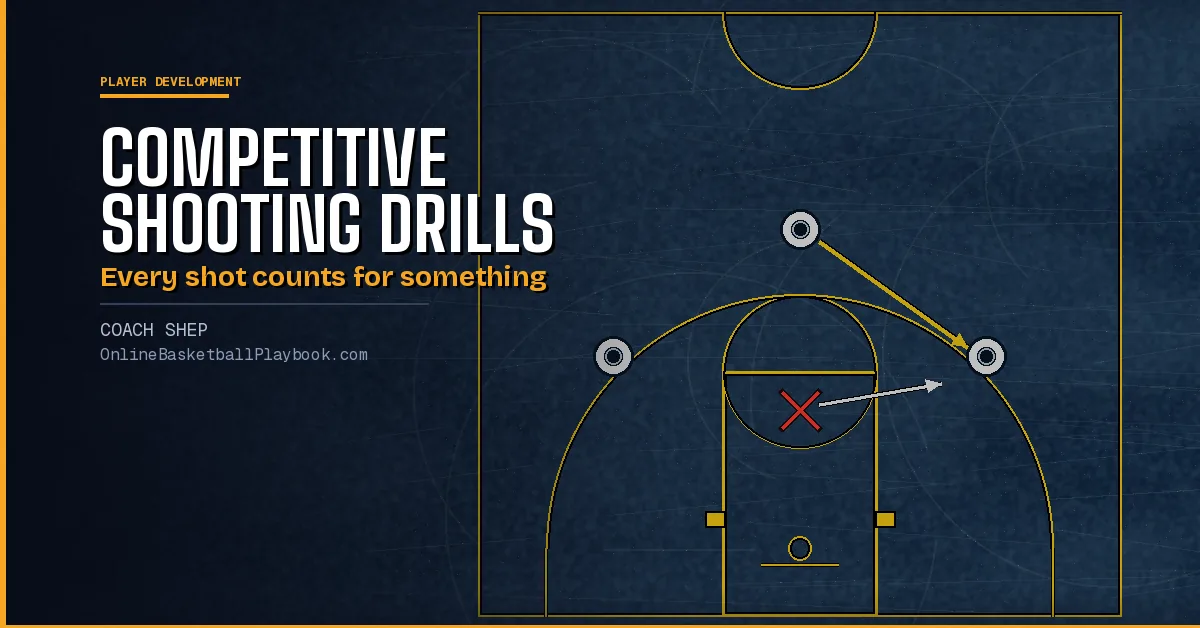
Competitive Shooting Drills: Scored Games and Records
Competitive shooting drills with a score on every shot: streak games, timed targets, Beat the Pro, plus and minus, 2-on-1 shooting and record boards.