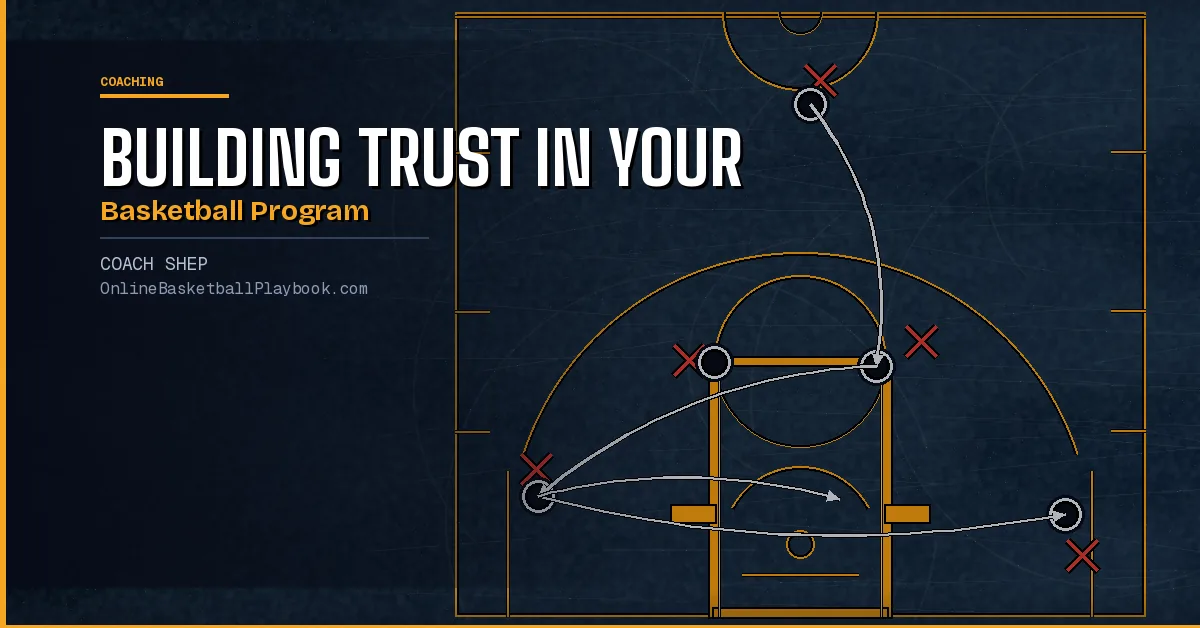
Trust is not a speech you give in October. It is the sum of every standard you set, every rule you enforce fairly, and every player you look in the eye and say something meaningful to, day after day, all season long.
Trust Starts With Non-Negotiable Standards
Every coach says they want their players to trust them. Few coaches understand that trust is not built by being likable. It is built by being predictable. When players know exactly what you expect, when they know those expectations apply equally on game 1 and game 28, and when they know you will follow through no matter who is in the lineup, they stop guessing and start believing.
Kelvin Sampson's operating principle is as direct as it gets: "Every program must have non-negotiables." His non-negotiables are attitude and effort, held to the same standard every single day. His reasoning is worth sitting with: "How you do anything is how you do everything." That sentence does not leave room for selective enforcement. It demands that the coach show up the same way in a late-February practice as in the first week of October. Players are watching. They always are.
The non-negotiables have to be named before problems arise. Obradovic's approach from his Euroleague preseason system is to install a code of ethics in week one (punctuality, rest, mutual respect) and enforce it immediately if it is broken. Not eventually. Not after a warning and a conversation and a grace period. Immediately. The value of a standard is in how quickly it is enforced the first time it is tested, not in how clearly it was written down.
Hubie Brown's four rules cut the same way: be on time, play hard, know your job, and know when to pass versus shoot. Simple enough that no player can claim ignorance. Specific enough that there is no gray area when someone breaks one. And Brown means what he says about time. "When practice is one hour, it is one hour." That kind of precision builds trust faster than any motivational talk because it tells players that the coach's word is reliable. A schedule that starts on time and ends on time signals that you value their time the same way you ask them to value yours.
The coaches who struggle with player trust almost always struggle with consistency. They hold their stars to a different standard than their reserves. They let a rule slide when it's a key player who broke it. Players notice every one of those moments. Steve Alford's fairness doctrine addresses this directly: be fair in all situations, no matter if it is your best or worst player. You cannot treat any game bigger than another. This is harder to live than it sounds. But programs that master it develop a locker room where players hold each other accountable because they have seen the coach model it first.
Role Clarity Is a Trust Act
Ambiguity about roles is one of the most underrated culture leaks in a basketball program. When players do not know where they fit (what they are expected to do, when they will play, what their job is in a late-game situation), they fill that ambiguity with anxiety and resentment. Both of those poison team chemistry.
Mike Dunlap's instruction is unambiguous: role declaration must happen before players play, not after they earn it or discover it through trial and error. His reason is both practical and cultural. Practically, players execute better when they know their assignment. Culturally, an explicit role declaration tells every player that the coach has thought specifically about them. That matters. The player who comes off the bench and knows exactly when he will enter the game and what the coach expects from him in those two minutes is far more invested in practice than the player who spends the entire week wondering if he's going to get time.
Dean Smith built this into the structure of his UNC program with the Blue Team concept. Players eight through twelve on the roster always entered the game as a unit, always in the first half, always for one to two minutes together. Role predictability. No confusion, no guessing. The reserve player who knows his role does not feel like an afterthought. He feels like part of the plan. That is what builds trust between a coach and a player who is not yet in the starting lineup.
Role clarity also requires revisiting. When a player's performance shifts (up or down), the coach who updates the role conversation earns more trust than the one who lets the situation drift. Dunlap's instruction is to declare roles explicitly, early, and revisit when performance shifts. A single honest conversation about a changed role, delivered directly and with respect, strengthens the relationship. Silence and avoidance damage it.
John Tauer uses a disarming tool on the first day of practice: he asks the room to raise their hands if they consider themselves role players. The room goes quiet. The moment resets the hierarchy and signals to every player in the gym that role acceptance is part of the program's identity, not a consolation prize. It also tests who is ego-driven and who is genuinely team-first, information a coach needs early.
Accountability Has to Be Daily, Not Seasonal
Most programs are good at accountability in October. The real test is January. By the time the season is grinding through its middle weeks, standards erode if they are not actively maintained. The coach who runs the same drill the same way in week twelve as in week one (and corrects the same mistakes with the same energy) is the coach players trust to lead them in a tight game.
Obradovic's approach to daily standards is deliberately simple: non-negotiables are run every single practice, no exceptions, no shortcuts. His drills are not complex by design. They are valuable because they are unconditional. "Fake first" and "look at the basket on the catch" are enforced identically in game one and game eighty. The value is in the repetition without exceptions, not in the sophistication of the drill. A player who has run the same action correctly three hundred times trusts his own execution. That is a form of team trust that gets built in practice, not in a timeout.
Sampson frames it through the lens of habits: "Once is an accident, twice is a coincidence, three times or more is a habit, and your job is to build good habits." This is a coaching mandate, not a player mandate. If a player consistently makes the same mistake, the question is whether the coach corrected it on the first and second repetition or let it slide. Sampson's harder statement on accountability cuts deeper: "Most coaches fail because they are afraid of confrontation." The fear of a difficult conversation with a player (or a parent, or an assistant) is the most common reason accountability breaks down mid-season. The coach who overcomes that fear, consistently and early, builds a program where standards hold.
Tom Crean's accountability framework focuses on the four things players expect from a coach: competence, sincerity, reliability, and trustworthiness. Reliability (doing what you said you would do, when you said you would do it) is the one most coaches underestimate. Every broken promise, every threat without follow-through, every rule applied one way on Tuesday and a different way on Thursday, removes a deposit from the trust account. Making that account whole requires consistent behavior over weeks and months, not a team meeting.
Your Behavior Sets the Ceiling
Mike Young's principle is one of the most transferable in coaching: "Firmly believe your team takes on your personality." This is either a gift or a warning depending on the coach. A program reflects the character of the person running it: the energy level, the consistency, the discipline, the way problems are handled, the way losing is processed. Players read the coach before they read any scouting report.
Rick Pitino's One Day Contract concept applies directly here. The principles: no cynicism, no moodiness, no negativity, and treat everyone with kindness (every day, as if it were the only day). This is not an inspirational poster. It is a behavioral standard for the coach that runs parallel to every standard the coach sets for players. You cannot preach fitness unless you demonstrate it. You cannot demand enthusiasm in practice if yours fluctuates by week. The coach who holds himself to the same non-negotiables he posts on the locker room wall is the coach who earns genuine respect, not compliance, but respect.
Bob Thomason's instruction after a loss is one of the most counterintuitive trust-building moves in coaching: tell your players it is your fault, not theirs. Show humility. Take the blame when the team loses and give the credit when the team wins. This sounds like it would undermine authority. The opposite is true. A coach who absorbs responsibility after a hard loss signals to every player in the room that they are in a safe environment, that mistakes will be corrected, not blamed, and that the coach is in the fight with them. That is the environment where players take risks, try new things, and stay bought-in through a rough stretch.
Hubie Brown's daily habit is worth adopting at any level: say something to every player, every day. Look him in the eye. Give personal congratulations after every win to every player who suited up. This is not complicated and it does not take long. What it does is tell each player (starter or reserve) that the coach sees him as an individual, not just a roster spot. That signal, repeated across an entire season, compounds into trust that holds when the team is struggling and the program is being tested.
Earning Buy-In Through Service and Honesty
Dan Hurley's framework for coach credibility is built on a clear order of operations: get after players in practice, then support them on game night. The relationship is built through what Hurley calls relentless service, daily investment in each player's skill development and personal growth. When that investment is consistent and visible, players stay bought-in even when the demands are high and the losses are mounting. The coach earns the right to be demanding because the players know the coach is all the way in on their development.
Anson Dorrance's framework for honesty runs a level deeper. His Fitz and Peyton Manning story makes the point: the mark of a high-character athlete is that when a coach says "here is what you are doing wrong," the player's first reaction is "thank you, I want to know." Mediocre players deflect. They blame the system, cite the previous coach, or find a way to make the correction someone else's fault. Dorrance uses a player's response to correction as the accountability test, not how well the player performs when it is going well, but how they respond when it is not.
This same principle applies to the coach-player relationship from the coach's side. Honest feedback, delivered directly and consistently, is how buy-in gets built. Erik Spoelstra's operating standard is radical honesty: "I don't believe in elephants in the room." Problems get named. Separation between the coaching staff and the players is not allowed to form. When a player sees that the coach tells the truth (even when it is uncomfortable), the player learns that the feedback he receives is real, and that the praise he receives is earned. Both land differently than they do in an environment where the coach says what is convenient.
Morgan Wootten spent 46 years at DeMatha Catholic building one of the most studied programs in American high school basketball. His program's pregame talks never used the word "win." His evaluation standard was whether the team gave a winning effort. The reframe protected player confidence and kept the culture focused on process. Players who are trusted to compete at full effort (without the weight of outcome pressure) tend to perform better and stay connected to the program longer. That is not a coincidence. It is the product of a coach who understood that trust flows from the environment the coach creates, not from the scoreboard.
Protecting Chemistry Protects Trust
Chemistry does not appear in a box score, but it shows up in every close game. A team with real chemistry (where players trust each other and trust the staff) executes under pressure in ways that physically more talented teams cannot. Protecting that chemistry is one of the most important things a coach does across a season, and most of the threats to it are preventable.
Messina's assembly principle puts the stakes plainly: "How the team is being assembled is more important than how the team is being coached." The character of the people in the program upstream of any tactical decision the coach makes on the sideline. Recruiting to character (to genuine hard work, to the ability to handle pressure, to the willingness to accept a role) is how programs build chemistry that survives a long season. Talent acquired without regard for fit poisons the locker room faster than a five-game losing streak.
Protecting fairness protects chemistry. Obradovic's principle is direct: do not overpay or over-elevate one player relative to the group. Imbalance poisons the locker room. This applies at every level of the game. When players see a teammate treated differently (held to a lower standard because he is the best scorer, given credit he did not earn, excused from consequences that everyone else faces), the trust erodes fast. The coach who holds everyone to the same standard, visibly and consistently, sends the signal that the team matters more than any individual. That signal is the foundation of real chemistry.
Dean Smith's team unity principles operationalize this at the practice level. No player yells at a teammate. Publicly visible frustration toward a fellow player is banned. Bench players stand and applaud team plays and subs coming to the sideline. The passer gets acknowledged on every made basket. Every player points to the man who made the pass. These are not big gestures. They are daily behavioral standards that add up to a locker room where players actually trust each other and not just the coaching staff. The chemistry the team has in March is the product of a thousand small habits practiced in October and November.
Bethel's "Me First, For Us" framework gives players a language for maintaining that chemistry under stress. Three question stems are banned from the vocabulary: Why (victim thinking), When (procrastination), and Who (blame). Players are trained to replace them with "What can I do?" and "How can I support the team?" Teaching this as a vocabulary drill (and posting it in the locker room where players see it after a tough loss) turns accountability from an abstract value into a daily practice. Programs that name the standard and post it publicly create teams that self-police. That is sustainable. The coach who has to enforce every standard personally, without player ownership, will not hold the culture through a difficult stretch.
Run Parcells' 4th-quarter role test at the end of every week: ask each player individually to describe their specific assignment in a late-game situation without prompting. If a player cannot answer clearly and confidently, that is not a player problem. It means the coach has more reps to give before the next game. Treat the test as a coaching checkpoint, not a gotcha moment, and players will lean into it rather than dread it.
- Set your non-negotiables (attitude, effort, punctuality) in the first week and enforce them immediately the first time they are broken. Selective enforcement is the fastest way to lose a locker room.
- Declare every player's role explicitly before the season opens, and revisit that conversation whenever performance shifts. Ambiguity about roles breeds resentment that compounds over a long season.
- Say something to every player, every single day (look him in the eye, make it personal). This habit costs two minutes and pays back in loyalty all season long.
- Hold your best player to the highest standard in practice, because the team is watching how you treat the star. Role players take their cues directly from what they see the coach demand of the best player on the floor.
- After every loss, take responsibility in front of the team rather than placing blame on players. A coach who absorbs accountability after a hard game builds the kind of trust that keeps players competing for him through difficult stretches.
- Run the same core drills the same way in week twelve as in week one. Culture does not maintain itself. Standards erode the moment enforcement becomes selective, and daily repetition without exceptions is what makes the standard real.
Want more basketball coaching strategies, drills, and tools?
Join the Online Basketball Playbook newsletter →
Draw this play free in the play drawer →
Membership: the full library, playbook packs, and Pro drawing tools →
Keep Building
Related breakdowns
Building Accountability in Your Basketball Program
Building Accountability in Your Basketball Program
Mentorship Program for Young Coaches: Match, Meet, Review
How to build a mentorship program for young coaches: set goals and a length, match on style and time, meet on a schedule, give one real job and review it.
Building Team Chemistry in Basketball: Roles, Rules and Habits
Building team chemistry in basketball comes from clear roles, a few rules applied to everyone and daily habits. Here is how to set up each one and how to drill it.