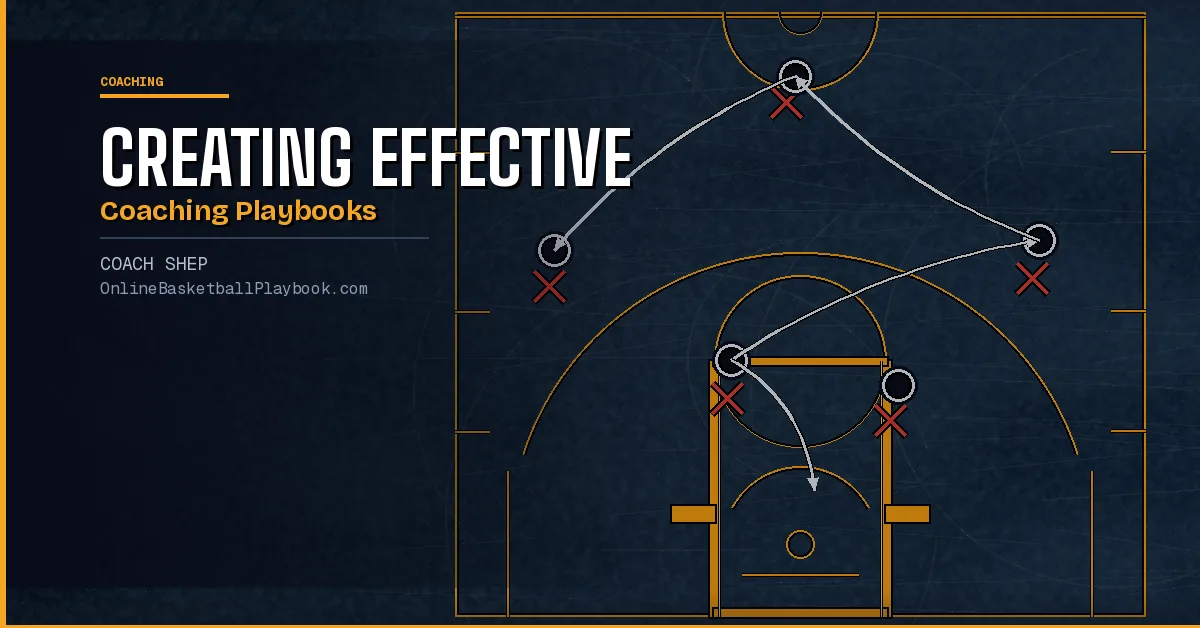
A great playbook is not a binder full of diagrams. It is a teaching system your players can read, remember, and execute under pressure, and building one starts long before you draw your first play.
What a Playbook Actually Is
Most coaches think of a playbook as a collection of plays: inbounds sets, half-court actions, out-of-bounds calls. Those are in there, but that framing gets the priority backwards. A playbook is first a decision-making guide. It tells your players what to do when the first option is taken away, when the defense cheats, and when nothing on the board is available. The plays themselves are secondary to the reads that make those plays work.
This distinction matters enormously at the youth and high school levels. When a coach loads a playbook with 30 half-court sets but never teaches players why each action works or what to look for, players freeze the moment the defense adjusts. They run the motion of the play without executing the intent. The result looks like poor execution, but the real problem is that the playbook was never translated into a teaching tool.
An effective coaching playbook has three layers. The first layer is the philosophy: how your team wants to play, what you value, what you are willing to live with defensively or offensively. The second layer is the system: your base offense, your defensive principles, your transition rules. The third layer is the play calls. Specific actions designed to get your best looks within the system. Every coach starts at layer three and works backward. The coaches whose players actually execute start at layer one.
Start With Principles, Not Plays
Before you diagram a single action, write down five sentences describing how your team plays basketball. Not the plays. The principles. Something like: we space the floor with all five players, we attack closeouts, we never turn the ball over trying to create something that is not there, we run in transition off every missed shot, and we communicate every screen defensively. Those five sentences are the backbone of your playbook.
Principles do what plays cannot. They give players a decision rule for situations you never covered in practice. If a player knows your team attacks closeouts, they do not need a called play when a defender overplays a catch. They attack. If a player knows your team runs in transition off every missed shot, they sprint without waiting for instruction. The play call is a specific vehicle; the principle is what drives it.
When you write your principles first, you also filter your play selection automatically. If a play requires a player to catch the ball standing still in the post and you have no post players, the principle "we space the floor and attack off movement" tells you that play does not fit your system. You save yourself from building a playbook full of things that will never work with your roster.
Keep your principles visible. Print them on the first page of the playbook. Put them on the locker room wall. Refer to them in film sessions when players make the right or wrong decision. The plays will change from year to year. The principles, if you have chosen them carefully, stay consistent and compound over time.
Organizing Your Offense and Defense
Once your principles are in place, organize your playbook in tiers. Most coaches try to put everything at the same level of importance, which means players treat everything as equally critical or equally optional. Tiered organization tells players where to spend their mental energy.
Tier 1: Your Base System
This is what you run when nothing is called. For many teams that means a motion offense: continuity principles, spacing rules, ball-movement habits. For others it is a set system with specific actions that repeat. Whatever it is, your players should be able to run your Tier 1 offense and defense without a call, without looking at the bench, and without hesitation. If they cannot, you have too many plays and not enough reps on the base.
Defensively, your Tier 1 is your base coverage. This is how you guard most situations: your stance, your gap rules, your help-side principles, your on-ball pressure defaults. Everything else (traps, zones, full-court pressure) is Tier 2 or Tier 3.
Tier 2: Situational Actions
These are the plays and coverages you use in specific situations: end-of-quarter sets, out-of-bounds plays under the basket, late-game defense, pick-and-roll coverages. They do not need to be executed from memory at game speed. Players need to recognize the situation, call the right action, and execute their individual role.
A common mistake is putting Tier 2 content in Tier 1 reps. If your team spends 40 percent of practice time on baseline out-of-bounds plays, you have inverted the priority. Situational plays matter, but they come up far less often than your base system. Practice time allocation should reflect that.
Tier 3: Emergency Calls
These are the plays you use rarely, maybe twice a season. A specific set you installed for one opponent. A trick play you hold in reserve for a playoff moment. These do not need to be in the regular playbook at all. Keep them in a separate section and introduce them at the right moment in the season, not in October when players are already absorbing the base system.
Teaching the Playbook in Practice
The playbook does not live on paper. It lives in practice repetitions. How you introduce and reinforce it determines whether your players own it or merely tolerate it. The most effective approach follows a simple sequence: walk, talk, run, compete.
Walk means you diagram the action and walk through it at practice speed with no defense. Every player understands their assignment, their reads, and what success looks like. This phase should be short, five to eight minutes maximum. If you are still walking through it at the 15-minute mark, the action is too complex for your personnel or you have not simplified it enough.
Talk means you add a token defense (defenders with their hands behind their backs or passive resistance) and let the offense make the reads. The coach stops play to name what the read is, what the player should see, and what the right decision is. This is where most of the teaching actually happens. Players start connecting the diagram to live movement.
Run means you go at full speed with full defense. No stopping. Let the action breathe. At this point players should be making their reads without prompting. Your job is to watch and collect data, not narrate every possession.
Compete means you put a constraint or a score on it. Run a five-possession sequence and track how many times the team executes the primary or secondary action correctly. Competition sharpens execution faster than any amount of walking and talking, because players will focus differently when the rep counts.
Adapting to Your Roster
One of the most common playbook failures is running a system that does not match the players in your gym. Coaches fall in love with an offense they saw at a clinic or a defense they ran at a previous program and try to install it regardless of personnel fit. The result is a team that technically runs your system but never really plays your system.
The roster audit should happen before you finalize the playbook, not after. Answer these questions in practice: Do you have a ball-handler who can run the point of a spread offense, or do you need ball movement to compensate? Do you have length and athleticism to run a switching defense, or do you need structure and help principles? Do you have a post presence that makes your entry actions worth teaching, or are you better served by a perimeter-based attack?
Your playbook is a translation layer between your principles and your personnel. The principles stay constant year to year. The specific plays and coverages evolve based on who is in the gym. A coach who ran a pick-and-roll-heavy offense with a great point guard one year should not be surprised when that same playbook underperforms with a different roster the following year.
Adaptability also means reading your team mid-season. If a play you installed in October is not working by January, not because of poor effort but because players consistently misread it, the answer is to cut the play, not repeat the same teaching cycle. A shorter playbook that is executed confidently beats a longer one that generates confusion.
When you add a new play mid-season, introduce it in a walk-through the day before the game, not during shootaround. Players need at least one practice repetition at full speed before they trust a new action in a real game environment. Surprise installs produce tentative execution.
Common Playbook Mistakes to Avoid
After watching hundreds of programs across every level, certain playbook errors appear over and over. Knowing them in advance lets you design around them rather than diagnose them after the season.
Too many plays, not enough reps. The most frequent mistake. A team with 12 half-court sets that each gets two reps per week owns none of them. A team with four sets that each gets fifteen reps per week owns all four. Repetition is the mechanism that converts a diagram into instinct. Volume of plays is not a competitive advantage. Depth of execution is.
Plays that require reads players have not been taught. If your play ends with a pick-and-roll and you have not spent practice time teaching your players how to read the coverage on a pick-and-roll, the play will fail regardless of how clean the setup is. Every play in your book requires an inventory of decisions. Make sure you have taught every decision in the play before you call it in a game.
No exit from the play. Every play needs a built-in reset or a clear signal that tells players what to do if nothing develops. If a player does not know what happens when the first two options are denied, they will improvise, and improvisation under pressure usually means a forced shot or a turnover. Build the bail-out into the teaching, not as an afterthought.
Teaching plays without teaching principles. As covered earlier, plays without principles produce players who execute mechanically rather than intelligently. When the defense adjusts, mechanical players stall. Intelligent players, players who understand why the play works, adapt.
Updating the playbook too frequently. Adding new plays every week prevents your team from achieving depth in anything. Set a rule: once the season starts, no new Tier 1 actions unless a clear personnel change demands it. Refinements and adjustments are fine. A wholesale install of a new base offense in week seven is a reset that costs more than it gains.
- Write your five core principles first: Post them in the locker room and reference them in every film session so players internalize the why behind every play call.
- Tier your playbook into Base, Situational, and Emergency categories: Then allocate practice reps proportionally, with the vast majority going to your Tier 1 base system.
- Use the walk-talk-run-compete sequence for every new install: Players need to see the read in slow motion before they can execute it at game speed under defensive pressure.
- Audit your roster before finalizing the playbook each year: The plays that fit your personnel will always outperform a system you love that your players cannot execute.
- Cut plays that are not working by midseason: A shorter playbook that your team owns with confidence will always beat a longer one that creates hesitation at critical moments.
Want more basketball coaching strategies and drills?
Join the Online Basketball Playbook newsletter →
Draw this play free in the play drawer →
Membership: the full library, playbook packs, and Pro drawing tools →
Keep Building
Related breakdowns
Effective Strategies for Coaching Basketball for Different Age Groups
Effective Strategies for Coaching Basketball for Different Age Groups
Creating a Competitive Yet Supportive Coaching Environment
Creating a Competitive Yet Supportive Coaching Environment
Basketball Coach Essentials for Effective Team Management
Basketball Coach Essentials for Effective Team Management