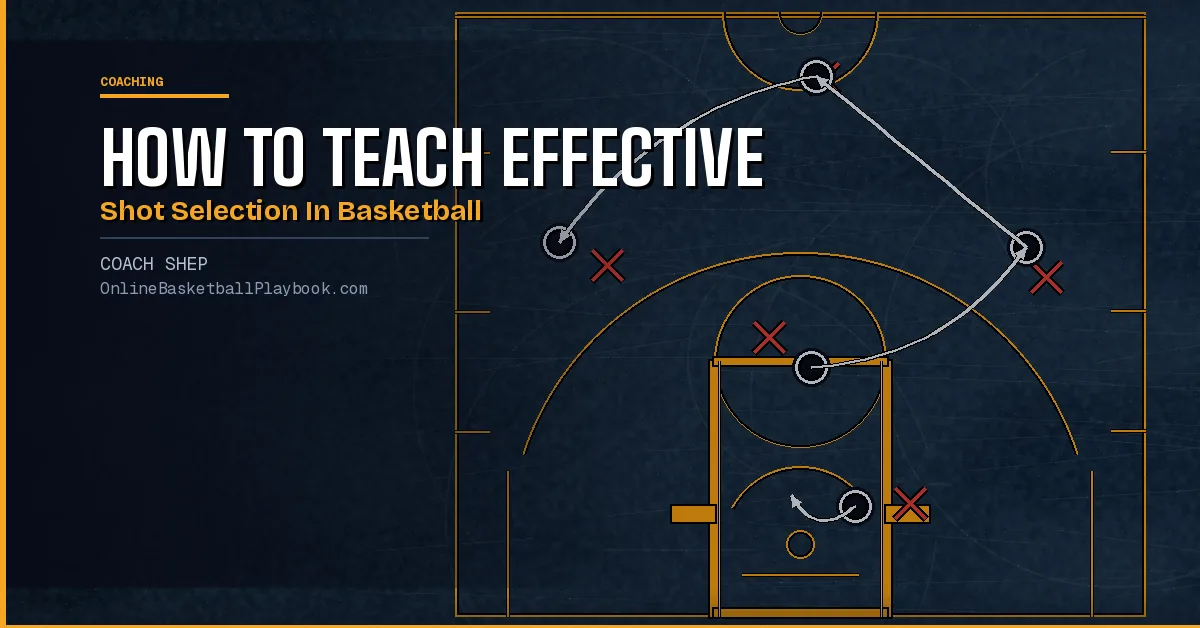
Shot selection separates good teams from great ones. This guide gives coaches a practical, drill-based system for teaching players which shots to take and the discipline to turn down the ones they should not.
Why Shot Selection Is a Teachable Skill
Most coaches talk about shot selection as though it were a feeling: "take good shots," "know your spots," "be smart out there." The problem with that approach is that players have no way to measure it, no feedback loop to improve against, and no shared language to discuss it after the fact. Vague instruction produces vague results.
Shot selection is a decision-making skill. Like every skill, it improves when it is practiced with intention, tracked with numbers, and held to a standard. The coaches who teach it best, Rick Pitino, Jay Wright, John Beilein, George Karl, all have one thing in common: they quantify the standard. They do not say "that was a tough shot." They say "22 percent." They do not say "we need to move the ball." They say "if a defender can get a hand up, restart the action, no exceptions."
When you make shot selection measurable, players can self-diagnose. They can hold each other accountable. And your practice time stops being about correcting mistakes after they happen and starts being about building habits before they do.
Shot selection also connects directly to offensive efficiency. A team that takes only layups, open threes, and pull-ups from the free-throw line will outscore a more talented team that settles for contested mid-range attempts. The math is on your side. You just have to install the decision-making system that makes the right shot feel natural.
The Contested-Shot Rule: Put a Number on It
Rick Pitino's Louisville program tracked a metric that should be in every coach's vocabulary: contested-shot percentage. Louisville shot 22 percent on challenged shots. The NBA baseline for contested shots is approximately 42 percent. That 20-point gap is enormous, and it is the same gap that exists on most youth and high school rosters, whether coaches measure it or not.
Pitino turned that stat into a practice rule: if the shot would be contested, pass the ball back and restart the action. No exceptions. There is no "but I had a feel for it" or "it was a good look from my spot." If a defender's hand would be near the ball, the ball goes back.
This is the clearest example of teaching shot selection through a rule rather than a mood. The rule does not depend on a player's confidence level, their shooting percentage in warm-ups, or whether they are in a hot streak. It depends on one visual cue (is a defender close?) and one response (pass it back).
George Karl framed the same idea differently with his "no tough twos" mandate. The underlying logic is identical: mid-range contested shots are the lowest-value shots in basketball, and teams that eliminate them replace them with layups, open threes, and free throws. You do not need to explain expected value to a 15-year-old. You need a rule they can apply in half a second, which is exactly what a contested-shot restart rule provides.
To install this in practice: run any offensive drill, pick-and-roll reads, motion cuts, drive-and-kick, and designate a defender to stunt or close out. If the defender's hand is within arm's reach when the shooter catches, the rep does not count. The offensive player must pass back and run another action. After a few sessions, players start seeing the defender before they receive the ball. That is the skill.
Earn the Shot with an Action First
Larry Brown's SMU system built every shooting drill around a realistic offensive movement before the shot. Players ran zipper cuts, baseline drives, ball-screen reads, and drive-and-kick actions before they pulled the trigger. No one stood still and caught a ball from a cone. Every rep started with a read.
This philosophy solves a problem that plagues shooting-drill design at every level: players practice shots that do not exist in games. They catch the ball stationary at the elbow, set their feet with unlimited time, and shoot with no defender nearby. Then in a game, they receive a pass off a cut while a closeout is coming and the action looks nothing like what they trained.
The fix is to put the action before the shot in every drill. A zipper cut before a wing catch. A DHO before a three. A drive that pulls the help before a kick to the corner. Players are always responding to a read, the angle of the closeout, the roll-or-pop decision, the help position, before they shoot. Over time, their shot selection calibrates to what game shots actually look like: earned looks off movement, not isolated catches.
Jay Wright at Villanova operationalized a specific piece of this: the "inside foot" principle. On every V-cut and screen-catch, the player plants the inside foot first. Wright required players to say the sequence aloud during technique work, "1-2, lift, follow through", because verbalizing the footwork burns it into muscle memory faster than silent repetition. The footwork creates the catch-and-shoot rhythm that turns an earned cut into a made shot.
Wright also taught screener-catchers to "think shot before you get the shot." The player coming off the screen has already decided whether the look is open before the pass arrives. That pre-decision eliminates the hesitation that gives the defender time to recover. The decision is made off the read; the shot is just the execution. That is shot selection at its highest level.
Make Every Rep Competitive and Scored
A shooting drill without a score is practice theater. Players go through the motions, coaches watch, and nothing meaningful is measured. The moment you add a number, makes in 60 seconds, a team target, a consequence for missing, the drill becomes a genuine test of whether players can execute under pressure.
Shaka Smart's Texas drill bank is one of the best examples of this principle at scale. His program ran approximately 18 named, recorded, moving shooting drills, each with a team record posted for players to chase. The "3-Minute" drill had a team record of 157 makes. The "Evans" drill had a record of 219. Every time the team ran a drill, they were competing against a number that a previous group of Longhorns had set. That is not just conditioning. It is culture.
Smart also enforced a rule that strengthened shot selection directly: players cannot shoot the same spot twice in a row during movement shooting drills. They must relocate to a new spot between every shot. This forces players to think about court geography, where is the open space, where does my action take me, rather than camping on one comfortable spot. Over a season of this, players develop a mental map of where their shots come from in a real game.
John Beilein at Michigan took competitive standards further. His benchmark for shooting off a down screen plus flare screen sequence was seven makes in ten shots in 30 seconds. Three players ran if the group failed. The screener was exempt. This standard is high enough that players must take quality shots, wild heaves at the buzzer do not contribute, which means the drill naturally trains shot selection alongside shooting skill.
The practical takeaway: every shooting block in your practice should have a make target, a time window, and a consequence. The make target trains shot selection because bad shots rarely count. The consequence ties performance to effort. The time window adds game-speed pressure. All three together create conditions where the right shot is also the fastest path to success.
The Pull-Up: Teaching the Lost Art
Shot selection teaching too often focuses exclusively on catch-and-shoot threes and layups, as if the mid-range game does not exist. But there is a specific shot that our coaching research library identifies as a "lost art", the pull-up and the hesitation from around the free-throw line, and its absence weakens offensive efficiency as much as any contested three-pointer.
A player who can take one or two dribbles off a ball screen and pull up at the free-throw line is genuinely difficult to guard. The defense must respect the drive, which means they cannot go under every ball screen. They cannot sag back to help. They must stay attached, which opens cutters, rollers, and corner shooters. One player's pull-up threat creates spacing for four teammates.
Teaching the pull-up starts with footwork. The player must be in balance at the moment they pick up the dribble, not leaning forward, not falling sideways, so the shot has the same platform as a catch-and-shoot. This requires practicing the footwork separately before adding the dribble. Walk through the two-step gather. Shoot it from a standstill at the free-throw line. Then add one dribble. Then two. Build the shot backward from the catch point.
The hesitation adds another layer. A player who can sell a drive with their eyes, shoulders, and first step, then pull up as the defender commits, is executing a skill that takes months to develop and is nearly impossible to stop when polished. Practice it in 1-on-1 settings where the defender is live and reacting. The read: is the defender committed to the drive? It must happen in real time against real pressure, not against a cone.
Shot selection for the pull-up is straightforward: the shot is available when the defender's momentum has committed to the drive and there is daylight between the shooter and the nearest help. That is a specific visual cue players can identify with practice. Name it, drill it, score it.
Building a Shot-Selection Culture in Practice
Culture is what happens when the coach is not watching. The goal of a shot-selection system is to make good shot selection so deeply habitual that players apply it in pickup games, in film sessions where they self-diagnose, and in the final seconds of a tight game when pressure is highest. That level of internalization requires structural changes to how practice is designed, not just a pre-game talk about taking good shots.
The record board is one of the cheapest and most effective tools available. Post three or four named drills on a board in your gym. Track makes, time, or both. Let players sign their names when they set a record. The record board does several things at once: it identifies which players are taking quality shots during training (shooters who hunt bad looks do not put up good numbers), it creates a culture of improvement around a measurable standard, and it gives players something to compete for every single day without any additional coach effort.
Free throws under fatigue belong in every practice. Players who shoot free throws only at the start of practice, when they are fresh, develop a free-throw form that does not survive the final two minutes of a close game. Shoot free throws after live 1-on-1 play, after conditioning, after the last drill of practice. Track the percentages separately from fresh free throws. The gap between the two numbers tells you exactly how much work is left to do.
Practice design should also eliminate what Jay Wright called "sloppy drills." Bad reps are not neutral. They actively train the wrong habit. A player who takes a contested shot in a shooting drill and no one addresses it has now done one more rep of bad shot selection. The drill did not waste time; it made things worse. Running fewer drills with complete discipline produces better shot selection than running more drills carelessly. This is a culture argument as much as a basketball argument.
Finally, use film. Pull clips of your own team's shot attempts, good and bad, and put them on screen without commentary. Ask players to classify each shot: open, contested, or forced. Let them do the evaluating. When players develop their own vocabulary for shot quality, they apply it in real time. The decision happens faster because the category already exists in their head. That is how shot selection becomes automatic.
When you first install a contested-shot restart rule, expect resistance. Players who rely on tough pull-ups and leaning threes will feel like they are losing weapons. Give it three weeks before evaluating. The shots they replace those misses with will be higher-percentage, and their overall efficiency will climb even if volume dips early.
- Install the contested-shot rule immediately: If a defender's hand would be near the ball at release, pass back and restart. No exceptions. It trains shot selection faster than any amount of coaching feedback after the fact.
- Put an action before every shooting rep: Cuts, screens, drives, and DHOs before every catch. No stationary-catch drills unless you are specifically building catch-and-shoot form in isolation. Game shots come off game actions.
- Score every shooting block with a make target and a consequence: Aim for six to eight makes in a time window, run if you fall short. Players who chase numbers take better shots because bad shots slow them down.
- Post a record board and update it every week: Three or four named drills, player names next to their records. Cheapest culture tool you have because it creates accountability without extra coach talk.
- Shoot free throws after fatigue, not before: Track game-condition free-throw percentage separately. The gap between fresh and tired tells you where conditioning and mental toughness need work.
- Teach the pull-up deliberately and drill it in live 1-on-1: One or two dribbles off a ball screen, pull up at the free-throw line. The hesitation read (is the defender committed?) must be trained against a real, reacting defender, not a cone or a stationary partner.
Want more basketball coaching strategies and drills?
Join the Online Basketball Playbook newsletter →
Draw this play free in the play drawer →
Membership: the full library, playbook packs, and Pro drawing tools →
Keep Building
Related breakdowns
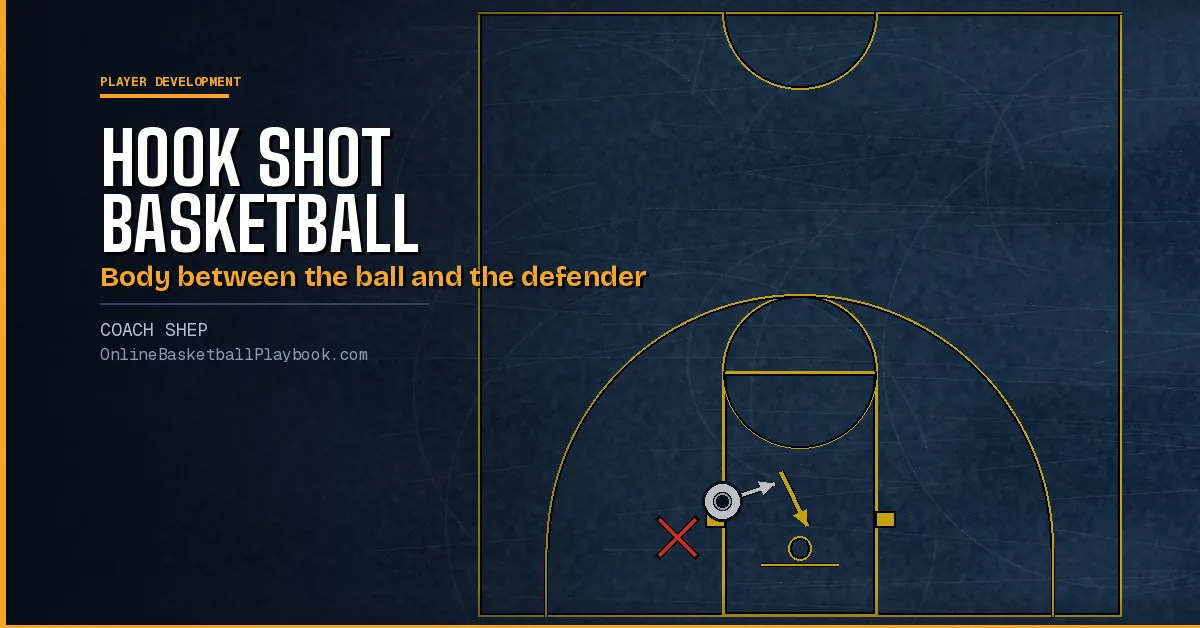
Hook Shot Basketball: How to Do It and How to Teach It
Hook shot basketball for post players and coaches: the classic hook, sky hook and jump hook, the footwork steps, when to use it, the pivot foot rules and drills.
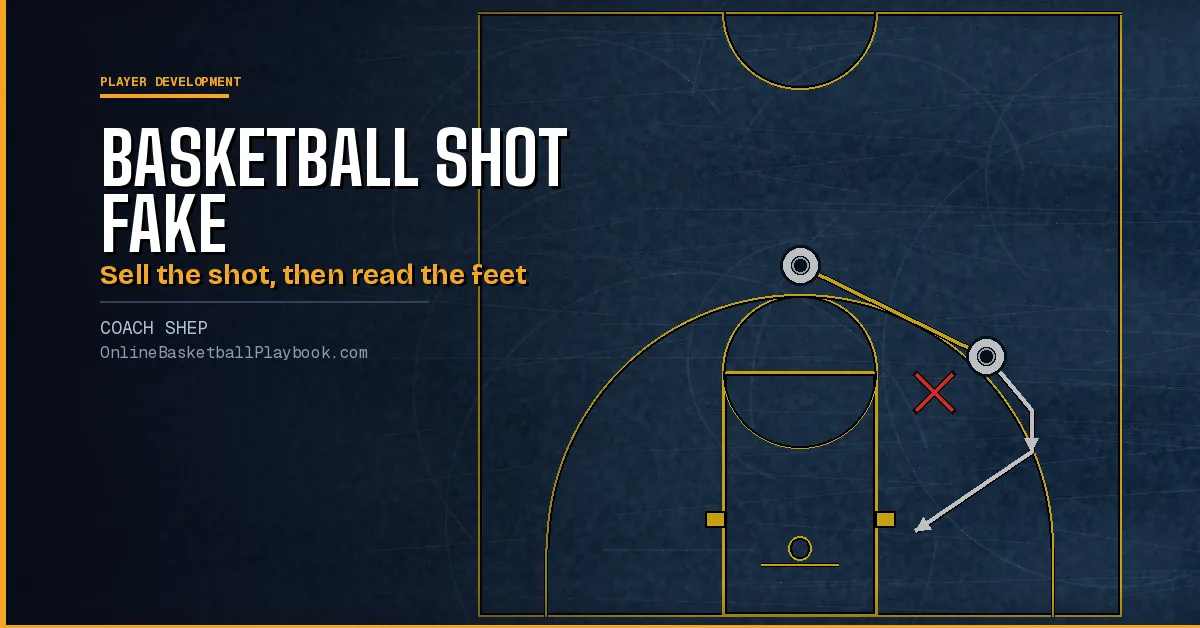
Basketball Shot Fake (Pump Fake): How to Do It and Teach It
The basketball shot fake, also called the pump fake, works when it looks like the real shot. The mechanics, the pivot foot footwork, the read and the drills.
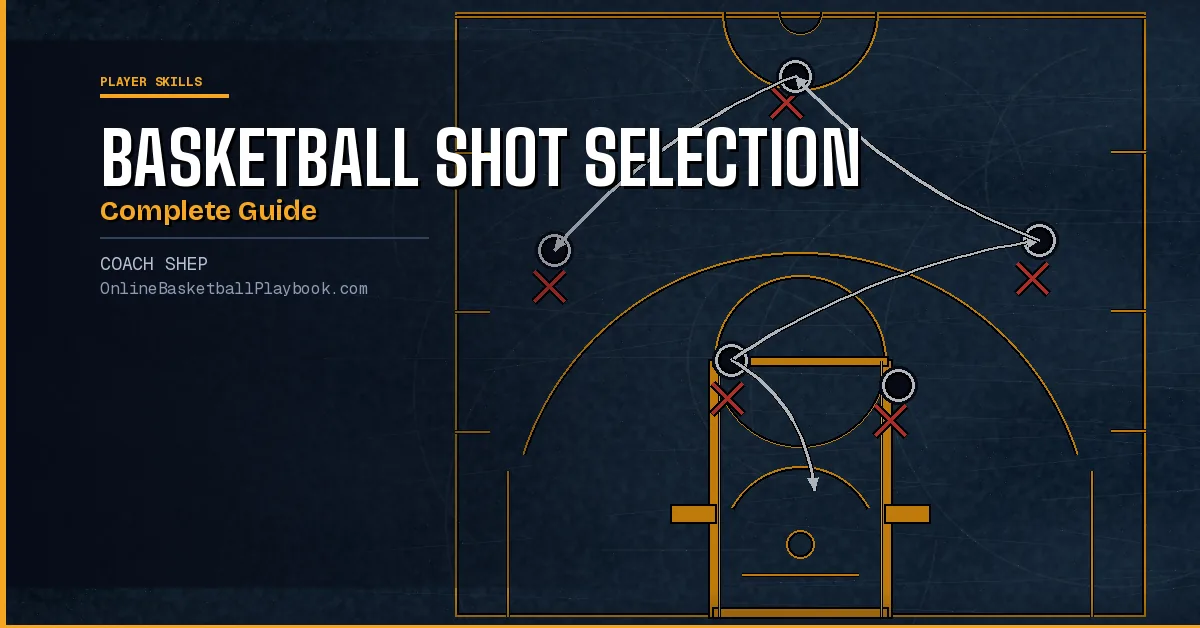
Basketball Shot Selection: The Complete Guide
Basketball Shot Selection: The Complete Guide