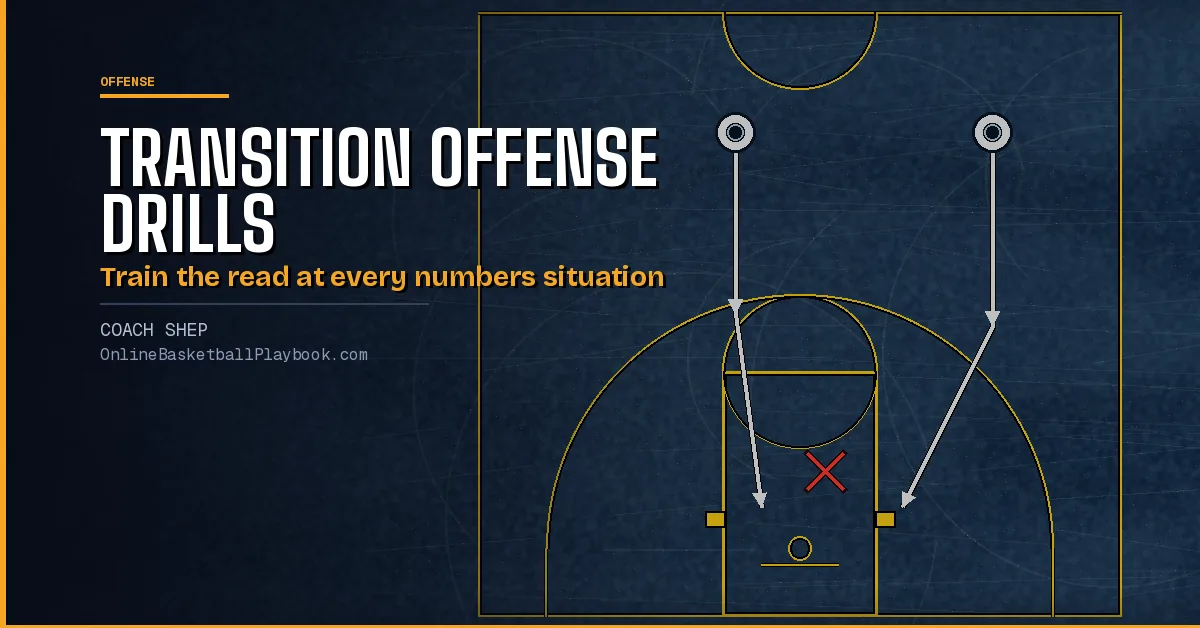
Transition offense drills build a trained decision for every numbers situation so players stop guessing in games. The drills below follow the order a break happens, which is the outlet, the lane fill, the small numbers situations, the full ladder and the secondary break. Each one has a setup, a rule and the mistake to watch for. For the game-side rules, see how to run the fast break.
Transition Offense Drills at a Glance
| Drill | What it trains | The rule |
|---|---|---|
| Outlet to the wing | The first pass | Turn to the outside and throw to the free-throw line extended |
| 3-on-0 | Lane fill and finishing | Few dribbles, jump stop, name the receiver |
| 2-on-1 | The foundation read | Attack the rim first, pass when the defender steps up |
| 3-on-2 | The most missed read | Stop at the free-throw line and read the top defender |
| 2-on-1 to 5-on-5 ladder | A decision at every number | Rebound, outlet and push one more player each cycle |
| Numbered break | The secondary break | Work the options in order, then flow into the half court |
Outlet and Lane Drills
The break starts with the outlet, and a slow or sloppy one kills the advantage before anyone runs. The rules are clear:
- Turn to the outside. The rebounder turns in the air toward the outside.
- Receive at the line. The point guard receives the outlet at the free-throw line extended and not at 28 feet.
- Run wide. The weak-side forward runs wide for the layup and trusts that the ball is coming.
- No pass back. Nobody passes back on the break.
- No low outlet. No outlet below the free-throw line, make or miss, unless you face a press.
The outlet drills:
- Outlet to the wing. Two offensive and two defensive rebounders battle for a shot the coach puts up. The rebounder pivots on his outside foot and throws a two-handed overhead pass to a wing at the free-throw line extended.
- Outlet to the center. The same setup with the target a point guard above the free-throw line who has a defender on him. The guard has to work to get open before he starts the speed dribble.
- Transition running drills. A rebound-outlet-break drill throws the ball off the glass, rebounds, outlets to a partner who dribbles to the elbow, jump stops and bounce passes for the layup. The Piston drill pairs two players. One inbounds and speed dribbles the length of the floor for a layup while his partner becomes a chaser trying to get ahead and stop the layup.

For lane filling, run a 3-on-0.
- Line up. Groups of three line up on the baseline with the middle player holding the ball.
- Sprint the lanes. All three sprint in their lanes, passing O1 to O2 to O1 to O3 and so on, with the wings running wide up the sidelines.
- Finish at the far end. At the far end the middle player speed dribbles back to the top of the key and passes to a wing cutting to the hoop for a layup, and the next group starts on the make.
- Few dribbles, jump stop. The middle player uses 3 or 4 dribbles, ends the dribble with a jump stop and finishes with a bounce pass while calling the receiver's name.
- Set a standard. A standard is 13 clean trips in a row, and any miss or fumble resets the count. Young or less skilled teams can lower the target.
Make the outlet and the lanes automatic before you add a defender.
2-on-1
Start every ladder here. Two offensive players start just inside half court against one defender in the paint. They pass quickly until they reach the three-point arc, and then the ball handler attacks while his teammate cuts at a 45 degree angle on the opposite side. A second defender starts on the sideline and sprints to touch mid-court and back to help, so the offense has to attack before the numbers turn into 2-on-2.
The rule is to attack the rim first and treat the pass as the second option.
- Read the defender. If the defender steps up to stop the drive, pass to the cutter. If he lays back, go to the hoop.
- Want a layup or a foul. The drill discourages the outside jumper and wants a layup or a foul every time.
- Attack at an angle. The ball handler attacks the rim at an angle along the lane line, and the partner holds the opposite low block for the pass or the rebound.
- Use two moves. Two moves beat the lone defender, the in-and-out dribble and the rocker step.
- No crossover. Coach players not to cross over, because it brings the ball back toward the teammate and collapses the spacing.

- Score it. A score or a shooting foul earns one point.
- Flip it. After a make, a turnover or a defensive rebound, the defenders become the offense and go the other way without stopping.
- Play to 10 or 12. Have the losers run.
- Teach the defender. The matching rule is to get as low as the lowest offensive player. He gives up the outside jumper, protects against the layup, avoids the foul and buys time for help to arrive.
Attack first and pass second.
3-on-2 and 3-on-3
The 3-on-2 turns on one rule. The point guard should not penetrate past the free-throw line or the elbow. He engages the top defender and then passes to either side or reverses the ball. Drive below the line and the 3-on-2 turns into a scramble while the defense recovers.

Set up the drill with a player who passes to start the break while two defenders sprint back, one of them from under the far basket. The defenders set a top player who stops and calls the ball and a low player under the rim. The wings sprint wide up the sidelines. Choose one wing job and teach it.
- Spot up for the three. The wings run all the way to the baseline and spot up for the transition three, avoiding the mid-range two.
- Slash for the layup. The wing slashes for the layup.
Two mistakes to coach against either way:
- No cross-lane pass. A wing with the ball should not force a pass across the lane to the far wing, because the defense is dropping into that lane.
- Shot fake the flyer. A low defender who flies out at a wing can be beaten by a shot fake and a drive.
A third defender can start on the sideline opposite the ball. If the break is stopped, the drill plays live 3-on-3 in the half court until someone scores, with quick ball reversal and no standing or aimless dribbling. Stop at the line, read the top defender and pass.
Get the next coaching guide in your inbox
One email when a new guide or diagram set goes up. Free.
The 2-on-1 to 5-on-5 Ladder
The ladder is the center of the practice block.
- Climb with a free throw. Start with a free throw and then run 2-on-1, 3-on-2, 4-on-3, 5-on-4 and a possession or two of 5-on-5. It is an everyday drill and takes about 15 minutes early in the season and about 5 minutes by March.
- Chain the levels. Run the levels in one continuous cycle. Two teams play, and one point goes to a score or a foul drawn. The drill starts 2-on-1. The lone defender rebounds and outlets to teammates who come from the sidelines while the two offensive players sprint back, which makes a 3-on-2. The defenders then push with two additional players for a 4-on-3, and the pattern repeats through 5-on-4 and 5-on-5. The cycle restarts at 2-on-1 with the other team on offense and runs 15 to 20 minutes or a set number of cycles.
The rules at each level stay short. At 2-on-1, attack the rim first. At 3-on-2, do not penetrate past the free-throw line. At 4-on-3 and 5-on-4, run the lanes, keep good spacing and use dribble-drive-and-dish or kick-out passes. Spacing is the coaching point at 4-on-3 and 5-on-4. Add one player each cycle and keep the rule short.
The Numbered Secondary Break
The numbered break gives every player a priority order that a point guard can call by number. After a made basket, a post player takes the ball out of the net, steps out of bounds and inbounds to the point guard without delay, so the defense has no time to set a press.
The two wings sprint the sidelines into the frontcourt. A third player plays opposite the ball and cuts to the ball-side block. The last player trails to the elbow opposite the ball.

The options run in order:
- Attack first. The point guard attacks all the way to the free-throw line, looking for a 3-on-1.
- Throw long. A long pass to a sprinting wing for a layup.
- Hit the cutter. A pass to the cutter on the ball-side block.
- Find the trailer. A pass to the trailer at the elbow.
Reads can chain, such as 1 to 2 to 4. If no option shows, the team flows straight into its half-court offense instead of forcing a pass. After a defensive rebound the same pattern runs, and the rebounder can become the trailer.
A read-discipline rule keeps the seam open. The cutter delays and trails if the point guard can attack the seam. If the point guard stops outside, he flash cuts to the block. Early cuts clog the lane the point guard needs.
The same break can double as a press breaker when the inbound is quick enough to beat the press before it sets. See secondary break basketball and drills to teach the press break. Rep the break 5-on-0 first, then against a scout defense. Run the options in order and let the break flow.
Live and Competitive Formats
- 4-on-4 with a head start. Four offensive players line up on the baseline and four defenders at the free-throw line extended. The coach yells the names of two defenders and throws the ball to the offense. The two named defenders must touch the baseline before they can sprint back. After a score, steal or defensive rebound, the other team pushes the break the other way. Keep score and have losers run.
- The 11-Man drill. One shot per possession. The rebounder outlets and becomes the next attacker. The four players who did not rebound yell "defense," and the first two callers defend.
- Scout defense that earns its ball. The defense must get five or six stops before it can run its own offense, which keeps the break honest against real pressure.
- 4 Second Bonus. Give a bonus point for crossing the opposite foul line within 4 seconds, or 6 seconds for younger players. It rewards passing the ball ahead.
Condition through the break and skip the suicides. Running the real secondary break 5-on-0 for five trips is one way to do it, and it teaches lane habits while players are tired. The conditioning drills on fast break basketball drills cover more ideas.
Rules to Attach to Any Drill
- Pass ahead of the dribble. Passing gets the ball up the floor faster. A three-dribble limit or a cone passing zone at the hash mark enforces it.
- Hurry, but do not rush. Pace is a weapon only if ball security and decision quality hold up at speed.
- Credit the assist. The scorer points to the passer who created the basket, which reinforces unselfish play.
- If you have to dribble across half court, the break is over. At that point the team runs its offense.
- Sprint every lane on every possession. The habit produces the occasional uncontested layup, and walking produces none.
- A drill constraint for pace. Run a three-on-three transition drill with no ball screen off a miss or turnover, possessions of seven seconds, and only threes and layups. Off a made basket the offense runs a named action such as a pistol, a wide pin, a key catch or a dribble handoff.
The habits connect to early offense basketball, and the same spacing carries into your half-court system. Taking advantage of early offense covers the shot side and transition offense plays for quick scores shows set actions.
A break that flows into a dribble-drive system is on drills to teach the dribble drive motion. The transition defense page covers the same possession from the other end, and basketball practice plan shows where a 10 to 15 minute ladder block fits. Attach one rule at a time and keep it until it is automatic.
Where Coaches Split
| Question | Keep it tight | Open it up |
|---|---|---|
| Shots in transition | No threes. Keep four players at the free-throw line or above | Threes and layups only, and give shooters a green light on the pass ahead |
| How far the point guard pushes | Never past the top of the circle except to finish a layup | Attack the seam all the way to the rim, or attack the paint |
| Ball screens in the break | No ball screen off a miss or turnover, so guards win one on one ahead of the ball | End the secondary break in a ball screen or a drag screen |
The two sides may define the transition window differently. Decide where transition ends and the half court begins before you install two systems, and make sure the ball handler knows which rule is on.
Questions Coaches Ask
What are the best transition offense drills?
Start with the outlet, add a 3-on-0 for lanes, then run 2-on-1, 3-on-2 and the ladder to 5-on-5. Finish with the numbered break and a live format.
How long should the transition ladder take?
The ladder runs about 15 minutes early in the season and about 5 by March. A continuous cycle runs 15 to 20 minutes or a set number of cycles.
Which drill should a coach run first?
The outlet and the 2-on-1. They train the first pass and the foundation read, and every later level of the ladder builds on them.
What is the rule in a 2-on-1 drill?
Attack the rim first. Pass to the cutter if the defender steps up, and go to the hoop if he lays back.
What is the difference between transition offense and early offense?
Transition offense is the structure of the break, including the outlet, the lanes and the numbers reads. Early offense adds the pace and the set actions in the first seconds before the defense is set.
Want the printable playbook packs?
OBP Pro members get the premium playbook packs: the zone attack, out of bounds and practice plan PDFs, plus each new pack as it is finished. The membership page lists what is in each one. Or draw your own version free in PlayDraw.
See what OBP Pro includesMore Coaching Guides
- Mentorship Program for Young Coaches: Match, Meet, Review
- Basketball Late Game Situations: Decisions, Fouls and Clock
Back to Early Offense in Basketball and every Offense page.
Keep Building
Related breakdowns
Princeton Offense Drills: Breakdowns, Shooting and Live Reps
Princeton offense drills that teach the reads: spacing, backdoor and hand-off breakdowns, 3-0 Chin and wave drills, Point shooting, a drive drill and an install.
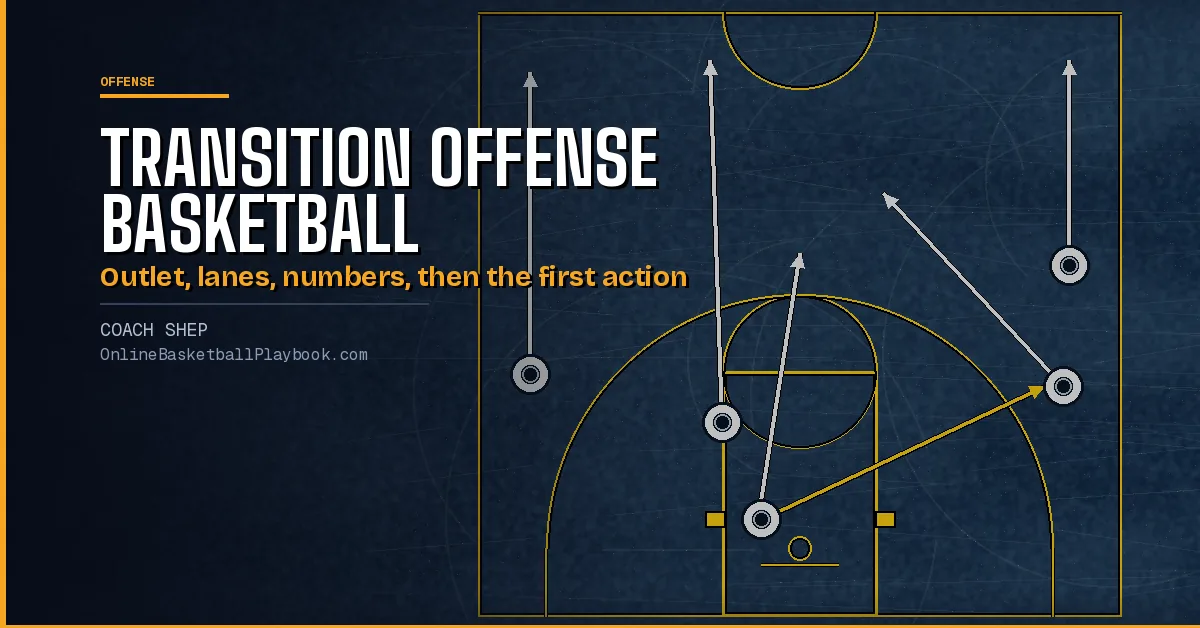
Transition Offense Basketball: Lanes, Reads and Early Offense
Transition offense basketball from rebound to first half-court action: outlets, lanes, 2 on 1 and 3 on 2 reads, the secondary break, early offense and crashing.
Pick and Roll Basketball Drills: From 2 on 0 to Live Reads
Pick and roll basketball drills that teach the action in order: a 2 on 0 screener series, chair reads, advantage drills, live coverage drills and youth steps.