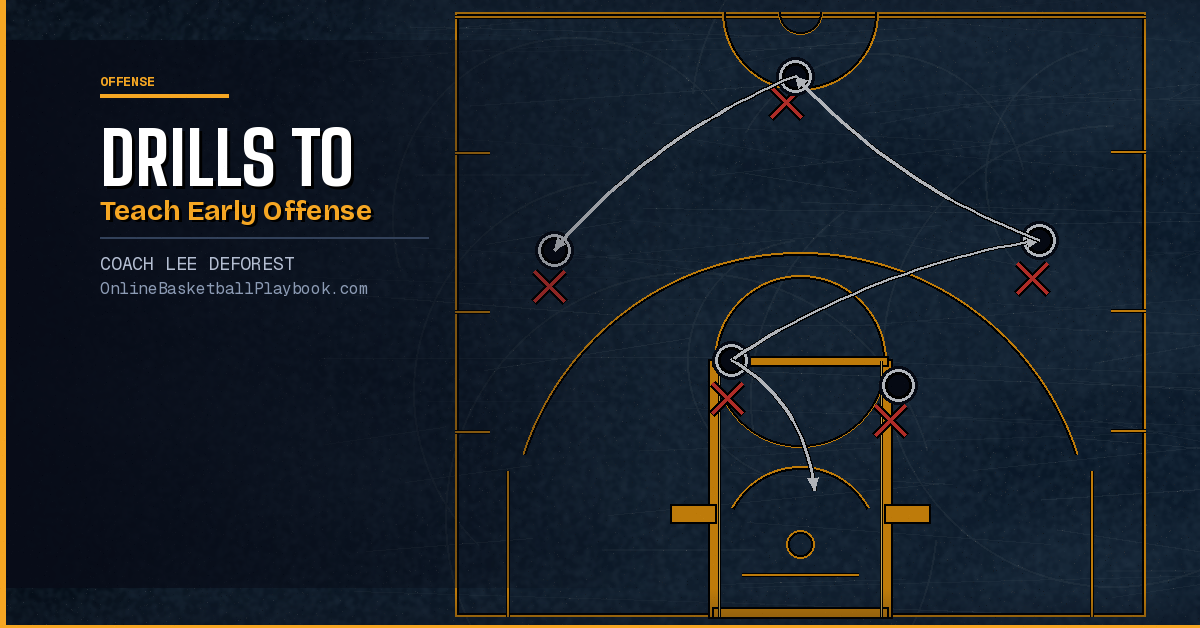

Early offense wins possessions before the defense is set. These five drills install the outlet, lane fill, push timing, and shot discipline your team needs to turn every rebound into an attack.
Why Early Offense Has to Be Drilled
Most coaches talk about pushing the ball in transition. Far fewer build drills that actually train the decisions — outlet reads, lane fill responsibilities, push timing, and shot selection — so that players execute them under game speed without thinking. The difference between a team that talks about pace and a team that plays with pace is practice structure.
Early offense is most dangerous in the first three to five seconds after a rebound or turnover, before the defense has matched up. When your team gets the ball over half-court in that window and attacks immediately, the defense is scrambling. Defenders are still running back, matchups haven't formed, and the paint is open. The moment your point guard stops and sets up, you surrender that advantage and hand the defense time to organize.
The goal of these drills is simple: build habits so your players push automatically, fill the right lanes without being told, and make the right decision at the end of the break — layup, early three, or flow into the half-court offense — without hesitation. That last part, shot selection, is where most transition drills fall short. Running the floor is one skill. Knowing what shot to take at the end of the break is a separate skill, and it has to be taught just as deliberately.
These five drills come from principles sourced across multiple high-level programs, from college to the NBA, and they build on each other. Run them in sequence early in the season to establish the habit, then use the shorter versions as daily maintenance once your team knows the system.
The Outlet and Push: Building the Foundation
Before you can run any transition drill, your players need clean outlet mechanics. A slow or sloppy outlet kills the advantage before the break even starts. Hubie Brown's outlet rules are the clearest framework at any level: the rebounder catches the ball, turns in the air toward the outside, and immediately looks to push. The point guard sprints to free-throw-line extended — not to half-court, not to the three-point line — and calls for the ball at that precise spot. The weak-side forward runs wide, all the way to the corner or wing, and trusts the ball is coming.
That last part — trust — is the piece that breaks down most often. Wings run wide but then slow down because they don't believe the point guard is going to throw it ahead. The point guard holds the ball because the wing didn't get wide enough. The outlet becomes a dribble-up instead of a push. You fix this by drilling the outlet in isolation first, before adding defenders, so each player builds confidence that their teammate will execute their role.
Drill: 3-Man Outlet Push
Set up with a rebounder at the block, a point guard at the elbow, and a wing on the opposite side. The coach or manager puts the ball off the backboard. The rebounder catches, turns to the outside, and outlets to the point guard at free-throw-line extended. The point guard immediately pushes ahead while the wing sprints wide to the opposite side for the layup or catch at the wing. Run it for five minutes every day early in the season until the outlet is automatic. Add a second ball and a second group going the other direction to keep the pace up.
The coaching point on this drill: the point guard must deliver the ball ahead if the wing is open. No holding. No dribbling up. Matt Painter's rule from Purdue applies here — the point guard's job is to make the outlet and push. If the wing earns the layup by running hard, the point guard must reward it. One missed reward and the wing stops running. Consistent delivery builds consistent effort.
3-on-2 Scramble — Training Transition Decisions
The Scramble drill is the most-used transition rep in early offense installation. Three offensive players attack two defenders who are already set. The advantage is built in. The drill forces the ball-handler to read the defense and make the right pass — not just push — and forces the other two players to fill the correct spots to create the angle for a layup or open shot.
How to Run It
Set up three offensive players at half-court and two defenders in the lane. On the coach's signal, the three attack. The ball-handler must probe the defense and make a decision: if the top defender commits to the ball, pass to the open player cutting to the rim. If the bottom defender sags, the ball-handler attacks the rim directly. The two offensive players without the ball must fill opposite sides and sprint to spots that create a passing lane, not cluster around the ball.
After each rep, the two defenders become part of the next offensive group. Rotate continuously so players experience both roles and understand the defensive reads they're attacking. Run ten reps, then add a third defender who starts at the opposite baseline and sprints to recover — now the offense must decide whether to push early or wait. That added defender simulates the game reality that the numbers advantage doesn't last forever.
The coaching emphasis in the Scramble: no hesitation at the rim. If the pass is there for a layup, take it immediately. The most common mistake is a ball-handler who makes the right read but then second-guesses and holds the ball until the defense recovers. Finish fast. The shot quality at the end of a good Scramble rep should be a layup or a wide-open wing catch. If your players are settling for pull-up mid-range jumpers out of this drill, your shot-selection standard isn't clear enough.
The Texas Advantage Drill
The Texas drill, referenced in Memphis breakdown material and used across multiple high-major programs, extends the Scramble concept into a more game-realistic situation. Where the Scramble is a clean three-on-two, the Texas drill builds flow — one group transitions directly into the next rep, so players experience the fatigue and mental demands of back-to-back early offense decisions.
Setup and Flow
Place two lines at half-court and two defenders at the far basket. The first group of three attacks the two defenders, just like the Scramble. After the possession ends — make, miss, or turnover — the next three immediately attack going the other direction. The two defenders from the first possession sprint to become two of the three attackers on the return trip, and two new defenders step in from the sideline.
The key is pace and seamlessness. There is no break between reps. The moment one possession ends, the next one starts. This teaches players to push while physically tired, which is exactly when early offense decisions break down in games. Players start holding the ball, slowing down in the lane, or taking the first available shot instead of the best one. The Texas drill puts them in that state deliberately and gives them reps to build better habits under fatigue.
Run it for five minutes straight with no stoppages. Coach from the side and call out reads as they happen — don't stop the drill for corrections. Let the reps accumulate. Save the teaching points for the end, then run five more minutes with those adjustments in mind.
Progressive Transition: 2-on-1 Through 5-on-4
Progressive transition is the full battery. You build from the simplest numbers advantage to the most complex, in sequence, within a single practice segment. Coaches like Grant Oats at Alabama have used this framework to install pace-and-space principles from day one of preseason, and the progression works because each stage isolates a specific decision and trains it before adding complexity.
2-on-1
Two attackers against one defender. The ball-handler must decide: attack the rim directly or pass to the trailer cutting to the opposite side. The defender has to make a choice — take the ball-handler or cover the pass. The offense must make the correct read and finish at the rim. No settling. This is the purest version of the break decision, and players who can't execute this cleanly won't execute it in the 5-on-4 either.
3-on-2 and 4-on-3
Each stage adds a defender and an offensive player. The reads get more complex because there are more passing options and more defensive rotations. At 4-on-3, the ball-handler often has to make a second pass before a layup is available, which tests patience — the discipline to pass twice on the break rather than forcing the first option. This is where the early three becomes a real decision: if the defense collapses to stop two straight passes into the paint, the skip to the corner or wing for an open three is the correct play, and players have to be trained to recognize that read and take the shot confidently.
5-on-4
Full break with one defender still catching up. The offense has a one-player advantage, but it's spread across five players, which means the ball-handler's primary read is spacing, not just the rim. Players in the wide spots must be ready to catch and shoot, not drift to watch. The defense has to cover four offensive players with three, so one person will be open if the attack is executed correctly — the drill trains the offense to find that person quickly and take the shot. If your team hesitates at the 5-on-4 stage, the root cause is almost always the wide players not being ready to shoot when the pass arrives.
Push for 32 minutes — run them early to wear them out late, using relentless pace as a conditioning weapon that compounds as the game goes on.
— Early Offense concept (Memphis/Walberg source), Basketball Vault
Freedom vs. Structure — Teaching Players When to Run and When to Call
One of the most important early offense principles, and one of the hardest to install through drilling alone, is teaching players when to run freely and when to run a called action. Dan Hurley's rule is the clearest version of this distinction: freedom off stops, structure off makes.
Off a missed shot or turnover — a stop — the defense is scrambling. Defenders are out of position, matchups aren't set, and the best play is to blast ahead and attack the paint one-on-one. Guards who can win that situation without a ball screen develop the individual skills that win close games late. Using a drag ball screen in that moment is a crutch — it takes away the advantage the stop created and slows down an attack that should be immediate. Hurley's teams ban the transition ball screen after stops specifically because removing it forces guards to develop the one-on-one skill.
Off a made basket — a make — the defense has a head start. They're already running back and the matchups will form before you get over half-court. In that situation, running a called action — a pistol action, a dribble hand-off, a step-up ball screen — creates the advantage that speed can't because speed isn't available. The structure generates the mismatch or the opening instead.
Drilling this distinction requires labeling. When you run your transition drills, you have to call out which situation you're simulating. If the rep starts after a made shot, tell the group: structure is on, call the action. If it starts after a turnover, tell them: freedom, blast ahead. After a few weeks of deliberate labeling, players start to read the situation automatically and make the right call without being told. That's the goal — self-regulating decision-making at pace.
Shot Diet Enforcement
Every transition drill should have a shot filter attached to it. Grant Oats values the early open three — a catch-and-shoot three in the first seven seconds of a possession — as one of the highest-quality shots in the game. An early open three is worth more than a contested mid-range pull-up, statistically and practically. Your drills should reinforce this by rewarding layups and open threes and discouraging everything in between.
One simple enforcement mechanism: designate a "green light" shot type for each drill. Layups and catch-and-shoot threes are green. Anything else requires a verbal call from the coach before the shot is taken in drill. Players quickly self-police once the standard is clear, and over the course of a season the shot quality in your real transition offense will reflect what you allowed — and disallowed — in practice.
George Karl's Gap Offense philosophy reinforces this from a different angle: in transition, you score on the second attack. The first wave probes the defense and draws the initial rotation. The second action — the kick-out to the corner, the ball reversal to the skip man — is where the open shot actually appears. Drills that end on the first pass often train players to force the first available look instead of recycling for the better one. Add a "second attack" constraint to your Scramble and Texas drills: the first pass can't be the shot, the ball must move once before a shot is taken. This single constraint changes the decision-making quality dramatically.
Install your outlet and lane-fill rules in dry offense first — no defenders, just movement — so the decision becomes a habit before you add defensive pressure. Players who have to think about where to go can't also think about reading the defense. Build the movement pattern first, then layer in the competition.
- Outlet to free-throw-line extended, not half-court — the point guard getting too deep kills the angle and slows the push; free-throw-line extended keeps the outlet fast and the passing lane tight.
- Wide players must run all the way wide and trust the ball is coming — a wing who slows down "just in case" never gets the layup; the point guard must deliver it when they earn it, every single time, to build the trust that makes the lane fill automatic.
- Label every rep as "stop" or "make" — so players learn the freedom-vs-structure rule through repetition; after enough labeled reps they start reading the situation and self-selecting the right approach without a prompt from the sideline.
- Green-light shots are layups and early catch-and-shoot threes only — mid-range pull-ups off the break are the transition equivalent of a drag screen: safe-feeling but suboptimal; enforce the shot diet in practice and it will hold in games.
- Run progressive transition at the end of a hard segment, not the start — players need to experience making break decisions while tired; that's when the habits either hold or break down, and practice is where you find out which.
Want more basketball coaching strategies and drills?
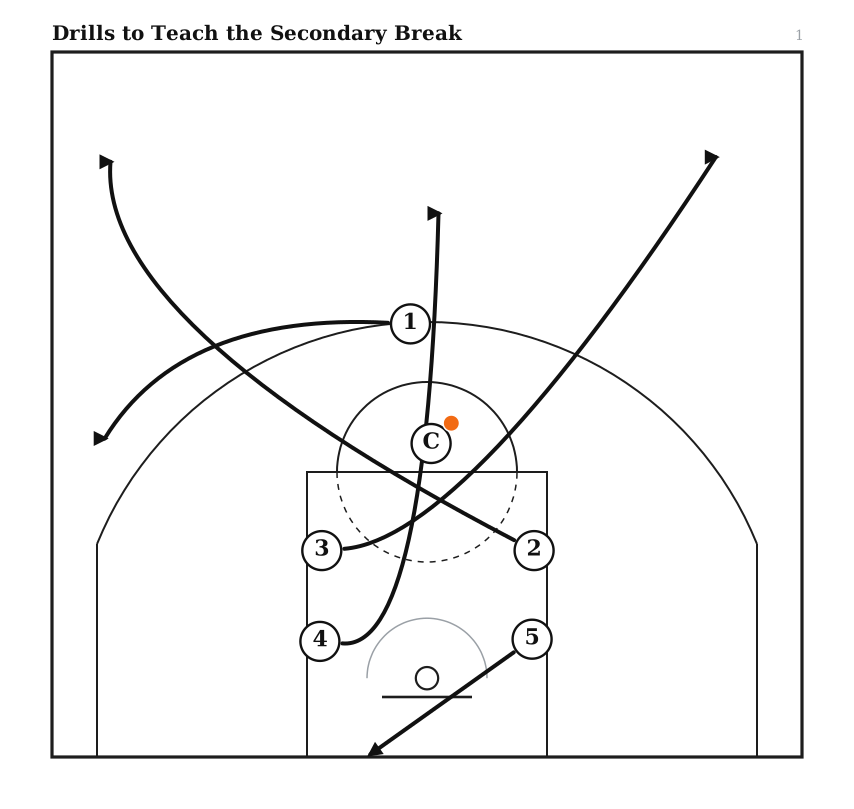
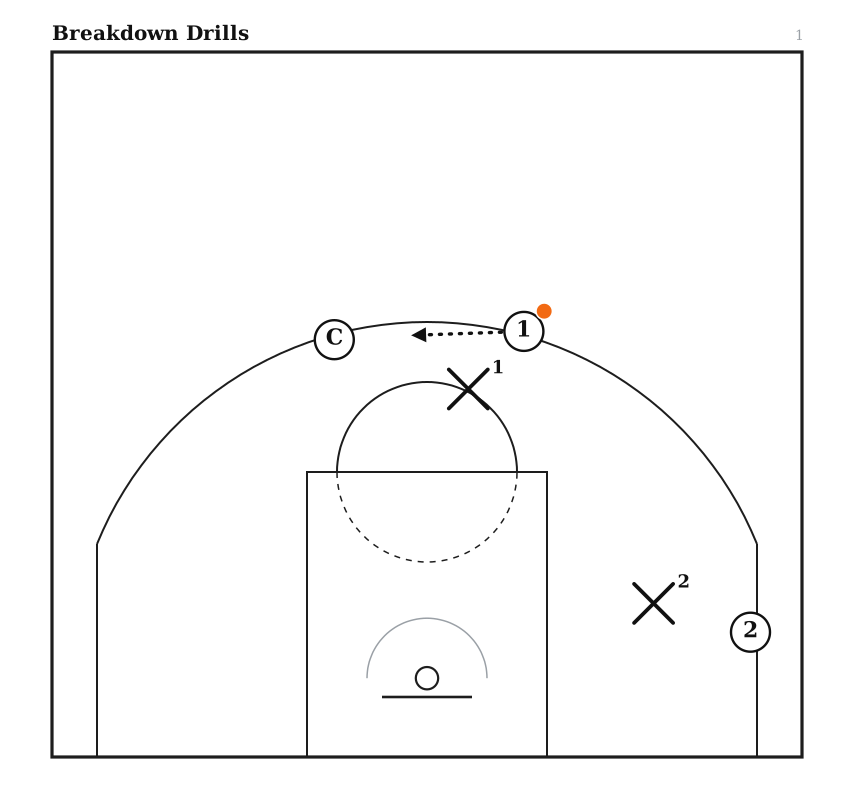
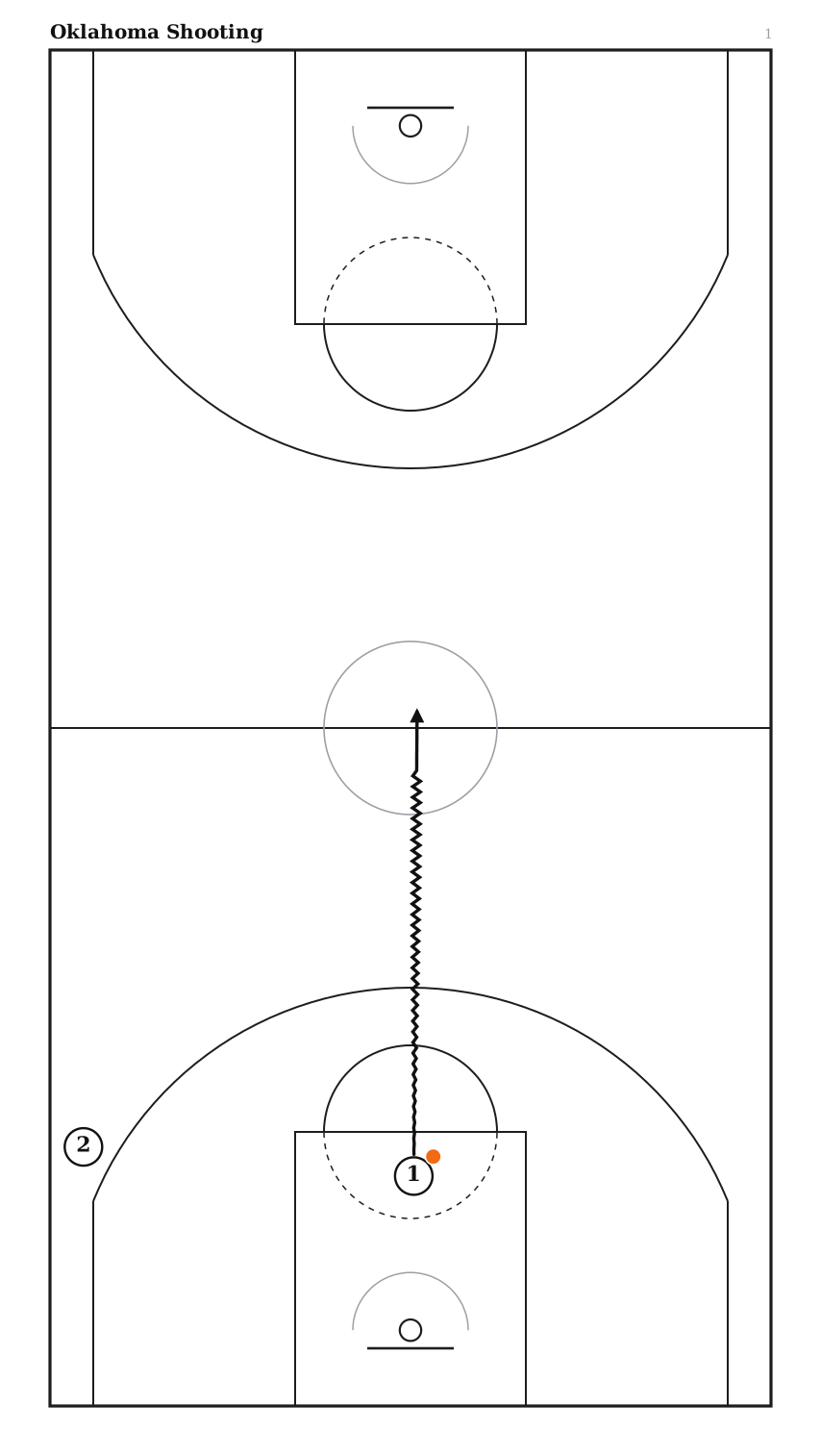
See it drawn up
Related diagrams
Keep Building
Related breakdowns
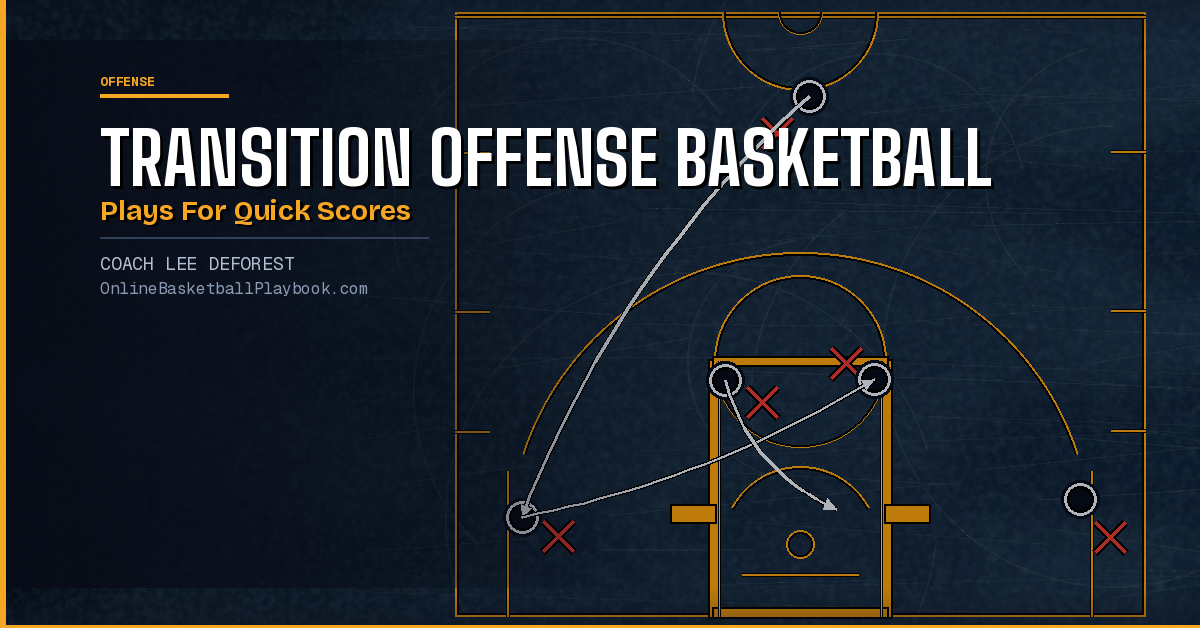
Transition Offense Basketball Plays for Quick Scores
Transition Offense Basketball Plays for Quick Scores