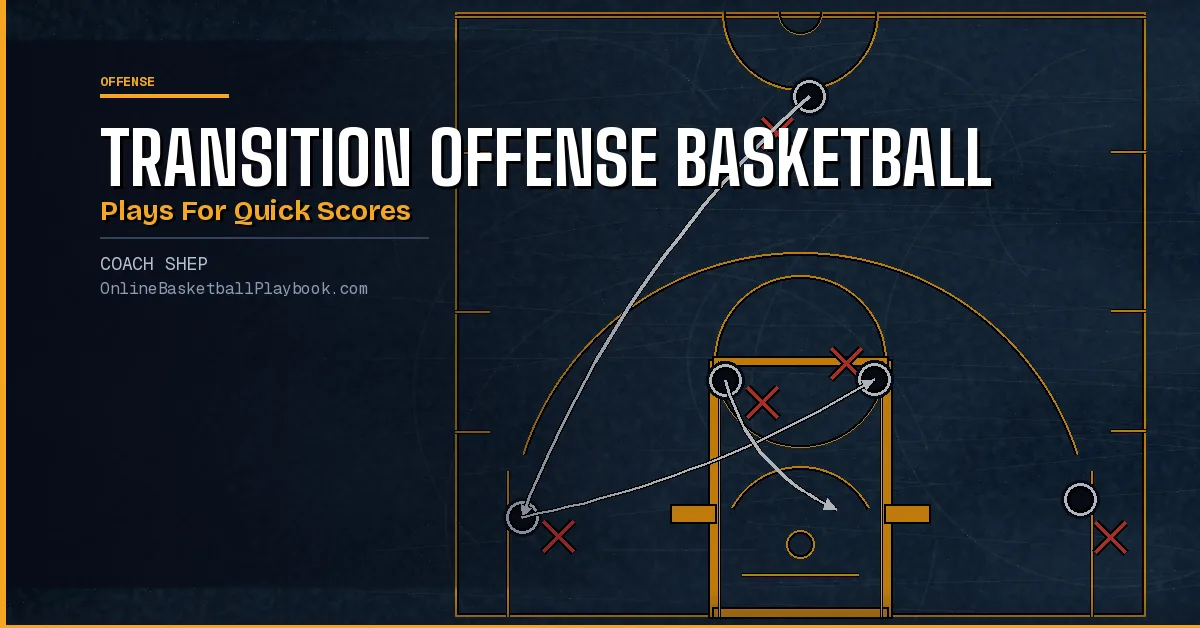
Transition offense is not about running faster. It's about having a structured decision tree for every numbers situation so your players convert advantages before defenses recover. Here's how to build it.
What Transition Offense Actually Means
Most coaches treat transition offense as a loosely defined period between the defensive rebound and the half court, a window where athletes do what they feel. That's the wrong frame.
Transition offense is a structured decision tree for every numbers situation from the moment a possession changes hands through the secondary break. It covers turnovers, missed shots, and made baskets. It runs from the outlet pass to the first action in the half court. Nothing in that window should be freelance.
The distinction matters because advantages expire quickly. A defense that took three seconds to recover is now organized. The window for a numbers advantage (2-on-1, 3-on-2, or even 4-on-3) might be two seconds wide. Teams that have trained decisions for those situations convert. Teams that improvise in those moments throw the ball to the wrong player, drive into traffic, or pull up for a mid-range jumper when a layup was available one pass earlier.
Transition offense and half-court offense are also not two separate phases. The best transition systems flow directly into the half court without a reset. When you install transition this way, you're teaching the same spacing, the same reads, and the same language your players will use all game long, just at a faster pace and against a defense that isn't set yet.
The Two Rules That Govern Every Possession
Dan Hurley's framework reduces all of transition offense to one sentence: freedom off stops, structure off makes.
Off a stop or turnover, the mandate is simple: blast the ball ahead, attack the paint, and drive and kick. No ball screen. Hurley is explicit about this. "The drag ball-screen is a crutch. Guards aren't winning one-on-one." The targets are layups and threes only. Mid-range shots off the break are a waste of the advantage you earned on defense. Hurley gives guards a 7-second target: a stop should produce a good shot attempt in seven seconds or fewer.
Off a made basket, where the defense is already retreating in organized fashion, you call a structure. That structure has a name: pistol, wide pin, DHO, step-up. The point guard knows which action is coming, the wings know their assignments, and the offense flows into a named action rather than five players improvising simultaneously.
This two-rule framework is the most efficient way to teach transition to any level of player. It answers the only question that matters in the break: do we push freely, or do we execute something specific? One sentence, no confusion.
Fast Break Start Rules and Lane Filling
Transition advantages start on the defensive glass. How you rebound determines what break you get.
Hubie Brown's outlet rules are worth installing verbatim. The rebounder turns in the air toward the sideline. The point guard receives the outlet on the wing, not 28 feet from the basket, not at half court. This positioning lets the guard see the floor before the ball arrives and read what numbers advantage exists. Once the guard catches, the rule is absolute: never pass back on the break. Every dribble and pass goes forward.
Lane filling is the other structural piece. The point guard pushes the middle. Wings sprint the sidelines. A trailer follows behind the first wave. And one player, the preventer, protects against the defensive counter-attack. These are permanent assignments, not in-game reads. Every player knows their lane before the break starts. The timing of all five players arriving simultaneously is what creates the numbers advantage. A defense that has to guard all five corners at once cannot load up to stop the ball.
The habit piece is worth dwelling on. A team that sprints its lanes on every possession, even possessions that turn into half-court sets, trains the reflex of sprinting. That reflex is what produces the occasional wide-open layup. A team that jogs back to half court, assessing whether the break is on, arrives a beat late on the possessions where they could have scored in transition. Build the habit of lane-sprinting before you build any play or action.
Secondary Break Plays and Named Actions
The secondary break is where most transition offenses actually live. Your team will not get a clear-path layup on every possession. But after a stop or a make, the defense is still recovering, still communicating, still sorting assignments. A named secondary break action exploits that window.
Bob McKillop's system at Davidson names five secondary break actions: Early Go, Early Drag, Early Kick, Trail Man, and Break. The naming is the point. Players can call actions verbally while they're running, eliminating the huddle or the signal that gives the defense time to set. Break-Reversal-Into-Offense takes this further: reverse the ball on the secondary break and flow directly into the motion offense, no reset required. Transition becomes the half-court on-ramp.
NBA coaches take named secondary break actions even further. One NBA system runs eight named series off a single trigger: a hit-ahead or kick-ahead to the wing, followed by a shuffle cut away. From that one cue, the offense can enter Oklahoma (double drag into pindown), Point (wide pindown into tight curl), Weak (shuffle cut into side ball screen), Kansas (back screen into flare into hammer), and more. Each series has a named denial counter built in. The counter is as much a part of the curriculum as the action itself.
You don't need eight named series. Two is enough for most high school programs. Pick Early Go (push the ball, attack the seam immediately) and one made-basket structure like a pistol action. Run them enough that every player can identify which one is happening in real time without being told.
Numbers Situations: 2-on-1 and 3-on-2
The most commonly violated rules in transition offense involve numbers advantages. Coaches drill 3-on-2s and assume players understand the reads. They don't. Until the rules are made explicit and practiced against live defenders.
2-on-1: Attack the hoop first. The pass is the second option. The ball-handler drives toward the basket and forces the defender to commit. If the defender commits to the ball-handler, the pass to the cutter is open. If the defender backs off to take away the pass, the ball-handler finishes. The mistake is passing first without making the defender choose. That gives a disciplined defender an easy stop on both players simultaneously.
3-on-2: The point guard stops at the free-throw line. This is the rule. The guard does not penetrate below the line. From the free-throw line, the guard reads the top defender: if that defender commits to the ball, the pass goes to the cutter moving toward the hoop. If the top defender retreats, the guard attacks. The second defender has to choose between the two wings. One of them is always open. This is the most commonly violated transition rule at the youth and high school level because guards feel pressure to drive all the way to the rim. Train the stop at the free-throw line as a habit before anything else in a 3-on-2 drill.
Zvjezdan Mitrovic's numbers principle adds one more layer: always attack with one more player than the defense. Push 100%. Keep the ball in the middle so it can go either way. And if no defender picks you up, don't pass. Wait for a defender to commit, then it becomes a real advantage read. Transition advantage is structural, not reckless.
How to Drill Transition Offense
The most efficient transition-offense drill structure is a daily progression ladder. Run it in sequence and don't skip levels.
Start at 2-on-1 and work up: 2-on-1, then 3-on-2 tandem, then 4-on-3, then 5-on-4 diamond, then 5-on-5. Each level has its own structural rules. The drill is not freestyle. The point of the ladder is that players get trained decisions at every numbers scenario before they face them in a game. A player who has taken 200 reps at the 3-on-2 free-throw-line rule will not panic when a real 3-on-2 develops at game speed.
Hubie Brown replaces suicides with the 5-Man Break conditioner. The whole team runs in lanes, the break happens at both ends, and conditioning happens at the same time as transition skill development. That double-duty is worth prioritizing over isolated conditioning runs.
Shell calls add a next layer of complexity. The coach calls a named action (pins, flares, DHO, stagger, pistol) and the offense executes it against a live defense coming out of a drill. This bridges the vocabulary of the practice session to in-game recognition. Players who know their shell-call vocabulary can hear a point guard call "pistol" at half court and immediately begin their movement. That's the transfer from drill to game that most practice reps never achieve.
Finally, drill the press-break and secondary break with the same lane assignments. If your team already knows their press-break lanes, where each player goes when the opponent applies half-court pressure, they already know the secondary break formation. Same lanes, same spacing, same timing. Installing one system teaches both. This is an underused efficiency in practice planning.
Before drilling any secondary break action, test whether your point guard actually stops at the free-throw line in a live 3-on-2. If they don't, fix that one habit before introducing any named play. A guard who penetrates past the line in a 3-on-2 turns a numbers advantage into a scramble every time, and no secondary break action will fix that underlying problem.
Early Offense: The First Two Seconds
Early offense is the 2-to-3-second window after a made basket or a slow-developing break, when the defense is still retreating but no clear numbers advantage exists. It's the territory between transition and the half court, and it's where well-coached teams separate themselves.
Stephen Silas identifies three early drive-and-kick initiators your point guard should learn to read coming up the floor. First, the pass-ahead: with a wing ahead of the defense, pass ahead and rip immediately to the baseline. The receiver attacks a defender who hasn't yet set their feet. Second, the skip-pass in transition: the defense is loading to the ball, so a skip-pass to the weak side attacks a defender who has to close out from a late position. Third, the slip: instead of catching, the wing slips to the rim, opening a driving gap for the guard. These three reads happen before the half court even begins. Guards who recognize them consistently generate better looks than guards who wait for the defense to organize.
Chris Capko's early-offense framework adds designed actions to this window. The Pistol action (guard passes and cuts to a corner while a big sets a ball screen) forces two defenders to make simultaneous decisions before either is ready. The twist screen re-angles after the initial set, exploiting the moment defenders are still deciding who covers whom. These are not drawn plays. They're trained reads that exploit the moment defenders are sorting assignments.
The practical takeaway: teach your guards to enter one early action in that 2-to-3-second window before defaulting to the half-court offense. Teams that do this consistently, every possession and every game, will generate more open looks at the rim and corner than teams that let the defense organize before attacking.
"Hurry, but don't rush" is the organizing phrase for all of this. Pace is a weapon. But a player who panics with the ball in transition, who forces a pass into traffic or dribbles into a crowd, kills the advantage faster than any defender. Train decision-making at game speed. Make catch-and-face the habit before dribbling. Pass away from the defense, not into it. And build the cultural practice of crediting the assist, pointing to the player who made the kick-out that created the score. That habit changes how guards think about transition from "can I finish?" to "who is open?" and that read-first mindset is the foundation the whole system runs on.
- Freedom off stops, structure off makes: Blast ahead with no ball screen after a stop. Call a named action (pistol, DHO, wide pin) off a made basket so every player knows their assignment immediately.
- PG stops at the free-throw line in every 3-on-2: No exceptions, no drives below the line. This single rule prevents the most common transition mistake at every level of play.
- Sprint the lanes on every possession, even when there's no break: The habit of lane-running is what creates uncontested layups. The habit of walking creates none, regardless of how good your plays are.
- Install a numbered secondary break (options 1–5): Give players a decision framework they can call by number in games, starting with PG attacking the seam and ending with the trailer option for the open three.
- Use the same lanes for press-break and secondary break: Teams that already know their press-break assignments already know the secondary break formation. Install both systems simultaneously to double your practice efficiency.
- Credit the assist on every transition score that comes from a kick-out: This one cultural habit shifts the entire transition mindset from individual finishing to the read-first decision-making the system depends on.
Want more basketball coaching strategies and drills?
Join the Online Basketball Playbook newsletter →
Draw this play free in the play drawer →
Membership: the full library, playbook packs, and Pro drawing tools →
Keep Building
Related breakdowns
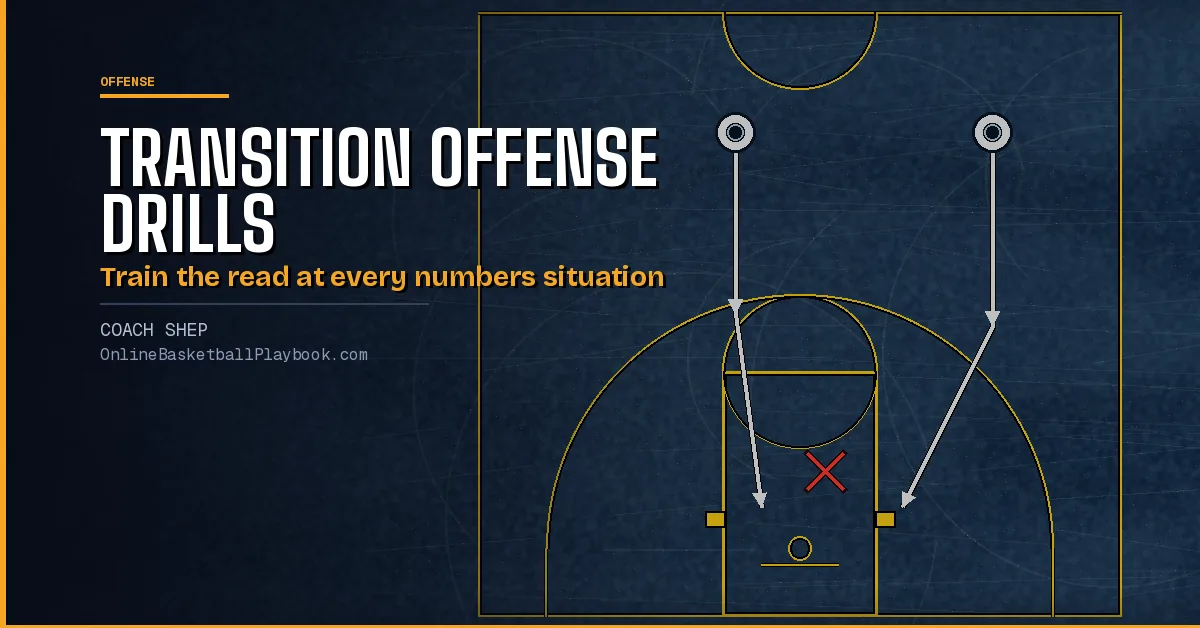
Transition Offense Drills: Outlet, 2-on-1 and Live Ladder
Transition offense drills that train a rule for every numbers situation: the outlet, lane filling, 2-on-1, 3-on-2, the 2-on-1 to 5-on-5 ladder and the numbered break
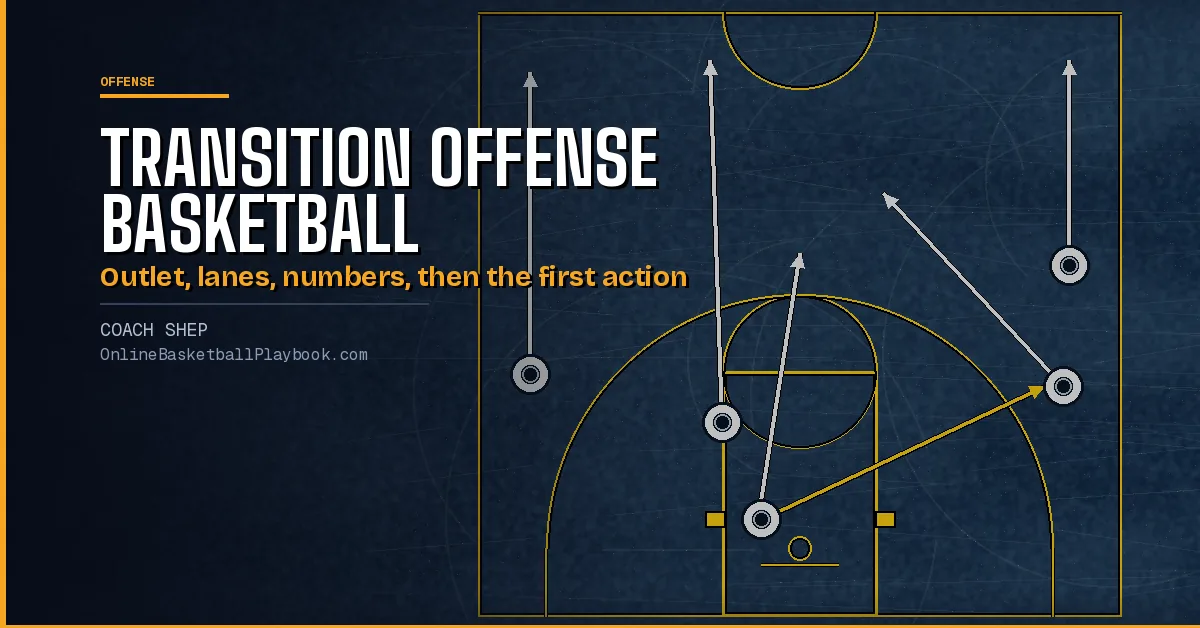
Transition Offense Basketball: Lanes, Reads and Early Offense
Transition offense basketball from rebound to first half-court action: outlets, lanes, 2 on 1 and 3 on 2 reads, the secondary break, early offense and crashing.
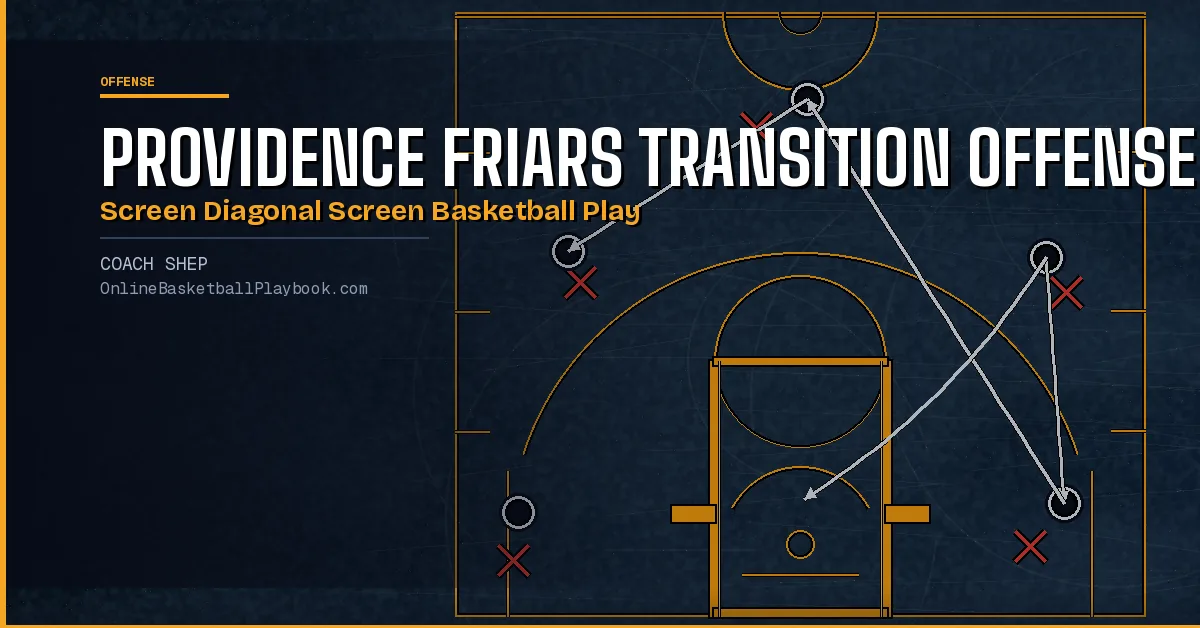
Providence Friars: Transition Offense Back Screen Diagonal Screen Play
Providence Friars: Transition Offense Back Screen Diagonal Screen Play