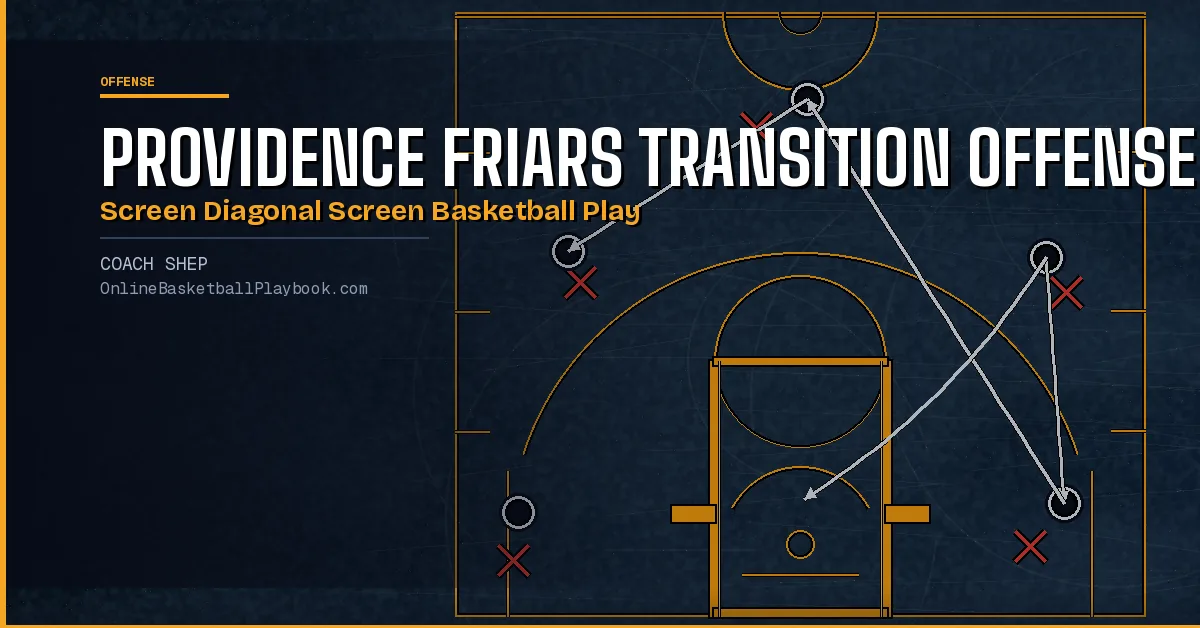
Providence uses a two-screen sequence in transition (a back screen followed by a diagonal screen) to free a shooter or cutter before the defense can organize. Here is how it works and how to teach it.
Why Providence Runs This in Transition
The Providence Friars have long leaned on the transition window, the first four to six seconds after a change of possession, to generate quality shots before defenses get matched up and communication is established. Ed Cooley built Providence into a Big East program that consistently punched above its roster ranking, and a big reason was using structured early offense rather than waiting for the half-court to set. The back screen diagonal screen play is a prime example of that philosophy in action.
Most teams treat transition as a moment to push and hope. Providence treats it as a designed attack. The defense is still running back, still calling out assignments, still deciding who takes the screener and who follows the cutter. In that window of disorganization, a two-screen sequence creates more chaos than a single action. Defenders have to make two separate decisions nearly simultaneously, and at least one of them will be wrong.
The play exploits a specific defensive vulnerability: when players sprint back in transition, they instinctively find the ball first and their assignment second. A back screen planted in that lane forces a critical choice, go over the screen and risk the cutter, or go under and give up position. The diagonal screen that follows arrives before the defense has recovered from the first decision.
Play Breakdown: The Back Screen Action
The play initiates the moment the ball crosses half-court. The point guard (1) pushes the pace up the floor while the shooting guard (2) sprints the strong-side wing lane and the small forward (3) sprints the weak-side wing. The power forward (4) trails the play as the screener, and the center (5) runs the dunker lane on the strong side, clearing to the short corner or weak-side block depending on coverage.
As 1 advances the ball, 4 makes the key move: instead of trailing wide, 4 cuts through the middle of the lane and sets a back screen on the defender guarding 2. This is the back screen. The timing must be precise. 4 plants the screen just as the 2 defender is sprinting back and trying to locate the ball. The natural tendency for a backpedaling defender is to face the ball, which means they are completely exposed to a back screen they cannot see coming.
When the back screen is set correctly, 2 has two reads. If the cutter lane is open to the basket, 2 cuts hard off the screen and receives a pass in stride for a layup or a short floater. If the defense switches or the helper rotates, 2 reads the coverage and flares to the corner, where the help defender cannot reach in time. The point guard drives the read by watching 2's cut and throwing to whichever option the defense leaves open.
The precision of the screen location matters here. A back screen set too high gives the defender room to slide under and recover. A screen set at the block level takes the defender completely out of the play. Providence coaches their bigs to set the back screen at the second hash mark on the lane, roughly at the first block position, so the cutter has the entire paint to attack before the help defense can arrive.
The Diagonal Screen and Second-Side Attack
Whether the back screen produces a shot or not, the play continues immediately into the diagonal screen action. After setting the back screen, 4 does not stand and watch. 4 pivots and executes a diagonal screen for 3 coming from the weak-side wing. This screen angles from the low block toward the elbow, cutting across the lane diagonally, which is where the play gets its name.
The diagonal angle is what separates this action from a simple ball-side down screen. A straight down screen is easier to defend because the path to the basket or the three-point line is predictable. A diagonal screen forces the defender guarding 3 to navigate a different plane. They cannot cheat over the top because the screen is not set in a straight line, and going under gives up a direct catch at the elbow or a curl to the rim.
Three has two primary reads off the diagonal screen. The first read is the curl. 3 reads a defender who fights over the top of the screen and curls around 4 into the lane for a mid-range or a finish at the rim. The second read is the pop. When the defender goes under the screen, 3 pops to the elbow for a mid-range jumper or attacks the closeout with a drive. Against zones or help defenses that rotate to the cutter, 3 can also fade to the corner for a kick-out three.
The point guard holds the ball at the top of the key or attacks the lane slightly to keep the defense honest while both screens are being set and read. This is not a passive dribble. 1 is an active threat who can drive, which keeps the lane defenders from sagging onto the screener or the cutter. The entire two-screen sequence, from the back screen trigger to the diagonal screen read, runs in roughly three to four seconds. That is inside the transition window where Providence wants to operate before the defense fully sets.
Spacing and Personnel Assignments
The play works best when specific personnel requirements are met. The back screener (4) needs to be a big who can move through traffic quickly without drawing an offensive foul. Setting a back screen in transition requires the screener to arrive at the correct angle with controlled momentum. A charging call eliminates the action before it starts. Providence bigs are drilled to plant their feet before the cutter arrives rather than running into the defender.
The cutter off the back screen (2) needs to be a guard who can catch in stride and finish. This is not a spot-up shooter action. The back screen creates a moving target at high speed, and the catch needs to come directly into a layup attempt or a pull-up read. A player who needs to gather before finishing wastes the advantage the back screen created. If 2 is a pure catch-and-shoot player, the better read is the flare to the corner rather than the cut, and the play can be adjusted accordingly.
The diagonal screen cutter (3) needs enough shooting range to punish the defender going under the screen. If 3 cannot shoot the elbow mid-range or the corner three, the defense can cheat under every screen with no consequence. When 3 is a legitimate threat to score off the catch at any of the read spots, the diagonal screen becomes a genuine problem for defenses to solve.
The center (5) in the dunker lane plays a spacing and garbage role. Five does not receive a direct pass in the designed play, but their presence in the dunker spot holds the weak-side block defender and creates the lane space that makes both the back screen cut and the diagonal screen curl viable. If 5 drifts to the corner instead of the dunker spot, the weak-side help defender can collapse on the cutter without leaving anyone open. The dunker lane is not a passive assignment. It is what holds the defense honest on both screens.
Counters and Defensive Reads
Defenses that have scouted this play will try two primary counters. The first is a switch on the back screen. The two defenders involved exchange assignments the moment the screen is set, hoping to eliminate the cutter's advantage. Against the switch, the back screener (4) becomes the threat. After setting the screen and seeing a smaller guard now assigned to them, 4 can seal and post, or step back to the short corner and receive a dump-off pass for a power move. Bigs who can recognize the switch and pin their new defender are essential to making this counter work.
The second common counter is a hard hedge on the diagonal screen. The screener's defender steps out aggressively to slow the cutter, allowing the cutter's original defender to fight over the top. Against the hard hedge, 4 slips the screen rather than setting it fully. The slip means 4 does not make full contact on the screen but instead peels to the basket while the cutter's defender is occupied fighting through. A slip to the rim in transition against a hedging defender produces one of the highest-efficiency shots in the game.
Against a zone defense in transition, the play adjusts at the point guard read. Zones in transition are often disorganized. Players are still running to their zone spots rather than dropping into coverage. The point guard can attack a gap at the zone break point, which eliminates the need for either screen entirely. If the zone is set when the ball crosses half-court, the back screen still has value because zone defenders key on ball movement rather than individual cutters. The back screen occupies the middle of the zone and creates the same cutter advantage against man defense.
How to Install This Play at Any Level
This play is installable at the high school level with four practice sessions. The first session focuses only on the back screen timing. Run the play without the diagonal screen, just 4 setting the back screen and 2 making the read. Get the footwork correct, get the angle correct, and get the cutter to understand both reads (cut versus flare) before adding complexity.
The second session adds the point guard's threat. Run it 4-on-4 with a live defender on 1 so the point guard is not just a static passer. The guard should be attacking the lane slightly, drawing the defense, which opens the back screen cut. Players need to feel the connection between the ball handler's threat and the space it creates for the cutter.
The third session introduces the full play, back screen followed immediately by the diagonal screen. Run it 5-on-0 first to establish the timing, then 5-on-2 with defenders only on the two screened players, then 5-on-5 live. The 5-on-0 step is not optional; players need to understand the intended spacing before any defense is introduced.
The fourth session runs it in the context of transition. Start with a live possession change, a defensive rebound or a scored basket, and have the offense execute the play in real transition tempo. This is where most install failures happen. The play looks clean in a walk-through and falls apart at game speed because the screener is still running back when the screen needs to be set. Drill the screener's sprint to the correct screen position as a separate habit before combining it with the full play.
Run this play immediately off a defensive rebound. Do not let the defense get organized. The most common coaching mistake is waiting until the offense is aligned before calling the action. The entire advantage of this play lives in the four-second window before defenders find their assignments. Once the defense is set, this is just a two-screen half-court action competing against a ready defense. Attack early.
- Back screen angle: plant the screen at the second hash mark on the lane, roughly block level. Too high and the defender slides under. Too low and the cutter has no room to attack the rim.
- Cutter's primary read: cut only if the lane is open inside the paint; if the defender fights through, immediately flare to the corner and stretch the defense rather than clogging the lane for the diagonal screen action.
- Diagonal screen slip counter: when the defense hard-hedges, the screener does not fully plant. Peel directly to the basket on a slip cut while the cutter's defender is occupied, creating a rim finish against a retreating helper.
- Dunker lane discipline: the center must hold the dunker spot through both screens. Drifting early collapses the lane and eliminates the cutter's path on the back screen action.
- Switch recognition: when the back screen produces a switch, the big seals the smaller guard immediately and calls for the ball. The post mismatch created by the switch is often a better shot than the designed cutter action.
Want more basketball coaching strategies and drills?
Join the Online Basketball Playbook newsletter →
Draw this play free in the play drawer →
Membership: the full library, playbook packs, and Pro drawing tools →
Keep Building
Related breakdowns
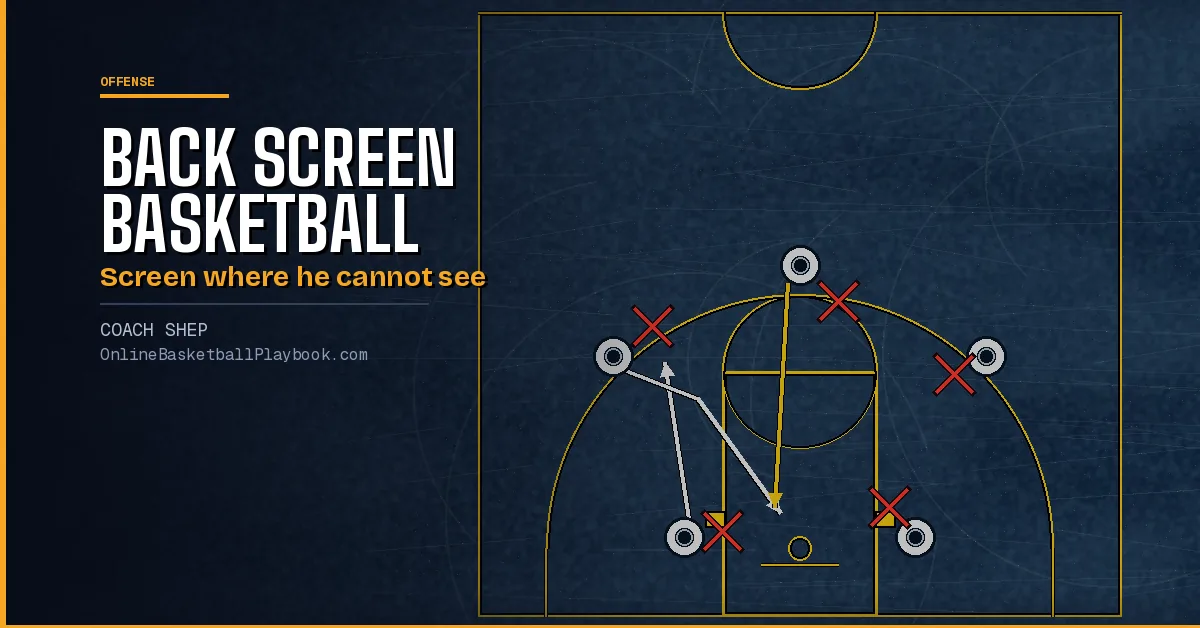
Back Screen Basketball: How to Set, Use and Defend It
Back screen basketball guide: what a back or rip screen is, setting it legally, the cutter's and screener's reads, the UCLA cut, chained actions and defending it.
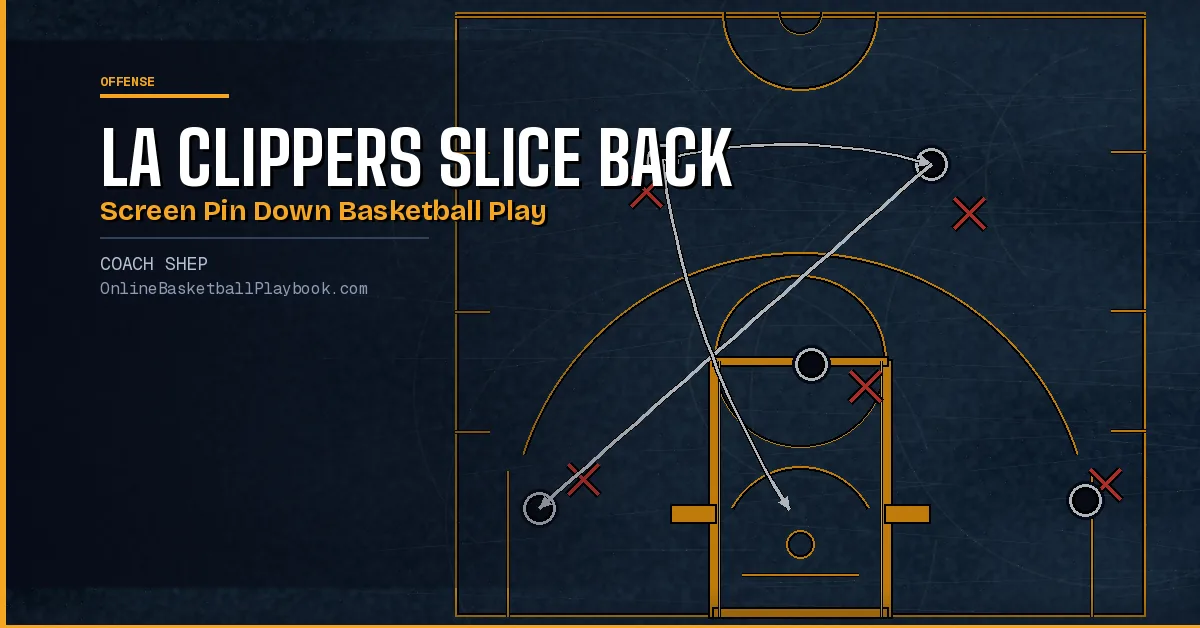
LA Clippers: Slice Back Screen Pin Down Basketball Play
LA Clippers: Slice Back Screen Pin Down Basketball Play
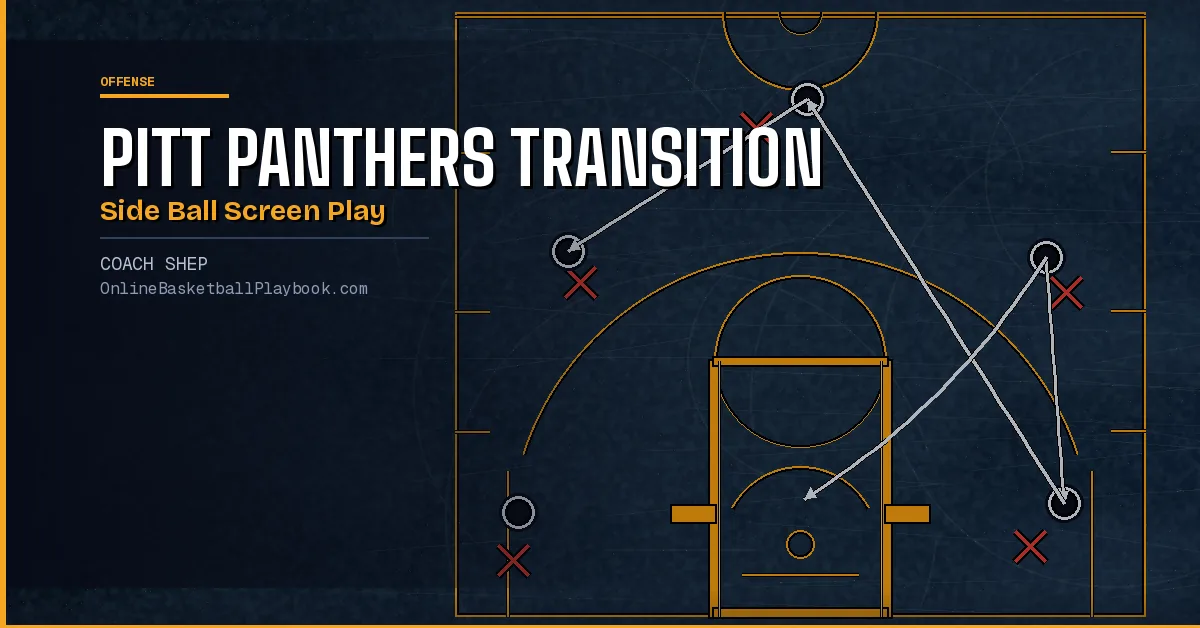
Pitt Panthers: Transition Side Ball Screen Basketball Play
Pitt Panthers: Transition Side Ball Screen Basketball Play