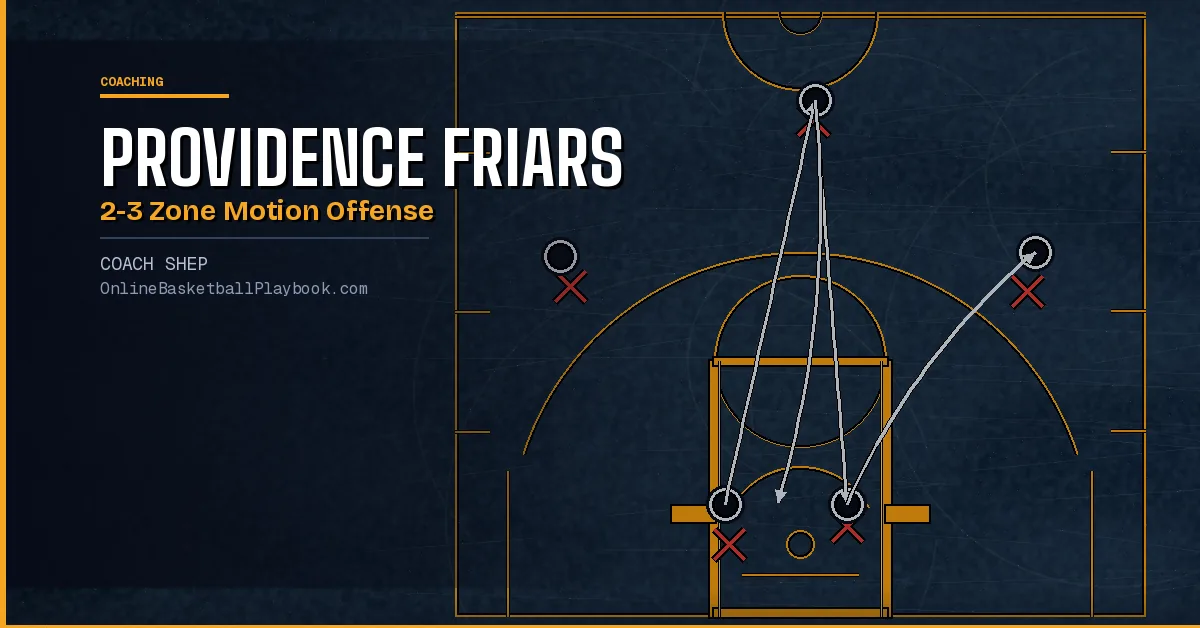
The Providence Friars use a baseline runner action to surgically attack the 2-3 zone, forcing the wing defenders into impossible rotation choices and freeing cutters for high-percentage looks inside and from the corner.
Why the Baseline Runner Attacks the 2-3 Zone
The 2-3 zone is one of the most widely used defensive alignments in basketball, from the youth level through the college ranks. Its appeal is straightforward: two guards in the slots protect ball reversal and the high post, while three defenders across the baseline guard the paint, the blocks, and the corners. When played well, it funnels offensive actions toward tough contested mid-range shots and forces the offense to make quick, precise decisions against a shifting wall of defenders.
But like every zone, the 2-3 has built-in vulnerabilities. The two biggest are the corners and the baseline. The wing defenders in a 2-3 are asked to play on the wing in their starting position, far enough forward to contest the corner immediately, but that positioning creates a gap along the baseline that a cutter can exploit. The moment the ball moves to one side and the ball-side wing closes out to the corner, the baseline runner can beat the weak-side wing across the paint before that defender can recover.
The Providence Friars, under Ed Cooley and continuing through subsequent staff iterations, have made this baseline runner a signature piece of their zone motion offense. Rather than simply dribble-driving at the 2-3 or chucking skip passes hoping the rotation is late, Providence uses deliberate player movement along the baseline to manufacture open looks. The principle is simple: move a body through the seams of the zone before the defense can shift. The execution requires precise timing, disciplined spacing, and patience with the ball.
What makes this play especially effective at the college level is that it pairs the baseline runner action with a high-post flash. The two actions happen simultaneously, creating an immediate two-option read for the ball handler. The defense cannot cover both; the offense takes whatever opens up. That dual-threat structure is what separates a designed zone motion play from random movement.
Providence's Initial Setup and Alignment
The play begins out of a 1-3-1 zone motion set, which is a common launching point for teams that want to attack the 2-3 defensively. The point guard (1) initiates from the top of the key. Two wing players (2 and 3) occupy the wings, the same position the defensive wings would play, which is intentional. By placing offensive players at those spots, Providence forces early decisions from the top two defenders about whether to guard those wings or stay home on the high post.
The post player (5) starts at the high post, either at the elbow or just above the foul line. The fourth player (4) begins on the weak-side block or short corner, tucked just outside the lane. This positioning is deliberate: the weak-side wing defender in the 2-3 must decide whether to sink into the paint to cover that block threat or stay at their FT-line-extended spot to contest the wing. Both are wrong if the offense times the baseline run correctly.
The alignment puts immediate stress on the three back defenders in the 2-3. X5, the center and hub of the zone, cannot guard both the high post and the short corner simultaneously. X3 and X4, the wing defenders, are asked to start forward and close on corner entries, but that leaves the baseline unprotected when the ball-side wing commits hard to the corner. Providence exploits all three tension points within a single possession.
Before any action begins, spacing discipline is non-negotiable. If the two wing players crowd the three-point line or collapse toward the paint, they remove the corner threat that keeps the 2-3 wings honest. Every player in this alignment must be positioned where they could receive a pass and make the defense pay, not where it is comfortable to stand.
The Baseline Runner: Step-by-Step
The play triggers when the point guard passes to either wing. Let's say 2 on the right wing. That entry pass is the starting gun. As soon as 2 catches, the following sequence unfolds:
Step 1: High-post flash: Player 5 at the high post flashes hard toward the ball, either to the elbow on the ball side or to the midpoint of the lane. This is not a token movement. 5 must sprint into that flash, demanding that X5, the zone's center, account for the catch. If X5 ignores the flash, 2 hits 5 at the elbow for an immediate post-up or mid-range shot. That threat must be real.
Step 2: Baseline runner goes: Simultaneously with the high-post flash, 4 on the weak-side block begins the baseline run. 4 cuts hard underneath the basket, along the baseline, toward the ball-side corner. The timing matters: 4 should arrive at the ball-side corner at the same moment the ball-side wing defender (X4) is occupied either closing to the corner after the entry pass or sliding to cover the high-post flash. Either way, X4 has too much to cover.
Step 3: The read: Player 2 with the ball reads the defense. If X5 followed the high-post flash, the paint is open for a skip to 4 in the corner or a direct feed to 5 on the catch. If X5 stayed home on the paint, 5 is open at the elbow for a shot or a drive. If the ball-side wing defender collapsed to the short corner to take away 4's baseline run, the skip pass to 3 on the weak-side wing is available. All three options are on the table from the same ball position. That is the design.
Step 4: 3 fills the weak side: While 4 runs the baseline and 5 flashes high, 3 on the weak wing lifts slightly above the three-point line. This keeps the weak-side top guard (X2 in the 2-3) occupied. X2 cannot collapse to help on the high-post flash or the baseline run because 3 is holding them on the perimeter. One player doing nothing on offense is still doing real work by occupying a defender.
The result is a four-option read from a simple, disciplined entry pass. Providence runs this action from both sides, and the mirror-image execution from the left wing is identical with personnel swapped.
The Wing Defender Dilemma
The reason this play works repeatedly against a well-coached 2-3 is that it puts the back-line wing defenders in a genuine unsolvable dilemma. Understanding that dilemma is what allows an offensive coach to anticipate and exploit the defense rather than just running the play and hoping.
In the 2-3, the ball-side wing (X4 in this case) has a clear assignment: close hard to the corner on any ball entry to the wing. The Merrimack and standard 2-3 teaching both specify this: "butt to the corner, shoulder to the baseline" on the close-out, contesting the catch and covering the baseline drive simultaneously. That technique is correct. But when the baseline runner (4) is already moving toward that corner as the entry pass is made, X4 faces a choice between closing out on the ball-side wing and accounting for the cutter moving into their assigned corner coverage zone. They cannot do both.
The weak-side wing (X3) has a parallel problem. Standard 2-3 teaching calls for the weak-side wing to retreat toward the paint on ball entry to the opposite wing: "foot in the lane, ready to cover a lob or backdoor cut." That retreat is exactly what opens the skip pass to 3 on the weak-side wing. If X3 retreats properly to cover the baseline runner coming through the paint, 3 is left alone above the arc. If X3 stays home on the weak-side wing, the baseline runner arrives in the corner uncovered.
Providence's motion play does not create this dilemma by accident. It is engineered to force it. Coaches who teach this play should walk their players through the defender's perspective explicitly: show them on film where X4 is standing, what X4 is trying to cover, and why 4's cut creates an opening. Players who understand the defense's problem execute the action with better timing and more conviction.
Zone Motion Principles That Make It Work
The Providence baseline runner play does not exist in isolation. It works because it is embedded in a broader zone motion offense that applies several fundamental principles that any coach can teach and install.
Move on air time, not after the catch. Every cut, every flash, every relocation in zone offense must begin the moment the ball is in the air, not when the pass is caught. If players wait to see where the ball goes before moving, the defense has time to shift and close gaps. The high-post flash from 5 and the baseline run from 4 must both start the instant 2 receives the entry pass, not a step later. This is the single most common execution error at every level.
Attack both soft spots simultaneously. The 2-3 zone has two well-documented soft spots: the high post and the corners. A zone motion offense that attacks only one gives the defense a straightforward assignment. Providence attacks both on the same possession. The high-post flash takes care of one soft spot, and the baseline runner arriving in the corner takes care of the other. The defense must choose which one to give up.
Space dictates the play, not the script. Good zone motion is not a set play with a fixed outcome. It is a set of reads triggered by defensive decisions. The ball handler reads which option the defense has conceded and delivers the pass accordingly. This requires players who can recognize zone rotations and understand what each defensive choice means, a skill that takes deliberate practice to develop.
Skip passes are weapons, not desperation throws. The skip pass from ball-side to weak-side corner or wing is one of the most powerful tools in zone offense. In this play, 2 should always have the skip to 3 available as the third read. Teaching players to survey the weak side before catching helps them see that option in real time rather than only after the primary reads collapse.
The cutter must sell it. If the baseline runner (4) jogs through the lane, the defense has time to track the cut and rotate. If 4 sprints the baseline with purpose and arrives in the corner at full speed, the defender physically cannot close the gap. Player 4 must treat every baseline run as if it is the scoring action because it is, until the defense proves otherwise.
Counters and Secondary Reads
A well-coached 2-3 defense will adjust after seeing the baseline runner succeed. The most common defensive adjustment is to have X5 step out earlier to take the baseline runner, dropping the center's rim-protection responsibility to help the ball-side wing. When that happens, Providence has counters built into the same motion structure.
Counter 1: Dive to the short corner. When X5 steps out to cover the baseline runner in the corner, the paint is vacated. Player 5, on the high-post flash, reads the X5 overcommitment and immediately dives toward the short corner or block. That is an open post touch with X5 out of position. Ball handler 2 skips over the collapsed defense to 5 in the paint for a short-range shot or free-throw area catch.
Counter 2: Point guard attack. If the two top defenders in the 2-3 shift heavily ball-side to help on the high-post flash, the top of the key opens up. Player 1, after making the entry pass to 2, immediately fills the slot above the free-throw line. Player 2 swings the ball back to 1, who now has a direct lane to attack the seam between X1 and X2, both of whom have rotated ball-side. This is the simplest counter and requires no new reads from anyone except 1 recognizing the gap on the return pass.
Counter 3: Weak-side skip-and-cut. As the ball reverses from 2 back to 1 or across to 3, the baseline runner (4) who has reached the corner does not stop. On the skip reversal, 4 immediately runs the baseline back the other direction, now becoming the baseline runner on the opposite side. This creates a continuous, relentless baseline run that forces the wing defenders to track the same player across the entire baseline on every reversal. Over time, the running wears down defenders and creates a late-rotation error.
Counter 4: Early offense before the zone sets. The best counter to any zone is to beat it before the back line gets into position. Providence pushes the pace after made baskets and defensive stops, looking to attack in transition before the three back defenders can spread across the baseline. A single possession won in transition removes the need to break down the zone in the half court entirely.
Coaching Implementation and Drill Progressions
Installing this play in practice requires building the components before running the full action. Coaches who jump straight to five-on-five zone work with this play skip the skill repetition that makes the timing automatic. A two-to-three week progression works well at the college and high school levels.
Week 1: Individual skill work. Drill the high-post flash in isolation. 5 starts at the block, reads a simulated ball entry, and sprints to the elbow to catch a pass. Add a defender and teach 5 to win the catch cleanly without walking. Separately, drill the baseline run with 4 starting at the weak-side block, sprinting the baseline on a cue, and arriving in the corner to catch a pass in rhythm. Add time pressure by requiring the catcher to shoot immediately. A slow catch-and-plant kills the timing advantage.
Week 2: Three-on-three action. Run the core of the play (2 with the ball, 5 at the high post, 4 at the weak-side block) against three shell defenders (the ball-side wing, the center, and the weak-side wing). The ball handler reads which option opens and delivers. This three-on-three structure isolates exactly the decision the play is designed to create and removes noise from unnecessary players.
Week 3: Five-on-five with the full motion. Add 1 and 3, complete the alignment, and run the full play against a live 2-3 zone. Prioritize reading over success. Stop play to identify what each defender did and which option it opened. A correct read that produces a mid-range shot the shooter misses is still a successful execution. A made shot off a broken play is not evidence the play worked.
Film work accelerates the learning curve. Show players the same baseline runner from multiple college teams (not just Providence) so they recognize the universal principle rather than memorizing a single set. When they see the same cut produce the same result from three different offenses against three different 2-3 defenses, the concept locks in.
Run this play early in the game to gather information, not just score points. The first two or three repetitions tell you exactly how X4 and X5 are making their rotation decisions. That information shapes every zone attack call you make for the rest of the game. Watch the wing defenders' feet on the first entry pass and you will know which counter to reach for in the fourth quarter when the defense is tired and communication is breaking down.
- Start the high-post flash and the baseline run simultaneously on the entry pass. If either action is a half-second late, the defense shifts in time and the gap closes before the ball arrives.
- Player 4 must arrive in the corner at full sprint speed, not a controlled jog. A lazy cut gives X4 just enough time to recover and contest the catch, removing the entire advantage of the action.
- Ball handler 2 should survey the weak-side wing (3) before catching the entry pass. Pre-reading the skip option means the ball moves faster when X5 steps out to cover the corner.
- When the defense adjusts by having X5 step out early, switch immediately to Counter 1 (dive 5 to the short corner where X5 just vacated) and drill that adjustment in practice before you need it in a game.
- The point guard's fill on the return pass (Counter 2) requires a specific cue in your offensive vocabulary. Call it in practice so players recognize when to use it rather than discovering it accidentally during a game.
- Drill baseline runs from both sides of the floor with equal repetitions. A team that only runs the baseline action from the right wing is easier for a scouted opponent to take away with a simple defensive adjustment.
Want more basketball coaching strategies, drills, and tools?
Join the Online Basketball Playbook newsletter →
Draw this play free in the play drawer →
Membership: the full library, playbook packs, and Pro drawing tools →
Keep Building
Related breakdowns
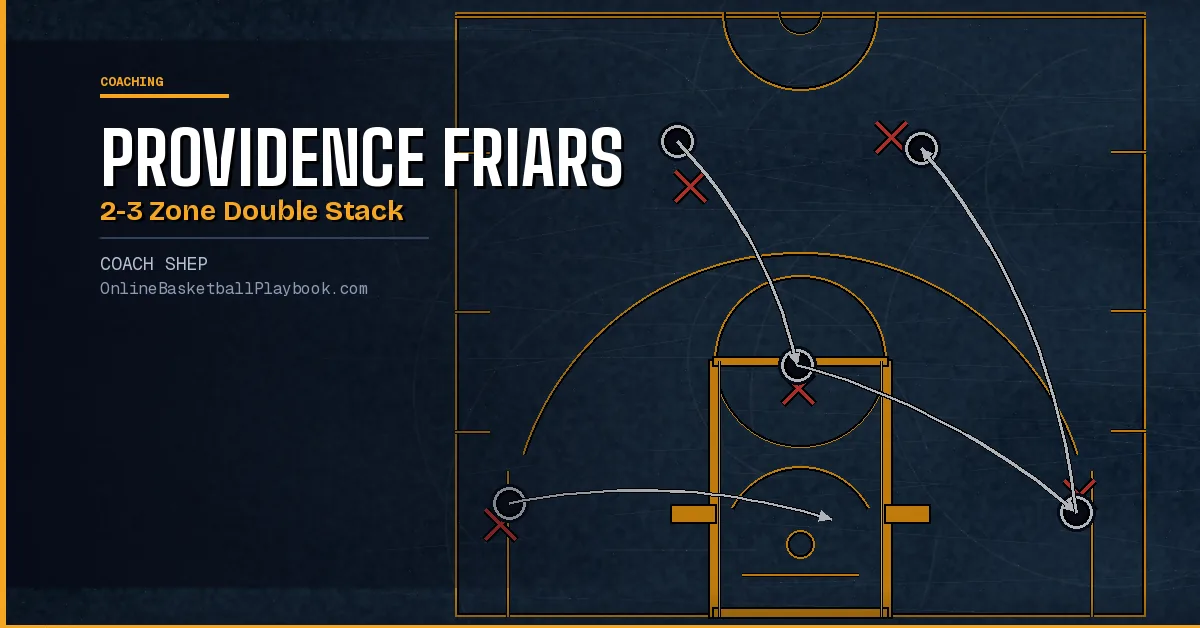
Providence Friars 2-3 Zone Low Double Stack Post Flash Basketball Play
Providence Friars 2-3 Zone Low Double Stack Post Flash Basketball Play
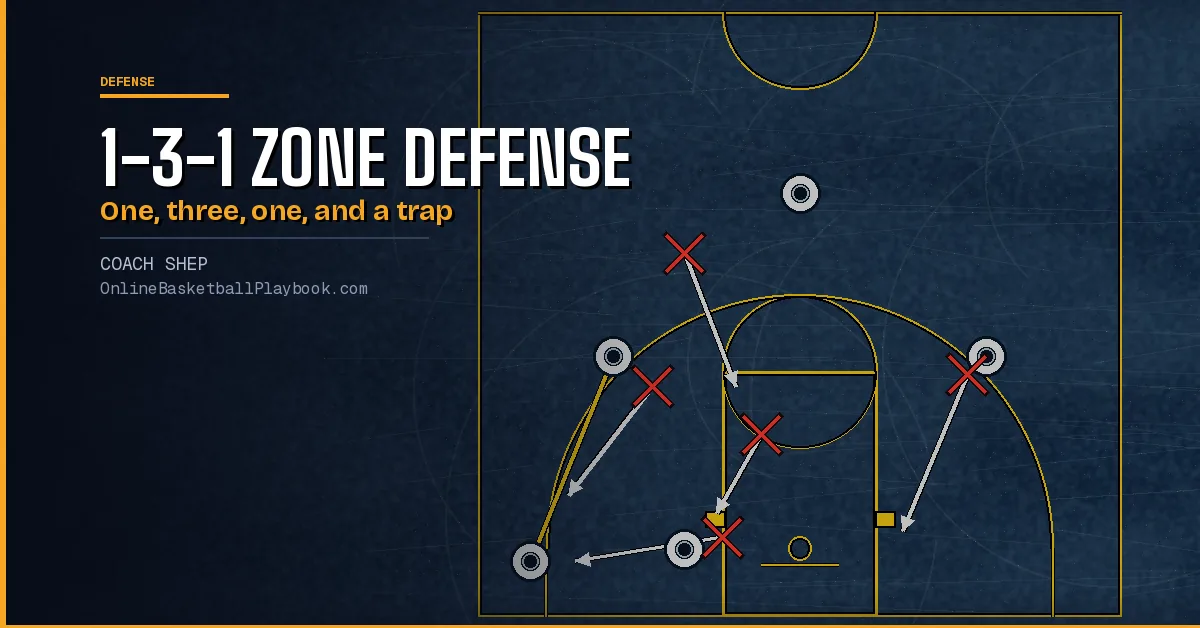
1-3-1 Zone Defense: Traps, Rotations and Drills
How to run the 1-3-1 zone defense: the five roles, the corner and wing traps, the skip pass that beats it, loose and tight depth, and the drills to install it.
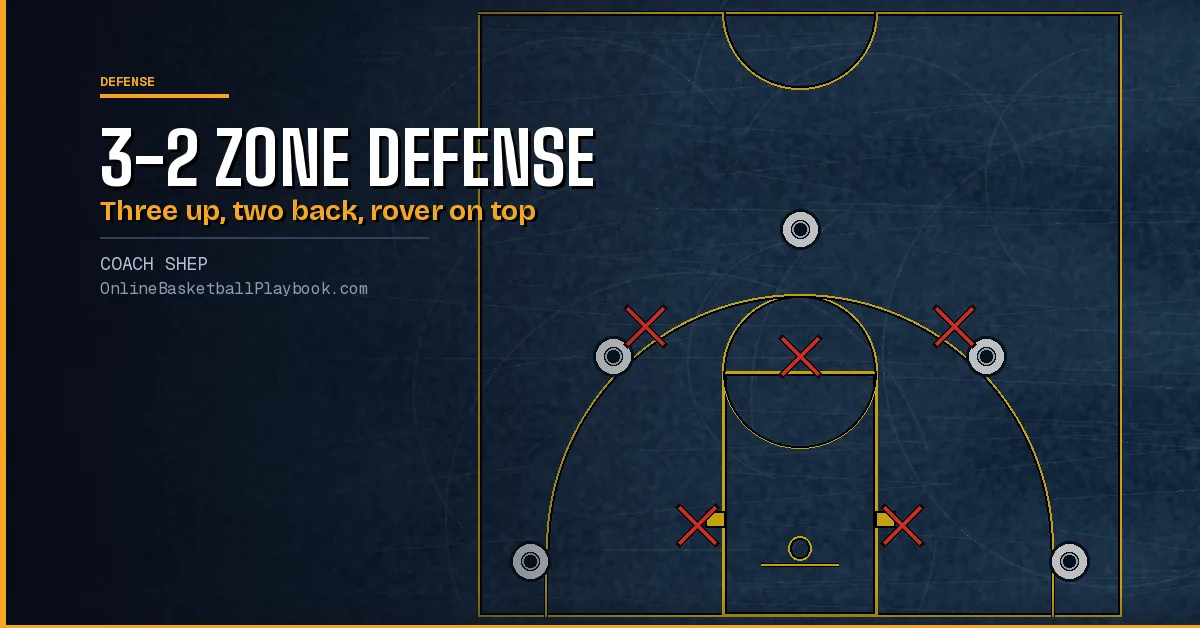
3-2 Zone Defense: Rotations, Weak Spots and Drills
How to run the 3-2 zone defense: the alignment, the rover, every rotation, the weak spots, the 3-2 matchup zone and the drills, plus when to pick it over a 2-3.