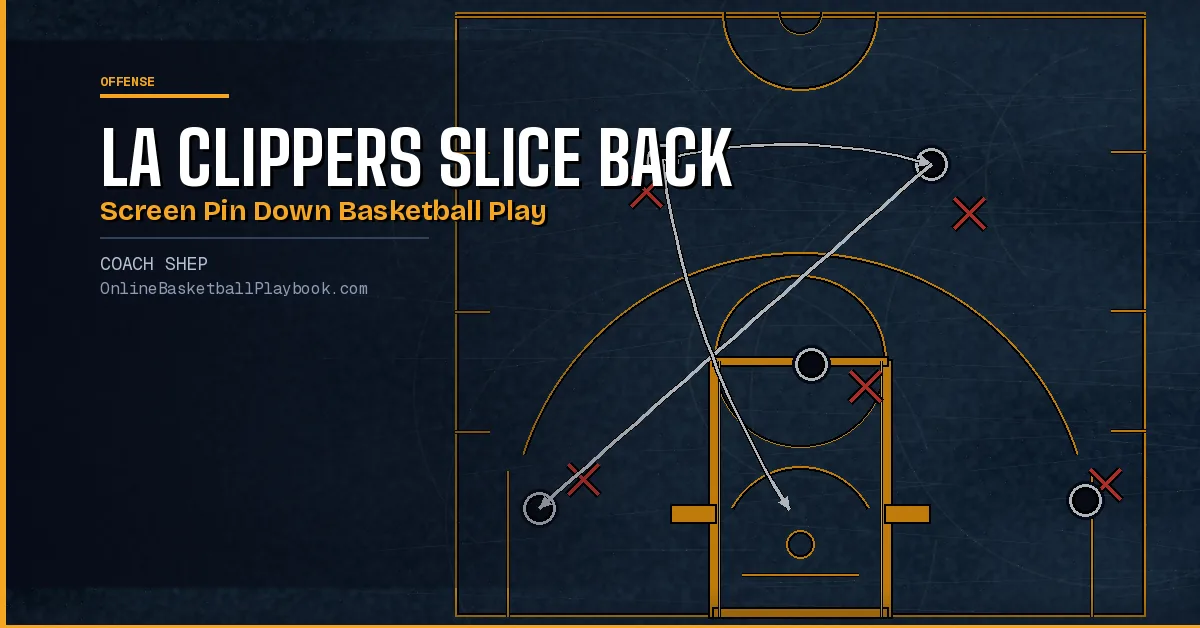
The LA Clippers use a two-action off-ball combination (a slice followed by a back screen and a pin down) to free shooters from layered defensive coverage. Here is exactly how it works.
Play Overview and Origin
NBA teams layer screens for a reason: one screen is scouted, two screens in sequence force a defense to make two consecutive correct decisions under pressure and in motion. The LA Clippers built this particular combination (slice cut, back screen, pin down) around their core offensive personnel, taking advantage of elite wing shooters and a big who can both screen and finish around the rim.
The play belongs to a broader family of NBA actions sometimes called "sequential screen" or "ghost screen" sets. The core idea is simple: before the primary screen is set, you soften the defender's positioning with a preliminary action. The slice cut does exactly that. It drives the wing's defender toward the basket, which is precisely where you do not want him when a back screen is coming from above the three-point line. By the time the defender recovers his depth, the back screen is already being set. And then a pin down immediately follows, compounding the problem. The defense is perpetually one decision behind.
Tyronn Lue, who coached this Clippers system, is a well-known proponent of layered off-ball actions. His teams consistently rank among the league leaders in assisted field goals, and plays like this one explain why. The ball moves, the screeners move, the reads are clear. And the shooters are the beneficiaries.
Personnel and Alignment
The play typically begins in a half-court set after the initial transition is over. The standard alignment uses a point guard at the top of the key with the ball, two wings (one strong-side, one weak-side), and two bigs (one at the strong-side elbow and one anchored near the strong-side block or short corner).
The primary shooter in this action is the weak-side wing. He is the player who will execute the slice cut, receive the back screen, and eventually benefit from the pin down. The ideal profile for this role is a guard or wing who shoots at high efficiency off the catch, a player whose defender sags if left open for even a fraction of a second. Paul George exemplified this profile during his time with the Clippers. His defender could not afford to trail him casually, which made every layered screen exponentially harder to navigate.
The back screener needs to be a credible roll threat. If the defense can ignore the screener and simply trail the shooter through both screens, the play breaks down. A big who threatens to roll hard to the rim, and who the defense knows will finish, keeps the screener's defender honest and opens the passing windows the shooter needs.
The pin-down screener is typically the strong-side big or a four-man who can step out and hold the screen long enough for the shooter to curl or fade off it. The ball handler must read whether the shooter is curling (drive the ball toward the curl side to shorten the pass) or fading (swing or skip pass to the wing for a catch-and-shoot three).
Action Sequence Step by Step
Understanding the play requires tracking three overlapping actions. They do not happen one after another in isolation. Each one begins before the previous one resolves, which is what creates the defensive problem.
Step 1: The Slice Cut
The weak-side wing cuts hard from the three-point line diagonally toward the basket. This is not a casual jog. It is a committed cut designed to do two things simultaneously. First, it attacks the basket and must be rewarded if the defender goes flat or sags. Second, and more importantly for the sequence, it pulls the wing's defender down toward the paint and away from the back screen that is being set above him.
The ball handler reads the cut. If the slice is open for a layup or a short catch-and-finish, he delivers the pass immediately and the play produces a high-percentage look right there. More often, the defense is prepared for the cut, the cutter's defender stays connected, and the cutter continues through to the weak-side corner or short corner. The real action is only beginning.
Step 2: The Back Screen
As the slice cut develops, a big or a forward steps up from the elbow to set a back screen on the cutter's trailing defender. Back screens are already among the most difficult actions to navigate in man-to-man defense. The defender is moving toward the basket, the screener arrives from behind him, and the contact is absorbed at the worst possible moment. Combined with the momentum from the slice cut, the defender has almost no ability to recover cleanly.
The cutter reads off the back screen. If the screen is solid and the defender is caught, the cutter can pop back toward the three-point line for an immediate catch-and-shoot opportunity. This is a live read, not a scripted outcome. Some possessions end here with a clean catch-and-shoot three. Others continue into the pin down.
Step 3: The Pin Down
The pin down seals the sequence. A second screener (typically the strong-side big or the initial ball-side forward) sets a downscreen for the shooter who has now curled back toward the wing area after using the back screen. The shooter comes off the pin down looking for either a curl into the paint (when his defender fights over the screen) or a fade to the corner or wing (when his defender trails under). The ball handler must have the ball in a position to deliver a quick pass either way.
The full sequence (slice, back screen, pin down) has forced the shooter's defender to make three reads in a single possession: stay connected through the cut, fight through or around the back screen, then navigate the pin down. Even one correct decision from the offense undoes all three.
Why It Works Against Man Defense
The power of this sequence lies in the accumulated decision debt it creates for the defense. Each screen in isolation is manageable. Combined in sequence, with the same defender responsible for tracking the shooter through all three actions, the cumulative demand exceeds what man-to-man principles can reliably supply.
The slice cut establishes depth. It moves the defender toward the basket. The back screen exploits that depth by arriving when the defender has already committed downhill. The pin down then punishes recovery. When the defender tries to sprint back out to the three-point line, the pin down absorbs him again and creates a choice between over-help (leaving the shooter's curl lane open) or under-help (allowing the catch-and-shoot three off the fade).
There is also a spacing dimension that matters. The strong-side wing and the corner players are spaced wide throughout. This keeps the help defense occupied. A helper who steps in to take away the back screen curl is abandoning a corner shooter. A helper who rotates to the pin-down curl is giving up the strong-side wing. The Clippers' spacing makes helping feel expensive at every decision point.
That principle applies directly here. The Clippers are not guessing. The slice-back-screen-pin-down sequence is a rehearsed answer to predictable man-to-man defensive behaviors. When a defense shows one coverage, the offense already knows which read produces the open shot.
Defensive Counters and How the Clippers Answer
Good defenders and well-coached teams will attempt specific counters to disrupt this sequence. Understanding the counters (and how the Clippers account for them) reveals the depth of the design.
Switching Everything
The most common counter to layered screens at the NBA level is the switch. If the defense switches every screen, the shooter never gets a clean look off mismatches in positioning. The Clippers answer switching teams with the ball handler attacking the switch immediately. If the back screener's defender has just switched to chase the shooter, his man (the big) is being guarded by a smaller wing. A quick pass to the rolling big, or a drive-and-dump to the big at the rim, punishes the switch before the defense can rotate.
Helping Hard on the Back Screen
Some defenses assign a helper to cut off the back screen curl, effectively doubling the shooter off the back screen read. When this happens, the ball handler skip-passes to the strong-side wing or corner before the pin down even develops. The play does not require all three actions to reach completion. The first open look in the sequence is the correct play.
Fighting Through the Pin Down
Elite defenders will attempt to fight through the pin down rather than going under it or switching off it. This is the most physically demanding option and requires the defender to take contact and maintain position simultaneously. Against this coverage, the shooter is coached to curl hard. The tight path through the screen is the defender's weakness because fighting over a solid screen at full speed usually produces separation in the curl lane rather than eliminating it.
When teaching this sequence, drill the back screen and pin down as a single connected action before adding the slice cut. Players need to understand the timing between screen two and screen three, specifically that the pin down is set as the shooter comes out of the back screen, not after he has already stopped. The continuous flow is what makes the defender's job impossible.
How to Install This Play at Your Level
This play translates cleanly to high school and college basketball, though the personnel requirements need to be realistic for your roster. The core concept does not require NBA-caliber athletes. It requires correct spacing, committed cutting, and disciplined screen angles.
Start by identifying your best catch-and-shoot player. This is the player who will run the slice, use the back screen, and come off the pin down. His shooting gravity is what makes the entire sequence functional. If his defender does not respect the catch-and-shoot three, the defense can cheat on every action and the play loses its teeth. Build around your best shooter, not your fastest player.
Next, confirm your screeners. The back screener must set a legal screen that actually contacts the defender. A soft screen that the defender simply avoids defeats the whole action. Your big needs to understand that his job on the back screen is to stop the defender's momentum, not just to put a body near him. The angle of the back screen matters: it should arrive perpendicular to the defender's path, arriving from the direction the defender cannot see.
For the pin down, screen angle is again the critical variable. The pin-down screener needs to be planted with his feet wide before the shooter arrives. A moving screen on the pin down will negate the action with a foul, and at the high school level, officials call moving screens more reliably on pin downs than on any other off-ball action.
Drilling the Sequence
Install this play in parts. First week: 3-on-3 with just the back screen and pin down, no slice cut. Second week: add the slice cut and practice the cut-versus-continue read at the basket. Third week: run it 5-on-5 against your scout team running a switching defense, then against a team that hard-helps on the back screen. By the time you put this in a game, every player should be able to identify the open look within the sequence before it arrives.
Walk the play through without defense first so every player understands the full sequence and the reads available at each action. Then add token defense (players who go through the motions of covering without fully contesting) so the ball handler can practice the read in real time. Only then add live defenders.
The Clippers ran this action late in half-court sets, often off a timeout or in the final two minutes of a quarter when the defense was tired and could be exploited by a demanding sequential read. Consider the same timing at your level. A play that runs a defender through three consecutive screen decisions works best when the defense is physically fatigued and when the shot clock has put enough pressure on the possession that a switch or a help rotation could leave an open shooter exposed.
- Shooter reads first: teach the cutter to identify whether the slice cut is open at the rim before committing to the back screen. The easiest basket in the sequence is the one the defense simply gives up on the slice.
- Back screen angle is perpendicular: the screener arrives from the direction the defender cannot see, contacts the body (not the shoulder), and holds the screen until the shooter clears, not one step before.
- Pin down timing is continuous: the pin-down screener sets his feet and makes contact before the shooter arrives off the back screen, not after. A screener who is still moving when the cutter arrives gives up the action before it starts.
- Ball handler drives toward the curl: when the shooter curls off the pin down, the ball handler must attack downhill to shorten the pass window. A ball handler who stands still forces a long pass that the help defense can intercept.
- Switch counter is automatic: if the defense switches the back screen, the now-open big rolls hard to the rim and the ball handler skips the pin down entirely. The switch is a gift if the ball handler reads it fast enough.
Want more basketball coaching strategies and drills?
Join the Online Basketball Playbook newsletter →
Draw this play free in the play drawer →
Membership: the full library, playbook packs, and Pro drawing tools →
Keep Building
Related breakdowns
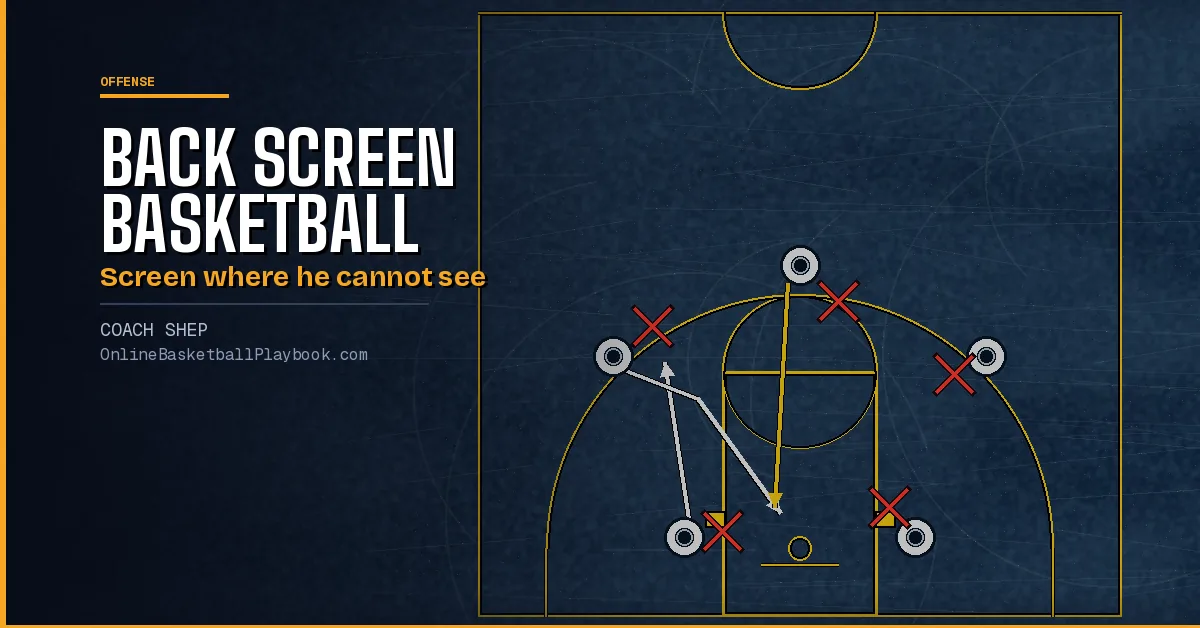
Back Screen Basketball: How to Set, Use and Defend It
Back screen basketball guide: what a back or rip screen is, setting it legally, the cutter's and screener's reads, the UCLA cut, chained actions and defending it.
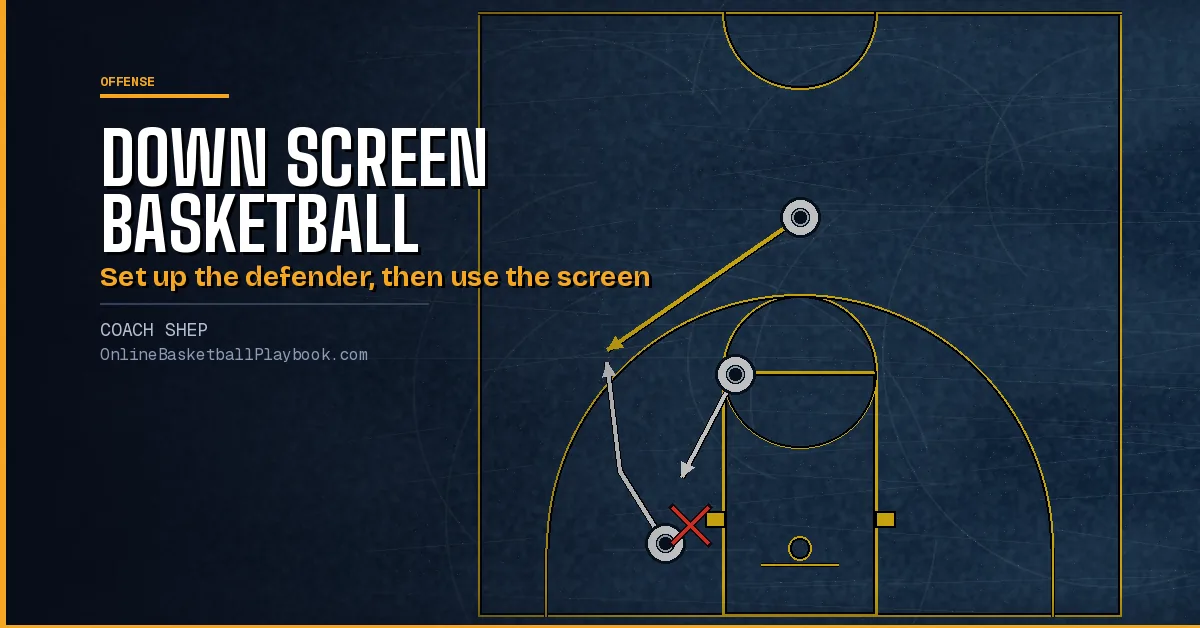
Down Screen Basketball: How to Set It, Use It and Read It
Down screen basketball for both players: how to set it, how the cutter uses it, the curl, pop, back cut and slip reads, and where coaches disagree.
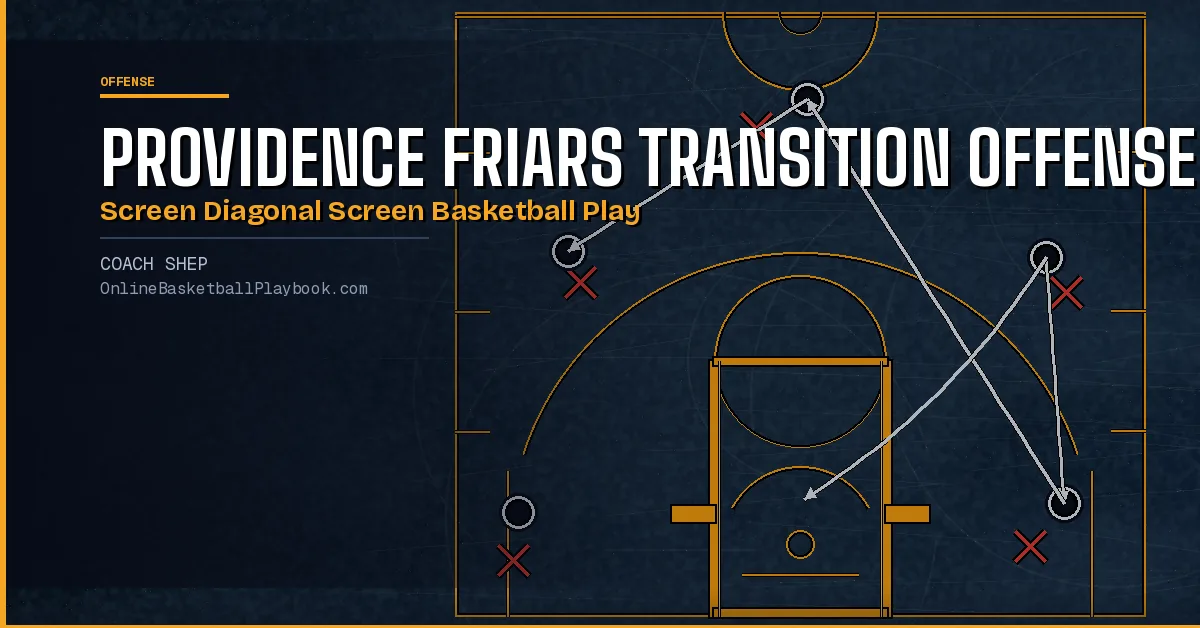
Providence Friars: Transition Offense Back Screen Diagonal Screen Play
Providence Friars: Transition Offense Back Screen Diagonal Screen Play