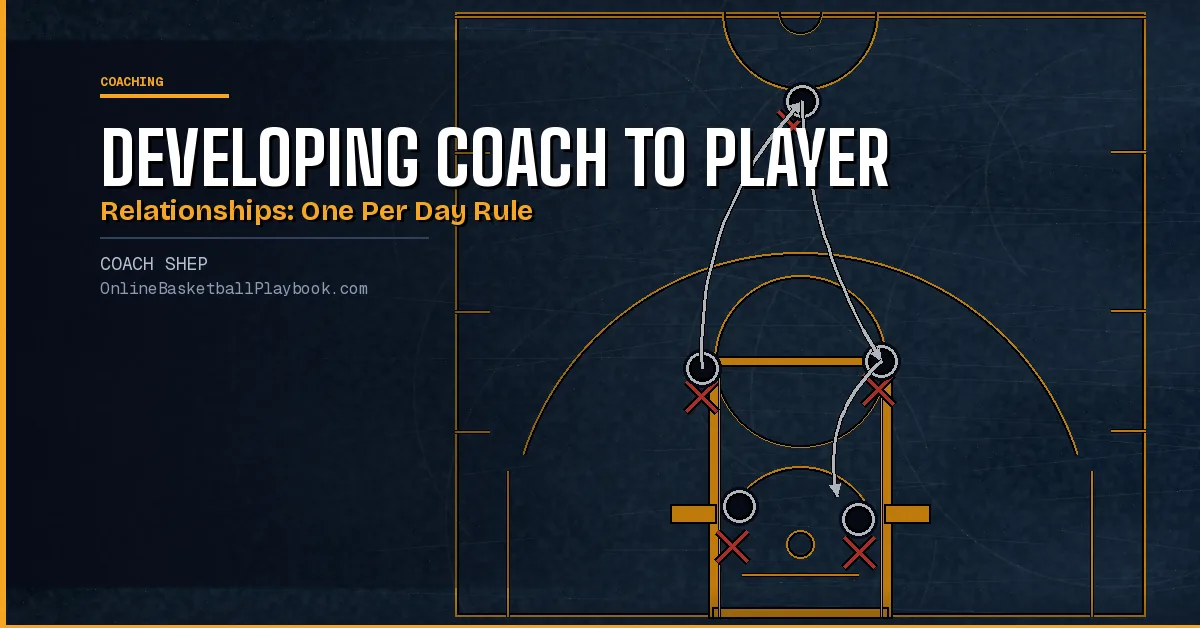
Strong coach-player relationships are the engine of every successful program. The One Per Day Rule gives you a simple, repeatable system: say something meaningful to every player, every single day.
Why Relationships Drive Performance
Coaching is often framed as a technical craft (the right play call, the best defensive scheme, the most efficient drill progression). All of that matters. But the coaches who sustain programs over years, across different personnel, in different situations, share one common trait: their players trust them.
That trust is not abstract. It is built through hundreds of small, intentional interactions. A word before practice. A question about a player's life outside the gym. A specific acknowledgment after a good play, not a generic "nice job," but a precise observation that tells the player the coach actually sees them.
When players trust their coach, they play through mistakes without shrinking. They accept hard feedback without shutting down. They compete on the defensive end (the area that requires the most sustained mental commitment) because they believe the coach is invested in their success, not just the scoreboard.
Research in sports psychology has long confirmed what great coaches have known through experience: perceived coach support is one of the strongest predictors of player effort, resilience, and willingness to accept a team role. The relationship is the infrastructure everything else sits on. Get it right and the technical work gets easier. Neglect it and even the best schemes underperform.
The One Per Day Rule is the most practical tool available for building that infrastructure systematically, without waiting for the relationship to develop on its own.
What the One Per Day Rule Actually Means
The rule is simple: say something direct and intentional to every player, every day. Not a group address. Not a general halftime speech. One targeted, personal moment per player (eye contact, their name, a specific observation or question) before or after practice, during a drill, in the hallway, anywhere the opportunity presents itself.
Hubie Brown, one of the most respected coaches in basketball history, made this a non-negotiable standard throughout his career. His directive was straightforward: give personal acknowledgment to every player after a win, look him in the eye, and find something meaningful to say. He extended that principle to daily practice as well. Something to every player, every day, because that daily contact is what drives consistent effort.
The word "say" is important. This is not about texting a player or posting a motivational quote. It is about a real exchange that signals individual recognition. Players (particularly teenage players) are acutely sensitive to whether they feel seen or invisible within a program. The coach who only addresses starters, or only speaks to players when correcting mistakes, inadvertently signals to the rest of the roster that they do not matter. That signal is corrosive, and it spreads.
One per day is not a high bar. It is entirely achievable for any coach at any level. The coaches who do it consistently are the ones who build the kind of program where players stay bought in even when their role is limited, even when the team is struggling, even when the message is difficult to hear.
How Elite Coaches Build Daily Connection
The best coaches in the game do not leave relationship-building to chance. They build it into their daily routine the same way they build in film review or conditioning work. The One Per Day Rule is not an afterthought. It is a coaching discipline.
Dean Smith at North Carolina built team cohesion through specific, daily behavioral standards rather than speeches. One of his core principles was acknowledging the passer (pointing directly to the player who set up the score) as a way of reinforcing that contribution is recognized at every level. That is a relationship tool disguised as a team culture standard. It tells every player on the floor, including the players who never appear in the box score, that their work matters.
Morgan Wootten at DeMatha Catholic ran one of the most successful programs in American high school coaching history. His philosophy was clear: use basketball as a classroom for life decisions, and be the coach you would want your own child to play for. Those are not abstract ideals. They show up in daily interactions (in whether a coach remembers a player's goals, checks in after a hard game, or takes thirty seconds to ask a reserve how he felt about his minutes).
Tom Crean identified four things players consistently expect of their coaches: competence, sincerity, reliability, and trustworthiness. Three of those four are established through repeated daily interaction, not a single conversation. Sincerity shows up over time. Reliability is demonstrated through consistency. Trustworthiness is earned through follow-through on small commitments. The One Per Day Rule is the mechanism through which all three accumulate.
Anson Dorrance at UNC built a 22-national-title program around the idea that players must feel the coach genuinely cares about their development, not just their performance. His filter for evaluating player character was to watch how a player responds to correction. But that filter only works if the player trusts the coach enough to receive the correction openly. That trust is built one daily interaction at a time.
Applying the Rule Across a Full Roster
Coaches with large rosters often push back on the One Per Day Rule: there simply is not enough time to have a meaningful conversation with fifteen players during a two-hour practice. That objection misunderstands the rule.
The interaction does not need to be long. It does not need to be emotional or personal in a deep sense. A single sentence that demonstrates the coach paid attention is sufficient. "I saw how you competed for that rebound in the second drill. That's the standard." "You're reading that pick-and-roll a lot faster than last week." "How are you feeling? Your ankle look okay?" Fifteen seconds. Eye contact. Their name. Done.
The key is that the comment is specific. Generic praise ("good job today," "you're working hard") does not count. Players recognize generic feedback immediately and discount it. Specific feedback tells the player the coach actually watched, actually remembers, actually cares about the details of that player's development.
For coaches managing multiple teams or large programs, a simple tracking habit helps. Before practice ends, mentally run through the roster and identify any player you have not spoken to directly that day. Make it a point to find them before they leave the gym. It takes thirty seconds and costs nothing. The cumulative effect over a full season is enormous.
Dean Smith used what he called the Blue Team concept: players eight through twelve on the roster entered as a unit, always in the first half, always for one to two minutes together. Role predictability is itself a relationship act. When a player knows exactly how they fit, the coach does not have to constantly reassure them. The structure communicates the relationship. The One Per Day Rule works the same way: the consistency of the habit is the message.
Before you leave the gym each day, mentally sweep the entire roster (first name by first name) and ask yourself whether you made intentional eye contact and said something specific to each player. If a name comes up blank, find that player before they walk out the door. This thirty-second habit, repeated daily across a full season, builds more trust than any single team meeting or motivational speech ever will.
The Three Interaction Types That Count
Not all daily interactions carry the same weight. Understanding the three types that actually move the relationship forward helps coaches deploy the One Per Day Rule more effectively.
1. The Recognition Interaction
This is the most common and most immediately powerful. The coach observes something specific (a technique, a decision, a competitive moment) and names it aloud, directly to the player. "You fought through that screen instead of going under. That's exactly what we want." The player learns two things: the coach is watching, and the coach knows what good looks like. Both build trust.
Recognition interactions are especially important for reserve players and developmental players who rarely see praise because they rarely see big moments. Mike Dunlap's framework from the Blueprint Clinic is instructive here: praise, prompt, walk away. Give the recognition, offer a single next step, then remove yourself. Do not over-coach the moment. The recognition itself is the point.
2. The Accountability Interaction
Accountability delivered inside a relationship lands differently than accountability delivered cold. A coach who has built genuine daily connection with a player can say a hard thing ("you're taking yourself out of plays when the game gets physical") and the player receives it as investment rather than criticism. The same message from a coach the player does not trust produces defensiveness and disengagement.
Kelvin Sampson's approach to player accountability is grounded in relationship: hold kids accountable, he argues, because that is how players grow. But the platform for accountability is trust, and trust is built through daily contact. You earn the right to make a difficult observation by showing up consistently for the easier ones.
3. The Personal Interest Interaction
This one is the easiest to skip and the most relationship-compounding when you do not. Ask about something outside basketball. How did the test go. How is the family situation. How is the player feeling after the travel weekend. This does not require a long conversation. It requires the coach to demonstrate awareness that the player is a person, not just a lineup slot.
Eureka Obradovic's preseason model makes this explicit: during the first weeks, the coaching staff is available around the clock to help new players with logistics (apartments, transportation, practical needs). Onboarding the person before coaching the player. That principle scales down to a high school or club program: when a coach asks about a player's life, the player understands the coach sees them as a whole person. That understanding is the foundation of every other coaching interaction that follows.
Common Mistakes Coaches Make
The One Per Day Rule fails when coaches apply it unevenly. The most common mistake is concentrating daily interactions on starters and high-usage players while ignoring the rest of the roster. This feels natural (those are the players whose performance matters most on the scoreboard), but it creates a two-tier program where half the team is functionally invisible. Invisible players stop competing. They go through the motions in practice and perform poorly when called upon. They talk to teammates in ways that undercut culture. The coach who does not see them cannot understand why.
A second mistake is confusing quantity with quality. Some coaches speak frequently but say nothing specific. "Looking good guys," "let's go," "work hard." These are sounds, not interactions. They carry zero relational weight because they require nothing from the coach. The player does not feel seen; they feel processed. Quality over quantity is the standard. One precise, personal sentence beats ten generic encouragements every time.
A third mistake is reserving personal interactions for high-stakes moments. The coach who checks in with a player only before a big game or after a bad performance has taught that player the relationship is conditional. The relationship should be consistent, not indifferent to outcomes, but not dependent on them either. Steve Alford's fairness doctrine captures this well: treat your best and worst player the same. Cannot treat any game bigger than any other. The daily interaction standard is the same for the starter as for the last player on the bench.
Finally, coaches sometimes make the mistake of using the One Per Day Rule as a management tool rather than a genuine act. Players detect inauthenticity immediately. If the coach is saying something to every player only to check a box, that purpose will come through. The rule works because it creates real attention, real recognition, real care. It requires the coach to actually look at each player with fresh eyes every day. That is the discipline underneath the habit.
Building a Culture Where Players Trust the Coach
The One Per Day Rule is a tactical habit. But executed consistently over a season and across multiple seasons, it builds something strategic: a program culture where players trust the coaching staff at a fundamental level. That trust changes how a team responds to adversity, how it handles conflict, and how players perform when the pressure is highest.
Tom Crean identified the legacy of leadership as a central concept: a player is a leader during his time in the program, but the legacy of leadership is the feeling he leaves behind when he is gone. That feeling is shaped almost entirely by the quality of the relationship the coach built with him. Players who felt genuinely seen and invested in become the alumni who recruit future players by word of mouth, who come back to the gym during the offseason, who speak about the program with genuine pride. Players who felt invisible produce the opposite.
Rick Majerus framed the coach's most fundamental challenge through what he called the coach of significance standard: the worst mistake a coach can make is giving up teaching to become a full-time coach. Teaching (in Majerus's framing) means making the person better, not just the player. The One Per Day Rule is how a coach operationalizes that commitment. Every daily interaction is a micro-teaching moment, a deposit into the player's development as a person and an athlete.
Dan Hurley's culture standard at UConn runs the same thread: build the relationship through relentless service (skill development and personal development) so players stay bought in even when the coach is demanding. The relentless service shows up in daily contact. In the small consistent moments that add up, week over week, until the player understands that the coach is on their side regardless of the scoreboard.
A program where every player feels that the coach is genuinely invested in them is a program where accountability is accepted, where role players buy in, where the starters do not coast, and where the culture sustains itself through difficult stretches. That program is built one daily interaction at a time. The One Per Day Rule is the simplest, most scalable tool available for building it, and it costs nothing but attention and consistency.
- Before practice ends each day, mentally run through every player's name and confirm you made direct, specific, personal contact with each one. If anyone is missing, find them before they leave the gym.
- Make at least one interaction per week a personal interest check-in that has nothing to do with basketball performance: ask about school, family, or how they are feeling physically and mentally.
- Use the praise-prompt-walk-away loop for recognition interactions: name the specific behavior, offer one next step, then step back. Do not over-coach the moment or dilute it.
- Apply the fairness standard consistently. Your last player on the bench receives the same daily contact as your starter. Any visible difference in attention level signals a two-tier roster to every player in the gym.
- After wins, give personal acknowledgment to every player: look each one in the eye, use their name, and name one specific thing they contributed to the team that day, even if their contribution was effort in practice rather than minutes in the game.
Want more basketball coaching strategies, drills, and tools?
Join the Online Basketball Playbook newsletter →
Draw this play free in the play drawer →
Membership: the full library, playbook packs, and Pro drawing tools →
Keep Building
Related breakdowns

Double Dribble in Basketball: Rule, Examples and Calls
A double dribble is a second dribble after the first has ended. Rules by level (NFHS, NCAA, NBA, FIBA), what restarts a dribble, examples and how to coach it.
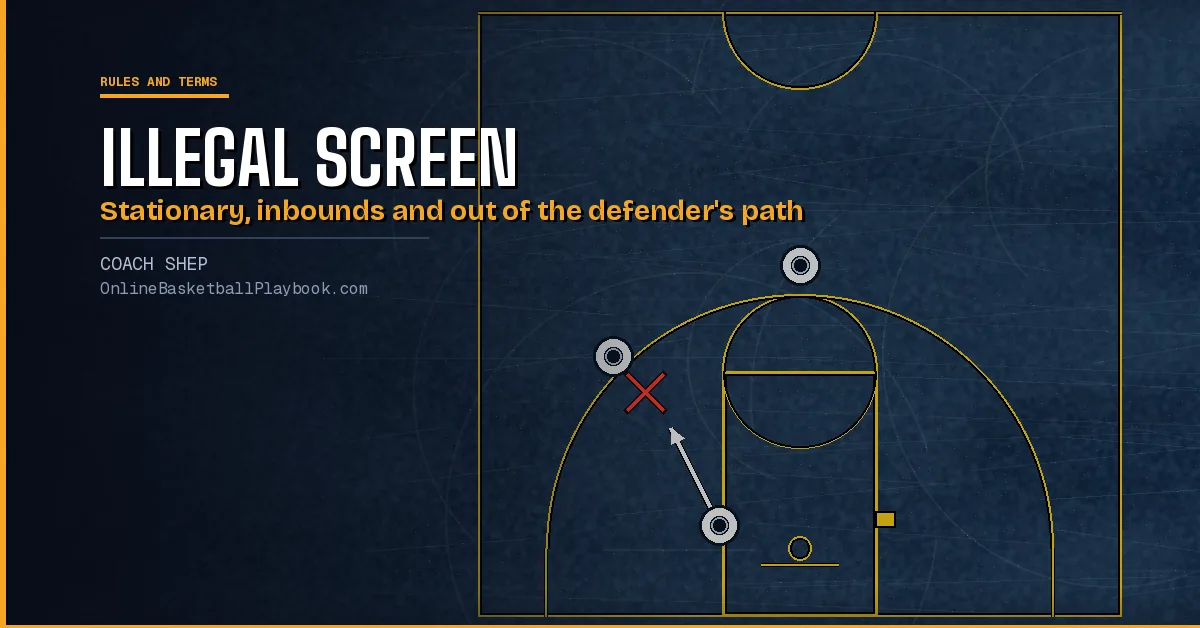
Illegal Screen in Basketball: Rule, Examples and Calls
Illegal screen basketball rules at the NFHS, NCAA, NBA and FIBA levels, with the stance, the one-step and two-stride distances, moving screens and the penalty.
Backcourt Violation in Basketball: Rule and Examples
A backcourt violation is sending the ball back across half court after gaining frontcourt control. Rule by level, exceptions, the 8 or 10 second count and examples.