
Mental toughness is not a trait players are born with — it is a habit coaches build through deliberate daily structure, consistent accountability, and a practice environment that is harder than any game players will face.
What Mental Toughness Actually Is
Most coaches talk about mental toughness as if it were a personality trait — something a player either has or doesn't. That framing puts the burden entirely on the player and lets the coach off the hook. The better coaches understand it differently: mental toughness is a behavioral standard that you build into your program through repetition, structure, and accountability.
Scott Nagy at South Dakota State puts it plainly — the goal is to make players "comfortable being uncomfortable." That is not a motivational slogan. It is a program design principle. When your players have been pushed harder in practice than they will ever be pushed in a game, the game itself stops being the hardest thing they face each week. They arrive at game night with a reservoir of experience that tells them they can handle pressure.
Anson Dorrance at UNC Women's Soccer built a 22-national-title program around a related idea he calls the "competitive cauldron." His version of mental toughness has three measurable traits: self-discipline, competitive fire, and self-belief. The critical insight is that these traits can be identified and developed — but they cannot be installed in a player who genuinely lacks them. That is why recruiting for mental toughness matters as much as developing it.
For coaches at every level, this has a practical implication: stop waiting for players to "show up mentally." Design your program so that mental toughness is the output of your daily system, not a prerequisite for it.
Practice Must Be Harder Than Games
The single most transferable idea from elite coaching is this: if practice is the safest competitive environment your players experience all week, they will shrink in games. The standard, established across multiple elite programs, is that practice must be more competitive, more demanding, and more consequential than any game on the schedule.
Dan Hurley at UConn makes this explicit in how he structures his culture. He describes deliberately creating chaotic practice environments so that games feel calm by comparison. When players have experienced genuine adversity in a controlled setting — high stakes, real consequences, competitive pressure — they develop the neural patterns that allow them to stay composed when the real version appears.
Mike Dunlap operationalizes this through what he calls building adversity into every practice. His recommendation is 15 to 20 minutes of No-Dribble drills daily. The drills force cutting, passing, pivoting, and communication. They also reveal personalities — you see quickly who pushes through discomfort and who looks for an out. Dunlap's phrase is that this structure "puts the WE in your gym." Toughness is built "inch by inch and day by day" — not through a pre-game speech, but through a daily structure that demands it.
The measuring stick for whether your practice is doing this job comes from Larry Eustachy's concept of "game slippage" — the degree to which your team's performance degrades from practice to game. If the gap is large, practice is not game-like enough. The chart, as Rick Majerus described it, does not lie. When you track the same actions in practice film versus game film, the slippage becomes visible and measurable. That is a coaching receipt, not a player verdict.
Accountability Systems That Work
Mental toughness without accountability is not toughness — it is compliance when things are easy. The programs that build genuine mental resilience have explicit, fair, and non-negotiable accountability systems. Not occasional confrontations when something goes wrong, but daily structures that make the standard visible and the consequence immediate.
Kelvin Sampson's framework is among the most direct. His non-negotiables are attitude and effort, held to the same standard every day. His core principle is that "how you do anything is how you do everything." When players understand that the standard applies identically to a Tuesday practice drill and a Saturday rivalry game, the standard becomes internalized rather than situational.
Sampson also distinguishes competing from playing hard — a distinction that matters for building mental toughness. "Playing hard" is effort. "Competing" means caring about the outcome enough to push through resistance when effort alone is no longer comfortable. His framing: "everything's a competition — the one who wants it most wins." That is a mindset shift that has to be deliberately taught, not assumed.
Hubie Brown's system adds an interpersonal layer. His rule is simple: say something to every player every day, and look him in the eye when you do. This is not sentimentality — it is a precision accountability tool. Players who feel seen by their coach are more likely to hold themselves to the coach's standard. Brown also requires personal post-win recognition for every player on the roster. The culture signal this sends is that no contribution is invisible, which means no lapse of standard is invisible either.
Bob Thomason's "covenants" framework extends this into a program-wide system. The structure is four offensive non-negotiables, four defensive non-negotiables, and four team non-negotiables — named publicly, visible on the game chart, and tied to every drill. When you make culture trackable, it stops being a mood and becomes a system.
Build adversity into every practice — toughness is inch by inch and day by day, not a speech. A daily structure that demands discomfort produces the mental resilience no halftime talk ever could.
— Mike Dunlap, Basketball Vault
The Language of Tough Teams
One of the most underrated tools for building mental toughness is the specific language a program uses. Kevin Eastman makes this point directly: give the program a shared language, short and sticky phrases that "capture the team's attention" and become the culture. When a word or phrase names a standard, it makes the standard repeatable. The word becomes the behavior.
John Tauer at St. Thomas built a six-trait character framework called INCHES: Improvement, No Excuses, Communication, Health, Energy and Enthusiasm, and Selflessness. The framework works because every trait is concrete enough to evaluate daily and memorable enough to be self-policed by players. This is the difference between a values poster and a culture system.
Bethel University's program takes the language principle further with what they call the "Me First, For Us" question filter. Players are trained to ask only questions that begin with "I" and focus on what they can control. Three question types are explicitly banned because they corrode accountability: Why questions (victim thinking), When questions (procrastination), and Who questions (blame). The replacement stems — "What can I do?" and "How can I support the team?" — are taught as a vocabulary drill, not a philosophy lecture.
Dean Smith's program at UNC applied language through operational rituals. His rule to "acknowledge the passer" — pointing to the teammate who set up the basket — is a daily culture rep that rewards team-over-self behavior at no cost and zero time. Run it from the first day of practice, on all your teams, and it becomes a signal that the program values the action that creates the score as much as the score itself.
The language of tough teams also has to address how players respond to adversity. Bethel's "Success Road" framing is useful here: the Road to Success is an imaginary destination, a scoreboard outcome. The Success Road is the daily journey — habits, process, short segments done right. "The winning will take care of itself." Teaching players to locate their identity in the road rather than the destination is a mental toughness skill that transfers to late-game pressure, losing streaks, and the inevitable moments when effort does not immediately produce results.
Building Habits, Not Speeches
Bill Parcells made a career of coaching teams to perform under maximum pressure, and his core doctrine is clear: habits survive the fourth quarter; game plans often don't. The job of practice is to make correct execution automatic — "we don't want players to think during a game, we want them to react. Thinking takes too long."
This has direct implications for how coaches should think about mental toughness. A player who hesitates in a late-game situation is not necessarily weak — they may simply not have enough correct reps to act without conscious deliberation. The coach's job is to eliminate that gap through volume of right practice, not to demand confidence the player hasn't earned yet.
Parcells also identifies the risk of over-scheming: coaches who layer in too much complexity give players a decision to make in the moment they need to act. The antidote is volume of correct reps until the action has no cognitive cost. When a player can make the right play automatically, under pressure, after a mistake, in a hostile environment — that is mental toughness expressed as a habit.
Sampson's habit principle completes this picture: "once is an accident, twice is a coincidence, three or more times is a habit — your job is to create good habits." The mental toughness coach's job is not to hype players before big games. It is to build the reps, create the conditions, and enforce the standards daily until the right behaviors become automatic. Speeches are inputs. Habits are the output. Judge your program by the output.
Morgan Wootten's 46-year program at DeMatha Catholic put this in practical terms: culture is built in daily routines. The "thought for the day" discussed before and after every practice, written exit evaluations from graduating seniors, postseason reports from every assistant — these are the mechanisms that make culture a discipline rather than a climate. Tough teams are built through specific, daily behavioral standards, not through occasional intensity.
Coaching the Fourth-Quarter Mind
The fourth quarter is where mental toughness either shows up or exposes itself. The best programs prepare for it not with motivational tactics but with structural tests built into weekly practice routines.
Parcells' fourth-quarter role test is the most practical version of this: at the end of every week, ask each player to state their specific assignment in a late-game situation without prompting. If they cannot articulate it, they are not prepared — and that is a coaching accountability tool, not a player accountability tool. The coach has not given enough reps. Add them before the next game.
Tom Crean's framework adds a mindset dimension. He teaches players that if they have a problem but haven't thought of a solution, they've compounded the problem. This is a fourth-quarter thinking skill: players who go into crisis mode when things go wrong, who look for someone to blame or wait to be told what to do, are not mentally tough. Players who immediately ask "what can I do right now?" have been trained to compete through difficulty rather than around it.
The Bethel program's adversity doctrine is perhaps the most counterintuitive: adversity is not a problem the program resolves — it is the mechanism the program uses. The Willow Tree metaphor describes it well: the tree that always gets water never grows deep roots. Players who are shielded from difficulty, whose coaches lower the standard when things get hard or whose parents intervene to smooth out conflict, do not develop the fourth-quarter mind. They develop a fair-weather competitiveness that crumbles under real pressure.
Dorrance makes this explicit when addressing parent interference: protecting a player from a hard truth about their performance does not spare them — it removes the developmental friction that builds what they need to compete at the next level. Coaches who want mentally tough players need to hold this standard with parents as clearly as they hold it with the players themselves.
Finally, the fourth-quarter mind requires a team that trusts each other. Erik Spoelstra's three-word culture spine — together, tough, trust — is not a slogan but a developmental sequence. Teams become tough together. They develop trust through the toughness. When both are present, fourth-quarter pressure becomes the moment a team leans in rather than the moment it fractures. Building that foundation is the work of every practice, every day, long before the fourth quarter arrives.
Before your next practice, identify one moment where you traditionally ease the pressure — a spot where players are allowed to cruise. Replace it with a scored competition that has a real consequence for the losers. Do this three times this week. Track what changes in player behavior by Friday. Small consistent adversity reps build the fourth-quarter mind that no single hard practice ever will.
- Run 15–20 minutes of No-Dribble drills daily to force cutting, communication, and composure under constraint — the highest-ROI toughness drill in your practice plan.
- Apply the fourth-quarter role test every week: ask each player to state their specific late-game assignment from memory without prompting. If they can't, add reps before the next game — that gap is a coaching responsibility.
- Post three banned question stems in your locker room — Why, When, Who — and teach players to replace them with "What can I do?" and "How can I support the team?" Practice the vocabulary after every tough loss.
- Make practice consequences real: scored competitions where losers run or do extra work, not optional effort segments. If practice is consequence-free, it builds compliant players, not competitive ones.
- Hold your best players to the highest standard publicly — the rest of the team is watching how your stars are held. Simultaneously, give role players explicit individual recognition so they stay bought in to the culture you are building.
- Treat every mental error under pressure as a coaching question first: "Did we drill that until it was automatic?" If the answer is no, add reps. Only after confirming the reps exist should you address player accountability.
Want more basketball coaching strategies, drills, and tools?
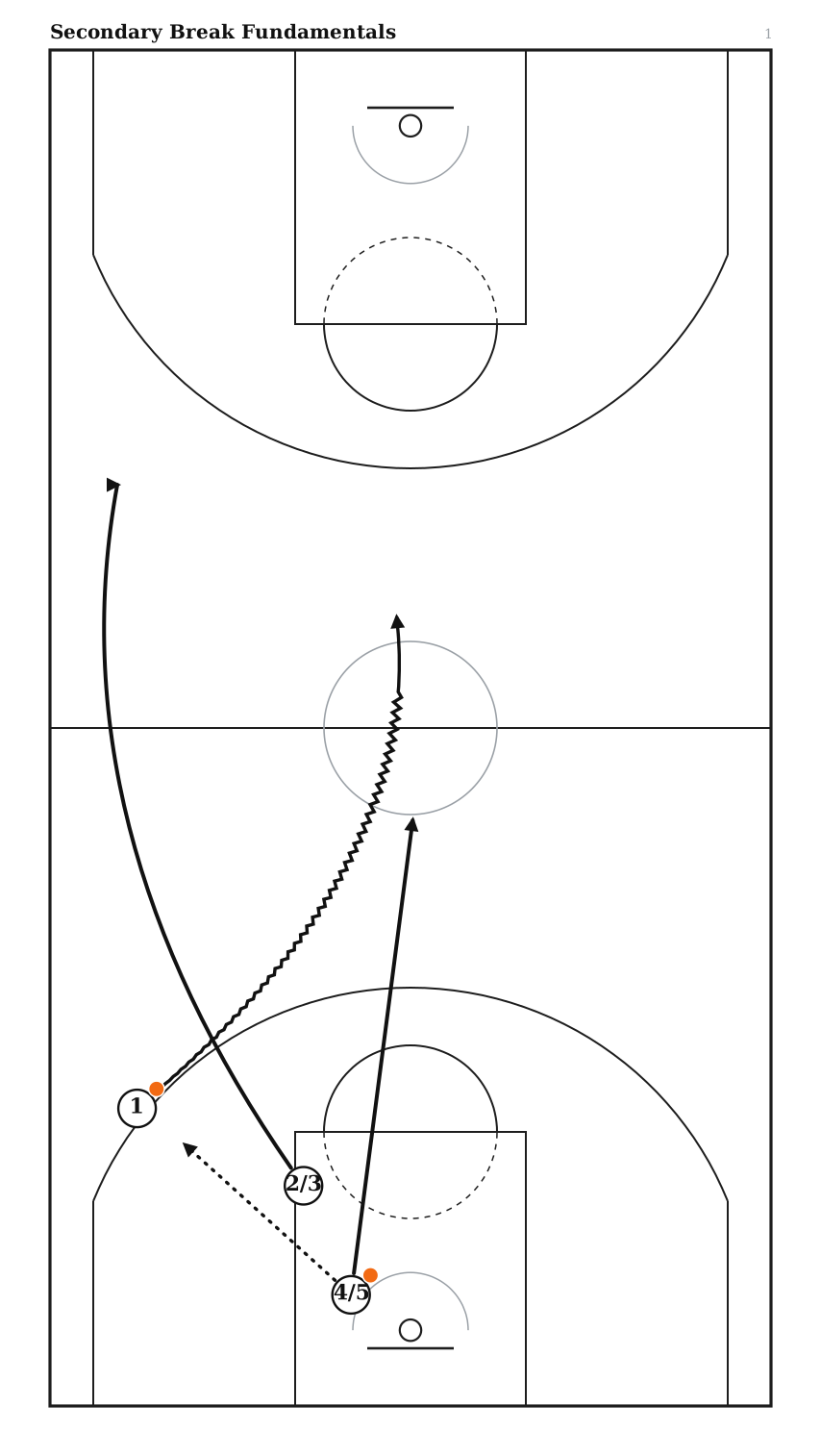
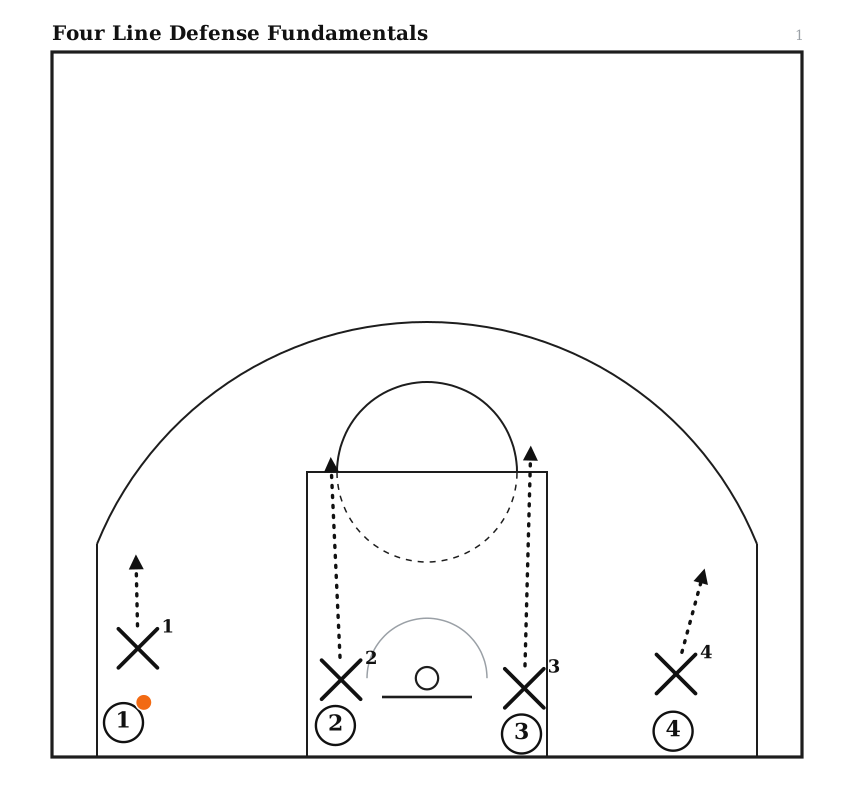
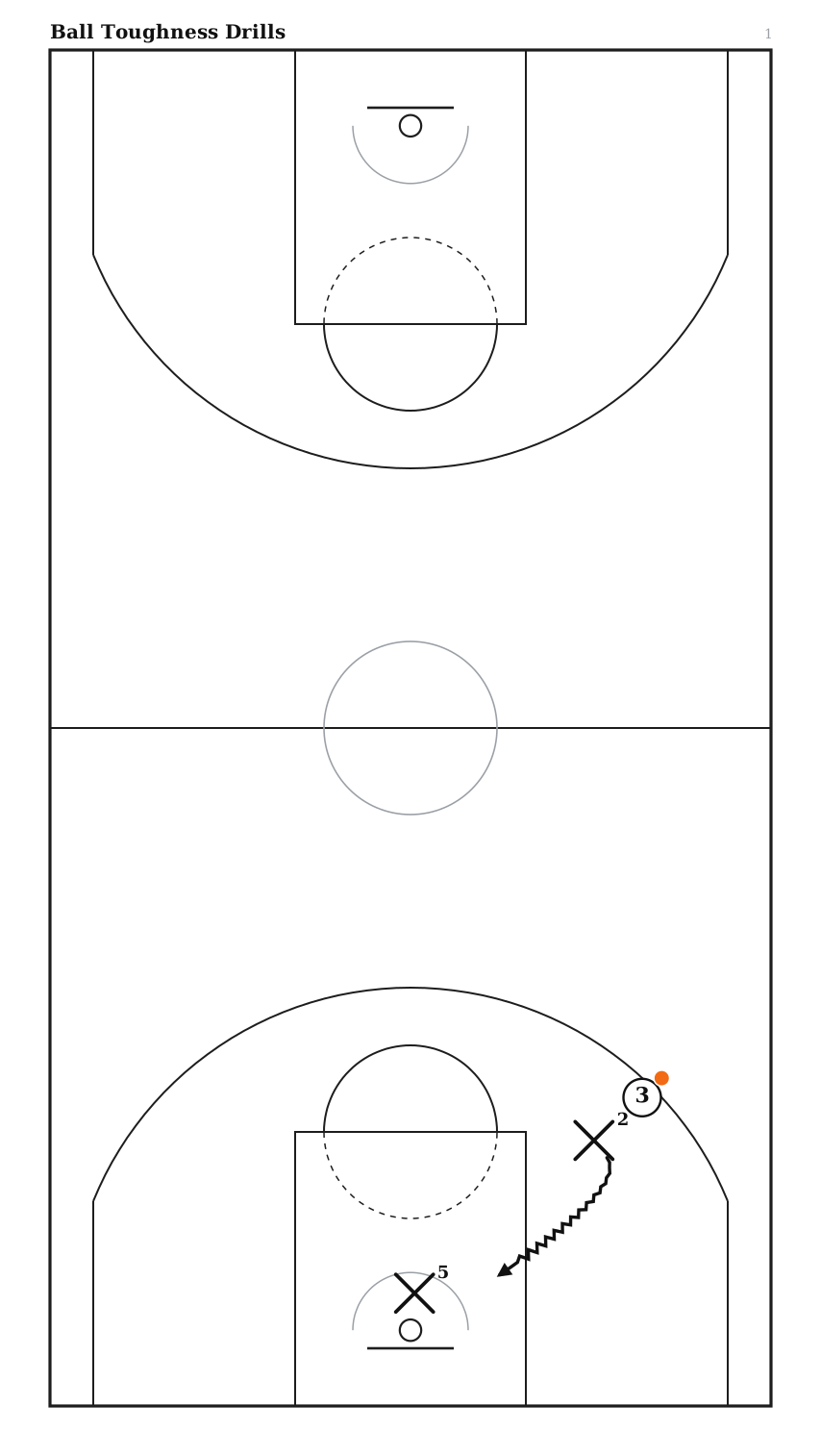
See it drawn up
Related diagrams
Keep Building
Related breakdowns
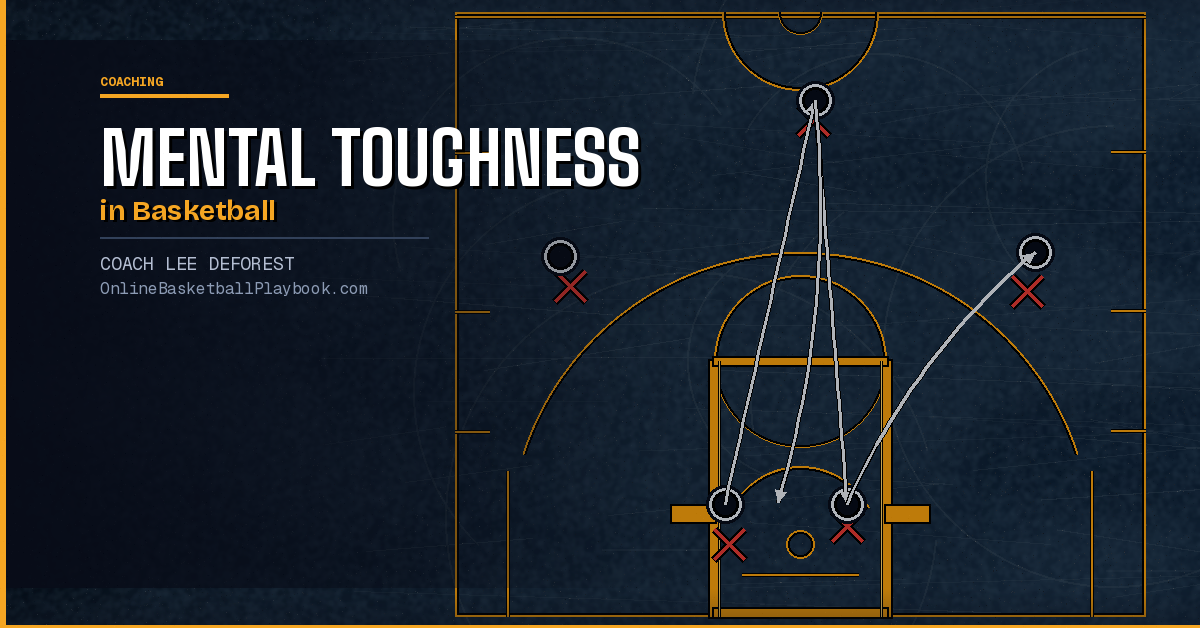
Mental Toughness in Basketball: How to Be Mentally Tough as a Player
Mental Toughness in Basketball: How to Be Mentally Tough as a Player
Developing a Strong Basketball Conditioning Program
Developing a Strong Basketball Conditioning Program