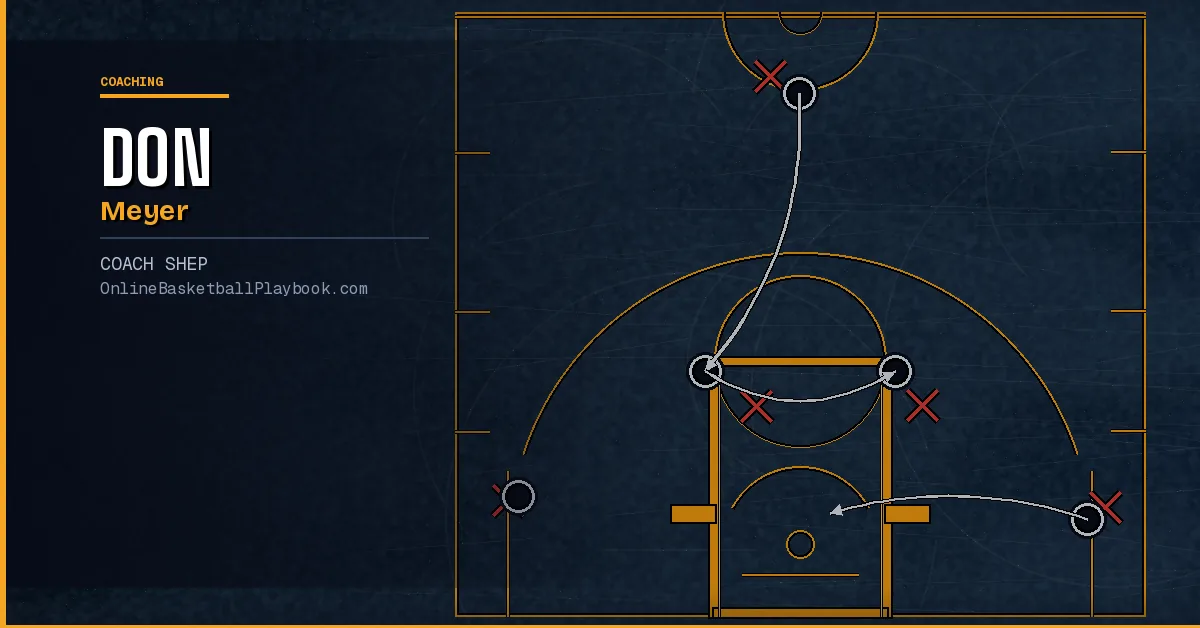
Don Meyer coached college basketball for 38 years and won 923 games. What made him different wasn't strategy. It was how he taught players to compete, think, and grow as people.
Who Don Meyer Was
Don Meyer spent most of his career coaching at small schools that nobody outside their conference had heard of: Hamline University, David Lipscomb, Northern State, and Pfeiffer. He never coached a Power Five program. He never had a roster full of McDonald's All-Americans. And yet, by the time he retired, he was the winningest coach in NCAA history at any level, with 923 career victories.
That record came at Division II Northern State, where he built the program from the ground up. He won with smaller, slower, less-recruited players who out-competed, out-prepared, and out-worked everyone they faced. When Sports Illustrated published a profile on him, readers outside South Dakota were hearing his name for the first time. Coaches who had been in the profession for decades were stunned they hadn't known about him sooner.
In 2008, Meyer was in a near-fatal car accident that required the amputation of his left leg. He returned to coaching within months. He died in 2014, but the body of work he left behind (the coaching philosophies, the competitive principles, the way he thought about player development) has been studied and taught ever since by coaches at every level.
His lessons aren't complicated. They don't require a whiteboard or a playbook. They require a commitment to doing ordinary things at an extraordinary level, every single day. That's what made Don Meyer's teams different, and that's what made Don Meyer himself one of the most influential figures in the history of basketball coaching.
Compete Every Single Possession
The foundation of Don Meyer's program was competition. Not just wanting to win (that's easy, everyone wants to win), but competing hard on every possession, in every drill, in every practice, regardless of the score or the circumstances.
Meyer believed that competitiveness was a habit, not a trait you were born with. You either practiced competing every day or you practiced not competing. There was no middle ground. If a player loafed through a defensive slide in October, Meyer expected that same player to loaf in January when the game was on the line. Habits don't disappear when the stakes get higher. They reveal themselves.
This meant his practices were intense by design. Every drill had a standard. Every rep had a purpose. Players were not allowed to go through the motions, because going through the motions was a form of practice. It was just practice at being average. Meyer refused to let his players practice average.
He talked often about the "gap", the distance between what you're capable of and what you're currently doing. Every player has a gap. The coach's job is to shrink it. The player's job is to close it. A team full of gap-closers beats a team full of talented players who are comfortable operating below their ceiling.
What's practical for other coaches here is straightforward: track competitive reps. Who wins one-on-one drills? Who finishes sprints first? Who boxes out when no one is keeping score? The player who competes when it doesn't count is the player who competes when it does. Meyer would tell you that scoreboard, in practice, matters every day.
Fundamentals Over Everything
Don Meyer was a fundamentals obsessive. Not in the way that word gets thrown around loosely. He genuinely believed that mastery of the basics separated good teams from great ones, and he structured his entire program around that belief.
His fundamental categories were simple: footwork, ballhandling, shooting mechanics, and defense. He didn't add categories or try to teach everything at once. He went deep on those four areas and drilled them relentlessly, year after year, at every level of his program.
The reasoning behind this was clear. At the end of a close game, when players are tired and the crowd is loud and the pressure is maximum, they don't execute the play you drew up in the huddle. They execute whatever they've practiced the most. If that's a clean shot off a catch, they make it. If they've only practiced it casually, they rush it. Meyer understood that a game-winning shot is just a practice rep performed in a high-pressure moment. Train the rep right, and the moment takes care of itself.
He also believed in repetition with purpose. It wasn't enough to do a drill 50 times. You had to do it correctly 50 times. A bad rep was worse than no rep, because it hardwired a mistake. This is why Meyer was demanding about technique even in warm-ups. The standard wasn't reserved for game situations. It applied from the first day of October through the last game in March.
For any coach reading this: your fundamentals window is bigger than you think. Younger players can absorb better footwork, cleaner form, and sharper habits than most coaches expect, but only if the coach demands it consistently and corrects it specifically every day.
The Mental Side of Coaching
Don Meyer was one of the most psychologically sophisticated coaches in the history of the sport, and he worked in an era before sports psychology was a standard part of programs. He arrived at his principles through experience, reading, and observation, and most of those principles are still ahead of what average coaches practice today.
His approach to player confidence was especially distinctive. Meyer believed that a coach's tone and body language were coaching tools, just as much as a drill or a play. He was blunt and demanding, but he separated the message from the delivery. He could correct a player hard without making that player feel like a failure. The correction was about the action, not the person. That distinction is harder to maintain than most coaches admit.
He was also a student of adversity. Meyer talked and wrote frequently about what difficulty reveals in a player's character, and he deliberately designed practices to put players in uncomfortable situations. Not to be cruel, but because he knew that a player who had never been tested under pressure would fold when the real test arrived. He wanted his teams to have already faced hard moments before the games that mattered.
Another element of his mental coaching was focus on what players could control. He didn't spend time worrying about the other team's press or their best player. He spent time making sure his players were locked in on their own execution. If his team did their job, the opponent's strengths became secondary. This is a posture (a disciplined choice about where to direct attention), and Meyer instilled it as a habit in his players.
He also read widely outside of basketball. He studied leadership, philosophy, and human behavior, and he brought those ideas into his program. He believed coaching was ultimately a teaching profession, and the best teachers never stop learning. His reading list included books on military leadership, education psychology, and competitive philosophy alongside the standard coaching manuals.
Building a Winning Culture
Don Meyer talked about culture long before that word became a coaching cliché. For him, culture wasn't a speech or a poster on the locker room wall. It was the daily behaviors that coaches tolerated or refused to tolerate. Culture was built by repetition, and it could be destroyed the first time a coach looked the other way.
His program had clear standards of behavior that applied to everyone, starters and bench players equally. Showing up on time. Giving maximum effort in every drill. Supporting teammates loudly and specifically. Holding eye contact when a coach or teammate was speaking. These weren't revolutionary rules, but they were non-negotiable, and that consistency was what turned a group of players into a program with an identity.
Meyer was also direct about the coach's role in shaping culture. The team, he believed, would take on the personality of its head coach. If the coach was scattered and inconsistent, the team would be scattered and inconsistent. If the coach was focused and demanding but fair, the team would develop those same qualities over time. There was no hiding from this accountability. The team was a reflection of the person leading it.
Parent and community management was also part of how Meyer thought about culture. He communicated expectations clearly, early, and often. He didn't let confusion fester into conflict. He addressed issues directly, usually with the player first and the parent second. This kept problems from growing into distractions that hurt team cohesion. Coaches who avoid difficult conversations early pay for it later, when the damage is harder to undo.
For any coach building or rebuilding a program: culture starts with the small stuff, not the big moments. The way you run the first five minutes of practice sets the standard for everything that follows. Meyer knew this and used it every day.
Hold a parent meeting before your first practice of the season. Cover playing time philosophy, game-day behavior expectations, and how parents can support the team rather than undermine it. A fifteen-minute conversation in September prevents most of the conflict that erupts in January when wins and losses start mattering more.
Lessons for Youth and High School Coaches
Don Meyer never coached youth players himself, but his principles apply directly to the youth and high school level, perhaps more directly than at the college level, because that's where habits are formed before they're hardened.
The most important lesson for coaches working with younger players: players won't remember the plays you ran. They'll remember how they felt when they walked out of the gym. Did they feel capable? Did they feel like they improved? Did the experience make them want to come back? A player who leaves practice excited to return is a player who will develop. A player who dreads practice is a player who will eventually quit.
Meyer's obsession with fundamentals translates directly. Young players who learn the correct footwork, the correct shooting mechanics, and the correct defensive positioning early don't have to unlearn bad habits later. The window to build clean habits closes faster than most coaches realize. Use it deliberately.
His demand for competitive effort at every level of practice is also directly applicable. Youth players who are held to a competitive standard every day don't have to be told to compete when the lights are on. It's already their default. Players who've only practiced casually have to try to compete, which is a different and harder thing than simply competing as a natural habit.
Finally, Meyer's leadership philosophy (building character as seriously as you build skill) is especially relevant for coaches who work with players between the ages of ten and eighteen. Those are the years when identity forms. What a coach teaches about effort, accountability, and resilience in those years stays with a player long after the game clock stops. That's the scope of the job, and Meyer never forgot it.
- Compete in every practice rep: Track who wins one-on-one drills, finishes sprints first, and boxes out when no score is kept. Competitive habits built in practice show up automatically in games.
- Master four fundamentals before anything else: Footwork, ballhandling, shooting mechanics, and defense. Go deep on those four. Don't add categories until the basics are clean and consistent.
- Correct the action, not the person: Be demanding about execution while keeping the player's confidence intact. Separate the mistake from the player's identity so they stay willing to try again.
- Culture is built by what you tolerate daily: The team will reflect the coach's standards. What you overlook on a Tuesday in November becomes the norm by February.
- End every practice on a positive note: Players should leave the gym feeling capable and motivated to return. A practice that ends on a punishment or a failure is a practice that chips away at the competitive drive you're trying to build.
Want more basketball coaching strategies and drills?
Join the Online Basketball Playbook newsletter →
Draw this play free in the play drawer →
Membership: the full library, playbook packs, and Pro drawing tools →
Keep Building
Related breakdowns
Five Lessons I Have Learned from Coaching Basketball
Five Lessons I Have Learned from Coaching Basketball
Kentucky Basketball Program Under Calipari: Lessons for Coaches
Kentucky Basketball Program Under Calipari: Lessons for Coaches