Coaching basketball has a way of humbling you. Every season teaches you something you thought you already knew. These are the five lessons that have changed how I think about the game, the players, and the job.
Lesson 1: Spacing Is Not Optional. It Is the Offense
The biggest shift in my coaching came when I stopped thinking of spacing as something you add to your offense and started treating it as the offense itself. When five players are spread around the perimeter, the math changes. Rim protectors have to leave the basket. Help defenders have to cover ground. Driving lanes open up. Every cut gets cleaner. Every pass hits a player who has a real decision to make.
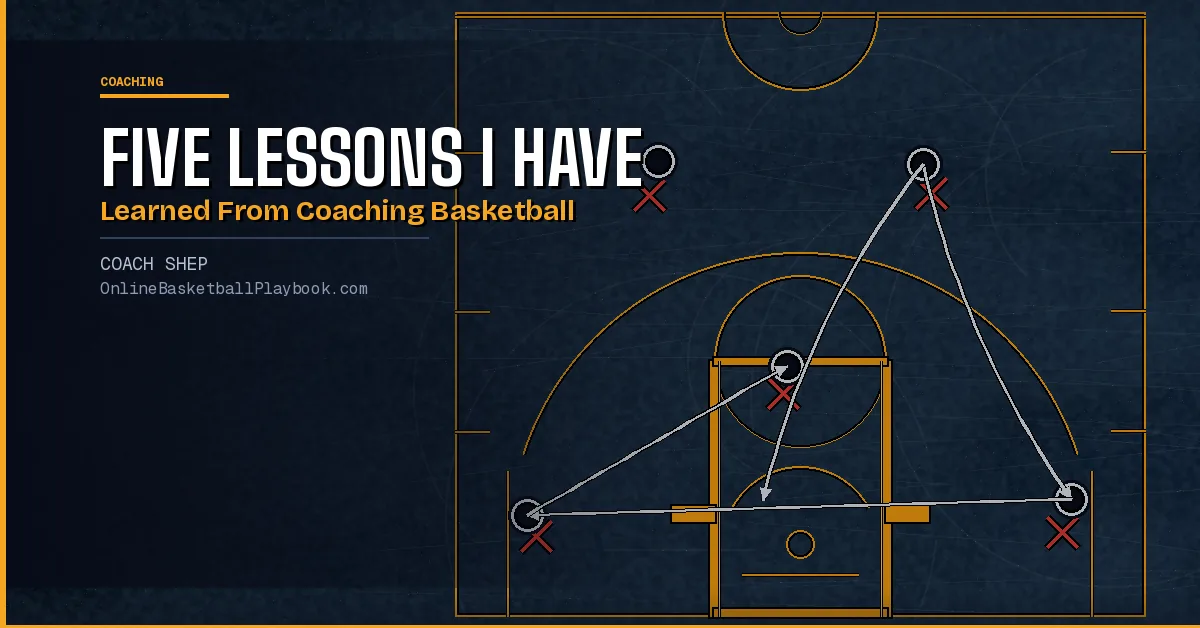
The five-out motion offense makes this concrete. When all five players are outside the three-point arc, you strip away the extra bodies clogging the paint. You force every defender to respect every shooter on the floor. If even one player on the court cannot be guarded, the defense can sag that player's defender into the lane and effectively give your team a fifth help defender on every drive. One non-shooter collapses the whole concept.
This lesson changed how I run practice. We spend more time on spacing and floor balance than we do on set plays. I put cones on the five spots for younger teams until filling out becomes automatic. Once players understand that their positioning is protecting the spacing for their teammates, the offense becomes self-correcting. Players stop drifting toward the ball out of habit. They fill out, stay wide, and give the ball-handler a court to work with.
The lesson underneath the lesson: if you want players to space instinctively, they have to understand why. Not just where to stand, but what their position does to the defense. When a player on the weak side pulls their defender eighteen feet from the basket, they have just cleared a driving lane for their teammate. That is a contribution. Make sure they feel it.
Lesson 2: Teach Reads, Not Just Plays
For a long time, I coached too many plays. We had a play for every situation. The problem was that plays only work when the defense cooperates. Defenders switch, help early, or extend beyond the plan. When that happens and your players do not know how to read the situation, the play breaks down and nobody knows what to do next.
The most useful framework I found was this: instead of calling a play, teach the read. The basket cut and the backdoor cut are not two separate things. They are one read. If your defender is sagging, you cut to the basket. If your defender is overplaying, you go backdoor. The same pass triggers two different reactions depending on what the defense gives you. Once players own that read, they do not need you to call anything.
Motion offense is built on this. The pass-and-screen-away continuity is not a set. It is a framework. Every pass becomes a screen-away with two complementary cuts: the screener sets the screen or slips based on how the defense plays it, and the receiver reads straight cut, tight curl, or back-cut based on where the defender is. Players who understand these reads never need to stop and reset. The offense has built-in motion on every possession.
The practical change this created in my coaching: I added named language for every read. Curl. Slip. Backdoor. Pop. When players have a word for what they are reading, they can talk to each other. The screener can call "Curl!" so the cutter knows what is coming even with their eyes on the ball. Named reads turn individual instincts into a shared language, which makes the whole offense faster and more coordinated.
The deeper lesson: plays are a substitute for understanding. Reads are the understanding itself. Build the reads first, and the plays become easy additions on top (calls that fit into a system players already know how to navigate).
Lesson 3: The Dribble Is a Weapon You Must Guard
Aimless dribbling is one of the most destructive habits in basketball. When a player catches the ball and starts dribbling without a purpose, several bad things happen at once. The offense stalls because players around the ball do not know what action to fill for. The spacing collapses as defenders relax. The clock runs without anything useful happening. And when the dribble ends, the player is often in a worse position than when they started.
The rule I picked up from Hackenberg's approach to five-out motion is one I now use with every team I coach: dribble for three reasons only. Attack the rim on a straight-line drive. Improve a passing angle. Or break a five-second count. That is it. Every other dribble is a drain on the possession.
This single rule changed how I structure individual skill work. Before we work on ball-handling, we talk about purpose. I ask players to narrate their dribbles in practice. "I'm attacking the rim." "I'm getting a better angle to the corner." Players who cannot explain why they are dribbling learn to pick up the ball and make a decision instead. It sounds simple. The effect on possession quality is significant.
When a player does attack the rim on the straight-line drive, the other four players have to read and react. Push/pull spacing: the player at the drive pushes up toward the ball-side elbow, the corner player on the strong side dives toward the basket, and the trailer on the weak side pulls toward the top of the key. These movements create the passing windows the ball-handler needs after the defense collapses. But none of it happens if the initial drive has no conviction. The drive has to be a real threat, not a hesitation move that reads as exploration.
Lesson 4: Every Lineup Decision Is a Spacing Decision
I used to think about lineups mostly in terms of matchups. Who can guard their best player? Who is in foul trouble? Who needs rest? Those questions still matter, but they are incomplete. The question I ask first now is: what does this lineup do to our spacing?
The three-out, four-out, five-out progression mapped this clearly for me. If you have a genuine post player who should touch the ball early and often, you run three-out-two-in. You keep interior presence. If you have one reliable post and four developing perimeter players, you go four-out. If your team has five players who can make a defender respect their catch, you go to five-out and maximize spacing across the floor. The alignment you choose is not just a tactical decision. It is a developmental one. You move teams up the progression when the evidence in their play supports it, not on a fixed schedule.
The lesson underneath this one cost me a couple of seasons to learn: a single player who cannot be guarded from the perimeter changes what every other player on the court can do. That player's defender can sag off and become a sixth defender on every drive. Knowing this changes substitution patterns. It changes how you construct lineups against different opponents. And it changes what you look for when you evaluate your own roster at the start of a season.
Before we finalize our offensive system each year, I map each player onto the spacing spectrum. How many of our players force a defender to respect their catch? How many of them, if left open, will punish the defense? That count determines what alignment we can run and what we need to develop over the course of the year.
Lesson 5: Patience Beats Aggression Against a Zone
Youth and high school players almost universally attack a zone on the first catch. The ball swings once or twice and someone sees an open gap and attacks it. The problem is that the first rotation of a zone is usually the zone at its most prepared. Defenders know their assignments, they are in their initial coverage positions, and they have not been forced to commit to anything yet. Attacking in that moment is attacking the zone at full strength.
The adjustment that changed how I coach against zone is the two-rotation rule. The five-out alignment stretches a zone to its maximum coverage area because every spot on the perimeter requires a defender to account for it. The first rotation tests the zone's commitment. Which defenders are cheating? Where is the coverage thin? The second rotation reveals the crack, the coverage adjustment that opened up because of the first rotation's demands.
The five-out set is particularly effective against a two-three zone because the high-low read creates genuine stress. When the ball enters the corner, the bottom zone defender has to commit to it. That commitment opens the mid-foul-line area for the top-of-key player, who can catch and attack before the zone recovers. But this action works best after two rotations, when the bottom defender has already been tested and their tendencies are visible.
Teaching patience against zone is harder than it sounds. Players feel the urgency of the game clock and the pressure of the opponent's setup. Part of my job is to give them a simple cue they can run in the moment. "Two rotations before you attack" is specific enough to use in a game. Players can count. They know what they are waiting for. And when they wait, they see more, make better decisions, and get higher-quality shots.
The broader lesson from this one: patience is a skill, not a personality trait. You can teach it. You do it with specific rules, specific cues, and enough practice reps that the habit overwrites the instinct to rush.
When you install any of these lessons, name the reads and rules out loud in practice so players can call them to each other during live play. A team that shares a common language makes better decisions faster, not because they are more talented, but because they are communicating more efficiently under pressure.
- Spacing first: Put cones on the five spots at practice until filling out is automatic. Players need to feel what their positioning does for their teammates before they will do it without being reminded.
- Name every read: Curl, Slip, Backdoor, Pop. Give each cut a word so screeners can call the read aloud and cutters can confirm it without stopping to look at the bench.
- Dribble with a purpose: Hold players to the three-dribble rule in practice: attack the rim, improve a passing angle, or break a five-second count. No other dribble is acceptable.
- Map your roster to the progression: Count how many of your players force a defender to respect their catch before you decide whether to run three-out, four-out, or five-out. The alignment choice follows the evidence.
- Zone patience cue: Give players a concrete instruction, "two rotations before you attack", so they have something specific to execute rather than a vague directive to be more patient.
Want more basketball coaching strategies and drills?
Join the Online Basketball Playbook newsletter →
Draw this play free in the play drawer →
Membership: the full library, playbook packs, and Pro drawing tools →
Keep Building
Related breakdowns
What I Have Learned Over the Years Coaching Basketball
What I Have Learned Over the Years Coaching Basketball
Kentucky Basketball Program Under Calipari: Lessons for Coaches
Kentucky Basketball Program Under Calipari: Lessons for Coaches