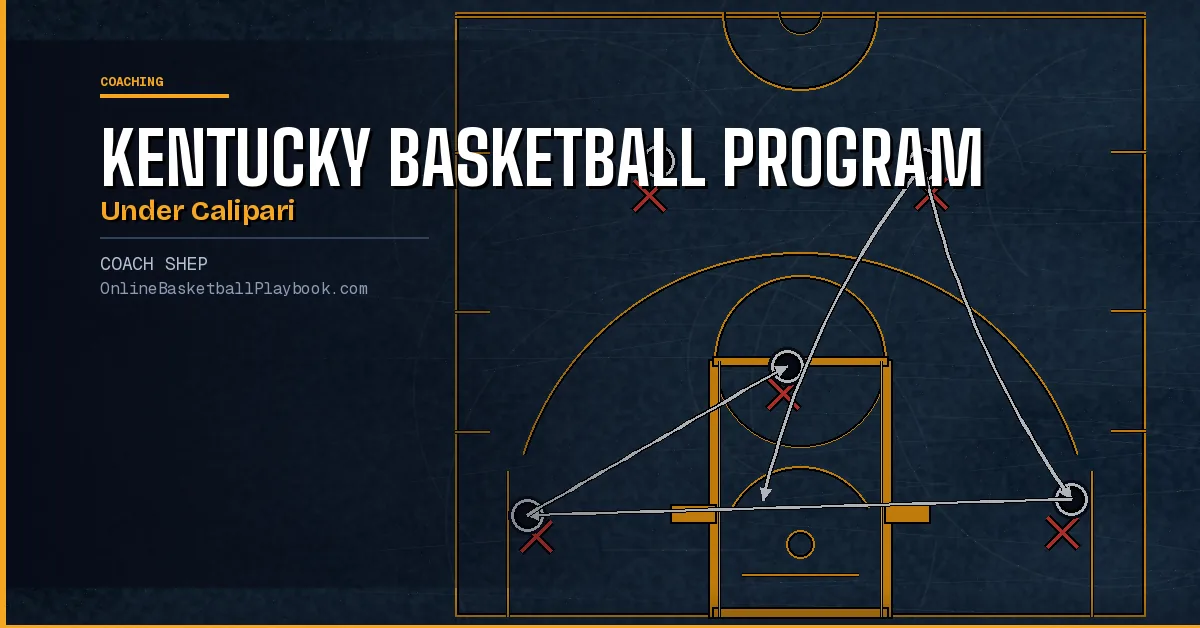
John Calipari's Kentucky tenure produced eight Final Fours and one national title by mastering one thing most coaches underestimate: how the program is assembled matters more than how it is coached.
Assembly Over Coaching: The Core Principle
There is a quote that reframes everything about how we evaluate coaching success: "How the team is being assembled is more important than how the team is being coached." It comes from Ettore Messina, one of European basketball's most decorated minds, and it applies directly to what Calipari built at Kentucky.
For fifteen years, Kentucky's program was the most dominant recruiting machine in college basketball. Critics framed it as simply "buying wins" with five-star talent. That misses what was actually happening. Calipari was doing something far more systematic. He was building a pipeline that assembled players who fit a specific identity, and then coaching them within that identity rather than trying to retrofit his system to whoever showed up.
The distinction is critical. Most coaches at every level (high school, club, college) try to coach their way out of roster problems. They install new plays, add new defenses, run new drills. Calipari's lesson is that the roster problem has to be solved before the season starts, not during it. Recruiting is not a side job for your assistant coaches. It is the primary act of program building.
This does not mean every coach needs to recruit McDonald's All-Americans. It means every coach needs a clear answer to the question: what kind of player fits what we are building? Kentucky's answer under Calipari was specific: elite athletes with NBA upside who could play inside-out basketball and defend at an elite level for one or two years. Every recruiting decision was filtered through that lens. The players who flourished (Anthony Davis, John Wall, DeMarcus Cousins, Karl-Anthony Towns) fit the profile precisely. The rare times Kentucky struggled, the roster had players who were talented but outside the system's identity.
The takeaway for coaches at every level is this: write down your program's player identity before you recruit or retain a single athlete. What are the three non-negotiable traits your players must have? What position-specific skills are required on day one versus coachable over a season? Knowing the answer in advance is what separates a program from a team.
Identity-First Recruiting at Kentucky
Calipari was explicit about something that many coaches treat as implicit: the values and style of your program do the recruiting for you. When your identity is known and public, the right players are attracted to it, and the wrong players self-select out.
This is what coaching scholars have called the "identity-first" model. You never start from zero. A foundation of core players plus a visible, public philosophy becomes the magnet. Kentucky under Calipari had a known, unambiguous brand: elite development, NBA preparation, championship culture, and a coach who had sent more players to the first round of the NBA Draft than anyone in history. That brand was the recruiting pitch. The actual conversations with recruits were confirmations, not negotiations.
What does this mean for coaches who are not at Kentucky? It means your program's identity needs to be visible and consistent before a recruit or a transfer ever walks through the door. Your players should be able to articulate in two sentences what your program is about. Not what your offense looks like, but what you value, how you hold players accountable, and what development looks like inside your system.
The programs that struggle in recruiting at every level share a common trait: they try to be everything to every player. They adjust their pitch based on what they think a recruit wants to hear. That approach does not build identity. It undermines it. When a recruit hears different things from different coaches on your staff, or a different story this year than last, the message that lands is "this program does not know what it is."
Kentucky under Calipari never had that problem. The brand was clear. The staff sold the same story. The culture the recruit visited on campus matched the culture that was described in living rooms. That alignment (between what you say your program is and what it actually is) is the foundation of recruiting trust.
A practical step for any program: write a single paragraph that describes your program's identity as if you were introducing it to a recruit's family for the first time. If your staff cannot agree on what that paragraph should say, you do not have a program identity yet. That is the work that has to happen before the next recruiting class arrives.
Accountability Standards That Actually Stick
One of the least discussed aspects of the Calipari era at Kentucky was how he handled accountability with players who were, by every measure, the best recruits in the country. These were teenagers who had been praised and protected their entire athletic careers. They had rarely been held to genuine team standards. Getting them to buy into accountability was not automatic.
The most durable accountability systems share a structural feature: the standards are set before problems arise, not in response to them. Calipari established team rules (on attendance, on preparation, on conduct) from the first day of preseason. This is not a minor procedural detail. When standards are introduced in reaction to a specific player's behavior, they feel punitive and personal. When they are set in advance and applied uniformly, they feel institutional and fair.
The discipline that protects a locker room, as coaching research consistently shows, is the discipline of fairness. The moment a team's best player is treated differently from its twelfth man, the standard becomes optional. Calipari's players were stars by definition, but the program's non-negotiables applied regardless of recruiting rank. Practice punctuality, treatment of staff, preparation standards. These did not flex based on a player's NBA projection.
Accountability also requires a coach who is not afraid of confrontation. This is the failure point for most programs at every level. Coaches who are conflict-averse allow violations of team standards to slide once, twice, then indefinitely. The team watches every one of these decisions. When a coach fails to enforce a standard, the effective message to the roster is that the standard does not actually exist.
The Kentucky model under Calipari also built in peer accountability. When a team is assembled correctly (with the right character in the right positions), players hold each other to the standard without the coach having to intervene in every situation. Building that peer culture requires early, deliberate work: senior leadership with real authority, team captains with defined roles, and a practice environment that creates genuine consequences for violations.
What the One-and-Done Model Taught Us About Role Clarity
The one-and-done era at Kentucky forced Calipari to solve a problem that coaches at every level face in shorter form: how do you build cohesion and clarity when your roster turns over almost completely every year?
The answer, consistently, was role declaration. Every player needed to know their specific role before the season started, not in general terms, but specifically. Which possessions would run through them? What were their defensive assignments? When would they be on the floor in late-game situations? Ambiguity about roles is a culture leak. It creates quiet resentment between players, confusion about who makes decisions in critical moments, and a diffusion of accountability when something goes wrong.
Role clarity also has a counter-intuitive effect on elite players: it relieves pressure rather than restricting freedom. A five-star freshman who knows exactly what the program needs from them can focus all of their energy on executing that role at an elite level, rather than spending mental and emotional energy trying to figure out where they fit in the hierarchy. Calipari was direct with players about their roles: in individual meetings, in front of the team, and in the context of what the NBA scouts were watching for. The transparency built trust.
For coaches at any level, the lesson is operational: hold a role-declaration conversation with every player on your roster before the first game. Do not leave role definition to assumption or to the natural emergence of playing time patterns. Tell each player directly: here is what we need from you, here is when you will play, and here is what development looks like inside that role this season. Then revisit it in practice when performance shifts.
How Calipari Built Practice Culture
Kentucky's practice culture under Calipari was built on two things that reinforce each other: competitive intensity and game-like conditions. The principle is simple and supported by decades of coaching research. If practice is a safer, lower-stakes environment than games, players will shrink when real pressure arrives. The solution is to make practice harder, not easier.
This is the competitive cauldron concept applied at the highest level. Everything in practice has a winner and a loser. Every drill has a consequence. The players who thrive in late-game situations at Kentucky were not naturally clutch. They had practiced under conditions that were, in many respects, more demanding than what they faced in January conference games. By March, those situations felt familiar.
Practice culture also determines what the team believes about itself. A team that practices with discipline and intensity develops a self-image as a disciplined, intense team. That identity is not something a coach declares in a preseason speech. It is built rep by rep across hundreds of practice segments. Calipari understood this, which is why the standards at practice were not relaxed when Kentucky was winning or when the team was fatigued. The consistency of the standard was the standard.
One practical element of elite practice culture is the deliberate insertion of adversity. Drills that put players in uncomfortable, failing positions (where the default is to make an error) are the ones that build real toughness. When a player has been in a bad position in practice fifty times and found a way through it, they do not panic in a game. This is not a philosophical claim; it is a mechanical one. Habits formed under pressure in practice are the habits that surface under pressure in games.
Kentucky's practice was also built around the principle that defense comes before offense in the identity hierarchy. Calipari was not running an offensive system and hoping his athletes could guard. He was building teams that defended at an elite level first, because that is what sustained success through a long tournament run requires. Offensive talent covers mistakes in the regular season. Defense is what wins in April.
Defensive Identity as the Program's Signature
Every program that sustains success over multiple years is defined by something specific that does not change when the personnel changes. For Kentucky under Calipari, that signature was defensive pressure. The style of offense evolved. The personnel rotated almost completely. The defensive identity was a constant.
Building a defensive identity requires a different kind of coaching commitment than building an offensive system. Players want to score. They will run your plays, learn your sets, and engage with offensive concepts without much persuasion. Getting players to defend with consistent effort and intelligence across an entire season (including the games in January when everyone is tired and the opponent is a mid-table team) requires a structural commitment from the coaching staff.
The first structural commitment is practice time. Calipari's teams spent significant practice time on defense because the program believed defense was where coaching showed. Anyone can score with elite athletes. Building a team that guards collectively (where all five players move as a connected unit, where help-side rotations happen automatically, where communication is a habit rather than an afterthought) is a coaching achievement that requires sustained investment of practice minutes.
The second structural commitment is selection. Not every talented player is willing to defend at a high level consistently. Some elite scorers have genuinely poor defensive habits and even poorer defensive attitudes. Recruiting or retaining a player who refuses to buy into defensive standards corrupts the standard for the entire roster. Kentucky's best defensive teams under Calipari were not simply more talented than opponents. They were assembled with players who took pride in guarding.
The third commitment is accountability. A turnover on offense is visible; a missed defensive rotation is often invisible to everyone except the coaching staff. Building a defensive culture requires coaches who track defensive execution as rigorously as offensive execution, and who hold players accountable for defensive mistakes with the same consistency as offensive ones. When players know the coaching staff is watching and evaluating defense in film sessions with the same attention they give to offensive plays, defensive effort becomes part of how players measure their own performance.
Lessons You Can Apply at Any Level
The Kentucky program under Calipari operated at a scale most coaches will never approach. The budget, the facilities, the recruiting reach. These are specific to one of the most resource-rich programs in the history of college basketball. But the principles underneath the surface do transfer, because they are not primarily about resources. They are about how coaches think and what they prioritize.
The assembly principle transfers completely. A youth coach running a twelve-player AAU team still makes assembly decisions. Which twelve players? What character traits are non-negotiable? Who already has the work habits the program requires? Recruiting and retention decisions at every level should be filtered through a known identity, not made on talent alone.
The role-clarity principle transfers completely. Players at every age respond to knowing exactly where they stand and exactly what is needed from them. Ambiguity does not protect feelings. It generates anxiety and quiet resentment. A direct conversation about roles, done with respect and specificity, builds more trust than any amount of positive reinforcement.
The accountability principle transfers completely. The coaches who struggle to hold players to standards are almost always coaches who set the standards too late, apply them inconsistently, or exempt their best players. None of these failures require resources to fix. They require the willingness to have uncomfortable conversations and to mean what you say about team non-negotiables from the first day of preseason.
The defensive identity principle transfers completely. Pick a defensive identity for your program. Not a defense that you think might work, but a defensethat you are committed to building over multiple seasons. Teach it relentlessly. Track it. Evaluate your players against it. Make it the thing that other coaches in your league know your program for. That kind of identity does not require five-star athletes. It requires a staff that believes in it and a practice structure that builds it day by day.
What Calipari built at Kentucky was not just a collection of elite players. It was a program with a clear identity, a consistent standard, and a structural commitment to building culture before trying to install schemes. The players changed every year. The program did not. That is the lasting lesson.
Before your next practice, run a role-declaration check: can every player on your roster tell you in one sentence exactly what the program needs from them this season? If any player hesitates or gives a vague answer, that is your coaching priority for this week, not a new drill or a new set, but a direct, specific, documented role conversation with that player before the next game.
- Write your program's player identity in a single paragraph before recruiting season starts: three non-negotiable character traits, two non-negotiable skill requirements, one cultural standard that has no exceptions.
- Set your team's non-negotiables (punctuality, effort, treatment of teammates and staff) in the first preseason meeting and apply them to every player equally from that day forward. Fairness across the roster is what protects chemistry over a long season.
- Hold a formal role-declaration conversation with every player before the first game: specific possessions, specific defensive assignments, specific late-game situations. Remove every ambiguity about where each player fits.
- Make at least two practice segments per week harder than your toughest game environment, scored competitions with real consequences for the losing group, so players are conditioned to perform under pressure before they face it on a scoreboard.
- Run a post-practice mental error audit: when a player makes an assignment mistake, ask whether that action was drilled to automatic before expecting it in a game. If the answer is no, that is a coaching gap to close, not a player discipline issue.
- Commit to a defensive identity that does not change with personnel. Track defensive execution in film with the same rigor as offensive plays, and hold players accountable for defensive mistakes with the same consistency as offensive ones.
Want more basketball coaching strategies, drills, and tools?
Join the Online Basketball Playbook newsletter →
Draw this play free in the play drawer →
Membership: the full library, playbook packs, and Pro drawing tools →
Keep Building
Related breakdowns
Mentorship Program for Young Coaches: Match, Meet, Review
How to build a mentorship program for young coaches: set goals and a length, match on style and time, meet on a schedule, give one real job and review it.
How to Build a Basketball Program: Identity, Staff and Culture
How to build a basketball program: identity first, written standards, staff roles, the season calendar, feeder programs and recruiting players who fit.
AAU vs High School Basketball: How Coaches Work Together
A school coach's guide to AAU vs high school basketball: how the two seasons differ, how to place players and plan the summer, and how to coach an AAU team well.