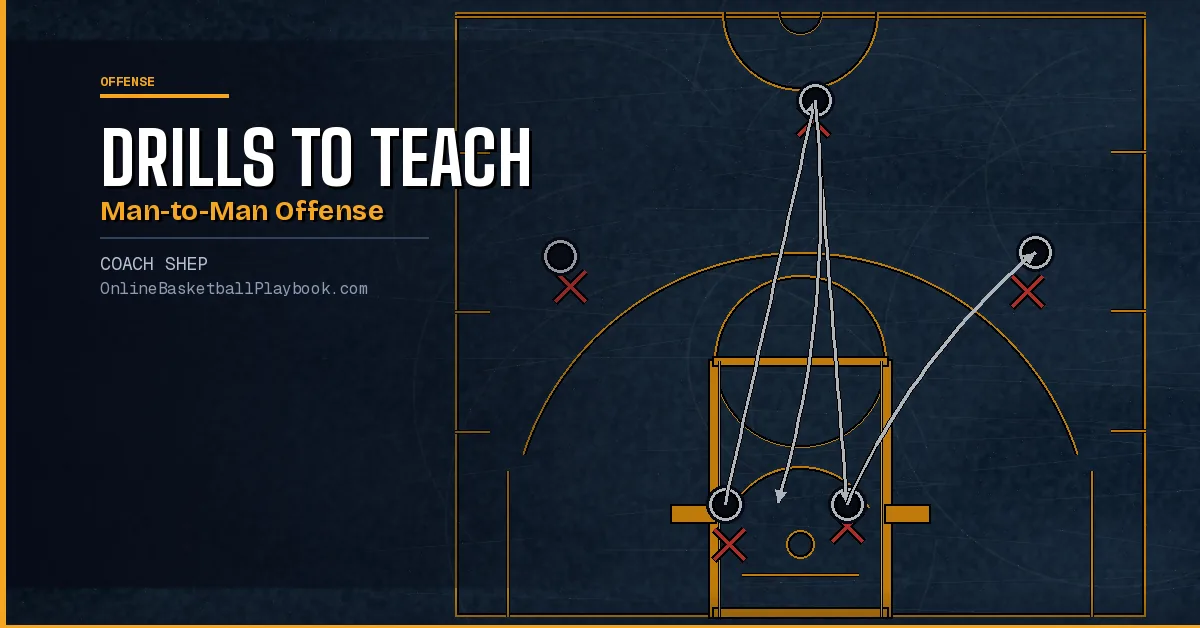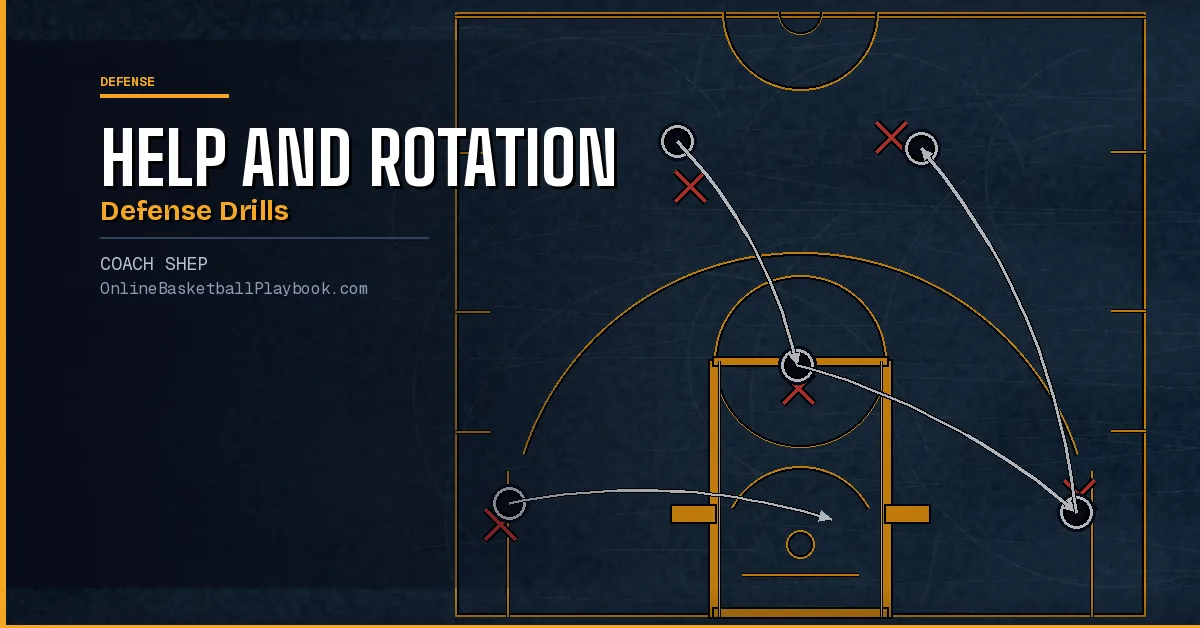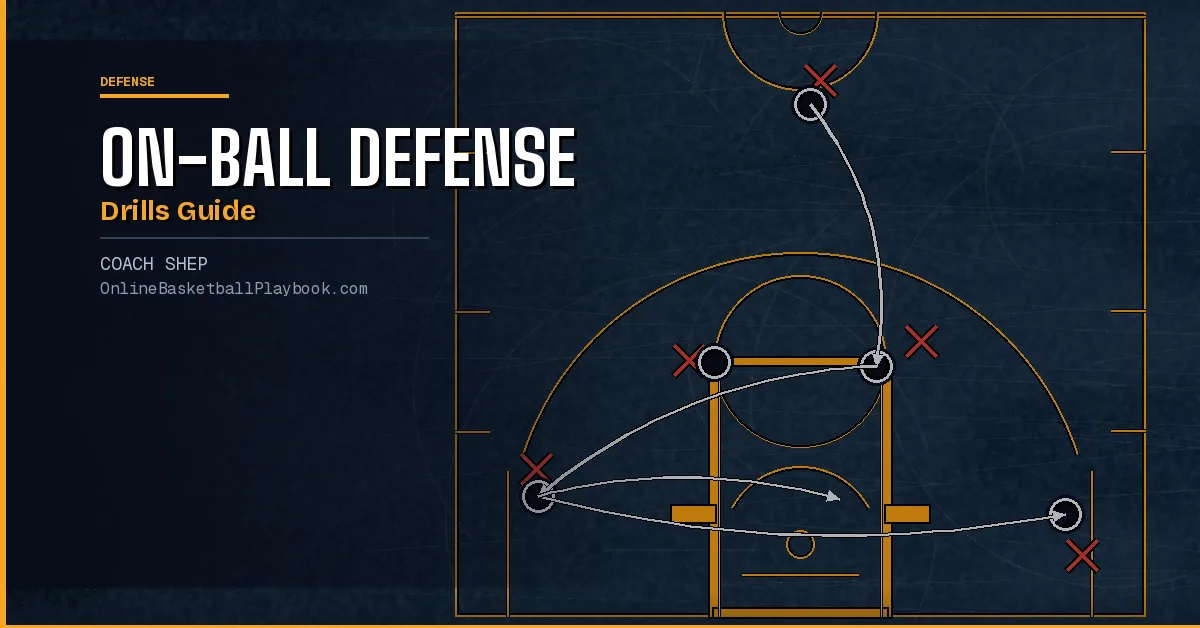
Good on-ball defense starts with stance and footwork, not athleticism. These six drills isolate the exact mechanics defenders need to stay in front, cut off angles, and apply ball pressure without fouling or gambling.
Why On-Ball Defense Is the Foundation
Every team defensive system (man, zone, press) collapses the moment the on-ball defender gets beat. When that defender can't stay in front, help defenders are pulled out of position, rotations break down, and easy shots appear. Teaching on-ball defense first is not optional. It is the prerequisite to teaching anything else.
The problem most coaches run into is drilling team concepts before players have the individual mechanics to execute them. A scramble help rotation looks great on a whiteboard. It falls apart in a game if the primary defender's footwork gives up the straight-line drive every possession, forcing the help to leave early and turning a 5-on-5 scheme into a reactive scramble.
The drills in this guide are deliberately isolated. Each one targets a single mechanical habit (stance, footwork pattern, angle control, or closeout) before combining them. The order matters. Build stance before movement. Build movement patterns before live reads. Build live reads before introducing team concepts.
"Everything you do 1 on 1 should fit your 5 on 5."
Steve Hawkins, Western Michigan
That principle is the governing rule for this entire drill progression. Every rep a defender takes in isolation is preparation for a specific role in your team defense. If your scheme wants defenders to force baseline, every 1-on-1 drill should reinforce baseline containment. If you run help-and-recover, your live 1-on-1 reps need to include a help trigger. The drills aren't separate from your system. They are your system at the individual level.
One more thing before the drills: establish non-negotiables at the start of the first practice and repeat them every day. Post them on the wall if you have to. No straight-line drives. No lob passes. The baseline and sideline are your co-defenders. These three rules give players something to measure every rep against without a coach stopping play.
Drill 1: Stance Mirror (Bucket-Down Freeze)
You cannot fix footwork if the base is wrong. This drill is 60 seconds per pair and requires no ball. One player assumes the "bucket-down" stance: knees bent, weight on the balls of the feet, chest out, hands shoulder-width. The coach or partner calls out a body part and the defender must instantly adjust: "hands up," "chest forward," "inside hand lower." The partner watches and corrects.
What you're looking for: feet at least shoulder-width apart, slight forward lean (not upright), both knees pointed outward (not caving in), and the inside hand, the one closest to the ball-side, at waist to chest height, active and alive. The outside hand is lower, ready to deflect passes, not reaching.
After the freeze check, add a lateral mirror component. The ball carrier takes slow, deliberate jab steps left and right. The defender slides without crossing feet and without coming out of stance. The instant a foot crosses, or a player stands up, the rep stops. Reset. The goal is to make the stance unconscious. You want players arriving in the right position before they think about it.
Run this drill at the start of every defensive practice for the first two weeks of the season. After that, use it as a reset when you see stance break down in live reps. Three minutes at the beginning of a session is faster than stopping live 5-on-5 every time you see a player go upright.
Drill 2: Zig-Zag
The zig-zag drill is the oldest on-ball footwork drill in basketball and still one of the most effective. Run correctly, it teaches the defender to stay nose-on-ball, use the sideline and baseline as help, and change direction without getting caught flat-footed.
Setup: two lines at one corner of the court. Ball carrier dribbles at a 45-degree angle toward the sideline. Defender slides to cut off the angle, forcing a change of direction. Ball carrier picks up the dribble and turns back toward half-court, changing direction. Defender pivots and resets. The sequence continues the length of the floor.
The defender's nose should stay on the dribbler's ball hand, not the hip, not the chest. Tracking the ball hand keeps the defender in the dribbler's vision (which creates psychological pressure) and in position to deflect without reaching. The moment a defender tracks the hip, they lose ball-position and start guessing.
Common errors: defenders who back-pedal instead of slide (they'll lose ground instantly against any live dribbler), defenders who stop sliding and plant their feet (the dribbler feels the hesitation and attacks), and defenders who reach with the near hand when the dribbler changes direction (instant foul, and the drive angle opens). Correct one error at a time rather than stopping play for a lecture. Call out a single cue: "nose on ball," "don't reach," "stay low" and let the rep continue.
Progress the drill by adding a live finish at the far baseline. After the full-court zig-zag, the ball carrier goes live for one move and the defender must contest or take a charge. This teaches players that the footwork isn't just a drill. It connects to a real defensive stop.
Drill 3: Retreat and Advance Step Isolation
Most youth and high school defenders only know one response when a dribbler attacks: back-pedal in a straight line. That gets them beat every time against any player with a first step. The retreat step and advance step are the two tools that actually allow a slower defender to stay in front.
The retreat step is triggered when the dribbler attacks toward the defender's front foot. The move: drop the threatened foot back and open the hip slightly, not a full turn, just enough to redirect the angle. The defender is now angled to the dribbler's path rather than parallel to it, which buys a step of distance and re-establishes the gap without retreating straight back.
The advance step is the opposite concept. Instead of waiting for the dribbler to attack, the defender attacks first, a quick step toward the ball before the dribbler gets into rhythm. This disrupts the offense's timing and forces a change of plan before the play develops.
Drill format: pairs, no ball. The coach calls "retreat" or "advance" and the defender executes the correct step. After 10 reps of each in isolation, add a ball and run it as a live read. The ball carrier drives and the defender reads which tool to use. The read is the skill. The isolated reps build the muscle memory so the read can happen without hesitation.
The swing step is the third option: when the dribbler attacks toward the front foot and the retreat step isn't available (ball is already past the gap), the defender swings the opposite foot around to cut off the angle. This is the emergency correction step. Teach it after retreat and advance are automatic. Using it as a primary move leads to body control problems and foul trouble.
Drill 4: Closeout to On-Ball
Half of all on-ball defensive reps actually start as off-ball. A pass is made, the defender closes out, and now they must transition from closeout to on-ball stance without a reset. This drill covers that transition, and it's where a huge number of easy buckets come from at every level.
Setup: defender starts at the elbow. Offensive player catches a skip pass on the wing. Defender sprints the first two-thirds of the closeout distance, then chops feet quickly (short, rapid stutter steps) for the final third, arriving under control with hands up and a wide base. From there, play is live for one dribble-drive or pull-up.
The most common closeout mistake is arriving at full sprint with feet together. That defender is easy to drive past because they have no lateral base and can't change direction. The chop-step mechanic solves it: by chopping feet, the defender absorbs their own momentum and arrives ready to slide rather than falling forward.
Coaching points on the closeout: close out to a position slightly off-center, shading the ball carrier's strong hand. Don't go straight at the shooter. That invites a drive to the live side. A slight offset forces the ball away from the preferred drive lane before the player has even made a decision. This is a one-rep habit, not a system adjustment. Build it into every closeout rep from day one.
Progress the drill to three-player sequences: one passer at the top of the key, one cutter who receives a pass on the wing, and a defender who must close out after rotating off the passer. This adds a realistic trigger: the defender has to read the pass, react, and close out rather than just responding to a coach's cue.
Drill 5: Restricted-Zone Live 1-on-1
Isolated footwork drills don't mean much if defenders can't transfer the mechanics into live reads. But full-court live 1-on-1 too early gives defenders too much space, too many options, and no clear success metric. The restricted-zone format solves this.
Setup: ball carrier starts at the wing extended, 25 feet from the basket. The only legal drive lanes are baseline or one step toward the middle. No full-middle penetration allowed. Defender must contain those two options. Play is live for three dribbles. If the ball carrier hasn't scored or created a clear lane in three dribbles, the possession ends and defense wins.
The three-dribble limit matters more than coaches realize. It removes the possibility of a ball carrier just dribbling until the defense breaks down from fatigue. It forces the offensive player to attack and forces the defender to respond to a real decision, not just slide left and right waiting for something to happen.
Score the drill explicitly. Defense gets a point for a stop, a deflection, a forced bad shot, or getting through three dribbles. Offense gets a point for a score or a clear driving lane. Post the score. Players compete harder when something is on the line, and competition creates the game-speed intensity that makes the drill transfer.
After the restricted-zone version is running well, expand to a full-side 1-on-1 from the wing, then to 1-on-1 from the top of the key. Each expansion adds complexity for the defender (more drive angles, more decisions) but the same mechanics apply. The retreat step, the advance step, nose-on-ball: none of those change. The defensive principles stay constant as the environment gets harder.
Coach's Cheatsheet and Practice Integration
The five drills above cover stance, footwork, angle control, closeout transition, and live reads. Together they form a complete individual on-ball development sequence that can be built into any practice structure at any level. Here is how to sequence them across a week of early-season practice.
In the first week, Drill 1 (Stance Mirror) and Drill 2 (Zig-Zag) are daily. Everything else is built on that base. In the second week, add Drill 3 (Retreat and Advance Step) at the start of defensive periods. By the third week, all five drills can rotate: Drills 1 and 2 as warm-up, Drills 3 and 4 as skill work, Drill 5 as the competitive finisher. Total time: 12–15 minutes of a practice period dedicated to individual on-ball defense. That is enough if the reps are deliberate and coached in real time.
The cheatsheet below gives you a single-page reference to keep in your practice folder.
- Stance first: bucket-down, weight on balls of feet, inside hand mirrors ball. Every rep, every drill
- Nose on ball: track the ball hand, not the hip. Keeps the defender in the dribbler's vision and in position to deflect
- No straight-line drives, no lob passes: these are the two non-negotiable outcomes; everything else is a defensive win
- Retreat before you retreat: drop the threatened foot back and angle. Never back-pedal straight or you'll lose a step instantly
- Chop on every closeout: sprint the first two-thirds, chop the final third. Arrive under control, not at full sprint with feet together
- Score the live reps: defense needs a point for a stop, offense for a score. Competition drives transfer
- Connect every drill to your system: if your scheme forces baseline, make every drill reinforce baseline containment
Get weekly drill progressions, defensive concepts, and full practice templates delivered to your inbox.
Join the Online Basketball Playbook Newsletter →
Draw this play free in the play drawer →
Membership: the full library, playbook packs, and Pro drawing tools →
Keep Building
Related breakdowns
How to Teach a Press to Youth Teams: What to Teach First
How to teach a press to youth teams: check your league's rules, start with man pressure, build it through small games, then add a simple trap or zone press later.