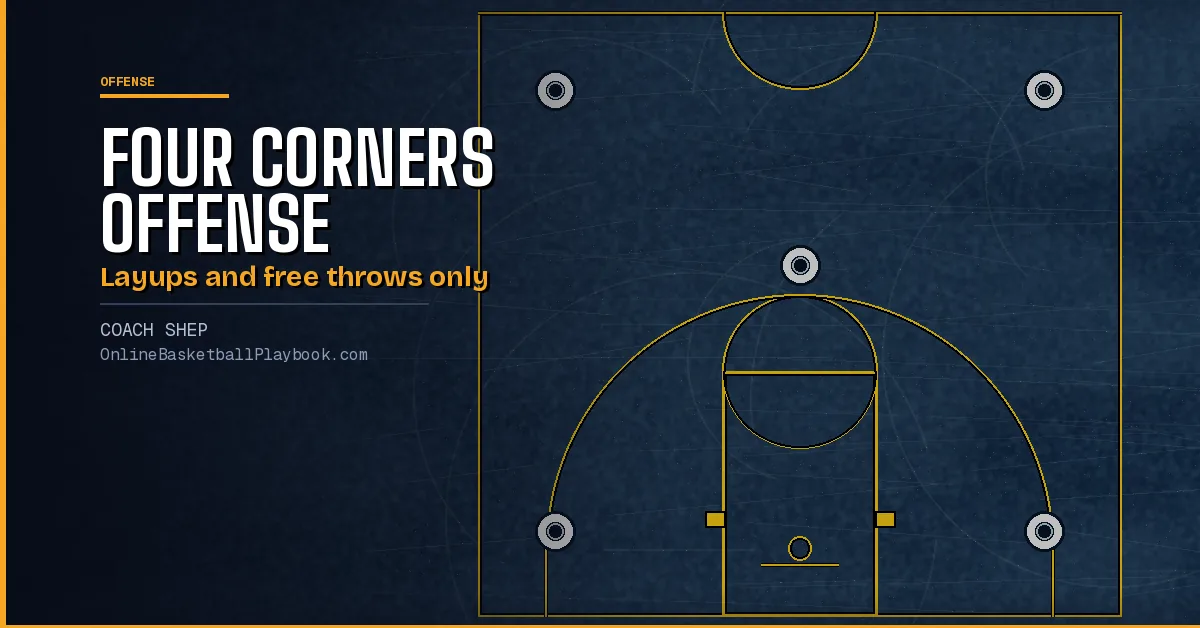
The four corners offense in basketball spreads four players a few feet inside the four corners of the half court and leaves one player, the chaser, in the middle to play one on one. It is a delay offense: it runs clock, protects a lead and pulls a zone out of its shell. With an attacking chaser it also produces high-percentage shots, and the offense hunts only two of them, layups and free throws.
Dean Smith made it famous at North Carolina. This four corners offense basketball guide covers the set, each role, the rules for the chaser, the wing and the post, when coaches run it, the late-game situations it answers and how the shot clock at each level limits it. It sits with the other systems in the offense section, and the wider family of clock-control offenses is on basketball delay game offense.
Where the Four Corners Came From
John McLendon is credited with inventing it, with his work placed anywhere from the 1940s and 50s to the mid 1950s. Dean Smith made it famous at North Carolina. It has been called the main reason the NCAA added a shot clock in 1985, and also a North Carolina trademark and probably the most recognizable of all the spread offenses.
The purpose is plain: reduce the opponent's number of possessions and its chance to get back into the game. It is a clock-control tool first.
The Four Corners Offense Basketball Set
Four players hold the four corners of the frontcourt. Put them about 6 feet off the sideline and the half-court line. The two near half court are guards or wings, the two along the baseline are posts. The point guard is the chaser, the only player free to dribble and cut through the middle. With every teammate spread to a corner, help is a long way off and the chaser can attack his defender one on one.

The team gets into it on a four-finger signal: the posts go to the baseline corners and the wings go to the half-court corners. Hold the spacing and the chaser has room to work.
The Three Roles
- The chaser. The best ball handler and decision maker, usually the point guard. He dominates the ball.
- The guards in the half-court corners. They space the floor and take the outlet when the chaser is doubled, and then they become the chaser.
- The posts in the baseline corners. They space, finish cuts and rebound. Want them able to shoot, so their defenders have to stay close.
The rules that follow share the shape and the chaser, and they differ in what the corners do. Know your one job and do it every trip.
The Chaser's Four Options
The chaser attacks toward the free-throw line while the posts take a few steps up the sidelines. Stepping up improves the passing angle, pulls their defenders up and sets up the back cut. From the middle the chaser has four options:
- Attack. Drive his man.
- Pass to a guard. Then relocate to the middle so the guard can attack the closeout, and curl opposite to refill a corner.
- Pass to a post. A pressure release and a reset, a back cut for a layup when the post's defender follows him up the sideline, or a one-on-one for an agile post or against a defender in foul trouble.
- Retreat. Dribble back toward half court and start again.

Read the defender first, then choose the option.
The Carolina Isolation
Dean Smith's four corners is a continuity built on the return pass.
- Drive. When the chaser gets a return pass from a half-court corner player, he dribble-penetrates to the basket.
- Kick out. If his defender stops the drive, he passes to the other half-court corner player and gets open for a return pass, or passes to either baseline corner player stepping out.
- Baseline action. Any time the pass to a baseline corner player stepping out is overplayed, that player back cuts to the basket for a feed from the chaser. A corner player who catches can also pass the ball on to the far corner player as he cuts to the rim. If the baseline player's defender sags off to help on the drive, he back cuts for a drop pass instead.
- Exchange. If the chaser's defender denies the return pass, the corner player with the ball exchanges places with him and starts the dribble penetration himself. The same exchange runs on the other side, so the isolation stays alive when the main ball handler cannot get the ball back.


More on reading the overplay is on cutting in basketball. Rep the return pass until the chaser expects it every trip.
Get the next coaching guide in your inbox
One email when a new guide or diagram set goes up. Free.
Chaser, Wing and Post Rules
The rules split by spot.
Chaser rules.
- Penetrate, then pass. Dribble-penetrate the middle, but pass before the double team arrives.
- Cut for the return. Cut hard to get the ball right back.
- Beat the denial. If the return pass is denied, either basket-cut or replace a corner player.
- Set up the layup. As a scoring wrinkle, the chaser penetrates to the circle and pops back out to a corner a couple of times to set up the defense, then on a later trip drives all the way for the layup once the defense starts overplaying the pass back.
Wing rules.
- Stay spaced. Stay about 6 feet off the sideline and the half-court line.
- Hold, then pass back. Hold the ball until challenged, then pass back to the chaser.
- Become the chaser. If the return pass is denied, dribble in and become the new chaser while the old chaser fills the empty corner.
Post rules.
- Flash to the block. When the ball goes to a baseline corner, the weak-side post flashes to the ball-side low block.
- Cut when his man leaves. If his own defender leaves to trap the chaser, the post cuts to the basket.
- Lift to bail him out. If a teammate is stuck with the ball, the post lifts to the wing to bail him out.
- Back cut the denial. If that lift pass is denied, the post back cuts.

Passing. Every pass must be crisp, accurate and high percentage, never thrown across the court into traffic, where a steal turns into a layup at the other end. A pass fake one way opens the lane the other way. Know the rule for your spot and play it every trip.
When Coaches Run It
Coaches run it in five situations:
- Run the clock.
- Stop the other team's run.
- Pull a team out of its zone.
- Protect players in foul trouble.
- Shorten the game against a more talented team.
The delay also pulls a zone out. A defense sitting in a 2-3 can be forced out of it and into man-to-man once it has to come out and guard the ball. Zone answers in a regular half court are on how to beat a zone defense. Pick the situation before the game and tell the team.
Late-Game Situations
Split the delay into three situations, each with its own risk:
| Situation | What the offense does |
|---|---|
| A small lead, under a minute left | Only an uncontested layup or free throws. Take the good layup instead of risking a live-ball turnover to hold the ball longer. |
| The last shot of a quarter | Move into the offense at about the 10-second mark and get a shot up around 4 to 5 seconds left, which leaves time for a putback but not for a full-court answer |
| A bigger lead earlier (the soft delay) | For example up 8 with 5 to 6 minutes left: run time off the clock but still look for a good shot, short of a full delay |
Avoid the common last-shot error of waiting too long and settling for a forced shot.
Dean Smith's own late-game habit, with the ball, the score tied and no shot clock, was to start the offense with about eight seconds left, which leaves room for one offensive rebound. He usually did not call a timeout, because his team had practiced it and a stoppage lets the other coach set his defense and make substitutions.
Two kinds of holding differ. A delay game runs 45 seconds to a minute before a shot and a freeze game takes layups and free throws only. Not every coach holds the ball with a lead: a keep-attacking approach keeps the clock running but keeps cutting to the rim, and forms a 2-1-2 against a trap. The full late-game picture is on basketball clock management and basketball late game situations. Decide the late-game plan in practice, not in the huddle.
The Shot Clock by Level
A shot clock caps how long any delay can last. Against a shot clock, the four corners can only be run for part of the possession before the offense has to shoot. The lengths:
| Level | Shot clock |
|---|---|
| NFHS (high school) | A 35-second clock by state adoption (NCAA/NFHS major rules differences, 2025-26). Check your state association. |
| NCAA men | 30 seconds (NCAA/NFHS major rules differences, 2025-26) |
| NCAA women | 30 seconds, same as NCAA men (same document) |
| NBA | 24 seconds (Rule 7, Sec. I) |
| FIBA | 24 seconds (Art. 29.1.1) |
The rules themselves are on basketball shot clock rules and high school shot clock. Know your level's clock before you plan the delay.
Youth Teams and Other Delay Offenses
Do not run the four corners with youth teams as a primary offense. It is boring and poor for development, so use it only as a delay in the last minutes.
Coaches who want a delay without the corners have other shapes on record.
- Spread five out. A 5-out spread delay repeats an L-cut and rotation pattern, with back cuts and back screens built in so the defense still gets punished for gambling, and it treats the three as the wrong shot late in a delay.
- Run the High-Flex. A High-Flex delay is listed as an alternate for teams that already run the flex.
More on the flex is on how to coach the flex offense, and other spread looks are on five man open post offense. Whatever shape you choose, rep it until it is automatic.
Want the printable playbook packs?
OBP Pro members get the premium playbook packs: the zone attack, out of bounds and practice plan PDFs, plus each new pack as it is finished. The membership page lists what is in each one. Or draw your own version free in PlayDraw.
See what OBP Pro includesQuestions Coaches Ask
What is the four corners offense in basketball?
A delay offense with four players near the corners of the half court and a chaser in the middle who plays one on one, passes out of help and gets the ball back. It runs clock and looks only for layups and free throws.
Who invented the four corners offense?
John McLendon is credited with inventing it and Dean Smith with making it famous at North Carolina.
Is the four corners offense still used?
A shot clock limits it to part of a possession. The NCAA uses 30 seconds, the NBA and FIBA 24, and high school states may adopt 35.
Why was the four corners offense banned?
It was not banned. It has been called the main reason the NCAA added a shot clock in 1985, which limits how long any team can hold the ball.
Should youth teams run the four corners?
No. It is boring, it does little for player development, and at most it belongs in the last minutes as a delay.
More Guides From This Batch
- How to Beat Man to Man Defense in Basketball: Reads and Drills
- Baseline Out of Bounds Plays: Sets vs Man, Zone and for Youth
- High Low Offense Basketball: Reads, Counters and Zone Rules
- Princeton Offense Drills: Breakdowns, Shooting and Live Reps
Back to Offense and every Offense page.
Keep Building
Related breakdowns
Game Plan Against a Press Defense: Scout, Roles and Rules
Build a game plan against a press defense: scout the press, assign every role, set the rules, plan your timeouts and turn a broken press into a fast break.
Spread Offense Basketball: Alignments, Rules and Versions
Spread offense basketball explained: the spread pick and roll, its alignments and spacing rules, the screener and handler reads, a no-post spread and a spread delay.
High Low Offense Basketball: Reads, Counters and Zone Rules
High low offense basketball explained: the two-post shell, the lob and bounce reads, answers to a front, down-screen reads, 1-4 low sets and the hi-lo against zones.