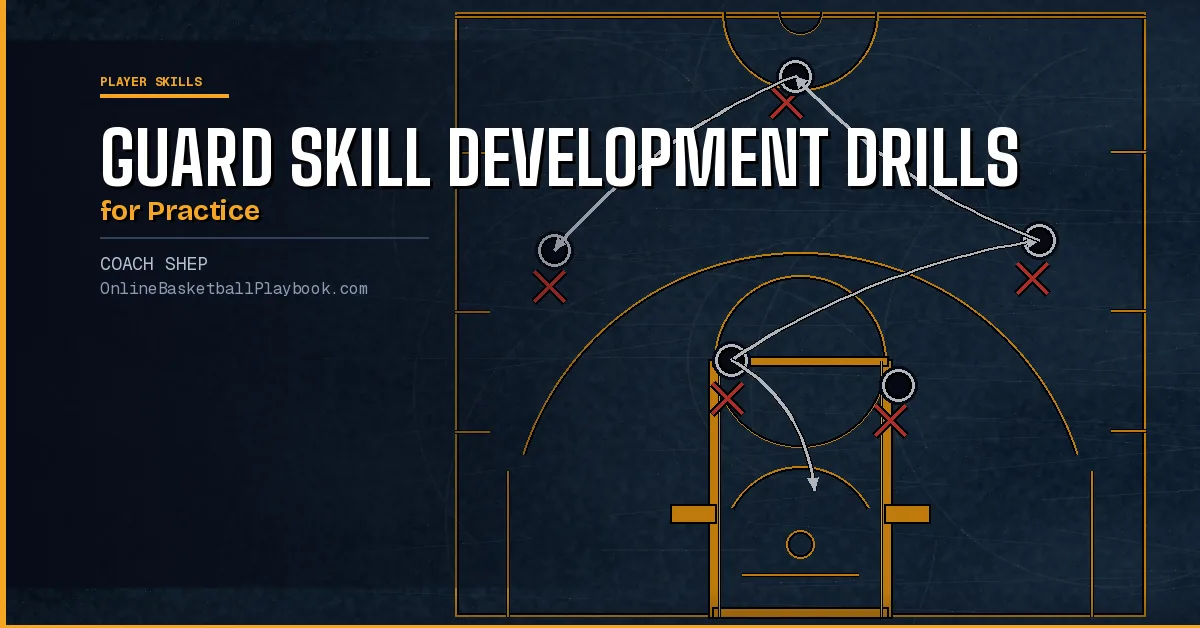
Great guards are built in practice, one rep at a time. These drills cover ball-handling, footwork, shooting under fatigue, and screen reads. Everything your guards need to make better decisions when the game speeds up.
Balance: The Organizing Skill Every Guard Needs
Most guard workouts start with the ball. The best ones start with the feet. Balance is the skill that makes every other guard skill possible, and it's the one coaches most often skip in the name of getting more reps.
Every rep in a guard workout should start from perfect balance: eyes up, feet shoulder-width apart, weight centered over the balls of the feet. And every move should return to that same balanced position. The challenge is not the footwork itself. It's recovering perfect balance after something difficult happens.
That's the actual drill. You force your guard off balance (with a step-off, a separation dribble, a 90-degree spin, a 180, a 360 reverse) and then require them to recover to perfect shooting position with eyes up. Do that for a season, and the "crazy" shots that show up in games (floaters, fades, pull-ups off screens) stop being crazy. They become natural because the player has practiced recovering balance from awkward positions hundreds of times.
The cue that sticks: the same distance between the feet on recovery, every single time. Guards who vary their stance width on the catch are inconsistent shooters. Guards who recover to the same stance every time build transferable muscle memory. Run your entire guard workout through this lens (balance challenge, then balance recovery) and the individual drills will compound on each other instead of staying isolated.
Ball-Handling Drills That Free the Mind
The goal of ball-handling work is not to make a guard look impressive with the ball. The goal is to make the ball irrelevant, so automatic that the guard's full mental bandwidth goes to reading the defense rather than managing the dribble.
"The more you dribble in practice, the less you dribble in the game." That is the principle behind every ball-handling drill worth running. A guard who has to think about the dribble will always be one step slow on reads.
Two-Ball Drills
Two-ball handling is the most efficient path to that automaticity. Eyes must stay up because the hands are too busy to watch. Start stationary: together (both balls hit simultaneously), alternate (one up, one down), shoulder height, crossover, push-pull. Then move to half court, changing moves at each jump stop without stopping the dribble. The non-stationary constraint forces the guard to manage rhythm changes while in motion, exactly what happens off a live ball screen.
Add a two-dribble-crossover-pass station and hot-potato passing to round out the session. These train the guard to make quick decisions under pressure without looking down.
Change-of-Angle Dribble
The change-of-angle dribble is underused at the high school level. Think of it as parallel-parking in reverse: the guard stops, fakes, goes backward, and opens a driving lane that was closed. Run this against a passive defender first, then live. The skill itself is simple. The read (when to use it) takes reps with a body in the way.
1-on-3 Full-Court Ball-Handling
The 1-on-3 full-court pressure drill builds the confidence to handle against multiple defenders in succession. One handler, three defenders each covering a third of the floor. The handler must beat all three in one trip. This drill builds the composure under pressure that no stationary dribbling drill can replicate, and it teaches guards to read the next defender while finishing the current one.
Footwork Fundamentals: The Mechanics Layer
Every move in a guard's arsenal sits on top of footwork. Get the footwork wrong and the move won't work, even if the player is athletic and the read is correct. These are the foundational mechanics that apply across all guard drills.
Triple Threat and the Catch
The moment of the catch is where most guard footwork errors happen. Two situations and two rules:
If the guard is catching with their back to the basket (coming off a curl, popping out, receiving a wing entry) and expects to shoot, they front-pivot off the inside heel. That inside foot (closest to the basket at the moment of the catch) is the pivot. The heel drives down to stop the cut momentum; the free foot swings to square up. If the guard does not expect to shoot immediately, they reverse pivot off the outside foot instead, keeping options open for a drive or a pass.
If the guard is already facing the basket (off a flare screen, in transition), the same inside-heel front pivot applies, just with a shorter swing of the free foot. The rule is consistent. Inside heel controls the pivot on every catch where a shot might follow.
Pre-catch preparation matters too. The inside shoulder should angle toward the basket before the ball arrives, with the guide hand already in position. This small habit gives the passer a target and shaves a half-beat off the catch-and-shoot sequence, enough to matter at the top level.
The Pull-Up Footwork Sequence
The pull-up jumper footwork follows the same inside-heel rule, making it easier to teach than most coaches realize. The last dribble before the shot is the lowest and hardest dribble. It generates the energy to jump. The inside heel drives into the floor at the exact instant that last dribble hits the floor. That synchronized moment stops lateral drift and squares the shoulders. The free foot swings around to complete the stance. The guard rises straight up and lands in the same spot.
The one-line cue: "Your last dribble down, your inside heel down, same instant." Run this drill in a circle with no basket needed: 7 stations, the whole squad working simultaneously. No shooting required to groove the footwork.
First Step: Blast vs. Front Crossover Drive
Two named attacking moves from the triple threat. The blast move is used when the defender's lead foot matches the guard's free foot. The guard steps almost directly at that lead foot ("step north, not east"), scrapes off the defender's shoulder, and cuts off their recovery angle. Stepping laterally gives the defender space to recover; stepping into them takes it away.
The front crossover drive applies when the defender's lead foot is on the guard's pivot side. Rip the ball low and hard across the shoe tops, front-pivot the free leg across the body, and start the dribble as the foot lands. Both moves use the same rip mechanic. Guards who drill this connection learn two attacking options from a single footwork foundation.
The Named-Move Library as a Teaching Framework
One of the most practical guard development tools is also one of the cheapest: name every move after a player. Not as decoration, but as a teaching system. The name does three jobs simultaneously: it credits a player whose film the guard can study, it gives the coach a one-word cue instead of a two-sentence description during practice, and it gives the guard a vocabulary for self-correction when no coach is present.
The Core Named Moves
The Nash hesitation: knee up, read, pull-up or pull-back dribble-pump-fake. The pull-back is the hesitation's escape valve. The move most programs never name, which means their guards never use it consistently. Name it, and guards will reach for it.
Manu Ginóbili's body fake: shoulders fake, ball stays in front, hands switch. Explicitly not a crossover. The ball never goes wide, which preserves the live dribble and the shot fake at the same time. Underused at the high school level because it isn't flashy. It works because defenders react to shoulders, not the ball.
Tony Parker's "never expose yourself": if the defender goes under the screen, stop right behind it and shoot. The screen itself is the advantage. Guards who keep running past a free pull-up are training the wrong read. Name the move, post a Parker clip, and the read sticks.
The Al-cut: a body-positioning seal-cut where the guard makes contact, seals, receives the pass, and rips through. Name it in your program so players have vocabulary for the action. Without a name, guards can execute it once and forget to file it away.
How to Install a Named-Move Library
Introduce one named move per week in pre-season workouts. Post a player clip on your team film account for that week's move. Keep a running list on the whiteboard or in the locker room. By the time the season starts, your guards have a vocabulary they built themselves, and a coach can call "Parker read" at halftime and every guard in the huddle knows exactly what that means.
Shooting on Tired Legs: The All-Game-Shots Circuit
The biggest gap in most guard shooting workouts is that the shots are taken fresh. Real shooting percentage is shot on tired legs, off real actions, with a defender recovering. The all-game-shots circuit is built to close that gap.
The circuit runs 9 to 10 stations off real game actions: elbow catch-and-shoot off the dribble, handoff, side pick-and-roll into the lane, pull-up off a hesitation, corner three off a kick. Each station ends with a team "make 11" target. Every player at that station must collectively make 11 before rotating. That target builds conditioning into the skill work without adding a separate running segment.
The circuit finishes with 5-spot shooting on tired legs, with one spot at each standard shooting position around the arc and mid-range. The percentage recorded here is the real number. Not a fresh-legs number, not a confidence number, but the number that reflects what will happen in the fourth quarter of a close game. Track it across the season and guards will take their conditioning seriously because they can see it affecting their shot quality directly.
The Florida Guard Shooting Arc
The Florida approach adds a full-court progression built into each shooting drill rather than treating conditioning and skill as separate. Full-court guard shooting runs from 3 angles: the guard pushes the ball, executes a move at a coach stationed above the three-point line, then finishes with a layup or pull-up. Different moves rotate each sequence: hesitation, inside-out, cross-reverse layup.
Sprint-and-catches simulate transition at game speed: start behind half court, push ball, execute a dribble move at a coach on the wing, one-push layup. The next player goes as soon as the previous player shoots. Continuous, no dead time. This is the design principle that separates Florida's approach: every drill has a progression built in, from form-work to live defensive pressure, inside the same session.
Screen Reads and Constraint Games Under Pressure
Individual skill work builds tools. Screen-read drills decide whether guards can use those tools when it counts. The transition from skill to decision happens in live repetitions with a defender present, not in chalk-talk, and not in form shooting.
The Get Open Drill
The foundational off-screen read: if the defender goes over the top, the guard fades to the corner. If the defender goes under, the guard curls. Run this 2v2 before teaching the move's name or technique. Guards who feel the read before they hear it memorize it at a deeper level than guards who learn it verbally first. The drill makes the decision automatic; the name locks it in afterward.
The Combination Screen Drill
Guards who only train one screen type in a workout are not ready for game sequences. The Combination Screen Drill chains four screen types in a single possession (pindown, UCLA screen, back screen, ball screen) before going live 3v3. Guards see all four screen types. Defenders practice all four coverages. One drill delivers four teaching reps in the time it would take to run one isolated screen drill.
Constraint Games That Teach Shot Diet
Constraint games are among the most efficient teaching tools in guard development because the scoring system does the coaching. The No Paint Drill scores 1 point for two feet in the paint and 2 points for penetrating to the charge circle. No shots taken, no free throws. The scoring system drives guards to attack the rim without a coach repeating the same instruction. The Paint Game uses similar logic for closeout-and-gap skill. Guards who play these games learn shot diet without a lecture, and the learning is durable because they discovered it through competition.
Putting It Together: Sample Practice Structure
A 45-minute guard skill session built around these principles might look like this:
Minutes 1–8: Balance and footwork foundation. Offensive Pivoting and Passing Breakdown Drill: 6 minutes, all players working simultaneously on jump stop, step-out, rip-through, and shooting footwork. No basket needed. Rotate through inside-heel pull-up cue to close out. This is the "mechanics layer" that makes the rest of the workout build correctly.
Minutes 9–20: Ball-handling battery. Two-ball stationary (together, alternate, shoulder, crossover, push-pull), then moving to half court. Change-of-angle dribble against a passive defender. 1-on-3 full-court pressure runs. This is the cognitive load portion. Guards need mental space, so save competition for later.
Minutes 21–30: Named-move work. Introduce or reinforce the week's move. Passive defender first, then a live closeout. Require the guard to name the read out loud before executing. This closes the gap between doing the move and understanding when to use it.
Minutes 31–45: All-game-shots circuit on tired legs. Four stations of 3 minutes each, team "make 11" at each station. Close with 5-spot shooting. Record the percentage. Post it. Let guards see their own data across the season.
Introduce the named-move library one move per week in pre-season. Post a player clip of each move to your team film account. By tip-off of your first game, your guards will have a shared vocabulary of 8 to 10 named moves, and you can communicate reads in one word at halftime instead of drawing diagrams on the whiteboard while the clock runs down.
- Challenge balance first. Every drill starts from perfect stance and returns to it after a move. Same foot width on every recovery.
- Run two-ball handling with eyes up only. If a guard looks down, restart the rep. The mental load is the whole point.
- Use the inside-heel cue on every pull-up: last dribble down and inside heel down must land at the same moment. Practice it in a circle drill before adding a basket.
- Name one move per week and post a player film clip to go with it; by season start your guards have a shared vocabulary that replaces two-sentence coaching cues
- End every individual workout with 5-spot shooting on tired legs and record the percentage. Track it across the season so guards see the direct connection between conditioning and shooting quality.
- Run the Get Open Drill 2v2 before teaching the screen-read verbally. Guards who feel the correct read before hearing it memorize it faster and apply it under pressure more reliably.
Want more basketball coaching strategies, drills, and tools?
Join the Online Basketball Playbook newsletter →
Draw this play free in the play drawer →
Membership: the full library, playbook packs, and Pro drawing tools →
Keep Building
Related breakdowns
Small Sided Games for Skill Development: Formats and Rules
Small sided games for skill development: why fewer players teach more, how to shape a game with one rule, scoring both ends, and four formats to run.
Fun Basketball Games for Practice: Scored Games for Any Team
Fun basketball games for practice at any level: shooting games, defense-only scoring, rebounding contests and passing games, with scoring rules and records.
Basketball Conditioning Drills for Teams: Runs, Games and Tests
Basketball conditioning drills in three styles, timed runs, conditioning inside skill drills and scored games, with the tests and yearly plans coaches use.