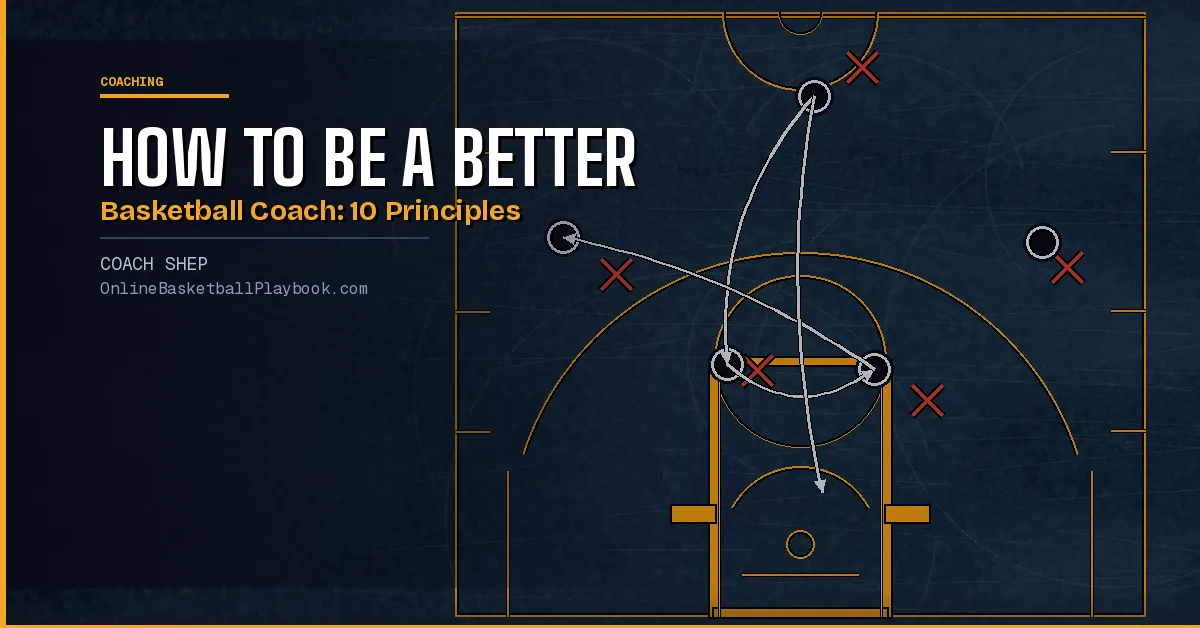
Great coaching is not about running clever plays. It is about teaching players to read the game, move with purpose, and compete as a unit. These ten principles will sharpen your practice planning and your players' development.
1. Teach the Game, Not Plays
The single biggest mistake youth and high school coaches make is spending practice time loading players up with sets and plays rather than teaching them how to read a defense. When players know only plays, the moment a substitute enters the game or a defense switches looks, the whole system collapses. When players understand basketball principles (spacing, timing, reading the defender) they can improvise within any system.
The motion offense tradition, grounded in coaches from Ettore Messina to Bill McKillop, makes this distinction explicit: the offense is designed to be unscoutable because options emerge from what the defense gives, not from what a coach calls. "Learn to play, not run plays" is the single most useful phrase a coach can put on a practice whiteboard.
This does not mean playing without structure. It means the structure is built from rules and reads, not from memorized sequences. Give your players three or four non-negotiable rules (pass and cut, catch and face the basket, never stand), and they will out-execute a team with twenty memorized plays every time, because their decisions are automatic and the reads are real.
2. Pass and Move, Every Time
Passing and then standing is the most common and most costly mistake in basketball at every level below the NBA. When a player releases the ball and freezes, two things happen: the defense relaxes, and the offense loses a potential cutter, screener, and scoring threat. Every possession that features a player watching the ball from a stationary position is a possession where the defense has a free helper.
The corrective is simple to state and hard to install. After every pass, the passer must choose: basket cut, set a screen, or receive a screen. Those are the three options. Standing is not one of them. Coaches who track this in film sessions and call it out consistently will see the habit form inside four to six weeks.
The best coaches make "never pass and stand" a rule with teeth, not a reminder whispered during timeout. Rick Majerus required economy of motion: every movement had a purpose, and standing wasted the defense's assignment. When players internalize this, the offense moves faster, defenses scramble, and open shots appear without a single set play being called.
3. Spacing Is Constant Work
Spacing is not a formation you arrange at the start of a possession and then forget. It is active, continuous work. Players must maintain fifteen to eighteen feet between each other throughout the entire possession, adjusting as the ball moves, as cuts happen, and as screens are set. The moment spacing collapses, help defense becomes easy, drives stall, and skip passes stop finding open shooters.
A useful coaching cue: "Fill the five spots." In a five-out alignment, every perimeter position must be occupied unless a player is actively cutting through or setting a screen. The moment a cut clears, another player fills. The moment a screen is set, the screener relocates. This discipline is what separates an offense that reads like a clinic from one that looks like organized chaos.
Spacing is also what makes every other principle on this list work. A cutter has nowhere to attack if the lane is congested. A ball-handler has no outlet if teammates have drifted together. A shooter on the weak side cannot get open if there is no threat from the opposite corner. Coaches who obsess over spacing (who stop practice, reset the floor, and drill it in 5-on-0 before adding defense) build offenses that are genuinely difficult to guard.
4. Install Your Offense by Progression
One of the most common coaching errors is teaching too many options too soon. Players who have not yet mastered the base rhythm of an offense cannot effectively execute the second or third action. They hesitate, they look confused, and the offense slows to the pace of the slowest decision-maker on the floor.
The correct sequence is: install one option, master it, then add the next. This is the install discipline that runs through every great motion system, from Princeton reads to Bill McKillop's Davidson continuity to the most complex dribble-drive packages. Start with pass-and-cut in 5-on-0. Add the first screening action only after players are moving automatically on every pass. Layer secondary reads only when the first is reflex, not thought.
Practically, this means your early-season practice plan should be narrower than you think. Resist the pressure to show your players everything you know. Show them one thing, drill it until it is muscle memory, then introduce the next layer. Teams that build this way are almost always more dangerous in March than teams that learned ten plays in October and run none of them cleanly.
5. Name Your Actions
Free motion is rules-based, but players need language. When a recurring action (a post screen away, a flare screen, a backdoor cut, a rip move) has a name, players can communicate it in real time. A screener who calls "curl!" before setting the screen has already told the cutter what the defense is doing. A guard who sees "flare" and knows exactly where the ball will be has a half-second advantage on his defender.
Naming actions does not make the offense scripted. It makes the reads coachable and the communication fast. You are giving players a shared vocabulary for the reads they are already making. The first time you name a "Post Screen Away" in practice, players will look at you blankly. The fifth time, they will call it themselves. By mid-season, it will be their language, not yours.
Start with the actions your offense uses most. If you run five-out motion, name the basket cut, the flare, the back screen, and the ball reversal trigger. Add names to things players are already doing instinctively. The effect is immediate: practice communication tightens, confusion disappears at critical moments, and the team feels like a unit instead of five individuals operating near each other.
Introduce action names the first time you teach each movement, not as a separate vocabulary lesson at the end of the week. When the word and the movement are learned together, the label sticks immediately and players can use it under game-speed pressure without any extra mental load.
6. Ball Movement Beats Player Movement
Ettore Messina, one of the most decorated coaches in European basketball history, built his offensive philosophy on a single foundational principle: five players standing still but passing quickly will beat five players constantly moving with one player always holding the ball. The ball moves faster than any defender can run. A quick, decisive pass finds a late defender in a fraction of a second. No screen required.
This does not mean standing is acceptable. Off-ball movement matters enormously. But the priority order is worth stating explicitly: if the choice is between a slow, dribble-heavy possession with lots of player movement and a crisp, ball-moving possession with disciplined spacing and purpose, the second wins. Players who hold the ball (who dribble in place, who pump-fake without shooting, who wait for the play to develop) surrender all initiative to the defense.
The coaching correction here targets the dribble. In a read-based system, the dribble has one primary purpose: penetration. Non-penetration dribbling should improve a passing angle only, and it should take no more than two bounces. Coaches who enforce this standard (who stop practice when a player makes three dribbles to fix their position) will see ball velocity increase, defensive rotations lag, and open threes appear at a noticeably higher rate within a few weeks.
7. Read Before You React
The instant a player catches the basketball, that player is at maximum danger to the defense. The defender has committed to a position, the helper has oriented toward where the ball was coming from, and the offensive player has an open window. What most players do in that moment is waste the advantage: they put the ball on the floor without looking, they pick up their dribble, or they drift into a difficult two-dribble pull-up instead of attacking what the defense has given them.
Svetislav Obradovic, who has won more EuroLeague titles than any other coach in history, teaches this with a three-step sequence: fake first, look at the basket, then read. On every catch. Not just when you plan to shoot. The fake creates a micro-reaction from the defender. Looking at the rim forces the defender to honor the threat. Then, and only then, you read what has been given to you. This sequence takes under one second, and it converts casual catches into live scoring opportunities dozens of times per game.
The same discipline applies off the ball. Obradovic's practice design includes no-dribble passing games run 5-on-5 at game speed, specifically to force players to read their defenders before cutting. The off-ball player cuts only when the on-ball defender turns his head. Never before. Coaches who build this read-first discipline into their daily practice structure will find that their players' decisions improve without any additional play-calling. The reads become automatic because the habit of looking first is automatic.
8. Build the Culture of Film
Practice is where habits are built. Film is where habits are seen. Coaches who do not watch film with their players regularly are missing the single most powerful feedback loop available to them. A player can hear "you stood on that pass" twenty times in practice and never fully believe it. The moment they see themselves standing on a clip screen while their teammate's curl cut goes completely unguarded, the behavior changes in a way no verbal correction can match.
Effective film sessions are not punishments and they are not passive. Players should know which specific behaviors you are grading before the film begins. Standing after a pass. Dribbling without purpose. Failure to read the backdoor when a defender turns his head. Arriving late to a spacing spot. When players know the standard in advance, they watch their own clips differently. They are looking for a specific mistake rather than waiting to be told what is wrong.
Keep film sessions short and targeted. Thirty minutes of focused, specific clips is more valuable than ninety minutes of full-game review where attention drifts after the first twenty. The standard you show on film is the standard your team will hold each other to on the floor. If you cut clips of every standing violation and play them without editorializing, players will start calling out standing in warm-ups. That is culture building, and film is the lever.
9. Compete in Every Drill
Drills that have no competitive stakes produce players who are comfortable being competent but never push past their current ceiling. A player who runs a cutting drill at seventy percent effort because there is no consequence for a lazy V-cut will bring that same seventy percent to a game situation when the stakes are highest and the margin is smallest.
Every drill in practice should have a defined winner, a defined standard, or a consequence for falling short. This does not require elaborate scorekeeping. It can be as simple as: the offensive player must score within two reads or it counts as a stop, the defensive player who gets beat on a backdoor runs a sprint, the team that gives up three consecutive stops in a shell drill stays in on the next water break. The specifics matter less than the presence of real stakes.
Competitive drills also reveal character. You will learn more about which players raise their effort under pressure in one week of competitive practice than in a month of unchallenged skill work. Those observations (who competes when it costs something, who folds, who elevates teammates) are the data you need for late-game lineup decisions, for identifying captains, and for targeting the individual development conversations that actually move players forward.
10. Coach the Standard Relentlessly
A coaching standard is only real if it is enforced every time, not most of the time. A standard enforced eighty percent of the time is not a standard. It is a preference, and players will feel the twenty percent and use it as the ceiling of what they must actually deliver. The coaches who build winning cultures are the ones who call the same violation in the first practice of November and the last possession of a playoff game, without variance and without exception.
Relentless standard-holding is not the same as constant criticism. The best coaches enforce the standard and move on immediately. A player stands after a pass. Coach names it clearly, practice continues. No lecture, no tone, no emotional weight. The enforcement is what matters. Players who work for coaches with an absolute standard quickly stop making the avoidable mistakes, because the standard becomes their own internal voice before the correction can come from outside.
This principle is what separates coaches who have a philosophy from coaches who have results. Philosophy is knowing that ball movement beats player movement, that spacing is constant work, that motion teaches kids to play instead of run plays. Results come from enforcing those ideas every single day, in every single drill, through every single game, not because you want to win badly enough, but because you respect your players enough to hold them to what they are capable of. That is the standard. Coach it relentlessly.
- Track standing after passes as an error in film. Name it, clip it, and show it so players self-correct before you have to say it twice.
- Run 5-on-0 passing-game drills daily at the start of practice to ingrain pass-and-move rhythm before adding defensive pressure.
- Name every recurring action in your system the first time you teach it (basket cut, flare, back screen, ball reversal) so players communicate reads in real time during live play.
- Enforce the dribble rule: penetration only, maximum two non-penetration dribbles to improve a passing angle, stop and correct immediately when violated.
- Layer options one at a time. Master the first before introducing the second, no matter how slow the install feels in early October.
- Build every drill with a competitive stake (a winner, a standard, or a consequence) so game-speed decision-making is practiced every day, not just in scrimmages.
Want more basketball coaching strategies, drills, and tools?
Join the Online Basketball Playbook newsletter →
Draw this play free in the play drawer →
Membership: the full library, playbook packs, and Pro drawing tools →
Keep Building
Related breakdowns
Pat Summitt's Definite Dozen: The 12 Principles Explained
Pat Summitt's Definite Dozen: all 12 principles in order, plus the Tennessee identity, practice rules, game goals, offense and defense that sat beside them.
European Basketball Principles American Coaches Should Steal
European Basketball Principles American Coaches Should Steal
How to Become a Basketball Coach: Paths, First Jobs and Steps
How to become a basketball coach: where coaches start, youth, school, club and college paths, entry jobs, coaching education, networks and mentors.