
Shooting is the most trainable skill in basketball. With the right form, competitive repetitions, and a structured approach to practice, any player can become a reliable shooter at their level.
Build Form Before You Chase Volume
The single most common mistake players make when trying to shoot better in basketball is skipping straight to volume. They pound up hundreds of shots before the mechanics are solid — and they groove bad habits at scale. The correct sequence is form first, reps second.
The foundational cue used from youth coaches all the way up to college programs is the "pizza waiter" setup: the shooting hand sits under the ball as if balancing a pizza tray. The elbow stays under the hand, the elbow stays over the shooting knee, and the follow-through finishes high — fingers hanging down toward the rim like you're reaching into a cookie jar. Jay Wright at Villanova opens every practice with Set Lifts: elbow under the ball, lift straight up, hold the follow-through until the ball lands. No jumping yet. Just clean mechanics under zero pressure.
The progression looks like this:
- Form work without the ball — establish the motion pattern
- Shooting against a wall — confirm hand position and wrist snap in a controlled setting
- Close-range one-handed form shots — watch the ball flight, confirm backspin
- Two-handed shot from short range — integrate the guide hand without letting it interfere
- Move back to normal range only after the short-range form is clean
Jay Hernandez's "Quarters" drill follows this exact logic at the pro level: every workout starts with one-handed form shots and works outward only after the ball is tracking straight. College coaches at Michigan under John Beilein held players to a timed standard — 7 makes out of 10 shots in 30 seconds coming off a down screen and flare — before trusting that the form could hold up in movement situations. The standard was non-negotiable. If the group failed, they ran.
The lesson: don't move on until the close-range form is automatic. High volume of bad reps does not build a shooter. It builds a player with a permanent flaw they have to unlearn later.
Make Every Rep Competitive
Shooting workouts without a score are not shooting workouts. They are catch-and-toss sessions that feel productive but train almost nothing. Every rep needs a result — make or miss — tied to a standard that can be beaten, recorded, and chased.
The Purdue Drill is a clean example: a rebounder and a passer, 60 seconds on the clock, the shooter sprinting baseline to half-court between every shot. The goal is four made threes in a minute. For every point below four, the shooter runs. The scored consequence is what separates this from ordinary shooting. It creates the same elevated heart rate, the same decision urgency, and the same accountability as a real game situation.
Shaka Smart's Texas drill library is built entirely on this principle. Named drills — 3-Minute, Evans, Beat the Pro — come with team records posted publicly. "3-Minute" had a team record of 157. Every player who walked into that gym knew the number and knew they were either chasing it or defending it. That public record board is the mechanism that converts a shooting drill into a competitive ritual.
The standard framework for competitive shooting:
- Set a make target before the drill starts — not "shoot around" but "make 6 in 30 seconds"
- Add a consequence for falling short — a sprint, extra reps, or a teammate's consequence
- Record the result every time — same drill, same standard, tracked over weeks
- Add movement between shots so players never shoot twice from the same spot cold
Shaka Smart's "can't shoot the same spot twice" rule captures this perfectly. Movement is what makes a drill real. A player who only practices stationary catch-and-shoot is training a shot that rarely appears in games at any meaningful level past junior high.
Diagnose and Fix Your Shot Errors
Most players who want to shoot better in basketball have a specific, repeatable error — a short shot, a flat arc, a consistent miss to the right. Dr. Hal Wissel, one of the most widely cited shooting experts at the international coaching level, built an error-to-cause-to-correction diagnostic system for exactly this reason. Rather than repeating a generic cue like "bend your knees," coaches should identify the mechanical root cause first and prescribe the right drill.
Here are the most common errors and their actual causes:
Short Shot
The ball leaves the hand before the arm reaches full extension. The fix is a high-extension finish: hold the follow-through with the arm fully extended, fingers pointing down at the rim, until the ball lands. Don't let the elbow drop early. The arm must be a guide, not a thrower — the legs provide the power, and the arm delivers the ball on a clean line.
Flat Arc (Line Drive)
The wrist is not fully flexed at release and the elbow is not finishing above eye level. A practical fix: pick a point on the gym ceiling above the front of the rim and aim the arc there. Players who shoot flat immediately gain four to six inches of arc when they aim at a ceiling target instead of the rim. The trajectory problem is almost always a finish problem, not a launch problem.
Wide Right or Wide Left (Guide Hand Interference)
The guide hand thumb pushes across the ball at release, kicking the shot offline. The correction is a thumb-lock drill: consciously hold the guide-hand thumb up and away from the ball, then shoot one-handed form shots until the ball tracks straight. When the one-handed shot is accurate, reintroduce the guide hand with the thumb staying passive throughout.
Inconsistent Release Timing
The player is rushing the release before the natural rise of the jump peaks. The Sight–Set–Shoot rhythm protocol addresses this directly: establish the target (sight), pause at the set-point with the ball above the shooting shoulder (set), then release on the way up (shoot). Three distinct beats, not one continuous motion. Most timing problems disappear when players learn to locate the set-point before the release instead of rushing through it.
Side Spin
The shooting elbow is flared out rather than aligned directly under the ball and over the shooting knee. At the set-point, check that the elbow is tracking straight — not cocked sideways — before the wrist snaps. Elbow alignment is the single most reliable predictor of a straight ball flight.
Make every rep competitive — against the clock, an opponent, or yourself. A shooting workout should have a winner. The most dangerous person is the one who is continually improving.
— Shooting Development, Basketball Vault
Footwork: The Foundation of a Repeatable Shot
Coaches Jay Wright at Villanova and John Beilein at Michigan arrived at the same conclusion independently: footwork is more important than any offensive system you run, because the player still has to make a play no matter what the defense does. Both coaches teach the inside foot principle as a first rule, not a system-specific one.
On all V-cuts and screen catches, plant the inside foot first. The sequence is "1-2, lift, follow through" — and players at Villanova had to say the sequence aloud during technique work until it was automatic. The inside foot plant sets the base. Without it, shooters are catching off-balance, falling away, or stepping into their defender on the catch. None of those outcomes produce a repeatable shot.
The shooting footwork checklist for catch-and-shoot situations:
- Come off the screen already thinking "shot" — Wright's cue was "think shot before you get the shot"
- Plant the inside foot first on the catch — the foot closest to the passer or the direction of movement
- Feet land in a balanced, shoulder-width stance — no gathering step needed if the catch is timed right
- Knees already bent on the catch — don't dip after you have the ball, arrive ready
- Eyes on the target before the ball arrives — find the rim, then catch, not the reverse
The pull-up and the hesitation deserve their own attention. These are what coaches call the lost arts of shooting development — players who can take one or two dribbles off a ball screen and pull up around the free throw line create just as much pressure as three-point shooters, but they are far less trained for it. Rick Pitino's practice rule is useful here: if a shot would be contested, pass it back and restart the action. His data showed Louisville shot 22% on challenged shots against an NBA baseline of roughly 42%. The consequence of taking a bad shot is not just one missed possession — it's a trained habit of taking bad shots. The restart rule builds the discipline to wait for a better look.
Free Throws: Train Them Tired
Free throws in games are almost never shot fresh. A player gets fouled driving to the rim in the fourth quarter, walks to the line with their heart rate elevated and legs fatigued, and is expected to make a routine shot they only practice when they're completely fresh. The gap between practice conditions and game conditions is why free throw percentage — which should be the most controllable statistic in basketball — is often wildly inconsistent.
The solution is simple: shoot free throws tired and counted inside the workout. Not as a warm-up. Not as a cool-down. In the middle of a drill sequence, after a competitive scored set, when the player is breathing hard. Rick Pitino tracked free throw percentages specifically after fatigued 1-on-1 games because that is the game condition that actually matters. Bob Hurley built a daily 20-minute shooting emphasis that included tired free throws as a structural component.
The mechanical cue for free throws: the ball and the head should both be over the free throw line. This projects the ball toward the rim rather than releasing it from behind the body. A shooter who stands too far back and leans forward at the release is fighting their own geometry on every attempt.
A practical free throw training protocol:
- 10 free throws mid-workout, after a hard competitive set — not before, not after stretching
- 10 more at the end, after the last drill — when legs are at their most fatigued
- Record the makes both times — track separately from fresh-shot practice
- Apply a consequence for falling below a set threshold — the consequence creates the game-like stakes
Don't let players only shoot free throws at the beginning of practice when they feel good. That trains a shot that doesn't exist in games. Schedule free throws after your hardest competitive drill and track makes — you will see the real number, and your players will have to earn their percentage when it matters most.
Build a Shooting Culture with a Record Board
The cheapest and most effective shooting development tool available to any coach at any level is a physical record board. Named drills. Team records. Players' signatures next to the marks they set. This is not motivational decoration — it is the infrastructure that turns individual shooting reps into a team culture.
Shaka Smart's Texas program posted explicit team records for every named shooting drill. Everyone in the program knew "3-Minute record: 157" and "Evans record: 219." These numbers gave players something specific to train against. The record board answered the question every player has during an individual workout: "what am I actually trying to do today?" The answer was no longer "get shots up." The answer was "beat 157."
The naming of drills matters too. Star, Around the Horn, M Drill, Streak, Personal Best — named drills become landmarks in a player's development. A player can tell you exactly when they set a new personal best on Streak. That memory anchors the habit. An anonymous "make-some-threes" session creates no landmarks and no culture.
For a multi-team program, the record board scales easily: one board per team, three to four named drills, make standard and time posted next to the record. Younger players compete against age-appropriate records, older players against higher ones. The format is identical. The culture is the same.
Jay Hernandez's drill menu is a starting point any program can adopt: Quarters (form shots), Streak (consecutive makes), Around the Horn (make from each spot), M Drill (movement pattern with make count), Personal Best or 30-30 (30 makes in 30 seconds), and Burner (high-intensity timed sequence). Post the records. Let players sign their names. Check those numbers every week. Shooting development that isn't measured is guesswork.
- Form before volume: Drill one-handed form shots at close range before moving to full-distance shooting — clean mechanics at short range are the prerequisite for reliable shooting at game distance.
- Score every workout: Set a make target with a time limit before each drill begins — no score means no standard, and no standard means no improvement signal.
- Inside foot first on all screen catches: Plant the foot closest to the direction of movement, arrive with knees bent, and find the rim before the ball does — this footwork habit is what separates catch-and-shoot players from catch-and-gather players.
- Diagnose errors by root cause: A short shot is a low release point; a flat arc is a wrist-finish problem; a wide miss is a guide-hand thumb issue — fix the cause, not just the symptom.
- Free throws mid-workout and at the end: Never shoot free throws only when fresh — track the count both times so players know their real game-condition percentage, not their warm-up percentage.
- Post a record board: Name three to four drills, post the team record for each, let players sign next to marks they break — this is the mechanism that builds a shooting culture instead of just a shooting session.
Want more basketball coaching strategies and drills?
See it drawn up
Related diagrams
Keep Building
Related breakdowns
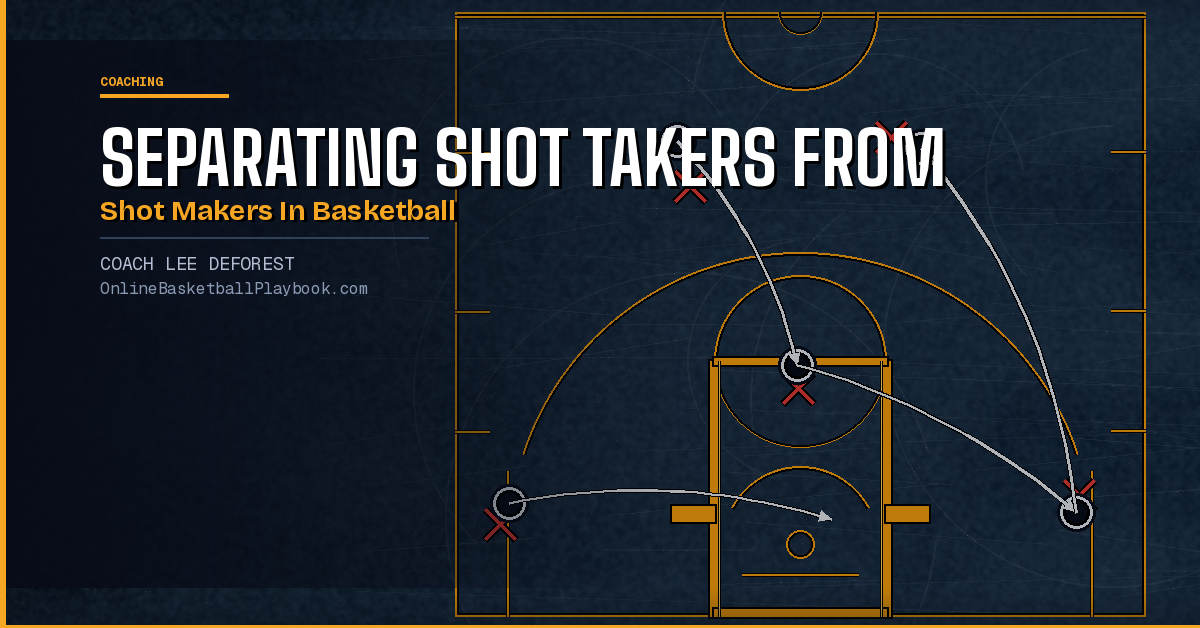
Separating Shot Takers from Shot Makers in Basketball
Separating Shot Takers from Shot Makers in Basketball
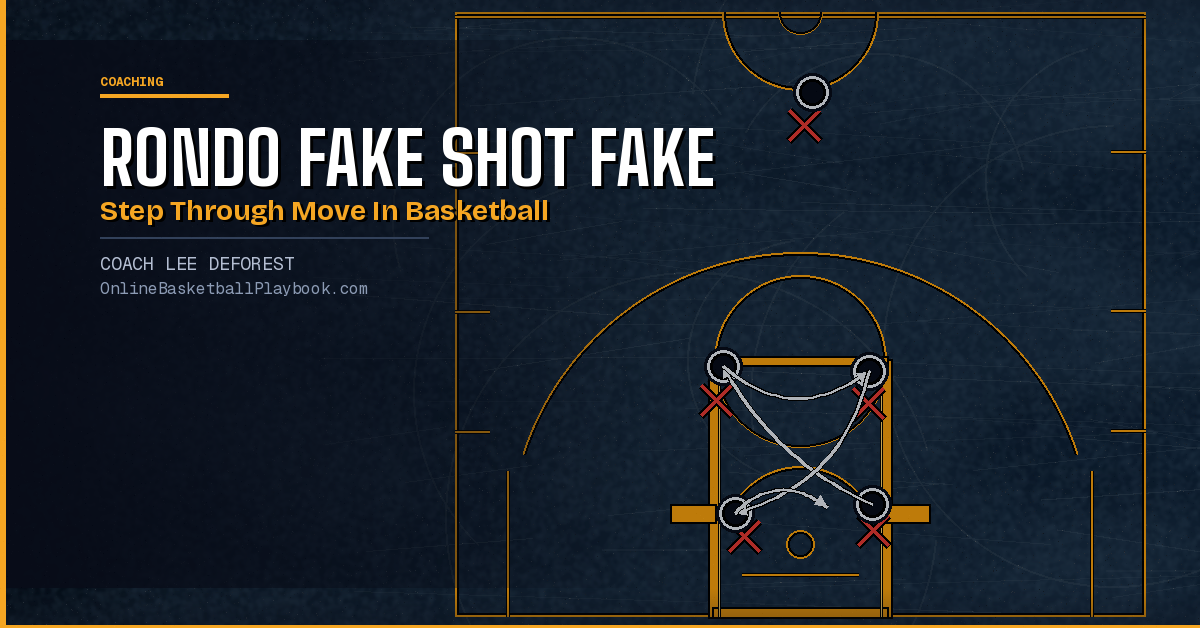
How to Do a Rondo Fake Shot Fake Step Through Move in Basketball
How to Do a Rondo Fake Shot Fake Step Through Move in Basketball