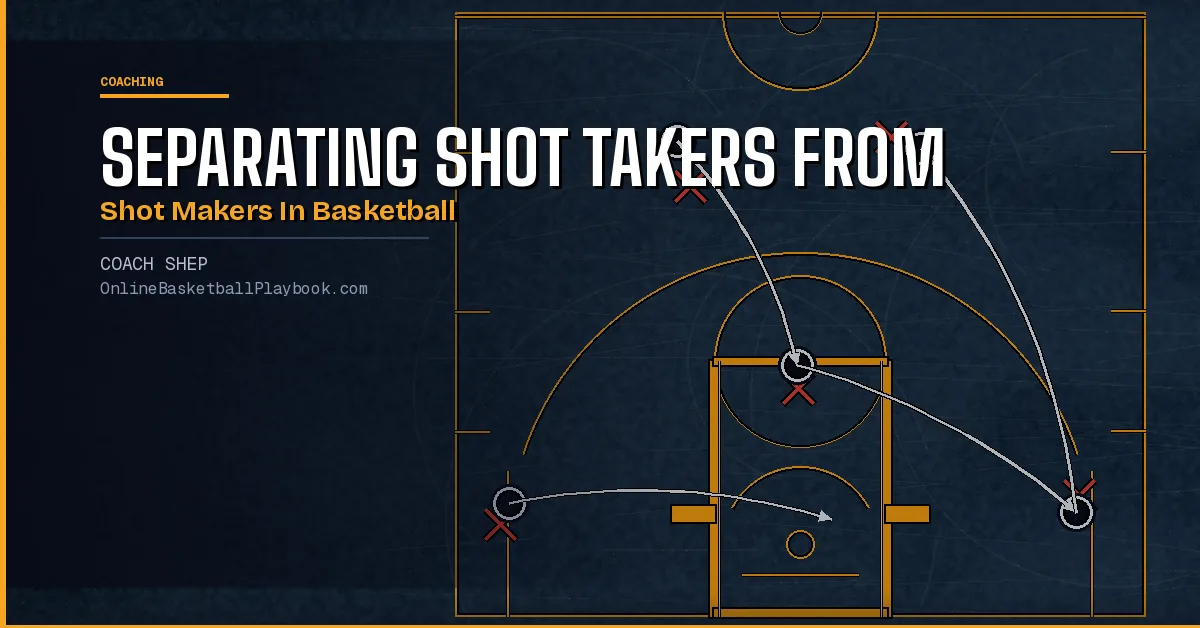
Every roster has players who shoot and players who score. The difference is not talent alone. It is how they train, what they track, and whether their reps have a winner. Here is how to build the second kind.
Form First: Why Mechanics Come Before Volume
The simplest mistake coaches make is handing a player a ball and telling them to shoot five hundred shots. Volume without form is just ingraining errors at scale. Jay Wright's Villanova program opened every single practice with two form-drill sequences before players ever shot from game range. The Set Lift and the Bradley Drill. The purpose was clear: build the habit of a correct release before asking the body to replicate it under pressure.
The progression matters. Start without the ball, working on footwork and the release motion. Then move to a wall. Then to the rim at close range. Jay Hernandez, one of the most respected individual skill coaches in the country, opens workouts with what he calls "Quarters". One-handed form shots at close range, progressing through no-jump and jump variations before any full-distance rep takes place.
For youth players, coaches like John Beilein and a generation of development coaches share a set of foundational cues that hold up across levels: a balanced stance, the guide hand under the ball like a pizza waiter carrying a tray, the elbow aligned under the ball and over the knee, and a high follow-through, "cookie jar," fingers reaching down toward the floor after the release. These are not youth cues. They are the same mechanics Villanova drilled before a Big East game.
The reason form comes first is not aesthetic. It is practical. Jay Wright identified it plainly: "sloppy drills create bad habits." A bad rep is not neutral. It is active rehearsal of a mistake. Building form correctly at low speed and short range before adding distance or defenders is the only way to stack reps that compound. Volume builds the wrong habits just as efficiently as it builds the right ones. Form determines which direction you are heading.
Make Every Rep Competitive
A shooting workout without a scoreboard is a shooting performance, not shooting training. The distinction matters more than most coaches realize. When a player shoots around without any target or time pressure, they select comfortable shots, relax after misses, and self-report "good workouts" based on feel. None of that transfers to games.
The framework used by coaches from Jay Hernandez to Shaka Smart at Texas to Tom Billeter at Augustana is the same: every drill has a winner. Compete against a clock, a partner, your own record, or a consequence for falling short. Hernandez's named drills (Streak, Star, Around the Horn, M Drill, the Burner, Over-and-Back) all share this feature. There is a target. You either hit it or you do not.
Shaka Smart's Texas program made this concrete in a different way by attaching explicit records to drills and posting them publicly. The 3-Minute drill had a program record of 157 makes. The Evans drill had a record of 219. Players were not just competing against a drill. They were competing against the best who had ever run that drill in that gym. That is an entirely different psychological environment than "go shoot some threes."
John Beilein's Michigan standard captures this at its most demanding: 10 shots, 7 makes, in 30 seconds, coming off a down screen and flare screen sequence. Fall short, and all three players involved run half-court sprints in 5 seconds. The screener gets a pass, but the standard is clear and the consequence is real. Jay Wright's version required 6 of 10 in 30 seconds with three players running if the group missed. Different schools, same philosophy. Every rep has stakes, and the player knows exactly where the bar is.
Billeter's "Purdue Drill" makes the consequence layer explicit: make four threes in one minute with a rebounder and passer, sprinting baseline to half-court between each shot. For each point short of four, the shooter runs an extra baseline. That is not a consequence that feels abstract. It is felt immediately, and players calibrate their urgency accordingly.
The Record Board and Shooting Culture
Posting scores matters more than most coaches expect. When Shaka Smart's Texas players could look at a board and see a named record from a former player, the drill changed character. They were no longer running a workout. They were entering a competition with the history of their program. That psychological shift is free to install and compounding over time.
The record board works at every level, not just elite programs. Set up three or four named drills. Let players sign their own marks when they set a record. Give the drill a name the team will remember. Over the course of a season, players will begin chasing those numbers before coaches ask them to. The board becomes the standard, and the standard becomes the culture.
Hernandez's approach included a "Beat the Pro" head-to-head format where a miss by the challenger counted as two points for the opponent. That is a named competition, not a drill. Players remember those formats. They talk about them. They come back to the gym and want to run them again. That kind of intrinsic pull toward the gym is exactly what separates programs that develop shooters from programs that run shooters through drills.
The record board is the cheapest tool a coach has for turning shooting from a chore into a team commitment. It requires no equipment, no budget, and no extra practice time. It requires only that the coach track numbers, post them, and make the achievement of beating a record feel like something worth celebrating. That is a cultural decision, not a technical one.
Diagnosing the Mechanical Root Cause
When a player misses consistently in the same direction, most coaches repeat a generic cue. "Bend your knees." "Follow through." "Stay balanced." Dr. Hal Wissel spent a career arguing that this approach is the wrong one. That effective shooting instruction requires working backward from the error to its mechanical cause before prescribing any correction.
The framework is a diagnostic chain: observe the miss pattern, identify the mechanical error producing it, then assign the specific drill that addresses that cause. A short shot is not fixed by "more arc". It is caused by a release point that is too low or an arm that does not reach full extension. The correction is a high-extension finish drill, holding the follow-through with the arm fully extended until the ball lands. A wide-right miss is not fixed by "aim left". It is caused by the guide-hand thumb pushing across the ball at release. The correction is a thumb-lock drill where the guide hand is held consciously away from the ball.
A flat, line-drive arc is caused by a flat wrist at release and an elbow that does not finish above eye level. The correction is a ceiling target: the player picks a point on the gym ceiling above the front of the rim and aims the arc there. Players who shoot line drives gain four to six inches of arc immediately with this cue. A "brick" that hits the front of the rim consistently is caused by a wrist that does not flex fully through the ball, with fingers leaving the ball simultaneously rather than in sequence. The index finger should be the last contact point.
Side spin (the ball rotating left or right off the hand) points to a set-point problem: the shooting hand is cocked sideways rather than facing forward. The elbow must be directly under the ball and over the shooting knee before the wrist snaps. Any flare in the elbow at set point creates spin.
The coaching discipline that Wissel identified is worth repeating: when a player misses consistently, work backward through the diagnostic before prescribing anything. Arc angle reveals the wrist. Wrist reveals the elbow. Elbow reveals the balance and foot position. The root cause is rarely what the player thinks it is, and rarely what a generic cue addresses.
Before you give a shooting cue, watch three misses in a row and identify the pattern: direction, arc, spin, and release timing. A cue that addresses the symptom without finding the cause will produce improvement in the gym and regression in games when the player reverts under pressure.
The Pull-Up: The Shot Most Players Never Develop
Every program develops catch-and-shoot players. Far fewer develop pull-up shooters. Coaches like Rumjahn and Kelbick have called the pull-up and hesitation "lost arts", skills that were once part of every competent guard's game and have been largely erased by the emphasis on three-point volume and rim pressure.
The pull-up from the free-throw line area is one of the most valuable shots in basketball precisely because most players cannot make it. A player who attacks a closeout, picks up his dribble two steps inside the arc, and hits a pull-up forces the defense to make decisions it is not prepared for. The defender cannot sag, because the player attacks. The defender cannot go under screens, because the player does not need them. That player changes the geometry of the floor for everyone around him.
The technical foundation for the pull-up starts with the same footwork principles that govern the catch-and-shoot. The inside foot plants first. The player must be "catch ready to attack": weight forward, knees loaded, prepared to shoot before the ball arrives. The difference is that the attack step, the one or two dribbles of separation, and the gather happen in sequence before the feet set. Training this requires movement shooting, not block shooting from stationary spots.
Larry Brown's SMU drill library makes this principle structural: every shot in every drill comes off a realistic offensive action first: a zipper cut, a baseline drive, a ball screen, a drive-and-kick. Players are always responding to a read before pulling the trigger. They are never standing still and catching. That practice environment produces players who shoot off motion because that is all they have ever practiced.
The pull-up also connects directly to free throw volume. Players who can pull up in the mid-range get to the line. Players who cannot either take impossible shots at the rim or settle for threes. Teaching the pull-up is not a concession to mid-range basketball. It is the move that keeps defenses honest enough for the three-point game to function.
Contested Shots and the Coaching Rule That Changes Everything
Rick Pitino identified one of the most instructive statistics in coaching: Louisville shot 22% on challenged shots. The NBA baseline for contested shots is approximately 42%. That 20-point gap represents a measurable coaching problem, not a talent problem.
Pitino's practice response was a rule, not a cue. If a shot would be challenged (if a hand is in the shooter's face, if the defender closes out in time), pass it back and restart the action. No exceptions. The consequence of taking a bad shot is immediate and structural: you give the possession back and run it again. That teaches the read, not just the mechanics.
George Karl's "no tough twos" mandate operates on the same logic. The problem is not just that contested shots go in at lower rates. It is that players who take them become practiced in the habit of shooting over a hand. They get comfortable with a shot that has a 22% success rate. That comfort transfers to games, and the team pays for it in possessions.
The contested-shot rule teaches something deeper than shot selection. It teaches players to read the defense before the shot leaves their hands. A player who knows that taking a challenged shot means restarting the possession learns to look for a better option as the shot develops. That is not just a shooting skill. It is a basketball skill. The coaching rule is the mechanism that builds it.
Free Throws Under Fatigue
Free throws at the end of a fresh warmup tell a coach almost nothing. Free throws at the end of a contested one-on-one drill, after a full workout, with a tracked percentage and a consequence for missing, those tell a coach everything.
The physiological reality is that game free throws happen when players are exhausted. Late in close games, in overtime, after sprinting back on defense, after a hard foul, that is when the free throw matters most, and that is the condition that most practice free throws never replicate. Bob Hurley built a 20-minute shooting emphasis into every daily practice that explicitly included tired free throws. Pitino shot free throws at the end of live one-on-one games with tracked percentages. The point is not to make the drill hard for its own sake. It is to make the drill match the game condition where it will be tested.
Wissel's recommendation of 100 free throws per day, mixing eyes-open and eyes-closed sets, builds the proprioceptive consistency that allows a player to repeat the motion under fatigue. The mechanics do not change when a player is tired. But the ability to execute them does, unless the player has trained the motion enough that it survives physical and psychological pressure. That only happens through repetition under conditions that mirror the game.
Baking free throws into the workout (Hernandez uses two sets of 10, one after the second turn of drills and one at the very end) ensures that players are shooting them in the right physiological state. Count every one. Track them over time. A player whose free throw percentage in practice is significantly higher than in games is a player who has been practicing free throws fresh. The fix is structural, not mechanical.
- Open every skill session with form shots at close range: One-handed, no jump, building the release motion before adding distance or a defender. Ten minutes of correct form produces better results than thirty minutes of volume with flawed mechanics.
- Name your drills and post the records: Give each drill a number to beat, let players sign their mark when they set it, and add a consequence for falling short. The record board converts a shooting workout into a shooting competition.
- Diagnose misses by direction, not by feel: Wide shots point to the guide hand, short shots point to the release point, flat shots point to the wrist. Find the mechanical cause before prescribing the cue, or the same miss will reappear under pressure.
- Train the pull-up and hesitation deliberately: Include one or two pull-up reps in every movement shooting drill so players build comfort with the shot off one and two dribbles. A player who can only shoot off the catch is a player defenses can ignore on the dribble-drive.
- Shoot free throws tired and track the percentage: Put one set of free throws in the middle of the workout and one set at the very end, count every make, and compare the percentage over the course of the week. Game free throws happen under fatigue. Practice should match that condition.
Want more basketball coaching strategies and drills?
Join the Online Basketball Playbook newsletter →
Draw this play free in the play drawer →
Membership: the full library, playbook packs, and Pro drawing tools →
Keep Building
Related breakdowns
Hook Shot Basketball: How to Do It and How to Teach It
Hook shot basketball for post players and coaches: the classic hook, sky hook and jump hook, the footwork steps, when to use it, the pivot foot rules and drills.
Basketball Shot Fake (Pump Fake): How to Do It and Teach It
The basketball shot fake, also called the pump fake, works when it looks like the real shot. The mechanics, the pivot foot footwork, the read and the drills.
Jump Shot Basketball: Footwork, Release and the Step-Back Jumper
The jump shot in basketball from the feet up: catch footwork, the lift and release, shooting off the catch or the dribble, the step-back jumper and fixing a miss.