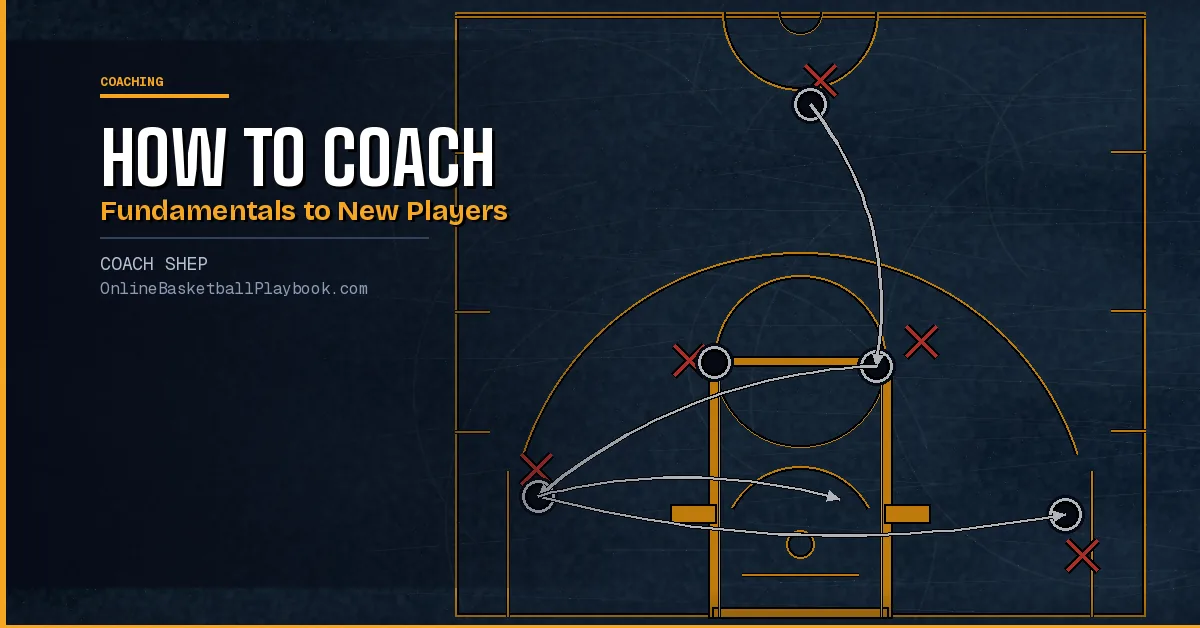
New players don't need a system. They need a foundation. This guide covers the skills, habits, and coaching approaches that give beginners the building blocks to improve fast and stay in the game.
Start With Athletic Stance and Footwork
Before a new player ever dribbles, passes, or shoots, they need to learn how to stand. That sounds simple. Most coaches skip it. They shouldn't.
The athletic stance is the anchor of every fundamental in basketball. Feet shoulder-width apart, knees bent, weight on the balls of the feet, back flat, eyes up. When a player catches a pass, they drop into this stance. When they're defending, they slide from it. When they pivot, they pivot from it. Everything in the game flows from this position.
For new players, teach the stance before anything else. Spend the first ten minutes of every early practice drilling it as a habit. Have players hold the stance for a count, shuffle laterally two steps while holding it, and return. No ball needed. No defender needed. Just feet, knees, posture.
Footwork is the next layer. New players almost always travel, shuffle their pivot foot, or lose balance when they catch the ball under pressure. These aren't talent problems. They're footwork problems, and footwork is entirely teachable.
Two-foot catches are the standard David Richman teaches at NDSU: catch with two hands, catch on two feet, and catch with two eyes, meaning full visual awareness at the catch point. Run this as a drill from the start. A player who catches with one foot, off-balance, or without looking the ball in has already lost the possession before they've done anything with it.
The Jump Stop
Teach the jump stop early. It's the single most useful footwork technique for beginners because it eliminates the travel call, allows the player to pivot in either direction, and keeps them balanced to shoot, pass, or drive. A new player who has a reliable jump stop handles defensive pressure far better than one who catches the ball and immediately tries to use a single-foot dominant step.
The drill is simple: cone on the wing, player sprints to it, receives a pass (or self-pass), and lands simultaneously on both feet in an athletic stance. Three sets of ten every practice for the first four weeks. By week five, it's automatic.
Teaching Ball Handling Without Overwhelming Beginners
New players often arrive with one of two dribbling problems: they stare at the ball, or they dribble too high. Both come from the same root. They haven't built enough repetitions at speed to trust their hand without watching it.
The fix is volume, not complexity. A thirty-minute ball-handling workout with a stationary ball (alternating hands, crossovers, behind-the-back) done every day for a month does more for a beginner than a ten-drill progression taught once per week. Muscle memory is built by repetition, not variety.
Start with stationary two-ball dribbling. Both hands dribble simultaneously at waist height for thirty seconds, then alternate (one high, one low). This forces the player to develop independent hand control and stops them from defaulting to their dominant hand. After two weeks of stationary work, add movement: two-ball dribble down the lane and back. After four weeks, introduce the crossover in place, then in motion.
Eyes Up Drills
To break the habit of staring at the ball, add visual triggers. Have a coach or partner stand at half court holding up fingers. The dribbler must call out the number while dribbling. It sounds trivial. It works immediately. Dribbling with eyes up is a habit built through consequence. If the player looks down, they miss the cue. Make it a competition: how many correct reads in a row before a miss?
Keep ball handling sessions short and daily rather than long and weekly. Ten minutes every practice beats thirty minutes twice a week for beginners. The goal is to make the ball an extension of the hand, not an object to concentrate on.
Build a Passing-First Culture From Day One
Passing is where new players show their basketball IQ most clearly, and where most youth coaches underinvest. Dribbling is individual. Shooting is individual. Passing is the skill that connects every other player on the floor, and a team that passes well wins more than its talent would suggest.
Start with the chest pass. Two players, ten feet apart. Step into the pass, thumbs rotate down at release, ball arrives at chest height. A hundred repetitions before you ever introduce the bounce pass or overhead pass. Mastery of one before diversity of many.
Once the chest pass is solid, add the bounce pass (one-third of the way to the receiver, so it rises to waist height). Then the overhead outlet. Then the skip pass. Each one has a specific situation it's designed for, and new players need to understand the why before the how.
Teach Players to Acknowledge the Passer
Dean Smith's UNC program ran one of the most consistent passing cultures in college basketball history. One of his core rules: acknowledge the passer. Every player who receives a pass on a scored basket points to the teammate who delivered the ball. No exceptions. It costs nothing, takes zero athletic ability, and builds a team identity around rewarding unselfishness.
Implement this from practice day one. When a player catches a pass that leads to a score in any drill, they point to the passer. When it becomes habit in practice, it becomes habit in games. The cultural signal it sends (the pass matters as much as the bucket) shapes how new players understand the game from the beginning.
Shooting Fundamentals: Catch, Set, Fire
More new players develop bad shooting habits in their first year than at any other time. The reason is simple: they shoot from too far away before they've established their mechanics. The arc is flat, the guide hand takes over, and the bad pattern bakes in.
The answer is the Mikan progression. Start every shooting session with layups at the basket: right side, left side, alternating. Then move to short bank shots at two feet, three feet, five feet. No player shoots from outside ten feet until they can make eight of ten at five feet with correct form. This rule stops the flat-arc epidemic before it starts.
The B.E.E.F. Framework
B.E.E.F. (Balance, Eyes, Elbow, Follow-through) is the cleanest shooting framework for beginners. Balance: feet shoulder-width, weight centered. Eyes: locked on the back of the rim before and through the release. Elbow: tucked under the ball, not flared. Follow-through: hold the wrist snap, hand stays relaxed and high.
Walk through each component with no ball first. Have the player mime the shot five times. Add the ball. Shoot from two feet. Check each component. Only add distance when the mechanics are clean.
The guide hand is the biggest beginner problem. New players push with both hands, and the guide hand steers the ball offline. Teach the player to separate their hands: shooting hand under the ball, guide hand on the side, guide hand falls away at release. Drill it with form shots against a wall until the separation is automatic.
Defense Is Where Coaching Shows
Euroleague Hall of Fame coach Zeljko Obradovic put it plainly: offense is easy. Defense is where coaching shows. Any group of players will run offense with enthusiasm. Getting new players to compete defensively (to slide, to rotate, to contest without fouling) is a coaching achievement.
Start with the defensive stance. Same foundation as the athletic stance: feet wide, knees bent, weight on the balls of the feet. The difference is the hands, one up to contest the pass, one low to bother the dribble. New players collapse into straight legs the moment they're tired. They need to be corrected immediately and consistently every single time it happens.
Slide Steps and Closeouts
Teach slide steps before any live defense. Players slide laterally, staying low, never crossing their feet. One cone to another, back and forth. Add a closeout: player starts under the basket, coach kicks the ball to a wing, player sprints toward the ball, chops feet at three feet away, and arrives in a balanced defensive position with a hand in the shooter's face without fouling.
The closeout is where most new defensive players foul. They run through the shooter rather than stopping short. Drill the chop-and-arrive separately from the contest. Once both pieces are automatic, put them together.
Effort is non-negotiable. Kelvin Sampson's phrase is exactly right: "compete, don't just play hard." Playing hard is about energy. Competing is about outcome, wanting the result badly enough to execute the difficult parts. Set the expectation early that every defensive possession is a competition the player is trying to win, not a requirement they're trying to survive.
Creating a Culture New Players Can Grow Into
The technical fundamentals matter. But the environment in which new players learn those fundamentals may matter more. Coaches who build programs that new players stay loyal to don't just teach the game. They build cultures that make players want to keep earning their place in it.
Morgan Wootten coached 46 years at DeMatha Catholic and produced dozens of college and professional players. His foundation wasn't a system. It was a philosophy. Play hard, play smart, play together, have fun. Four things. Posted. Lived. Non-negotiable. New players who join a program built on those four principles learn basketball in the context of something larger than individual performance.
Adopt a simple set of non-negotiables for your program and introduce them on day one. Kelvin Sampson uses attitude and effort as his two absolute standards, held the same every day, no exceptions. When new players understand that the standards are fixed and apply to everyone equally, they don't spend energy testing the limits. They spend energy improving.
Declare Every Player's Role Explicitly
New players arrive with uncertainty about where they fit. Ambiguity about role is a culture leak: it breeds resentment, comparison, and disengagement. Mike Dunlap's advice from the Blueprint Clinic is direct: declare roles explicitly, early, and revisit when performance shifts.
This isn't about limiting players. It's about giving them a clear target. A new player who knows their primary role (defensive stopper, spacing shooter, ball-handler in transition) can practice toward that role with purpose. One who doesn't know their role practices in a fog, never sure what success looks like for them specifically.
Call each player in for a five-minute individual conversation before the season begins. Tell them their role on the team. Tell them what improving in that role looks like. Ask them if they understand. This single habit eliminates more confusion and resentment than almost any other coaching behavior.
Practice Structure That Locks In What You Teach
New players learn best in structured repetition followed by competitive application. The worst practice structure for beginners is two extremes: pure drills with no competition, or live scrimmage with no structure. Neither locks in skill. The best structure moves from individual mechanics to small-group competition to team application within a single session.
A reliable practice block for new players looks like this: ten minutes of individual skill (footwork or ball handling), ten minutes of partner work (passing, shooting form), fifteen minutes of small-sided competition (three-on-three with a specific teaching point), and ten minutes of team application (five-on-five with one coached rule). End with a conditioning element that doubles as a competitive drill: sprints, suicides, or a ball-handling race.
No-Dribble Drills Build WE
Mike Dunlap's highest-ROI culture drill for new players is also one of the simplest: no-dribble basketball. Fifteen to twenty minutes every practice. Players can only catch, pivot, and pass. No live dribbling. This single constraint forces cutting, calling for the ball, communicating on defense, and moving without the ball. It makes players who have never played together look like a team faster than any other drill.
Run it as a competitive game: two teams, scoring like real basketball, but no dribbling. Every turnover or travel caused by dribbling shifts possession. The team that learns to read each other (to cut when a teammate is being trapped, to backdoor when a defender is fronting) is developing the basketball IQ that all the individual skill drills are trying to build.
Parcells' doctrine applies here too: habits, not schemes, survive under pressure. Practice at game speed. Make drills competitive. If a mistake is worth correcting, correct it the same way in game four as in practice one. The standard doesn't fluctuate. New players rise to meet a consistent standard far more reliably than they rise to meet an inconsistent one.
In the first four weeks with new players, resist the urge to add plays or systems. Spend the time building a small number of habits (stance, jump stop, two-handed catch, acknowledge the passer) until every player does them automatically without being reminded. Those four habits will carry your team further than any play you could install during that same period.
- Teach athletic stance before any skill: feet wide, knees bent, weight on the balls of the feet. Every other fundamental builds from this position
- Use the jump stop from week one to eliminate travels and give beginners a stable pivot base under defensive pressure
- Run two-ball stationary dribbling drills daily for the first month. Volume of correct reps beats drill variety for beginners building muscle memory
- Add eyes-up accountability to all dribbling drills by having players read and call out finger counts held by a coach at half court
- Master the chest pass with a hundred reps before introducing bounce passes or overhead passes. Build one skill to automaticity before adding the next
- Acknowledge the passer after every scored basket in practice: point to the teammate who delivered the ball. Run this habit from day one
- Declare every player's role explicitly in a one-on-one conversation before the season begins, and revisit whenever their role or performance shifts
- Run no-dribble basketball for fifteen to twenty minutes every practice to build cutting, communication, and team cohesion faster than any individual drill
- Hold attitude and effort as the two non-negotiable standards, the same every day, with no exceptions for any player regardless of talent or status
Want more basketball coaching strategies, drills, and tools?
Join the Online Basketball Playbook newsletter →
Draw this play free in the play drawer →
Membership: the full library, playbook packs, and Pro drawing tools →
Keep Building
Related breakdowns
Cutting Players: What to Say and How to Say It
Cutting players: what to say on day one, in the meeting and to parents, the words to use and avoid, what to hand the player, and how to keep the door open.
Coaching Communication: How to Explain Basketball to Players
Coaching communication for basketball: the teaching order, fewer and clearer words, how to correct a mistake, one team vocabulary and calls taught inside the drill.
Teaching Players to Adapt to Different Playing Styles
Teaching Players to Adapt to Different Playing Styles