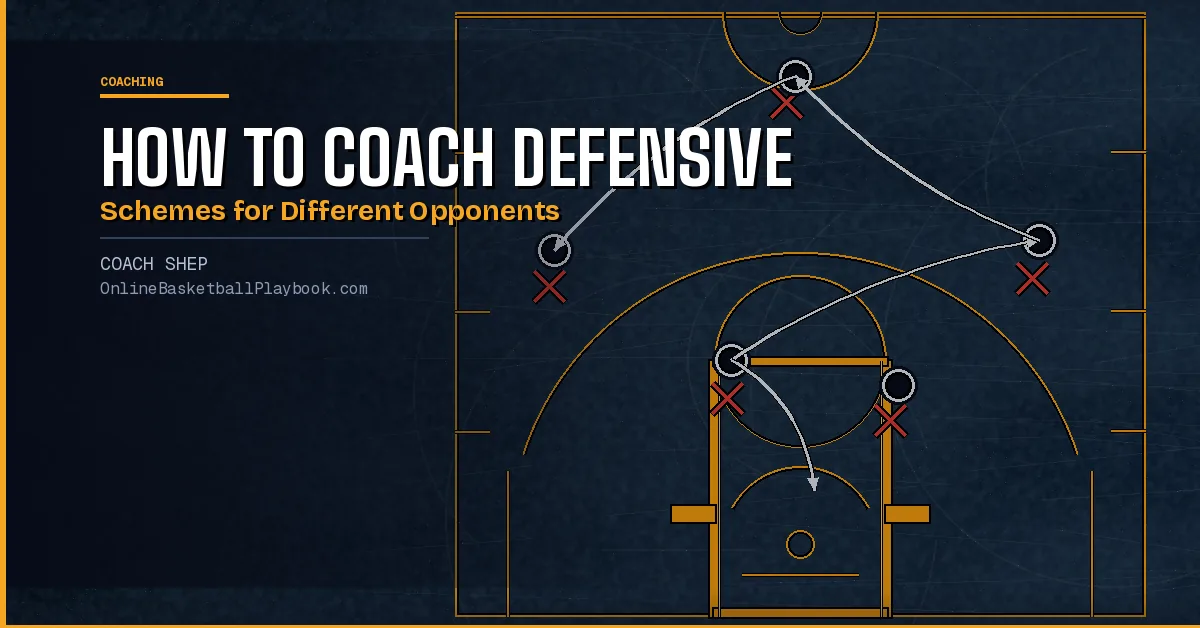
The best defensive teams don't run one scheme, and they scout the opponent, pick the right coverage, and drill it until execution is automatic. Here's how to build that system at any level.
Scout First, Scheme Second
Every defensive adjustment starts with a scout. Before deciding what coverage to run against a particular opponent, you need to know three things: who their best scorer is, how they generate shots, and what they cannot do when their primary actions are taken away.
A pick-and-roll heavy team that relies on a pull-up shooter requires a completely different defensive posture than a dribble-drive attack with weak shooters on the perimeter. Against the shooter, you play tight through ball screens and force the handler left. Against the drive-and-kick team, you compress the lane, load help toward the paint, and live with corner threes from secondary options.
The scouting categories that matter most are:
- Shooting range and gravity: Does their star shooter force you off the line, or can you give a step?
- Primary action: Do they run ball screens, dribble handoffs, post feeds, or freelance isolation?
- Transition footprint: Do they push pace and punish you in transition, or do they set up half-court every trip?
- Weak hands and weak links: Who on the floor cannot beat you from range, and who struggles going left?
Once you have those answers, defensive scheme selection becomes straightforward. You're not picking your favorite coverage. You're picking the coverage that removes what the opponent does best and forces them into their worst actions.
Man-to-Man Adjustments by Opponent Type
Man-to-man defense is the baseline for most programs, but the adjustments within man coverage vary dramatically based on who you're guarding. The same fundamental principles (ball-defender-basket alignment on the ball, ball-defender-player positioning off the ball) apply everywhere. What changes is the degree of pressure, the help positioning, and the recovery rules.
Guarding a Perimeter Shooting Team
Against a team that spaces the floor with four or five shooters, your closeout technique becomes the most important defensive skill you have. A flat-footed closeout gives a shooter a clean look. A reckless running closeout draws a foul or lets the driver by you.
The three-label closeout system (Curry, Wade, and Rondo) gives defenders a named assignment before the ball is even passed. Curry means run the shooter off the three-point line entirely (run off the line, deny the catch). Wade means close hard and contest on the rise, body under control. Rondo means stay off, give the catch, and contest late, used on a non-shooter to avoid giving up a drive.
Your scouting determines which label goes on which player. Label the most dangerous shooter Curry. Label the secondary shooter Wade. Label the one player you're willing to let catch the ball Rondo. Brief your defenders on the labels before tip-off, and they have a clear assignment instead of guessing in the moment.
Guarding an Attack-the-Paint Team
Against a dribble-drive offense that wants to collapse your defense, your help positioning is the scheme. The driving line principle is foundational: when you close out, close top-side, put your chest on the offensive player's shoulder, and beat him to a spot that sends him on a driving line away from the lane. No hands. No reaching. Force the path, then let your help defenders finish the coverage.
Your weak-side defenders shrink toward the paint on every drive, not because you tell them to during the drive, but because you've drilled the shrink-and-spread pattern until it's automatic. On the kick-out, they re-expand. That pattern (shrink on entry, spread on kick) is a rehearsed, named action, not a hope.
Choosing Your Ball-Screen Coverage
Ball screens are the most common action in basketball at every level, and your coverage choice has to match your personnel and the shooter on the ball. There is no coverage that works against every team. You pick the right one for the opponent in front of you.
Drop Coverage
Drop is your base coverage against a non-shooting ball handler or a handler whose pull-up from the mid-range is acceptable. The on-ball defender goes under the screen; the big drops to the level of the screen and contains. You give up the mid-range pull-up to protect the rim and prevent the lob.
Show (Hedge)
Show is your coverage against a handler who will pull up or turn the corner if you give him open floor. The big steps out hard above the level of the screen and forces the handler to reverse the ball. The on-ball defender trails over the top and recovers. The risk is a quick roll pass to the big's man, and you compensate by loading your weak-side help toward the nail before the screen is even set.
Blitz (Trap)
Blitz is your most aggressive coverage, used against a ball handler who cannot pass out of pressure or against a team that relies heavily on one initiator. Both defenders (the on-ball defender and the screener's defender) attack the handler after the screen. You are deliberately giving up an open man to force a turnover or a scramble. It requires exceptional rotation from your weak-side defenders, and it should be practiced at three-quarter speed with full talk and full intensity before it ever appears in a game.
Switch
Switch eliminates the coverage problem entirely by taking the screen away. The on-ball defender and the big swap assignments. Switch is easiest to execute with length and athleticism at both positions, and it's most effective when your roster can guard multiple positions without a significant mismatch. Against a team that hunts switches aggressively (sending the mismatched player immediately into the post after the swap), switching can become a liability.
Install ball-screen coverage by starting with 2-on-2 reps at sixty to seventy percent intensity before you ever go five-on-five. When the coverage read (drop, show, blitz, or switch) is clean at partial speed, defenders carry the right habits into full-speed reps without reverting to guessing. Skipping this step is the most common reason ball-screen defense breaks down in games: players have the vocabulary but not the automatic reads that only come from isolated repetition.
When to Use Zone or Press
Zone defense and pressure systems are not substitutes for man-to-man, and they are tactical tools you deploy against specific opponents for specific reasons. A good defensive program has both in the playbook and a clear decision framework for when to use them.
Zone as a Scheme Tool
Zone is most effective against a team that lives on individual isolation scoring, struggles with ball movement under pressure, or has one dominant post player who becomes less dangerous without a direct matchup to exploit. A 2-3 zone takes the post feed away and forces perimeter passing; a 1-3-1 forces ball movement into unfamiliar lanes and creates trapping situations on the baseline.
Zone is least effective against a team with multiple shooters who will stand in the gaps, a patient offense that reverses the ball until the zone shifts out of position, or a program that has genuinely scouted and prepared for it. If you're going to zone, you need to transition into it mid-game without a timeout. Teams that can change defensive looks without a break force opponents to adjust on the fly.
Press as a Tactical Weapon
Full-court pressure is not a conditioning drill disguised as a scheme. It is a system that requires will as much as it requires skill. The most successful pressing programs say it plainly: to be an elite pressing team, it has nothing to do with skill; it has everything to do with will. That means your press is built in practice through scored, competitive reps where the losing group sprints, not through walking through rotations on a whiteboard.
Press works best against teams with a limited number of ball handlers, teams that struggle with sideline traps, and teams that have not specifically prepared for full-court pressure. Use it to disrupt tempo against a slower, methodical offense that needs time to set up. Use it to extend a lead and force the opponent into a rushed pace. Use it after made free throws, where ball placement and limited timeout availability make it hardest to break.
Breakdown Drills That Install Any Scheme
The whole-part-whole teaching model is the most reliable way to install any defensive system. Show the entire scheme, break it into isolated parts, drill those parts to mastery, then reassemble five-on-five. Every elite defensive program, regardless of the specific scheme, uses this structure.
The Footwork Foundation
Every defensive scheme starts from the same stance, and that stance is built through daily footwork work before a single scheme concept is introduced. The progression runs from a boxer stance to a half-squat, into the step-slide with towels held overhead to force defenders to stay low, into the big one-step and two-step reactions that cut off the first move, into full run-recover reps.
This is not a warm-up. It is the foundation of your defensive identity, and it should take eight to fifteen minutes at the start of every practice. Teams that skip this step wonder why their defenders are upright and out of position when games get fast.
Closeout Drills
Closeout technique is where most defensive breakdowns actually happen. The drill structure is simple: start with a pass from under the basket, defenders close on a shot-only offensive player, then progress to live one-on-one, then make-it-take-it. The critical mechanics are sprinting the first two-thirds of the distance, chopping down to controlled steps on arrival, and bringing both hands up simultaneously (the parachute technique that slows the body while presenting a contest).
The number of closeouts you practice should match the number of ball screens you expect to see. Every time a ball screen is set and hedged, someone is closing out. If your opponent runs twelve ball screens a game, your team needs twelve closeout reps per practice at minimum.
Shell Drills
The four-on-four shell drill is the backbone of half-court defensive installation. Run a standard shell with two players on top and two on the wings, teaching help positioning and jump-to-ball rotations. Progress to the variants that match your upcoming opponent: add pin-downs and flare screens if the opponent runs those actions, add a diamond alignment if you expect high ball-screen volume, and introduce the no-man's-land rule (no offensive player gets two feet in the lane in position to make a play) when you need your defense to compress the paint.
The single most important habit in any shell drill is jump-to-the-ball on every pass. When your defenders move on the pass, not on the catch, they are always one step ahead of the offense. Teach it slow first at half-speed, call it by name every time someone does it correctly, and make the violation visible by stopping the drill and showing the missed rotation to the whole group.
Making It Stick with Competitive Validation
Drills that end on a clock do not prepare players for games that end on a score. Every defensive drill should have a winner, a loser, and a consequence (a short sprint, a condition, a make-it-take-it rule) so intensity in practice matches intensity in competition.
Stop-Score-Stop
This five-on-five format does not end until one team chains a stop, a score, and another stop in sequence. It pairs the two outcomes, offense and defense, instead of rewarding them independently. Players cannot coast on one side of the ball because the chain breaks immediately if either possession is given up.
Defensive Validation
A team's offensive score only counts if they get a stop on the next possession. Play to five points. The defensive emphasis is hidden inside an offensive competition. Players are trying to win a game, and accountability follows automatically. This is the format to run after you've installed a new coverage and want to see if it holds under real competitive pressure, not just drill pressure.
Cut Throat Formats
Three-team cut-throat (three teams rotating, win only by getting three stops in a row) creates the most consistent defensive intensity of any practice format because no team can win without a defensive streak. The full-court variant adds a conditioning element: the losing team sprints outside the court while the ball stays in play. Use the Perfection Cut Throat variant when you need to embed one specific habit under competitive conditions. Name the habit before the drill starts (jump to the ball, closeout with hands up, sprint on the pass) and any defender who misses it means the defense loses the possession and cycles out.
Run the 24-Second Drill when your defense needs to learn what sustained pressure over a full possession feels like. Five-on-five half-court: the defense must hold the offense scoreless for a full 24 seconds. If the offense scores, they stay on offense. If the offense gets an offensive rebound, the clock resets to 24. It is demanding and difficult, and that is exactly the point.
- Label your closeouts before tip-off: assign Curry (run off the line), Wade (close and contest on the rise), or Rondo (give the catch, contest late) to every perimeter player in your scout. Give your defenders a named assignment instead of a guessing game.
- Install ball-screen coverage at 60–70% intensity in 2-on-2 before going 5-on-5: the coverage read has to be automatic before defenders can execute it against a live defense at full speed.
- Run the jump-to-ball habit slow first, then fast: teach it at half-speed with the drill stopped on every mistake, name it every time someone does it correctly, and do not progress to full-speed reps until it appears without prompting.
- Match closeout reps to ball-screen volume in the opponent's scout: if they run twelve screens a game, your team needs twelve closeout reps in practice minimum. The number is not arbitrary.
- End every multi-team practice with a competitive validation format: Defensive Validation (score only counts with a stop next possession), Stop-Score-Stop, or Cut Throat. No drill that ends on a clock, always a format that ends on a score or a streak of stops.
- Use Perfection Cut Throat to embed one habit at a time: name the single habit before the drill starts and never add a second one mid-drill; one habit embedded completely beats two habits half-learned every time.
Want more basketball coaching strategies, drills, and tools?
Join the Online Basketball Playbook newsletter →
Draw this play free in the play drawer →
Membership: the full library, playbook packs, and Pro drawing tools →
Keep Building
Related breakdowns
Teaching Effective Defensive Strategies for Different Matchups
Teaching Effective Defensive Strategies for Different Matchups
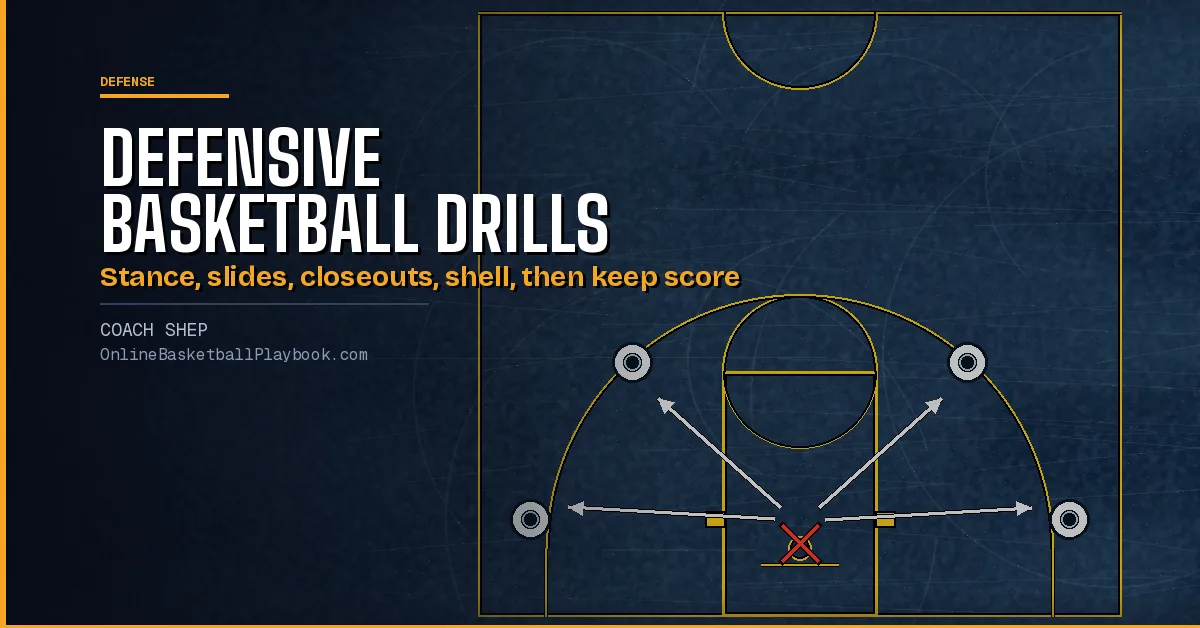
Defensive Basketball Drills: Slides, Closeouts, Shell and Games
Defensive basketball drills in teaching order, from stance and defensive slide drills to closeouts, pass denial, shell and scored games, with the versions coaches split on.
Defensive Stance in Basketball: Weight, Feet, Hands and Drills
Defensive stance in basketball: weight, feet, hands and eyes, the footwork out of the stance and the drills that build it.