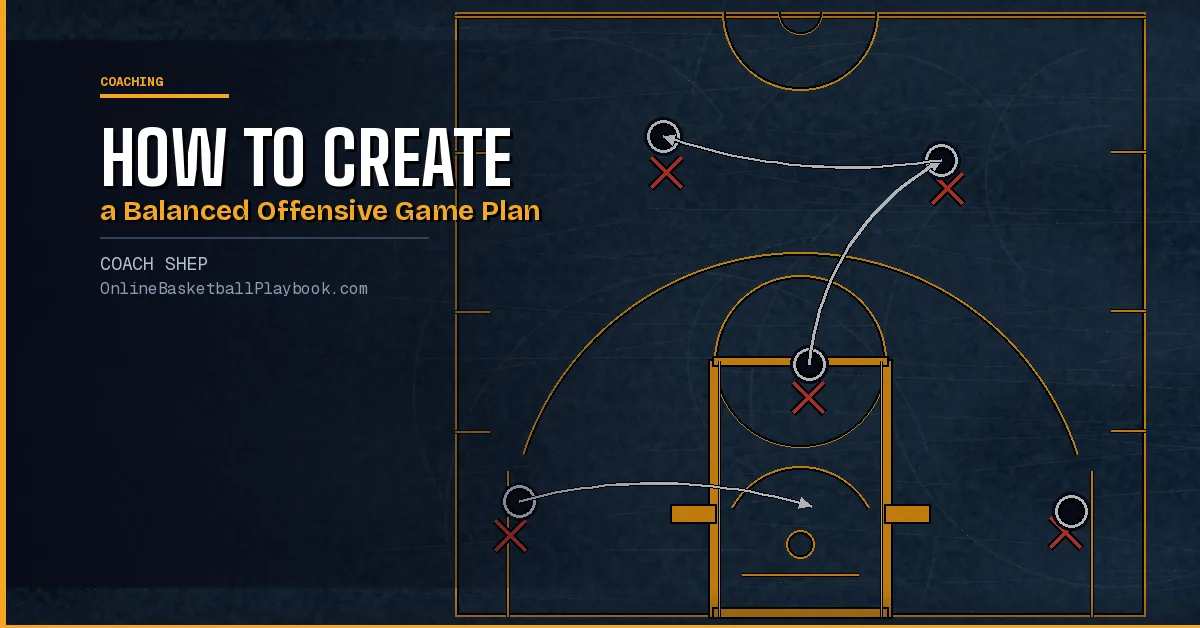
A balanced offense attacks every defender, not just one corner of the floor. This guide shows you how to build one from the ground up: starting with reads, then spacing, then the drills that make it stick under pressure.
What "Balanced" Actually Means
Most coaches say they want a balanced offense but what they really mean is they want options. That is not the same thing. A team that runs its best play forty times a game has options on paper but the defense has already scouted those options and eliminated them by the fourth quarter. A truly balanced offense makes the defense wrong no matter what it takes away.
Balance has three dimensions. The first is horizontal. You attack from both sides of the floor, not just one wing or one ball-handler's strong hand. The second is vertical. You threaten the paint and the perimeter simultaneously, so the defense cannot sag into the lane or crowd the three-point line without surrendering something. The third is temporal. You can score in transition, in the half court, and out of timeouts, so the other team cannot simply stall your rhythm by playing at a different pace.
When all three dimensions are present, no single defensive adjustment solves the offense. That is the goal. Everything that follows is about building those three dimensions deliberately rather than hoping they emerge on their own.
Start With Reads, Not Plays
The most common mistake in offensive game planning is installing plays before installing reads. A play is a choreographed sequence of actions. A read is a decision rule: if the defender does X, you do Y. When teams run plays without reads, they execute the choreography even when the defense has already countered it. The open shot walks right by because the player was looking for the next scripted action instead of the open man.
Reads-first coaching flips this. You teach the decision first (catch, read the defender, choose cut or shot) and then the play becomes the context that sets up the read rather than the thing players are trying to execute. This approach scales. When a player genuinely understands the read, they make it correctly in a set play, in a motion sequence, in a secondary break, and in a late-clock scramble, because the rule is the same in all four situations.
The practical starting point is 1-on-1. Before you run any team concept, players should own the basic reads from the perimeter: catch-and-shoot when the defender is closing out, attack middle when the defender turns their hip, attack baseline when the defender overplays middle. Every team offensive concept is built on combinations of these individual reads. If the individual reads are not there, the team offense will always be one defensive adjustment away from breakdown.
Two-on-two is the next layer. The drive-and-kick is the most important two-man action in modern basketball, and it belongs in this layer. One player attacks the paint; the other reads whether to shoot, cut, or hold spacing. The decision lives with the spacer, not the driver. When spacers learn to make that decision reliably, the whole offense becomes harder to guard because now the defense must account for a second correct decision after already being beaten off the dribble.
Spacing: The Foundation Nobody Skips
Spacing is not where your players stand before the ball is thrown. Spacing is where they move after it is thrown. This distinction matters enormously. Teams that memorize floor spots but do not know how to relocate after a pass or a drive will compress the court the moment the ball moves, and a compressed court eliminates angles that the offense spent all week creating.
The five-out alignment is the cleanest starting framework because it puts the maximum number of players outside the lane before any action starts. The center of the lane stays empty, which accomplishes two things. It gives the ball-handler a clear driving lane, and it eliminates help positions for defenders. Any big who wants to help on a drive has to travel further to get there, which buys an extra beat for the kick-out. Five-out is not the only spacing scheme, but it is the easiest to teach and the hardest to stop when spacing discipline is high.
Two spacing rules that apply regardless of the system: first, never stand still when the ball is driven toward you. The default movement is to step back or drift to a corner, which opens the driving lane and keeps you in a catch-and-shoot position. Second, every cut is a spacing action for someone else. When one player cuts through, another player fills behind. If players do not fill the vacant space, the floor compresses on every cut and the defense can sag without paying a price.
Spacing also has a shot-selection component. A balanced offense has specific zones where it attacks and specific zones it avoids. The most expensive shot in basketball is a long two, far enough from the basket to make it low percentage, close enough to the three-point line that the defense does not have to respect it as a potential three. Any game plan built around long mid-range twos is unbalanced by design, regardless of how many different actions create them.
Build It With Breakdown Drills
Breakdown drills are how reads and spacing become reflex. The principle behind every effective breakdown drill is the same: isolate one read or one skill at a time before scaling to five-on-five. Trying to install the full offense in a five-on-five scrimmage without first isolating the component parts is like teaching a player to shoot by putting them in a live game. The complexity of the environment overwhelms the skill before it has a chance to form.
Part-whole progression is the framework. Start with the individual skill: the footwork, the finish, the catch-and-shoot mechanics. Move to the two-man action (the drive-and-kick, the ball screen, the give-and-go) with one read attached. Then add the third player, who changes the read by providing a secondary option. Only after players consistently make correct decisions in the small-sided format do you scale to five-on-five.
Constraint drills accelerate this process. A constraint is a rule layered onto a drill that forces a specific behavior without the coach having to stop play and lecture. For example, in the Blood series from the Memphis breakdown drill library, any mid-range pull-up jumper is called a turnover. The constraint coaches the shot diet and the drive-all-the-way mentality simultaneously, without a single word from the coaching staff after the rule is explained. Players self-correct because the drill's scoring system penalizes the wrong choice in real time.
Advantage drills (formats where the offense begins with a numbers advantage like three-on-two or two-on-one) train decision-making under pressure. When the defense is outnumbered, the offense must find and execute the right read quickly or the advantage disappears. This replicates the decision speed required in transition and in any situation where a defender is caught out of position. Running the Texas 22 drill, which is two-on-two from the half court, and the Texas 33, which is three-on-three, builds the habit of attacking advantages instead of waiting for set-play situations.
Competition scoring locks in the behavior. Every drill that can be scored should be scored. The 444 drill format (continuous four-on-two with plus-three for a charge drawn, plus-two for an offensive board, plus-one for a score, and minus-two for a turnover) creates an environment where every possession has consequences. Losers run the difference. When players know the scoring system, they coach themselves. The drill becomes self-reinforcing.
Control Your Shot Diet
A balanced offense is also a disciplined offense. Shot diet (the distribution of shot types your team attempts) is one of the most controllable variables in offensive game planning, and most teams leave it completely unmanaged. The result is that players shoot whatever they can get rather than whatever the math says they should be looking for.
The three categories that define a modern, mathematically sound shot diet are layups and close finishes at the rim, three-point attempts from good catch-and-shoot positions, and free throws drawn by attacking the paint. Everything else (the pull-up mid-range, the step-back from eighteen feet, the contested two off the bounce) is a concession to the defense rather than an attack on it. A team can take those shots situationally, but they should not be the foundation of the offense.
Shot diet starts in practice, not in games. When breakdown drills reward rim attacks, kick-outs to the corner, and drawn fouls (and penalize pull-up twos and bad threes), the practice environment shapes what players reach for under game pressure. This is the direct connection between drill design and shot selection at the varsity level. What the scoring system rewards in the gym is what players default to when the moment is live and the coach cannot script it.
Off-ball screening is the most reliable way to generate clean three-point looks against a prepared defense. A balanced offense should have at least one systematic way to generate kick-out threes from a drive (typically through drive-and-kick spacing) and at least one systematic way to generate catch-and-shoot threes off movement (typically through a skip pass to a player cutting off a screen). When both are present and teams can execute either based on what the defense gives, the three-point attack becomes nearly unguardable without surrendering the paint.
Transition: The Free Points Layer
No game plan is complete without a transition offense. Transition is where a balanced offense gets its free points, situations where the defense is disorganized and the offense can attack before the other team gets set. Teams that treat transition as an afterthought leave four to eight points per game on the floor, which is the margin in most close games.
The principles of a sound transition offense are simple. Push the ball in the middle of the court immediately after a make or a defensive rebound. Fill the outside lanes wide so the defense has to guard three threats at once. Attack before the defense can set, but do not force a bad shot just because the opportunity arose. The decision rule is: if we have a numbers advantage, we attack; if the defense is set, we execute the half-court offense without hesitation.
Full-court transition drills build the habit. The 11-Man continuous three-on-two drill, where the rebounder outlets to a sprinting wing who fills the lane and the third player trails for the trailer option, trains transition spacing and decision-making simultaneously. The outlet pass is a skill that requires deliberate practice. Players who catch a defensive rebound and immediately look to push the pace in the right direction are acting on a trained reflex, not spontaneous inspiration.
Secondary break is the bridge between pure transition and the half-court offense. When the defense recovers before the first wave of transition finishes, the offense should flow directly into its half-court entry without stopping and resetting. This continuity (transition into secondary break into half-court) is what separates fluid, hard-to-scout offenses from choppy, reset-every-time offenses. The drill for this is a controlled scrimmage format where the coach governs tempo: the ball is thrown to the coach after each possession and the coach dictates whether the next sequence starts in transition or in the half court. Gregg Popovich's three-ways format, which awards one point for a score and one point for a stop in controlled five-on-five, trains exactly this awareness of situation and pace.
Run one transition drill every practice before your first five-on-five segment. Even five minutes of outlet-and-fill reps in an 11-Man format builds the lane-filling habit that teams who only scrimmage never develop. Transition is a skill like any other. It requires its own isolated repetitions before it shows up reliably in games under pressure and fatigue.
Putting It All Together in a Game Plan
The game plan is not the offense. The game plan is the scouting-informed layer you add on top of the offense to exploit what this particular opponent gives you. A team that has reads, spacing, a controlled shot diet, and a transition attack in their base offense can adjust the game plan each week by simply emphasizing what the opponent's defense is weakest against. Not by installing an entirely different offense, which is what teams do when they have no base to build from.
Game-plan preparation starts with three questions. First, what does the defense take away? If they pack the paint, you attack the three-point line first and drive into the gaps they create to recover. If they deny the three, you drive and create layups. If they switch every ball screen, you post the smaller of the two switched defenders. Second, what does the defense give? Find the leak (the side they shade away from, the defender who helps aggressively and leaves someone open) and make that the first read in your primary action. Third, where is their defensive personnel weakest? Match up your best drivers against their slowest defenders and your best shooters against their worst closeout players.
Late-game situations require separate planning. Out-of-bounds plays should be drilled weekly, not drawn up in emergencies. Baseline out-of-bounds plays and sideline out-of-bounds plays belong in the regular drill repetoire, built and drilled during practice so players execute them with the same confidence as any other action. The coaches who struggle at the end of games are usually the ones who have not created systematic answers to late-game situations in advance.
Finally, the half-time adjustment is its own skill. The first half tells you what the defense is taking away and what they are giving. The adjustment should never require players to learn something new at half-time. It should redirect them toward reads and actions they already own in practice, now pointed at the specific gap the defense has revealed. This is why the reads-before-plays approach compounds over a season. The team with more trained reads has more adjustment options without any additional learning load.
- Install every new offensive concept through breakdown drills first: isolate one read or one skill per drill, run it at game speed, and score it competitively before scaling to five-on-five.
- Use constraint rules in your drills (mid-range jumper = turnover, dribble limits, validate every score with a free throw) to coach shot diet and decision speed without stopping play repeatedly.
- Run advantage drills (3-on-2, 2-on-1) daily to build the habit of attacking numbers advantages in transition before defenses can set.
- Build your spacing rules into the drill scoring: reward kick-outs, corner relocations, and skip passes that lead to open threes; penalize standing still while the ball is driven.
- Prepare one baseline out-of-bounds play and one sideline out-of-bounds play that you drill weekly so end-of-game situations never require players to execute something unfamiliar under pressure.
- Match game-plan adjustments to reads your team already owns in practice. A half-time adjustment is a redirection, not a new installation. The team with the most trained reads has the most half-time options.
Want more basketball coaching strategies, drills, and tools?
Join the Online Basketball Playbook newsletter →
Draw this play free in the play drawer →
Membership: the full library, playbook packs, and Pro drawing tools →
Keep Building
Related breakdowns
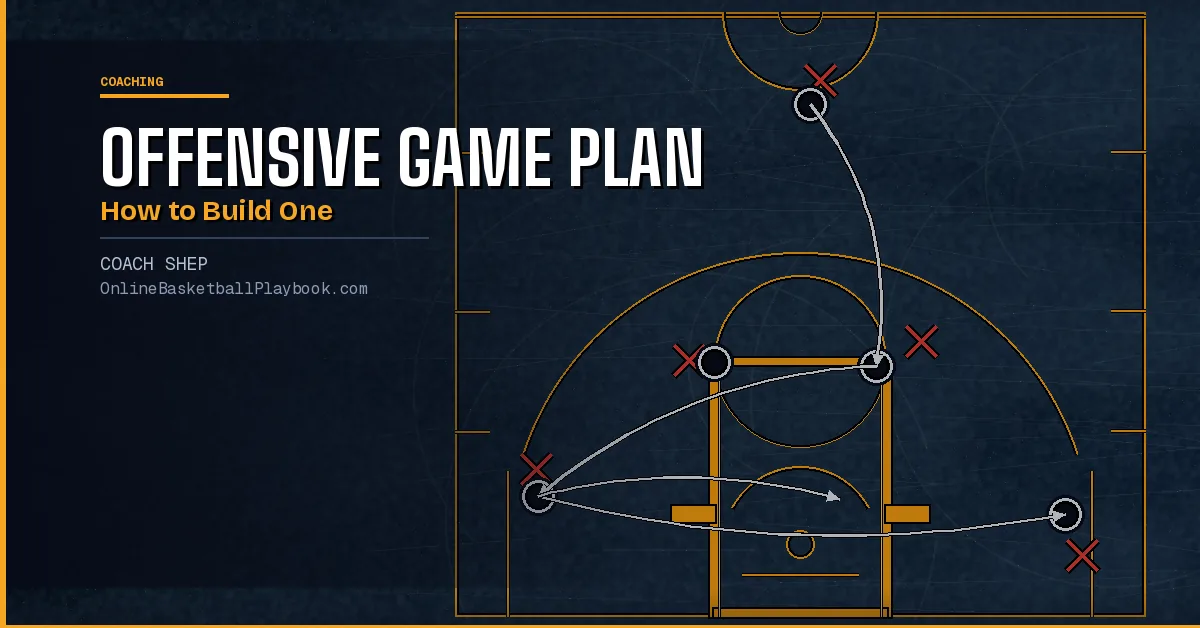
Basketball Offensive Game Plan: How to Build One
Basketball Offensive Game Plan: How to Build One
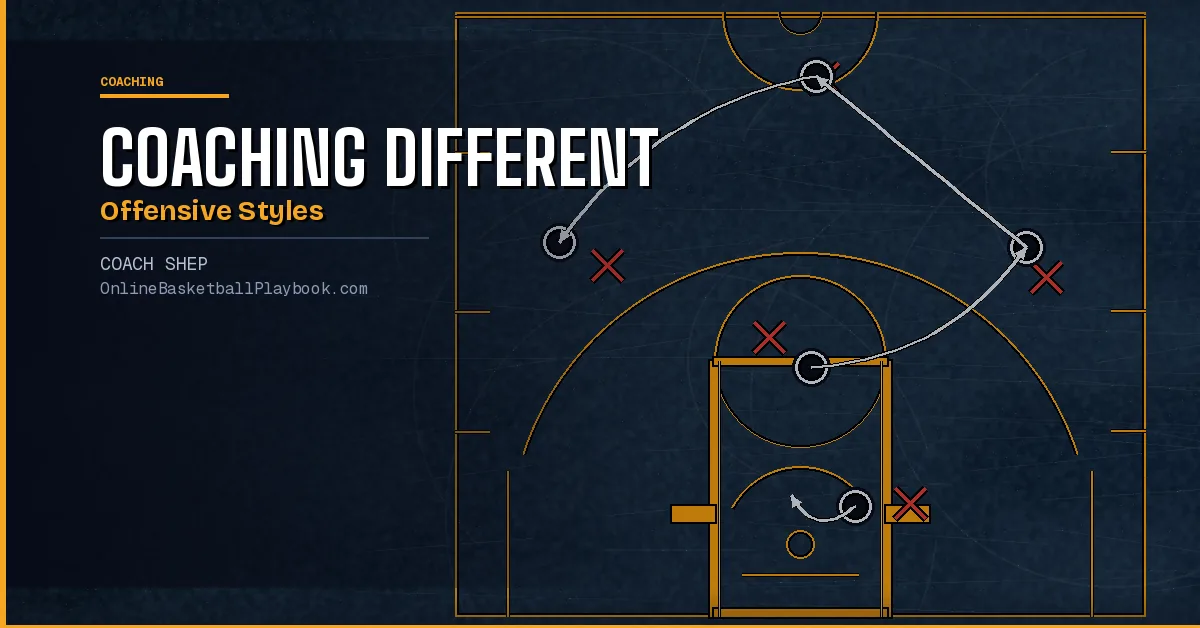
Strategies for Coaching Different Offensive Styles
Strategies for Coaching Different Offensive Styles