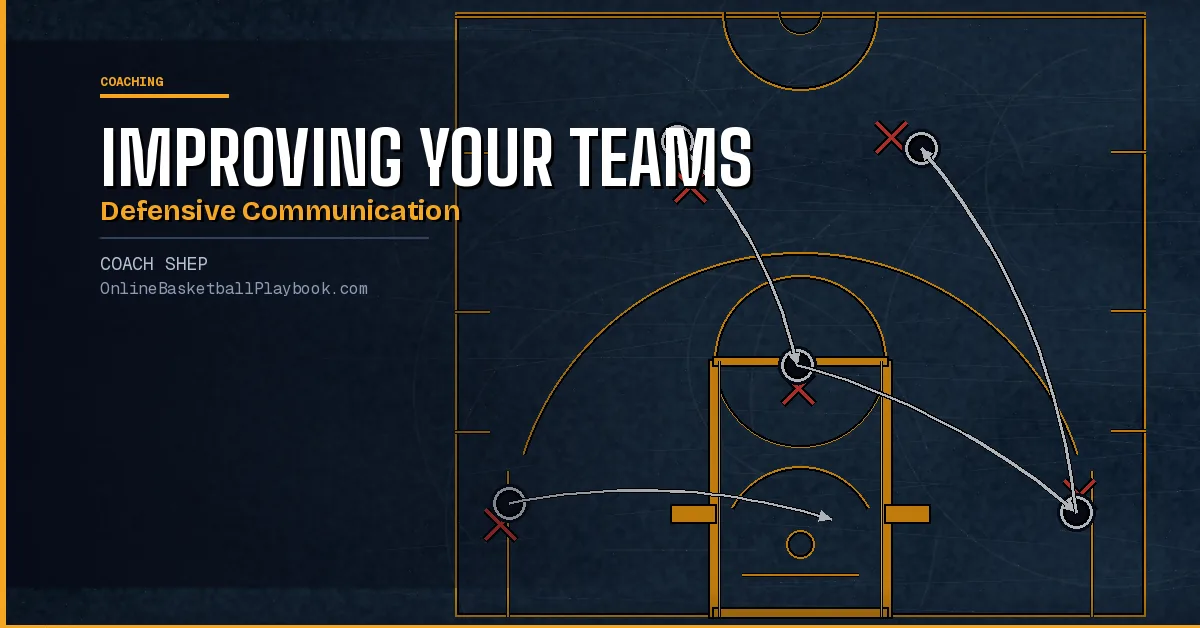
Defensive breakdowns are almost never a scheme problem. They are a communication problem. Teaching your players what to say, when to say it, and how to rehearse it in drills is the fastest lever you have.
Why Defensive Communication Breaks Down
Every coach has seen the same film clip: a wide-open corner three because nobody called out the skip pass, or a backdoor layup because help-side was silent. These moments do not happen because players are lazy or careless. They happen because players were never given a specific, practiced communication habit to fall back on under game pressure.
The root cause is almost always a practice environment that treats communication as a byproduct. Coaches run the shell drill, run the coverage reps, and correct footwork, but nobody says which words to use, when to use them, or how loud to be. Over time, players learn the movements while the talking remains optional. When the game speeds up and cognitive load spikes, talking is the first thing that disappears.
The fix is treating communication as a named skill with its own rehearsal reps, just like footwork or closeout technique. You cannot expect players to find their voice in a game if the practice environment has never demanded it of them.
There is also a confidence layer to address. Younger players and players new to a system often stay quiet because they are not certain they are reading the situation correctly. They would rather be silent than call out the wrong thing. Coaches who build a culture where incorrect calls are corrected, not punished, unlock a much louder, more connected defensive unit faster than coaches who let silence stand.
The Language Your Defense Needs
Before you can drill communication, you need to standardize the language. Every defensive scheme has its own vocabulary, but the principles for choosing and teaching that vocabulary are consistent across systems.
Words need to be short, distinct, and loud by design. A call like "ball" or "help" works. A call like "watch out for the skip" does not function under pressure because it requires too much cognitive bandwidth to produce. The best defensive vocabularies use single words or two-word phrases that are hard to confuse with each other under fatigue.
The NKU defensive system (one of the most documented breakdown drill batteries in the college game) uses the "50" / rope / Defensive GPS vocabulary to train spacing and rotation. These are trained live inside the double-contest and 4-on-4 shell drills, not introduced on a whiteboard and forgotten. Players hear the word, see the corresponding movement, and make the connection inside a competitive rep. That pairing of word and action is what makes vocabulary stick.
For most teams, the minimum communication vocabulary for a man-to-man defense includes:
- "Ball": the on-ball defender's declaration that they have the ball handler
- "Help": announcing your position in the help lane
- "Screen left / screen right": directional call on any ball screen
- "Switch" or "Stay": coverage decision on the screen, called before the contact happens
- "Dead" or "Corner": alerting teammates to a live driver who has used their dribble
- "Shot": boxing out trigger for all five defenders
These calls should be written on your practice board every day until they are reflexive. The Spartan Drill uses a similar install: vocabulary is introduced slowly at half speed in the "Jump-to-Ball / MSU" phase (one foot off the line of the ball, hand above the ball) before it is ever applied at game speed. The teaching sequence matters as much as the vocabulary itself.
Drill Progressions That Build Communication Habits
The most effective approach to building defensive communication follows the whole-part-whole teaching model. Show the complete defense at game speed, break it into 1-on-1 and 2-on-2 pieces that isolate one communication habit, drill those pieces at competitive intensity, then reassemble to 5-on-5 and hold players accountable for carrying the talk forward.
The Ettore Messina 13-drill progression is the clearest example of this philosophy applied end-to-end. The sequence moves from 2-man zig-zag footwork all the way to 5-on-5 defensive validation, and at every step the communication requirement grows. By the time players reach the shell and full-team drills, talking is no longer a request. It has been baked into every preceding rep.
Start with 1-on-1 and 2-on-2
The first communication habit to build is the on-ball declaration. Run zig-zag 1-on-1 drills and require the defender to call "ball" every time they engage a new dribble move. It sounds simple. It is not. Players forget it within three reps at game speed. Freeze the drill when silence happens. Resume when the call is made. The repetition cost is low; the habit value is high.
Move to 2-on-2 as soon as the on-ball declaration is consistent. The drag-screen 2-on-2 drill from the Messina sequence is ideal here: the screener sets the ball screen early and far from the line, and the two defenders must communicate coverage before the screen is set, not after. This is the moment the "switch / stay / hedge" vocabulary gets pressure-tested for the first time. At NKU, ball-screen coverage is installed as 2-on-2 at 60–70% offense intensity before any 5-on-5 reps happen, precisely so the communication read is clean first.
The 4-on-4 Shell as the Communication Lab
The shell drill is where team-wide defensive communication gets built and tested. Scott Nagy's four-stage shell progression (jump to the ball, give-and-go, flash, live to the paint) works exactly because each stage adds one new communication trigger. Players cannot skip the jump-to-ball stage and go straight to live reps; they need to feel the pass, say the word, and see the reaction before they earn the next layer of complexity.
Mike Young's shell variant adds a practical filter: start almost every practice with a sprint to the ball, then run the traditional 4-man shell before graduating to the Diamond, which rehearses the exact ball screens and pin-downs teams will face in their schedule. When practice replicates what players will see in games, the communication calls carry over because the situations look and feel familiar.
Tom Billeter's closeout series fits naturally inside the shell: influence-baseline, influence-middle, and closeout on a shooter, all requiring the on-ball defender to communicate their chosen angle before they arrive. The jump-to-ball closeout that ends in fronting the post is a second communication moment built into the same rep.
Shell Drills and Spacing Vocabulary
Spacing vocabulary (how off-ball defenders talk to each other) is harder to build than on-ball talk because it requires players to track the ball, track their man, and process their teammate's position simultaneously. The players who do this well in games are the ones who have done it hundreds of times in practice under structure.
The "Spartan Drill" is the most direct tool for building help-side communication. It drills jump-to-ball from every position with a rim-cutting passer, and the key habit embedded in the drill is deliberate: guard the gaps, do not follow your man to the corner, keep feet parallel to the line of the ball. Every one of those habits requires a player to know where the ball is, and that awareness is reinforced by requiring them to talk. You cannot stay in the proper defensive GPS position while being silent. The two behaviors are linked.
Chris Oliver's NBA camp note about shell drills adds a useful physical anchor: every player in the gym holds both arms up for the full 24-second shot clock during 5-on-5 shell work. The on-ball defender throws both hands up the instant they clear a screen. This is not just a visual habit. It makes the communication louder because players who have their hands up and their heads up are also more likely to be calling out what they see. Physical posture and verbal communication reinforce each other.
The "3/4 speed but full talk" standard from the Clifford blitz progression is worth posting on your practice board. It captures the counterintuitive truth of defensive communication drills: slowing the pace slightly so players can process and talk out loud produces better in-game communication than running everything at full speed with silence. Once the talk is automatic, the speed can come up. But speed without talk first is a habit you will spend months trying to undo.
Competitive Validation That Forces Talking
The fastest way to eliminate silence on defense is to make silence cost something. Competitive drill formats that score stops (where a team wins only when they communicate correctly) create accountability that no amount of coaching instruction can replicate.
Bruce Weber's "Perfection Cut Throat" drill is one of the clearest examples. Three teams compete in a 3-on-3 or 4-on-4 format, and before the drill starts, the coach designates one communication habit, "sprint on the pass" or "call the screen before it comes." Any defender who fails to execute that habit on any possession means the defense is out. The drill does not add a second habit mid-rep. One word, one rep, all the way through. That constraint forces players to hold each other accountable between possessions because they cannot afford to lose a teammate's lapse. Teammates coaching teammates is the goal. Coaches should not have to be the sole voice calling out silence.
Messina's "Defensive Validation" format embeds the same competitive pressure without any setup overhead: a team's score only counts if they get a stop on the next possession. Players compete to win a game, and defensive communication accountability follows automatically. Play to five or seven points. The winning team must have communicated well enough to earn back-to-back stops. This format works at every level, from youth programs to college teams, because the motivation is built into the game rather than delivered by the coach.
Weber's 24-Second Drill adds a time pressure that directly mirrors games: 5-on-5 half-court, and the defense must hold the offense scoreless for a full 24 seconds. If the offense gets an offensive rebound, the clock resets. The only way to survive 24 seconds against a half-court offense is to talk continuously: call out every cutter, every screen, every change in ball position. Coaches who run this drill for the first time often discover which players have been relying on silence and guessing all season.
When you first introduce a competitive validation drill, name the one communication habit being graded before the drill starts. Write it on the board. Call it out loud at the opening whistle. A player who violates it in the first two possessions should be corrected immediately and specifically ("No call on the screen, Johnson, your team is out") so the connection between silence and consequence is unmistakable. Add a second habit only after the first is automatic across all three teams in rotation.
Building Communication Into Every Practice
The teams with the best defensive communication did not get there through one special drill. They built it through daily structural decisions that kept the talking requirement present in every defensive rep, every session, all season.
The Ken Ammann "combining drill ladder" principle is a clean framework for this: each drill in your practice plan folds the previous communication rules forward and ends only on a steal or rebound. No drill ends on a clock. No drill ends on a made shot. Every rep ends on a defensive outcome, which means players talk until they earn the stop. That habit (talking until the job is done) is the defensive identity you are building.
Mike Dunlap's "Great Drills = 6 Components" filter is worth running against every drill you plan to use for communication development. The six components are: Time, Score, Advantage/Disadvantage, Unpredictability, Communication, and a Rebound in every rep. A drill that lacks the Communication component should either be modified to include a required talk element or dropped in favor of one that does. The rebound requirement is also not incidental. Ending every defensive rep with a box-out reinforces one of the loudest and most physical communication moments in the game.
Bob Hurley's Florida 1-on-1 drill fits naturally into a daily closeout rotation because it teaches closing angle from a shoulder-to-shoulder sprint, and the angle choice itself is a communication decision. When you run it in pairs and require the closing defender to announce their angle before they arrive ("baseline" or "middle"), you turn a technical drill into a communication drill without adding any setup time.
The NKU approach to daily practice structure gives a practical time framework: an 8-to-15-minute breakdown block, then 5-on-5. Inside that breakdown block, at least one communication call should be explicitly required and monitored. Freeze the drill when it is absent. Name the player. Reset. The physical corrective action of stopping and restarting a drill communicates to the entire group that silence is not acceptable, without the coach needing to give a speech about effort or attention.
Weekly Structure for Communication Development
Early-season work should focus on vocabulary installation: introduce one or two calls per week and drill them in the smallest format possible (1-on-1 or 2-on-2) before moving to team settings. Mid-season work should use competitive validation formats two or three times per week to pressure-test vocabulary under fatigue. Late-season and tournament-prep work should use Weber's Gut Check format (12 minutes, 3 teams, sprint after every score) to simulate the physical exhaustion that typically causes communication to collapse in elimination games.
The pattern is the same one used by NKU, Messina, and Weber: install the vocabulary in controlled reps, pressure-test it in competitive drills, then validate it in full-team formats that mirror game conditions. No shortcut exists between those three phases. Teams that skip the controlled rep phase and go straight to competitive formats develop players who react to noise rather than produce it, which is not the same thing as a team that communicates.
Closing every practice with Messina's Defensive Validation (score counts only if you get the next stop, play to five) costs nothing in setup time and delivers a daily reminder of the connection between defensive communication and winning. Over a full season, that reminder compounds. The teams that end October the loudest usually end March the most connected.
- Name one communication call at the start of every breakdown drill and freeze the drill immediately when that call is absent. Do not let silence pass without a correction during the rep.
- Install ball-screen coverage vocabulary in 2-on-2 at 60–70% offense intensity before going to 5-on-5; the communication read must be clean before the tempo goes up.
- Run Messina's Defensive Validation format at the end of every team practice. A team's score counts only when they get a stop the following possession, play to five points.
- Use Weber's Perfection Cut Throat drill to embed one specific habit under competitive pressure; designate the habit before the drill starts and do not add a second until the first is automatic.
- Require defenders to announce their closeout angle ("baseline" or "middle") out loud before they arrive. Turn every closeout rep into a communication rep without adding setup time.
- Apply Dunlap's six-component filter to every drill you plan: if Communication is missing from the drill structure, modify it or replace it with one that forces players to talk as part of earning the defensive stop.
Want more basketball coaching strategies, drills, and tools?
Join the Online Basketball Playbook newsletter →
Draw this play free in the play drawer →
Membership: the full library, playbook packs, and Pro drawing tools →
Keep Building
Related breakdowns
Defensive Basketball Drills: Slides, Closeouts, Shell and Games
Defensive basketball drills in teaching order, from stance and defensive slide drills to closeouts, pass denial, shell and scored games, with the versions coaches split on.
Defensive Stance in Basketball: Weight, Feet, Hands and Drills
Defensive stance in basketball: weight, feet, hands and eyes, the footwork out of the stance and the drills that build it.
Defensive Identity Basketball: Choosing What Your Team Will Be
Defensive identity basketball coaches build on purpose: deny or pack, switch, force, press, zone, crash or get back, plus the standards that make it stick.