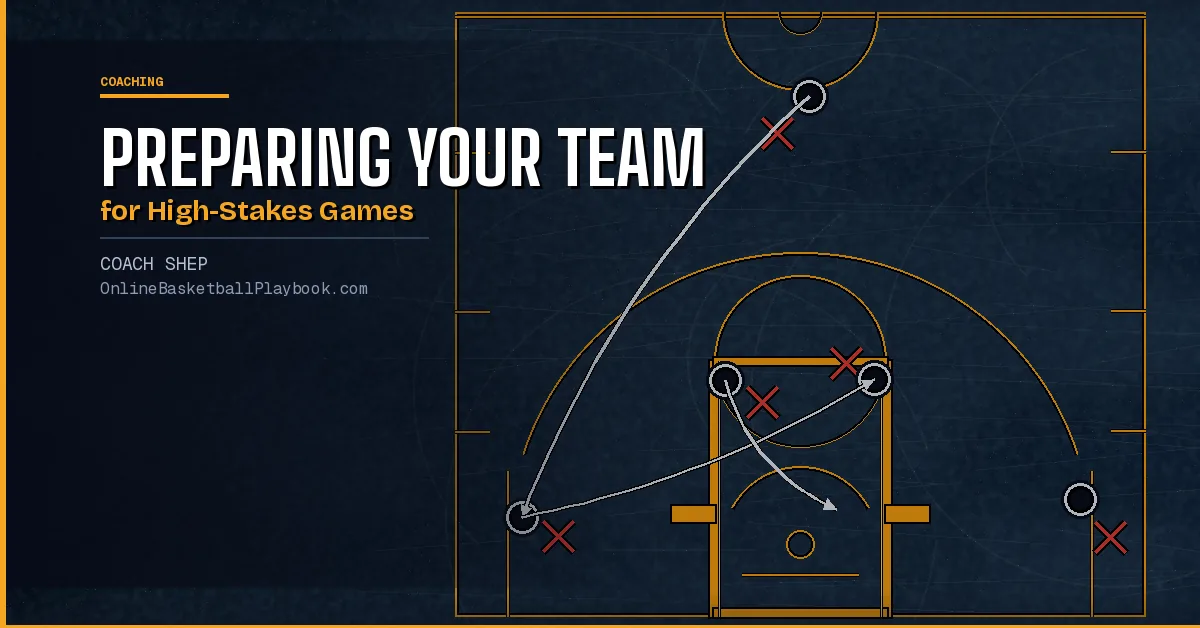
When the lights get brighter and the scoreboard matters more, preparation separates teams that fold from teams that rise. Here is what elite coaches actually do before a big game.
Why Habits Beat Schemes Under Pressure
Bill Parcells spent decades coaching in the highest-pressure situations professional football offers: playoff games, Super Bowl runs, must-win regular season moments. His core doctrine was not about X's and O's. It was about preparation and the habits that survive when the game plan breaks down.
His central insight: a scheme can fall apart under maximum pressure, but the habits built in practice cannot. The job of every practice leading up to a high-stakes game is to deposit correct execution into the reflex bank so deeply that players do not have to think when the moment arrives. Thinking, Parcells said, takes too long.
For basketball coaches, this means that the week before a championship game, a rivalry matchup, or a tournament opener is not the time to install new concepts. It is the time to drill what you already know (at game pace, with game-level intensity) until those actions have no cognitive cost. A player who has run a ball screen coverage a thousand times in practice does not need to decide what to do in the fourth quarter. The habit decides for him.
This framework also reframes what coaches should be adding in the days before a big game. Over-scheming is a real trap. Coaches who layer in too much complexity give their players decisions to make at precisely the moments when they need to react. The antidote is not a cleverer game plan. It is volume of correct reps on a small number of trusted actions until those actions are automatic.
The practical question for every coach building a preparation week: which three or four actions do you need your team to execute without thinking? Those are the reps that matter most.
The 4th-Quarter Role Test Every Coach Should Run
Parcells had a concrete accountability standard he used as a preparation benchmark: every player must be able to describe their specific assignment from memory and under pressure, without prompting. If a player cannot articulate what they are supposed to do in a late-game situation (who they guard, which action they set, what their read is) they are not prepared. And the coach is not done yet.
This is a coaching accountability tool, not just a player accountability tool. When a player blanks on their assignment, the correct response is not frustration at the player. The correct response is more reps before the next practice ends.
Run this test at the end of every preparation week before a high-stakes game. Pull players aside individually or address the full team during a walk-through. Pose specific late-game scenarios: "We are down two with forty seconds left. You are on the floor. Walk me through your assignment." A player who responds quickly and specifically is prepared. A player who hesitates, guesses, or looks to a teammate for help is not. And you still have time to fix it.
The test also tells you which concepts have been drilled to automaticity and which are still living in the playbook but not in the player's body. High-stakes games expose exactly this gap. The role test surfaces it before the game does.
Applied at a program level (say, a six-team club program), this standard also creates consistency across rosters. When every coach runs the same pre-game role-check protocol, the entire program raises the floor on preparation quality. Players internalize that knowing their role is a minimum expectation, not an optional extra.
Make Practice Harder Than the Game
Anson Dorrance built twenty-two national championship teams at UNC Women's Soccer on a principle he called the Competitive Cauldron. The logic is direct: if practice is a safer environment than games (less pressure, less consequence, less intensity), players will shrink when real game pressure arrives. The antidote is to invert the equation. Make practice the hardest competitive environment your players ever face, so games feel like relief by comparison.
For basketball coaches preparing for high-stakes games, this means that the practices leading into a big game cannot be relaxed run-throughs. They need to have stakes. Scored competitions between units. Consequences for the losing group. A level of defensive intensity that is harder to play through than what the upcoming opponent will bring.
The phrase Dorrance used was "comfortable being uncomfortable." The players who compete best in pressure games are the ones who have already been in that discomfort repeatedly. In practice, in scrimmages, in preseason conditioning. The stage does not feel larger because they have already stood on larger stages before, every week, in their own gym.
Dan Hurley built this same principle into UConn's preparation culture through what he described as a chaotic practice environment (difficult by design) so that game night, in comparison, feels calm. His program's spine is built around Relentless Competitive Effort and the standard that no single player can make the pack weaker. When practice enforces those standards daily at maximum intensity, the team that shows up for a tournament game has already been there mentally.
Two practical ways to implement this before a high-stakes game: first, run at least two practice segments each week that are harder and higher-stakes than the actual game will be (scored competitions with real consequences for the losing group, nothing purely instructional without a competitive wrapper). Second, track whether your players compete at the same level when things go poorly in practice as they do when things go well. Players who only compete when the stakes feel safe are not ready for a high-stakes game.
Mental Errors Are a Coaching Receipt, Not a Player Verdict
One of the most practically useful frameworks for preparing a team (and for responding correctly when the preparation falls short) is the mental-error reframe. When a player makes an assignment error under pressure, most coaches' instinct is to address the player's focus, effort, or decision-making. Parcells' instinct was different: the first question is whether that action was drilled until it was automatic.
A mental error in a high-stakes game is not primarily a character statement about the player. It is a coaching receipt, evidence that a specific action was not drilled to the level where it could survive pressure. The correct response in the moment is to put the player in a better position. The correct response in the next practice is to add reps on that specific action until it is no longer a question.
Mike Dunlap reinforced this from a teaching standpoint with the principle "no dumb players, just dumb coaches not teaching." When players consistently do something wrong in big games, the first question a coach should ask is whether it was ever genuinely taught. Generic corrections ("concentrate," "make the right read," "be more physical") are not teaching. Specific triggers and cues are teaching: a named timing point, a body-position cue, a decision rule tied to what the defense shows.
Applying this framework in preparation means that every mental error in the practices leading up to a high-stakes game gets cataloged and addressed with a specific correction, not a general exhortation. By game day, the team's preparation should have closed the gap between what was drilled and what the game will demand. If that gap still exists on game day, the honest answer is that the coach did not close it, and the honest follow-up is a more targeted preparation plan for the next big game.
Non-Negotiable Standards That Hold in High-Stakes Moments
Kultuur is not something a program builds in the week before a big game. The standards that hold in high-stakes moments are the standards that have been enforced unconditionally from the first day of preseason. Coaches who attempt to tighten up their team in the week before a championship game usually discover that the standards their team actually performs to are the ones that were enforced every day in October, not the ones written on a whiteboard in March.
Obradovic's operational principle here is worth sitting with: non-negotiables must be repeated every single day with no exceptions and no shortcuts. The drills are simple by design and run daily precisely because standards erode the moment enforcement becomes selective. A two-word rule enforced identically in game one and game eighty is more powerful than a ten-point preparation memo distributed forty-eight hours before a big game.
Kevian Sampson's framework identifies attitude and effort as the two non-negotiables that must be held the same every day, with the explicit statement that how you do anything is how you do everything. The team's behavior in a high-stakes game will be a direct reflection of what has been tolerated in ordinary practices. If players do not sprint back in transition when the score is comfortable in a mid-January game, they will not sprint back when the tournament is on the line either.
Bob Hurley's system adds an operational discipline that speaks directly to high-stakes preparation: players sprint to the coach on the whistle, seniors are responsible for daily standards because it is their team, and practices are run with a consistent structure whether the next game is the season opener or the finals. That consistency is not rigidity for its own sake. It is the mechanism that makes standards durable under pressure, when the environment gets chaotic, the team falls back on practiced behavior, and practiced behavior is built from how every ordinary Tuesday was run.
The practical takeaway for coaches: audit your ordinary practices against your standards for big games. If there is a gap between how you run Tuesday practice and how you need your team to perform on Saturday, that gap is your preparation problem, and it cannot be closed in the twenty-four hours before tip-off.
Game-Day Communication and Mindset Setting
Morgan Wootten coached at DeMatha Catholic for forty-six years and produced some of the most decorated players in high school basketball history. His pregame talks did not use the word "win." His evaluation standard was not the final score. It was whether the team gave a winning effort. This reframe was not motivational wordplay. It was a deliberate protection of the culture he had built, which rested on effort and process rather than outcomes.
For coaches preparing their team for a high-stakes game, this distinction matters. A team obsessed with winning (or, worse, terrified of losing) rarely reaches its potential in big moments. Wootten identified three types of teams: those who want to win at all costs, those who are afraid of losing, and those who focus on effort and playing together. The third group, in his experience, consistently performed best when the pressure was highest.
The game-day mindset a coach sets for their team on the morning of a big game should reinforce the process standards that have been enforced all season, not introduce new outcome-based pressure. Remind the team of the specific things they have drilled. The coverages they know, the actions they have run a thousand times, the defensive habits that are now automatic. Put the focus on execution of the known, not pursuit of the unknown outcome.
Hubie Brown added a communication practice that is particularly relevant on game day: say something personal and direct to every player, every day, and especially on game day. Look each player in the eye. The players who feel seen and known by their coach compete harder in high-stakes moments. This is not sentiment. It is an observation from decades of coaching that spans from the NBA to international basketball. Individual connection activates individual effort.
Tauer's ACTG framework (Adaptability, Curiosity, Trust, Gratitude) is a useful lens for what you want your players walking into a big game carrying. Not anxiety about the outcome, but a posture of adjustment (they are ready to adapt), learning (they are curious about what the game will show them), mutual trust (they believe in each other), and gratitude (they are glad to be competing). These four traits, when they are the actual emotional state of the team, produce performance that holds under pressure.
Run the 4th-quarter role test at the end of every preparation week before a high-stakes game. Pull each player and ask them to walk through their specific late-game assignment without prompting or help from teammates. If they hesitate or guess, you have more reps to add before game day, and you still have time to add them.
- Drill your three or four most critical actions to automaticity (not new concepts) in the week before a big game. Volume of correct reps on a small set of trusted plays beats a expanded playbook your players have to think through.
- Run at least two practice segments each week that are harder and more competitive than the upcoming game will be. Scored competitions with real consequences for the losing group. If practice is the easiest place your players compete, they will shrink when the real pressure arrives.
- Use the mental-error reframe: when a player misses an assignment under pressure, ask first whether that action was drilled to automaticity. If not, add reps immediately rather than addressing the player's character or focus.
- Say something direct and personal to every player on game day. Look each one in the eye. Individual connection from the coach produces individual effort when the moment demands it most.
- Set the pregame mindset around process (the coverages they know, the actions they have run a thousand times), not around the outcome. Teams focused on what they can execute perform better under pressure than teams focused on winning.
- Audit your ordinary Tuesday practices against your standards for big Saturday games. Any gap between those two environments is your real preparation problem, and it cannot be closed in the final twenty-four hours.
Want more basketball coaching strategies, drills, and tools?
Join the Online Basketball Playbook newsletter →
Draw this play free in the play drawer →
Membership: the full library, playbook packs, and Pro drawing tools →
Keep Building
Related breakdowns
Tips for Basketball Tryouts: How to Prepare and Stand Out
Tips for basketball tryouts from the player's side: how to prepare, what coaches watch, what to show by position, what to wear and what to do if you do not make it.
How to Mentally Prepare for a Basketball Game: Essential Strategies
How to Mentally Prepare for a Basketball Game: Essential Strategies
How to Become a Basketball Coach: Paths, First Jobs and Steps
How to become a basketball coach: where coaches start, youth, school, club and college paths, entry jobs, coaching education, networks and mentors.