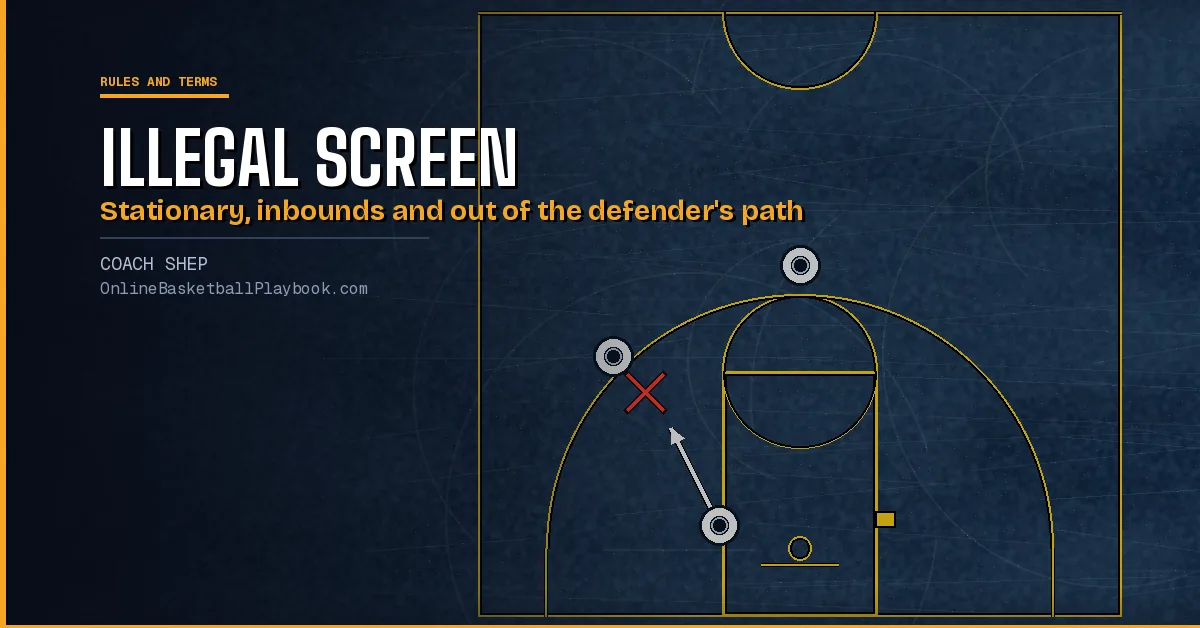
An illegal screen in basketball is contact caused by a screener who has not set up legally: still moving, leaning or sticking out a hip, or stopping so close to a defender that he cannot avoid the contact. The NCAA, NBA and FIBA books all write the rule around two questions. Did the screener cause the contact, and did he give the defender the room the rule requires? The room depends on whether the defender can see the screener and whether the defender is moving. Every rule below carries its level and rule number. The current NFHS rulebook is not freely available, so high school lines come from the NCAA's published rules-differences chart, and anything that chart does not cover says to check your state association rulebook.
Illegal Screen Basketball Rules at a Glance
| Point | NFHS | NCAA men | NCAA women | NBA (2025-26) | FIBA (2026) |
|---|---|---|---|---|---|
| Rule | Check your state association rulebook | Rule 4 Sec. 35 | Rule 10 Sec. 5 | Rule 4 Sec. X, Rule 12B Sec. III | Art. 33.7 |
| Stance | Vertical plane, about shoulder width (DIFF) | Vertical plane, inside of the feet no wider than shoulder width, no leaning or hips into the path | Same as men | No width stated | Stationary inside his cylinder, both feet on the floor |
| Screener inbounds | No rule (DIFF) | Must be inbounds | Must be inbounds | May not leave the floor over the end line to set a screen (Rule 10 Sec. XIV) | Not stated in Art. 33.7 |
| Defender can see the screener | Check your state association rulebook | No contact when setting it | Same, and the visual field runs out to each ear | As close as he likes without contact | As close as possible without contact |
| Blind screen, defender standing | Check your state association rulebook | Allow a normal step | Allow a normal step | No nearer than a normal step | Allow 1 normal step toward the screen |
| Defender moving | Check your state association rulebook | Room to stop or change direction (Rule 4-35.3.c), usually one to two strides on a blind screen (Appendix III) | Room to stop or change direction, usually one to two strides (Appendix II), set by the defender's speed | One to two normal steps or strides, by speed | Never less than 1, never more than 2 normal steps |
What a Legal Screen Needs

The NCAA men's book defines a legal screen as action that delays or prevents an opponent from reaching a desired position without causing contact (Rule 4 Sec. 35 Art. 1). The women's book uses the same words (Rule 10 Sec. 5 Art. 1). The NBA says without causing undue contact (Rule 4 Sec. X). FIBA calls screening an attempt to delay or prevent an opponent without the ball from reaching a desired spot (Art. 33.7).
- NCAA men and women. Stay within your vertical plane, with the inside of the feet no wider than shoulder width. Do not lean into the defender's path or push the hips into it, even with the feet still. The screener does not have to face any direction and must be inbounds (men Rule 4 Sec. 35 Art. 2, women Rule 10 Sec. 5 Art. 2).
- NBA. After taking a legal position the screener may not move sideways or toward the defender, but he may move in the same direction and path as the defender (Rule 12B Sec. III).
- FIBA. A screen is legal when the screener is stationary inside his cylinder and has both feet on the floor at the moment of contact (Art. 33.7).
- NFHS. The NCAA's comparison chart lists the high school stance as a vertical plane with the feet about shoulder width apart, and no rule on where the screener stands. Check your state association rulebook for the rest.
How Much Room the Defender Gets
The distance a screener owes depends on what the defender can see and how fast he is going.
Inside the defender's field of vision, defender standing. The NBA comments say the screener may be as close as he desires providing he makes no contact, and the defender is expected to go around (Comments on the Rules II.A.3). FIBA says the same (Art. 33.7). The NCAA books ban contact when setting a screen inside the defender's visual field (men Rule 4 Sec. 35 Art. 3.b, women Rule 10 Sec. 5 Art. 3.b). The NCAA women's book defines that field as forward and side vision, out to a line through each ear.

Behind the defender, defender standing. A blind screen must leave the defender one normal step. NCAA men Rule 4 Sec. 35 Art. 3.a, NCAA women Rule 10 Sec. 5 Art. 3.a, NBA Rule 12B Sec. III(1) and FIBA Art. 33.7 all use the normal step. The NBA comments give the reason. The defender cannot be expected to see a screener behind him, so he gets room to step backward (II.A.3). The NCAA books also treat inadvertent contact by a defender screened outside his visual field as incidental, as long as he does not displace a screener who has the ball (men Rule 4 Sec. 21 Art. 5, women Rule 10 Sec. 2 Art. 5).

Defender moving. The screener may not take a position so close that the defender cannot avoid contact by stopping or changing direction (NCAA men Rule 4 Sec. 35 Art. 3.c, NCAA women Rule 10 Sec. 5 Art. 3.c). The books put a number on it in different places. The NBA says the distance depends on speed and may be one to two normal steps or strides (Rule 12B Sec. III). FIBA says never less than 1 and never more than 2 normal steps (Art. 33.7). The NCAA men's officiating guidelines say usually one to two strides for a blind screen on a moving defender (Appendix III Sec. 2). The NCAA women's guidelines give usually one to two strides for any moving defender (Appendix II Sec. 2). The NCAA women's points of emphasis tie the room to the defender's speed whether or not he can see the screen.
Same path. When the screener and the defender are moving in exactly the same path and direction and the screener slows or stops, the trailing defender is responsible for the contact (NCAA men Rule 4 Sec. 35 Art. 5, NCAA women Rule 10 Sec. 5 Art. 5). The NBA comments say the player in front may stop or slow but may not move backward or sideways into the opponent (II.A.3).
Moving Screens and Leaning

A moving screen is the call most coaches know. NCAA men Rule 4 Sec. 35 Art. 4 and NCAA women Rule 10 Sec. 5 Art. 4 say no player, while moving, may set a screen that causes contact and delays an opponent. FIBA lists a screener who was moving at contact as illegal screening, and says a player attempting to screen commits a blocking foul if contact occurs while he is moving and the opponent is standing or backing away (Art. 33.7, 33.9). The NBA bans moving sideways or toward the defender after taking a legal position (Rule 12B Sec. III(3)). The moving screen page covers that call alone.
The feet are not the only test. The NCAA books call it a foul when the screener extends the hips or buttocks to displace a defender, or spreads the legs past legal width and trips him (men Appendix III Sec. 2). When a defender pushes into the screener's torso, the foul is on the defender even if the screener's legs are too wide, and when the contact is with a leg that is too wide, the foul is on the screener (men Rule 4 Sec. 35 Art. 6, women Rule 10 Sec. 5 Art. 6). The NCAA books also bar two screeners from lining up side by side within 6 feet of a boundary and parallel to it so that contact occurs (men Art. 7, women Art. 7).
After the Screen: Rolling and Fighting Through

The NCAA women's points of emphasis say a screener may roll after a legal screen, and the roll is legal if he does not hold, clamp or make other illegal contact. The NBA lets a screener move in the same direction and path as the defender (Rule 12B Sec. III). Rolling into the defender sideways or toward him is a different matter in the NBA, which bans that movement after the screen is set.
The rules bind the defender too. In the NCAA books a defender may not use the arms, hands, hips or shoulders to force through a screen or to hold or push the screener (men Rule 4 Sec. 35 Art. 6, Rule 4 Sec. 18 Art. 4, women Rule 10 Sec. 5 Art. 6). The men's officiating guidelines call a foul when a defender is held or pushed off his path around a screen, or holds or pushes through it (Appendix III Sec. 2). FIBA says a legally screened player is responsible for any contact with the screener (Art. 33.7). For the defensive side of screens, see defending screens.
Get the next coaching guide in your inbox
One email when a new guide or diagram set goes up. Free.
Penalty by Level
An illegal screen is a personal foul on the screener. Because his team usually has the ball, it is an offensive or team-control foul, and the penalty follows that category.
| Level | Penalty | Team foul | Rule |
|---|---|---|---|
| NFHS | Free throws are never shot on a team-control foul. Check your state association rulebook for the throw-in spot | Check your state association rulebook | DIFF, Free Throws Shot |
| NCAA men | A throw-in for the opponents, no free throws. A team-control foul during a loose ball can bring the bonus | Counts toward the team total | Rule 10 Sec. 1 Penalty a, c |
| NCAA women | A throw-in for the opponents, no free throws | One team foul | Rule 10 Sec. 10 Penalty a.2 |
| NBA | No points, the ball on the sideline, no penalty free throws | No team foul | Rule 12B Sec. VII(a) |
| FIBA | A throw-in for the opponents, even when they are in the team-foul penalty | Counts as a team foul | Art. 42.1.1, 42.2.2 |
In the NBA, a screener who leaves the floor over the end line in the frontcourt to set a screen commits a violation, not a foul, and loses the ball (Rule 10 Sec. XIV). See the basketball fouls list for how the team-foul total and the bonus work at each level, and the offensive foul page for the other fouls in this family.
Teaching Screeners to Stay Legal
The rulebooks say what is illegal. Coaches teach the habits that keep a screener inside the rule, and they do not all teach the same thing.
- Perpendicular set. The cue is loud, low and legal, with the screener set perpendicular to the defender's path.
- Two-count hold on the numbers. Screen on the defender's numbers, jump stop with the feet shoulder-width apart about an arm's length away, and hold for two counts.
- Name call, one step away. Call the cutter's name, jump stop one full step from the defender, stay still, then seal and look for the ball.
- Rear end to the cut. Rear end toward the direction the cutter will go, arms crossed, and the screen set 2 to 3 feet from the teammate so he comes to the screener.
- Bob Knight. Hold every screen on a two-second count.
- No lean. Both feet on the floor, no lean and no arm or leg sticking out.
- One step of space. Hold the position and give the defender one step of space. A moving screen typically starts when the defender beats the screener to the spot and the screener shifts to make contact.
- Real contact. Make real contact with the defender without holding or pushing, feet wide and planted, arms tucked into the chest so nothing reads as a push.
Coaches split on contact. The real-contact version asks the screener to make contact, while the name-call and step-of-space versions ask for a step of space. The rulebooks answer a narrower question. The screener may not cause the contact, and a defender who runs into a legal screen he could see is the one responsible for it (FIBA Art. 33.7, NCAA men Rule 4 Sec. 21 Art. 4).
Timing causes as many calls as stance. In one Bo Ryan play the screener waits until the cutter and his defender have passed before popping, or the pop becomes an illegal screen. The step-of-space version warns that an elevator screen closed early or late risks a moving screen. For technique beyond the rule, see setting screens, what a screen is, the pick and roll and the flare screen.
Questions Coaches Ask
What is an illegal screen in basketball?
Contact caused by a screener who was moving, leaning or extending a hip or leg, or who set up too close to a defender who could not see him or was moving. The NCAA rule is men Rule 4 Sec. 35 and women Rule 10 Sec. 5, the NBA rule is Rule 12B Sec. III and the FIBA rule is Art. 33.7.
Is a moving screen the same as an illegal screen?
A moving screen is one kind of illegal screen. A screener can also be called for leaning, sticking out a hip, spreading his legs past legal width, or setting a blind screen without leaving a normal step.
How far away does a screener have to be?
In the NCAA, NBA and FIBA books: against a standing defender who can see him, no set distance, only no contact. Behind a standing defender, one normal step. Against a moving defender, enough room to stop or change direction, which the NBA puts at one to two steps or strides and FIBA at 1 to 2 normal steps.
Is an illegal screen a turnover?
Yes. The other team gets the ball, and in the NCAA, NBA and FIBA books no free throws are shot for it, except the NCAA men's loose-ball case. The NBA does not count it as a team foul, while the NCAA books and FIBA do.
Can the screener roll after the screen?
The NCAA women's points of emphasis say yes, after a legal screen and without holding or clamping. The NBA lets the screener move in the same path as the defender but not sideways or toward him.
Want the printable playbook packs?
OBP Pro members get the premium playbook packs: the zone attack, out of bounds and practice plan PDFs, plus each new pack as it is finished. The membership page lists what is in each one. Or draw your own version free in PlayDraw.
See what OBP Pro includesMore Guides From This Batch
- Post Moves Basketball: Seal, Read and Score From the Block
- Basketball Finishing Drills: Read the Defender, Then Finish
- Coaching Youth Basketball: Practices, Games and Parents
- Basketball Fouls List: Every Foul, Penalty and Limit by Level
Back to Basketball Rules and Regulations and every Rules and Terms page.
Keep Building
Related breakdowns
Double Dribble in Basketball: Rule, Examples and Calls
A double dribble is a second dribble after the first has ended. Rules by level (NFHS, NCAA, NBA, FIBA), what restarts a dribble, examples and how to coach it.
Backcourt Violation in Basketball: Rule and Examples
A backcourt violation is sending the ball back across half court after gaining frontcourt control. Rule by level, exceptions, the 8 or 10 second count and examples.
Technical Foul in Basketball: Rule, Penalties and Calls by Level
What a technical foul is in basketball, what draws one, what it costs in free throws and when it ejects a player or coach, labeled by NFHS, NCAA, NBA and FIBA rules.