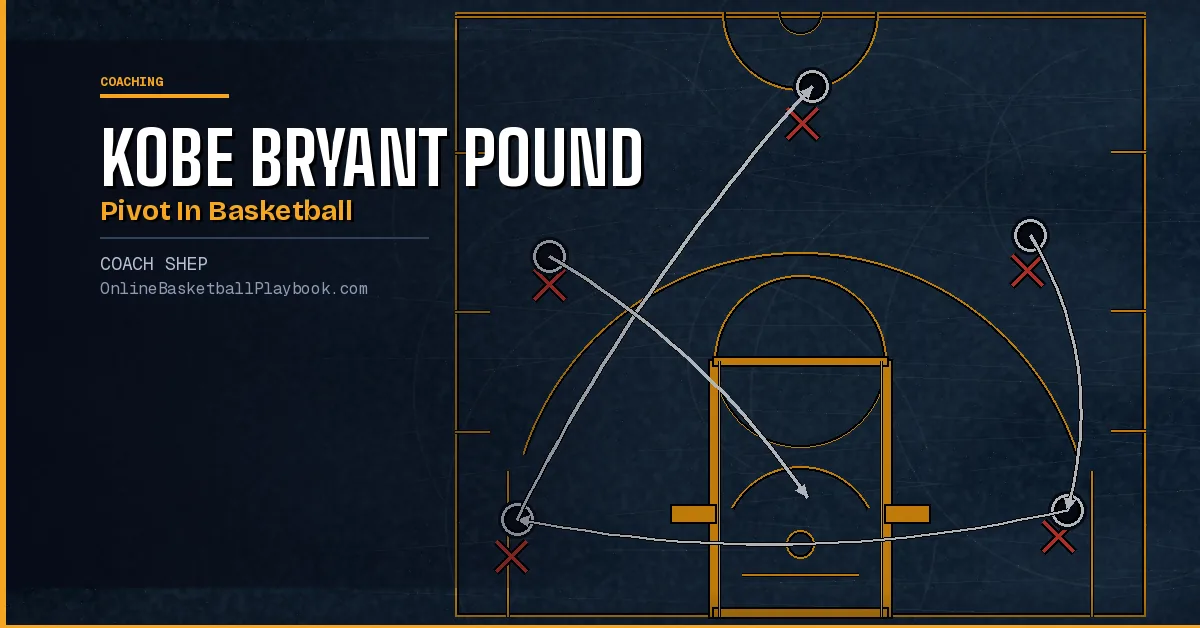
The pound pivot is Kobe Bryant's signature dead-ball weapon, a shoulder-fake pivot move that freezes defenders and creates a clean look. Here is how to do it correctly.
What Is the Pound Pivot?
The pound pivot is a dead-ball move, meaning you execute it after your dribble is already used. Kobe Bryant used it as the centerpiece of his mid-post and perimeter isolation game. The mechanics are simple on the surface: you catch a pass, kill the dribble (or receive it having already made your one dribble), and then use a front pivot combined with a hard ball-pound toward the floor to sell a drive fake. As the defender reacts to the fake drive, you counter with a pull-up jumper, a step-through to the basket, or a rip-through to a different angle.
The name comes from that pound, the ball hitting the floor hard enough that any defender watching reads it as the beginning of a dribble drive. That moment of hesitation is all the space a skilled scorer needs. Kobe called it part of his "12 moves in the stance", a library of fakes, jabs, and footwork patterns that could all be deployed from a balanced triple-threat position before the first dribble was used, and from dead-ball pivoting positions after.
What separates the pound pivot from a simple shot fake is that it occupies two senses at once: the defender sees the ball drop and also feels the pressure of your shoulder moving toward them. A shot fake only works visually. The pound pivot makes the defender respect a drive, a shot, and a pass at the same time, giving you a genuine three-way threat even without a live dribble.
Why It Works Against Any Defender
Most dead-ball situations give defenders a significant edge. Once your dribble is used, a disciplined on-ball defender knows you can only pivot, shoot, or pass. They crowd the passing lanes, contest your shot line, and wait. The pound pivot disrupts that calculation by creating false information, specifically by making a defender think your dribble might not actually be dead.
Elite defenders watch the ball. When a player pounds the ball hard toward the floor, even the best defenders react. It is a trained response. The pound pivot exploits that training against them. At the NBA level, Kobe used it most effectively in isolation situations on the left elbow, his strongest post-up area. He would receive the ball, kill his dribble, pivot front toward the defender, pound once hard, and read the defender's feet. If their weight shifted backward, he pulled up. If they jumped or reached, he ripped through to the basket. If they held position and went for the shot, he pivoted away for a pass.
The move works at every level for the same reason: defenders are taught to respect the dribble drive above all else because it leads directly to the paint. When you simulate that first dribble with a pound, you trigger that defensive training even though your dribble is already gone. The pound buys you one beat, and one beat is enough.
Step-by-Step Execution
There are five distinct phases to the pound pivot. Done correctly, the whole sequence happens in about two seconds. Rushed, it falls apart. Walk through each phase slowly in practice before putting it at game speed.
Phase 1: The Catch and Stance
Catch the ball in a balanced triple-threat position. Your weight should sit on the balls of both feet. The ball goes directly to your shooting pocket, not held out wide, not held high. A high or wide ball makes the pound awkward and telegraphs what you are about to do. Feet should be staggered slightly, with your toe-to-instep stagger creating the base from which any direction is possible. Select your permanent pivot foot the moment your feet land. Do not wait.
Phase 2: The Kill
If you still have a live dribble, end it on purpose, not by accident. Dribble once hard to the floor, gather with both hands back to your shooting pocket, and immediately designate your pivot foot. Many players accidentally kill their dribble and then scramble. That scramble is visible and gives the defender a read on your confusion. Kill your dribble deliberately, and the defender cannot tell whether it was intentional or forced.
Phase 3: The Front Pivot
Push off your permanent pivot foot and swing your free foot toward the defender, a front pivot moving toward the basket. Keep your height consistent throughout this pivot. Rising and falling during a pivot telegraphs every fake you make. Stay low, stay at one level. The pivot should bring your shoulder directly at the defender's chest, creating contact pressure even without actual contact.
Phase 4: The Pound
As your free foot steps toward the defender, pound the ball hard to the floor, not a soft dribble, a full-force pound that makes a sound the defender can hear as well as see. Your eyes go directly at the defender's hips, not their face. Hip movement tells you where they are actually going. The ball hits the floor and comes straight back up to your shooting pocket. Do not chase the bounce or let it travel wide. Ball returns to pocket, and you are immediately in position to shoot, pivot away, or rip.
Phase 5: The Read and Counter
Read the defender the moment the ball hits the floor. Three outcomes are possible: they step back (shoot), they jump or reach (rip through and drive), or they hold position and go for the shot (pivot away, find the open man, or use your remaining shot-fake variation). The counter must happen with your feet already in position. Do not think about which counter to use, let the defender's hips tell you. Kobe's mastery of the move came from drilling every counter until the read was automatic.
Common Mistakes and How to Fix Them
The pound pivot is one of those moves that players think they are doing correctly long before they actually are. The subtle errors are what separate a move that works in drills from a move that works in games.
Rising During the Pivot
Standing up during the front pivot kills the move before the pound even happens. A defender watching a player's center of gravity rise immediately knows a fake is coming. Stay at one level throughout. Coach cue: "Pivot like you are sliding under a low bar." If a player naturally rises, have them practice the pivot in slow motion watching their shadow or reflection.
A Soft Pound
A tentative pound does not register as a drive threat. The sound and force of the pound is what triggers the defender's reaction. Many players hesitate because they are afraid of losing control of the ball, which is itself a symptom of not practicing the move enough at speed. The pound must be hard enough that the ball returns to exactly shoulder height. Practice the pound in isolation, just the ball-pound motion, until it is automatic and forceful.
Watching the Face Instead of the Hips
Face-watching is a beginner's error that persists into high school and college. Defenders are trained to disguise their reactions in the face. Their hips cannot lie. Train your players to lock their peripheral vision on the defender's hip pocket from the moment the pivot begins. This single adjustment makes the read dramatically faster and more accurate.
Letting the Ball Travel Wide on the Pound
A pound that bounces away from your body puts you in a scramble to recover, and the move is dead the moment the ball travels wide. The pound must go straight down and return straight up to the shooting pocket. Practice the pound against a wall to develop the precise downward force that keeps the ball under control.
Choosing the Counter Before Reading the Defender
Players who decide before the pound that they are going to shoot, or that they are going to rip through, are using the pound as a performance rather than a read. The defender's hips choose the counter, not the player. Drill each counter separately until all three are automatic, then drill them in combination with a live or scramble defender calling out which read to execute.
Drills to Build the Move
The pound pivot is a dead-ball skill, which means it is easy to drill without a rebounder or a full court. A player and a wall is enough to build the mechanical foundation. Layer in defenders once the mechanics are clean.
Wall Pound Drill
Stand two feet from a wall in triple-threat stance. Pound the ball to the floor, let it return to shooting pocket, and reset. No pivot yet, just building the forceful, controlled pound. Ten repetitions, then add the pivot. This isolates the hardest mechanical element without the complexity of footwork.
Mirror Pound Pivot
Solo in front of a mirror or glass door. Execute the full sequence: catch (or simulate a catch), kill, front pivot, pound, read (simulate each counter one at a time). The mirror gives immediate visual feedback on pivot height. If your center of gravity rises, you will see it immediately. Ten reps per counter, per side.
1-on-1 Pound Pivot Drill
One offensive player at the elbow, one defender in ball-denial. A passer on the wing throws into the elbow. The offensive player catches, kills the dribble, and executes the pound pivot reading the defender's live reaction. Run each of the three counters for five reps, then switch. The defender is told to alternate reactions, stepping back, jumping, or holding, so the offensive player cannot predict which counter is needed.
Combo Sequence Drill
Most effective for intermediate and advanced players: pound pivot into pull-up, then pound pivot into rip-through, then pound pivot into pivot-away pass, all in one continuous possession sequence against the same defender. The defender applies live pressure. The offensive player reads and counters. Run three minutes each side. This is the closest drill approximation to a real game situation.
Introduce the pound pivot only after your players have a clean jump stop and a designated permanent pivot foot. Players who do not consistently select their pivot foot on the catch will travel during the pound pivot. The move requires a stable base before the fake begins. Install the jump stop and pivot foot selection first, and the pound pivot will click in two or three practice sessions rather than two or three weeks.
How to Chain It With Other Moves
The pound pivot is most dangerous not as a standalone move but as one link in a chain. Kobe's scoring was built on chains, move A sets up move B, and if the defender adjusts to B, move C is already available. Understanding how the pound pivot connects to the rest of a player's arsenal is what takes it from a drill skill to a game skill.
Pound Pivot Into the Shot-Fake Step-Through
After the pound, if the defender's weight is neutral or slightly forward, add a shot fake before the rip-through. The sequence becomes: pound (defender holds) → ball rises to shot position (defender jumps or reaches) → step-through to basket. This is a two-beat move and works best against shot-blocking defenders who have learned to ignore the initial pound.
Pound Pivot Into the Jab-and-Go
If your dribble is still live when you catch, the pound pivot threat creates an opening for the jab-and-go. Receive the ball, jab directly at the defender's lead foot (the same shoulder pressure as the pivot fake), read their feet. If they step back, go directly north with your first dribble. The jab mimics the pivot pressure without using the pivot, preserving your live dribble for the drive.
Pound Pivot Into the Baseline Reverse
Frontcourt catch on the wing, permanent pivot foot established as the inside foot. Front pivot toward the defender (pound pivot), defender locks down the middle. Reverse pivot back to the baseline side, attack the baseline with one dribble and finish with a reverse layup or floater. The pound pivot becomes an entry fake that opens the baseline, a counter that works particularly well against help-side defenders who cheat toward the middle to cut off the rip-through.
Pound Pivot Into the Pull-Up Jumper Off the Drive
Use the pound pivot to freeze the defender, then attack, not to shoot from the spot, but to use that one beat of hesitation to get the first step on a live-dribble drive. Drive past the defender's hip, then use a one-dribble pull-up at the elbow or short mid-range. The pound pivot becomes a setup tool for the drive rather than the finishing move itself.
Chaining the pound pivot with one or two of these counters and drilling each counter live is what made Kobe's post and mid-post game so hard to guard. Defenders had to respect every branch of the chain simultaneously. No single adjustment could stop all of them. That is the real lesson of the pound pivot, not the mechanics of the move itself, but the decision tree it sits inside.
- Permanent pivot foot first: establish your pivot foot the moment your feet land on the catch, before the pound, before the fake. Players who float between pivot feet will travel.
- One level through the pivot: stay at the same height from the catch through the pound. Rising and falling telegraphs the fake before it starts.
- Full-force pound: the ball must hit the floor hard enough to return to shooting-pocket height without you chasing it. A soft pound triggers no defensive reaction.
- Eyes on hips, not face: lock your read on the defender's hip pocket from the moment the pivot begins. The hip tells you where they are actually going; the face tells you where they want you to think they are going.
- Drill all three counters equally: pull-up, rip-through, and pivot-away pass each need separate reps before they can be chained. A player who only drills the pull-up counter will be stopped every time a defender learns to ignore the pound.
Want more basketball coaching strategies and drills?
Join the Online Basketball Playbook newsletter →
Draw this play free in the play drawer →
Membership: the full library, playbook packs, and Pro drawing tools →
Keep Building
Related breakdowns
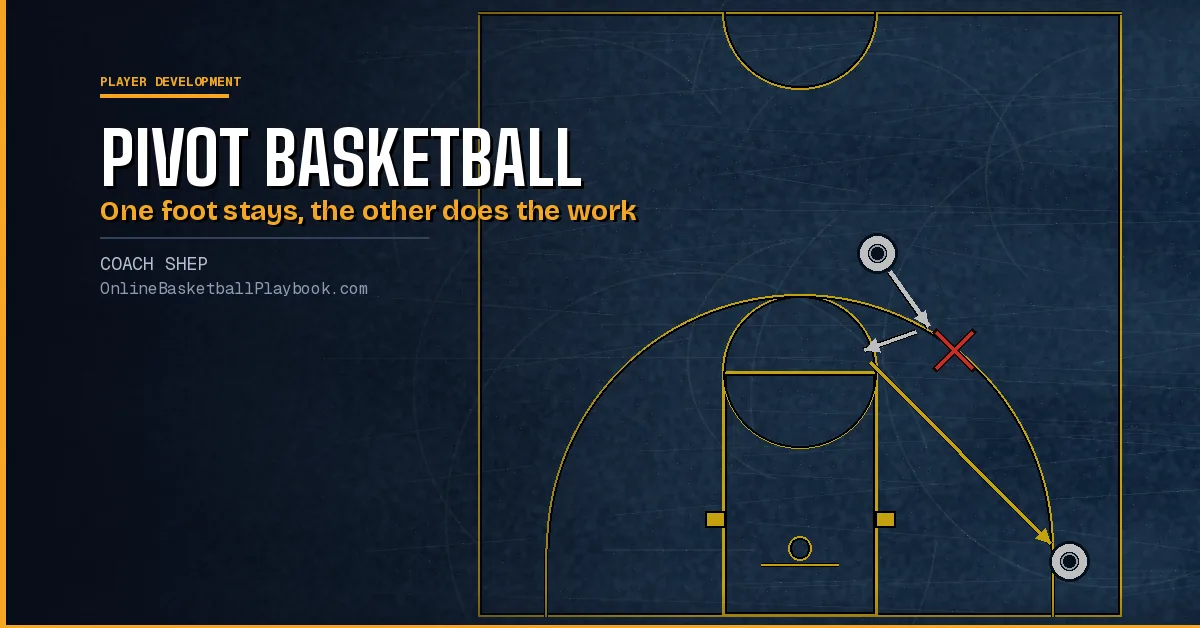
Pivot Basketball: Pivot Foot Rules, Footwork and Drills
What a pivot means in basketball, which foot is the pivot foot after each stop at every level, front and reverse pivots, the inside pivot on the move and the drills.
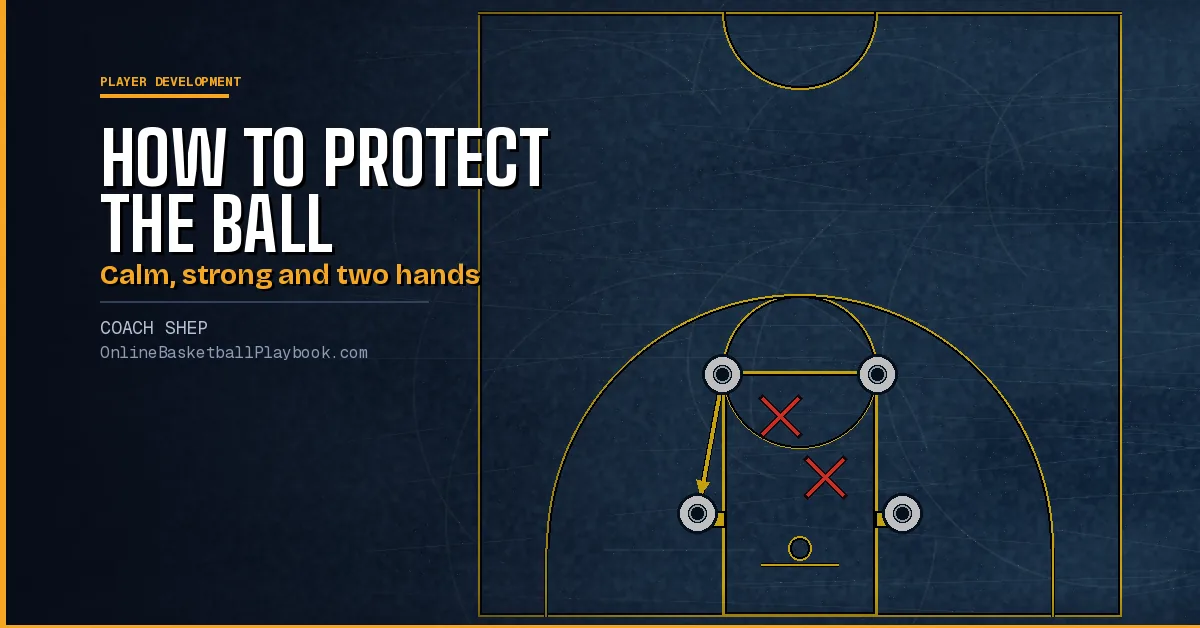
How to Protect the Ball: Ball Security and Fewer Turnovers
How to protect the ball in basketball: where turnovers come from, ripping and catching, the sure pass, beating a trap, ball security drills and pricing turnovers.
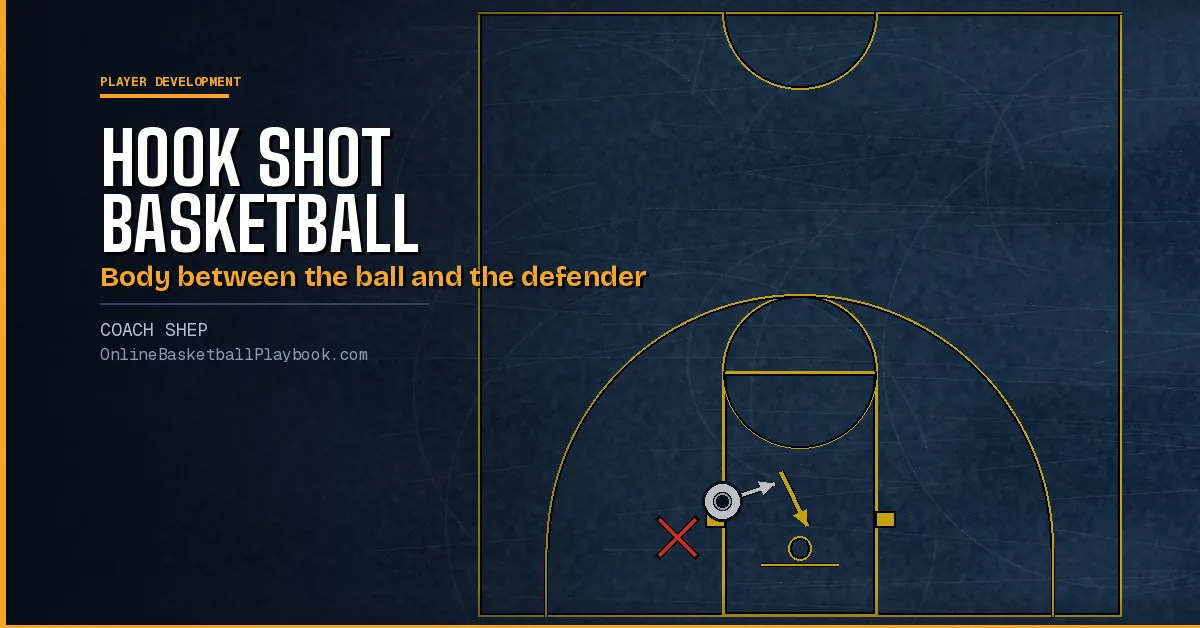
Hook Shot Basketball: How to Do It and How to Teach It
Hook shot basketball for post players and coaches: the classic hook, sky hook and jump hook, the footwork steps, when to use it, the pivot foot rules and drills.